
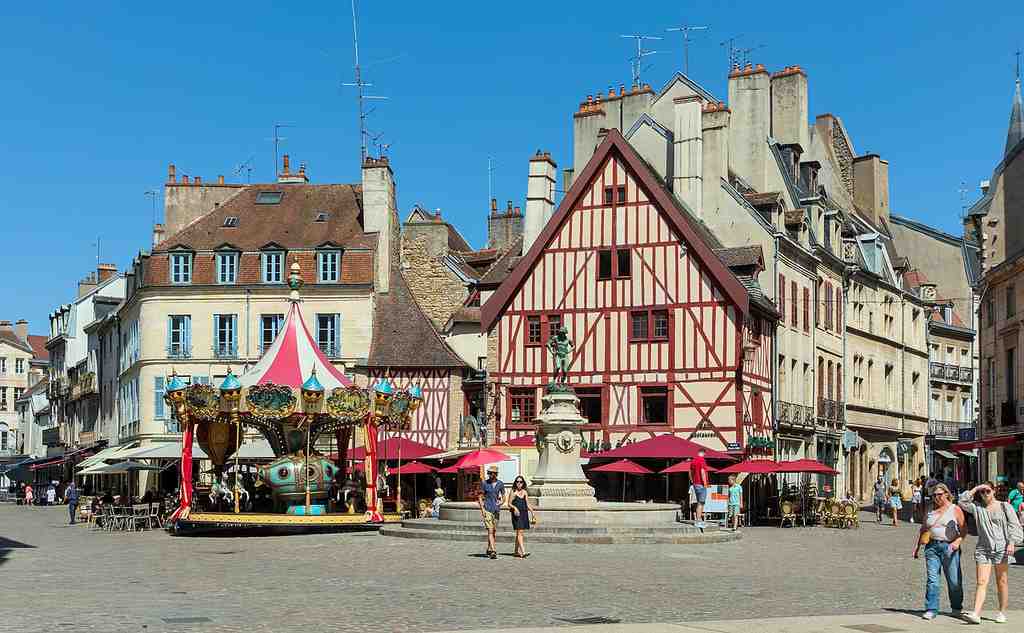
Look for the striking medieval half-timbered house with its steep triangular roof and exposed wooden beams, sitting just behind the central stone fountain topped with a bronze statue.
You have made it to Place François-Rude. Officially, the city named this square after the renowned local sculptor François Rude, who was born right nearby at number five. But if you ask a local for directions, they will almost certainly call it Place du Bareuzai.
Why the nickname? Look up at the top of that stone fountain. Sculptor Noël-Jules Girard created that bronze figure of a grape stomper in the eighteen fifties. The city placed the statue here in nineteen hundred and four, when architect Paul Deshérault designed the fountain. To open up this spacious plaza, city planners had just demolished a dense, winding block of medieval buildings.
As for the local nickname, bareuzai is an old Burgundian term for a very specific occupational hazard. Back in the day, the workers who climbed into the massive wooden vats to crush grapes with their bare legs would step out completely dyed by the juice. They looked like they were wearing pink stockings, or bas rosés in French, which over the years morphed into the word bareuzai.
As you stand here, you are surrounded by a real architectural timeline of Dijon. On the north side, you can see that striking half-timbered house we used to find our bearings, a rare survivor from the Middle Ages. Look over to the east, and you will spot the Foucherot house, which architect Claude Saintpère constructed from elegant cut stone in seventeen seventy-five. And on the west side stands a grand neo-Renaissance building, which merchants opened in the late eighteen nineties to house a massive department store called À la Ménagère.
It is a wonderful spot to just stand and imagine the generations of grape stompers, merchants, and artists who shaped the heart of Dijon. Picture the lively wine trade that once filled this square, and when you are ready, we can head to the next stop.




