
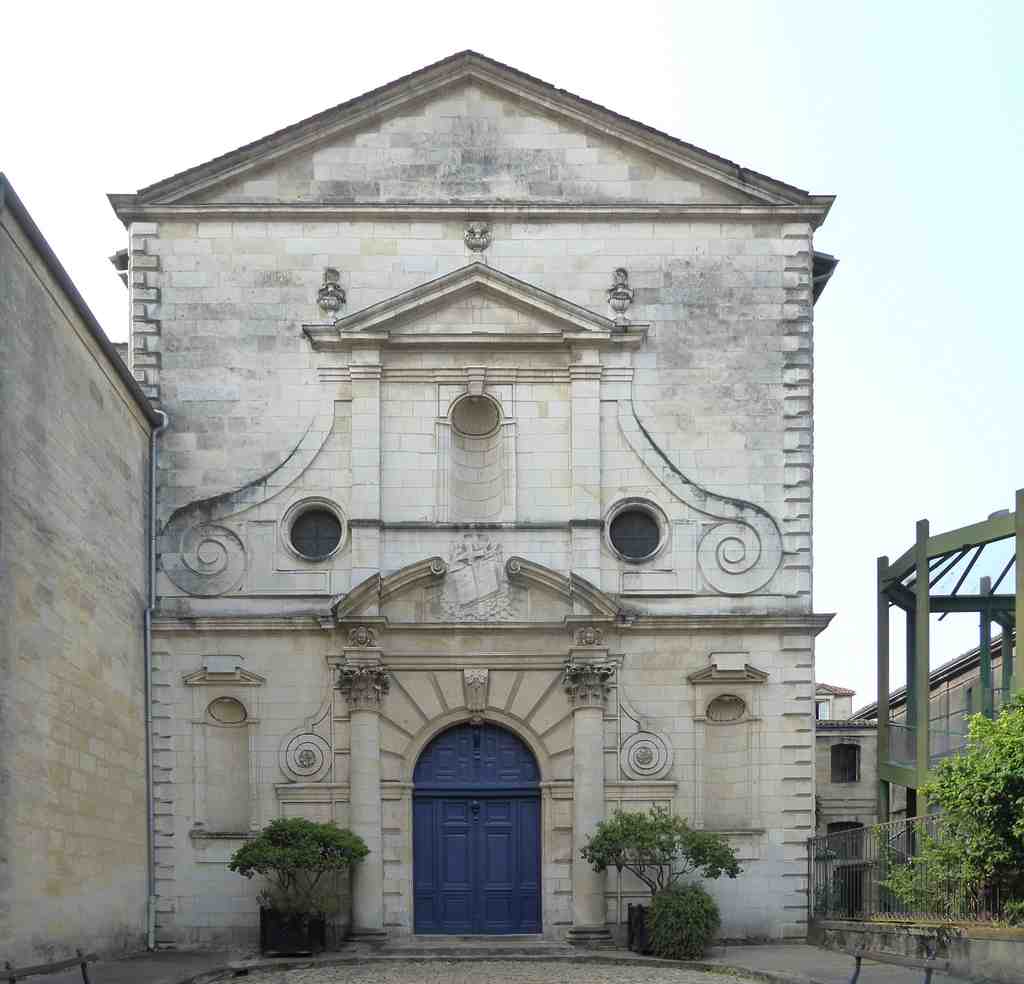
Alright, look straight ahead-you’ll spot the Temple of Ha by its grand, creamy stone façade, topped with a triangular roof. See those three round windows and big blue double doors right in the center? That’s your target. The facade looks like a three-part composition, with swirly stone curves and a certain calm dignity-like a wise old friend waiting for a chat. If you’re standing on rue du Hâ, you can’t miss it, framed tightly between two buildings and nearly glowing in the daylight.
Now, imagine yourself in the bustling streets of Bordeaux in the early 1600s. This building wasn’t always a Protestant church. It started as a chapel for Catholic sisters-built from 1625 to 1638, by an architect named Henri Roche. The sisters’ mission? To educate young girls, especially those whisked away from their Protestant families. Could you imagine the hushed voices, the sound of students’ footsteps, the air full of chalk dust and the scent of old wooden benches?
Jeanne de Lestonnac-the founder-had an impressive family tree. Her uncle was none other than Michel de Montaigne, the philosopher and once-mayor of Bordeaux. Fun fact: the family gatherings probably had more debates than desert!
The earth beneath your feet here even quaked in 1751, forcing a rebuild of the main hall. Then came the French Revolution-out went the religious items, in came… hay! Yes, this chapel turned into a forage store for the army. Hay there-imagine that aroma!
In 1803, after things calmed down, Napoleon handed this place to the city’s Calvinist Protestants. From that point, it became the Temple of Ha, its name borrowed from the nearby Fort du Hâ. On December 1, 1805, Pastor Martin led the first Protestant service here-probably with a nervous gulp and a proud smile.
Peek inside through the windows, and picture sturdy benches, a simple pulpit at the front, and the Bible resting on the communion table. There’s even an organ built in 1883, with its music echoing in the sober, baroque interior. Outside, life continued-by the 1860s, a nearby Protestant school bustled with children’s laughter. The building now hosts cultural events and supports communities in need.
So, as you stand here, let the stone walls and blue doors remind you: if a chapel can go from sisters to hay bales to Protestants, anything’s possible in Bordeaux. And remember, wherever there’s a mysterious door, there’s a story just waiting to be heard. Ready to see what’s next?




