
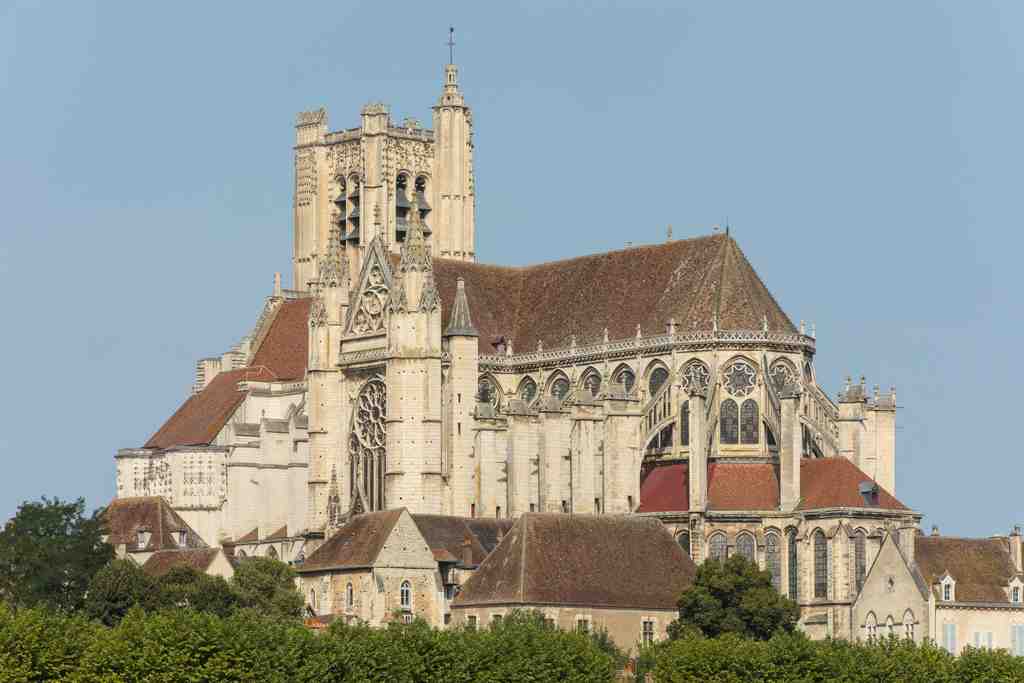
Take in the towering limestone cathedral featuring a single heavily ornamented square tower on its left side and a long array of arched flying buttresses supporting a steep tiled roof on the right. This is Saint-Etienne Cathedral. Or rather, this is the fifth version of Saint-Etienne Cathedral.
This site is a monument to sheer, unyielding stubbornness. The first church here became too small, so Bishop Amatre, who we crossed paths with earlier, laid the stones for a larger sanctuary in the late fourth century. That one burned down. A third sanctuary was built. It burned down too, taking much of the city with it in ten twenty-three. Unfazed, the city built a massive Romanesque church, a heavy, thick-walled style with rounded arches, complete with an underground stone chamber, or crypt, to level out the sloping ground.
But by twelve fifteen, the boundaries of architectural ambition were shifting. A new, soaring style was sweeping northern France. Bishop Guillaume de Seignelay looked at his heavy Romanesque cathedral and decided it just was not grand enough. He wanted pointed arches, massive stained glass, and terrifying heights. He wanted Gothic. So, he began simultaneously tearing down the old church and building the new one right over the crypt.
Then, in twelve twenty, Guillaume got promoted to Bishop of Paris and promptly left.
Without their enthusiastic founder, the local religious chapter was left holding the bag on a colossal construction project. It took over three centuries to finish. If you look closely at the western front, you will notice a glaring asymmetry. The north tower was finally completed in fifteen forty-seven. The south tower? It was never finished. They literally just put a makeshift roof over its massive stone base and called it a day, preferring to spend their remaining funds on a shrine instead.
For centuries, this building was caught in a tug-of-war over who controlled the city, its walls acting as a canvas for whoever held power. In fifteen sixty-seven, Protestant troops sacked the cathedral, taking axes and hammers to the exterior statues and systematically decapitating them. Later, during the French Revolution, the sanctuary was seized, stripped of its religious authority, and rebranded as a Temple of Reason. The revolutionaries were ready to smash the beautiful marble statue of Saint Stephen, the first Christian martyr, depicted dying under a hail of stones.
But someone cleverly pointed out that the dying saint looked an awful lot like Jean-Paul Marat, the famous radical revolutionary who had just been assassinated in his bathtub. The mob squinted, agreed, renamed the statue, and saved a masterpiece. Pure, opportunistic brilliance.
If you want to step inside this survivor, it is open Monday through Saturday from nine in the morning to six in the evening, and Sundays from ten to five.
From this ever-changing center of spiritual authority, we are going to walk five minutes over to the Yonne Departmental Archives, where we will dive into a very different kind of power struggle and a tale of brewing rebellion.




