
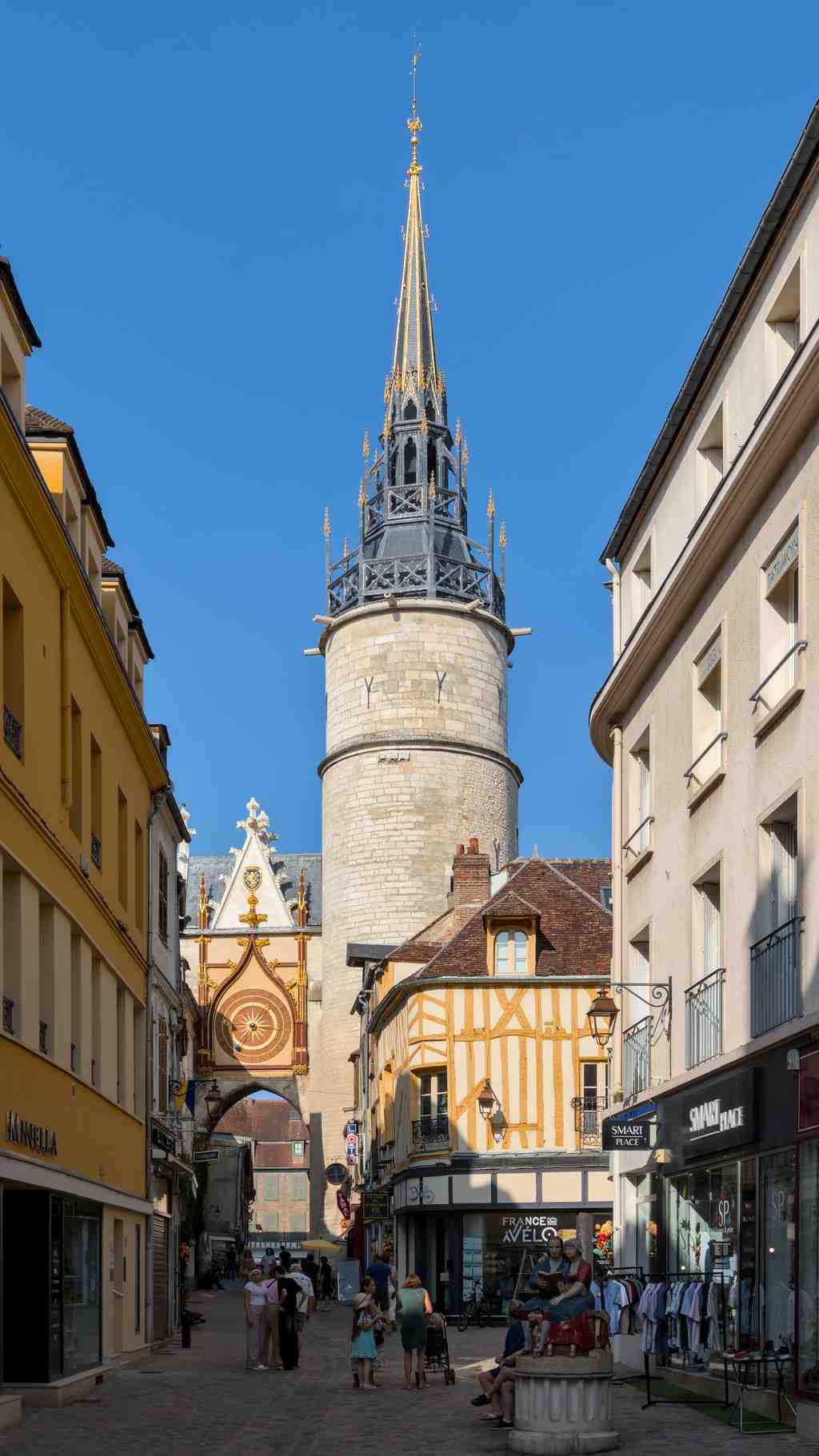
Notice the massive cylindrical tower of pale stone, topped by an intricate metal spire, standing right beside a highly decorated arched gateway. This is the Auxerre Clock Tower, built over the old Paris Gate, and it perfectly captures how a growing city asserts control over its people.
Centuries ago, this was the Tour Gaillarde, part of the original defensive ramparts. Back then, it was a brutal, windowless military structure that doubled as a freezing prison. It was the kind of place where people went in and simply stopped existing to the outside world. But as the city expanded beyond these old walls, its center of gravity shifted. The authorities needed a way to regulate this bustling new urban life, to synchronize the defense, the markets, and the citizens. So, in the late fifteenth century, they transformed this grim fortress into a masterpiece of civic order.
Look closely at the magnificent astronomical clock face above the archway. Notice how the dial is divided into two sections of twelve hours, with noon at the top and midnight at the bottom.
The engineering behind this is wonderfully complex. The clock does not just tell the time of day. It features two hands. One carries a golden sun, tracking the solar hours. The other, slightly slower hand, carries a globe that is half-black and half-gold. That is the moon hand. Through a hidden iron rod rotating inside a hollow shaft, that little globe actually turns on its axis to show the current phase of the moon. They meet at the very top for a new moon, and at the bottom for a full moon. It is a brilliant piece of fifteenth-century mechanical problem-solving.
Of course, a monument this tall attracts trouble. During the religious wars of the fifteen hundreds, the city was fiercely contested. A Protestant craftsman, a member of the heavily persecuted Huguenot minority, was hired to repair the clock. As a silent act of defiance against the ruling Catholic authorities, he sealed his statement of faith inside a tin box and hid it at the very top of the spire, inside the weather vane globe. It sat up there, completely undiscovered... for an entire century before another repairman stumbled upon it.
Then came the great fire of 1825. Plumbers were working on the roof, carelessly melting lead. They accidentally set the wooden spire ablaze. The fire raged, raining molten lead down onto the streets below while firefighters desperately used hooks to pull burning timbers inward so they would not crush the surrounding houses. The spire was destroyed and temporarily replaced by a hideous wooden cage that locals absolutely hated, until an architect finally restored the elegant gothic spire you see today in 1890.
Before we move on, I have to mention one of the tower's most eccentric residents. In the late eighteenth century, a quirky bailiff named Guillaume Roussel bought a small apartment built directly into the archway beneath the clock. He was so notoriously odd in his real estate choices and flamboyant clothes that the locals wrote a teasing nursery rhyme about him. That song, Cadet Rousselle, is still sung by French children today.
Our path now takes us deeper into the monumental heart of the city. We are heading to the Saint-Étienne Cathedral, just a four-minute walk from here.




