
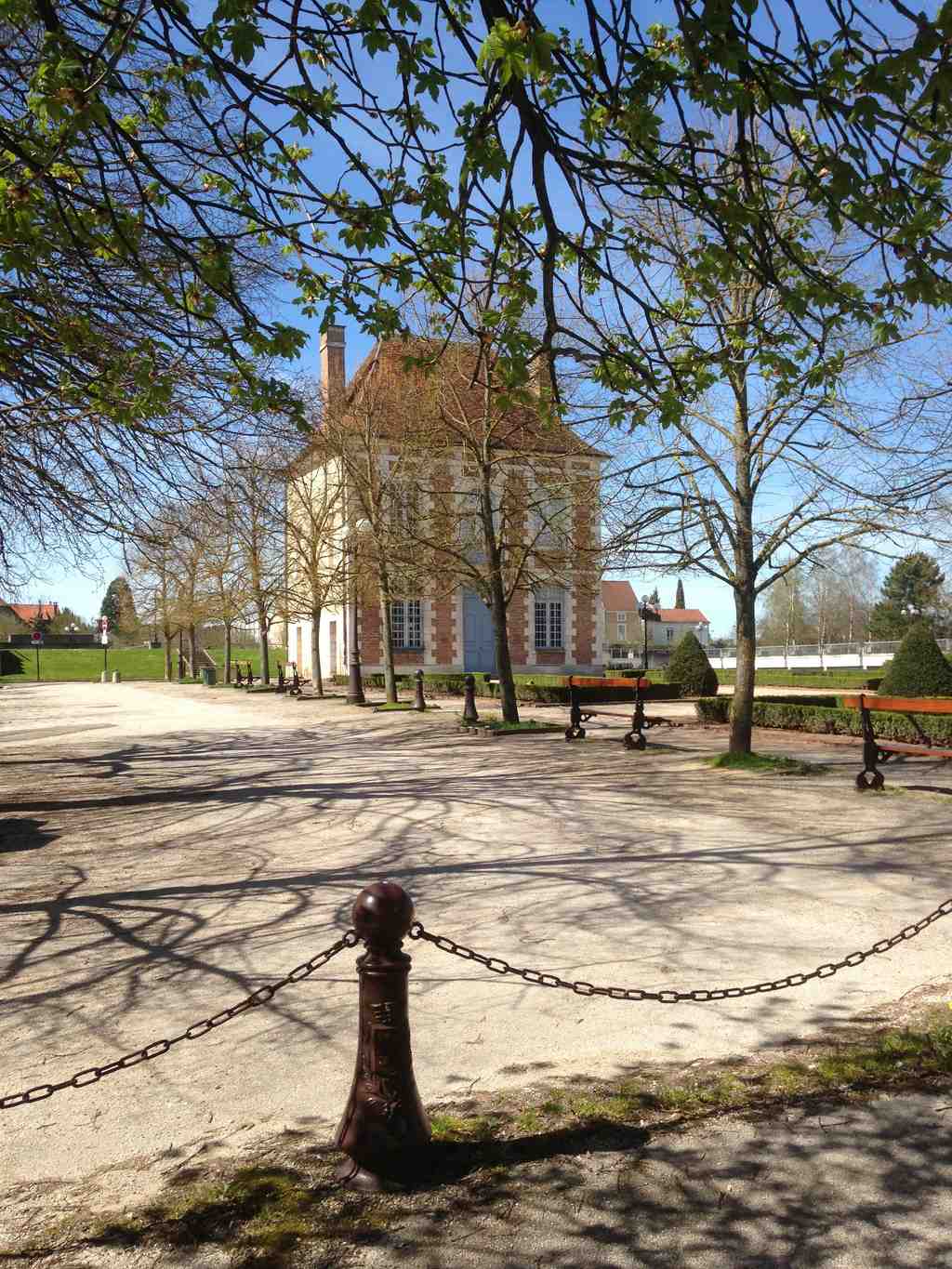
Look to your right and you will see a squarish, two-story stone and brick pavilion topped with a tall, steeply pitched roof and framed by light blue doors. This is the Maison des Arquebusiers, and its name tells you exactly what used to happen here.
An arquebuse was an early, incredibly heavy matchlock firearm. Today, Place de l'Arquebuse is a bustling, thoroughly paved civic center. But for centuries, this was the ragged edge of Auxerre.
Look around this open, orderly space. Picture this modern market square not as a safe civic hub, but as a loud, smoky, unprotected perimeter where armed men fired heavy weapons at wooden birds.
Back in the early 1700s, the local knights of the Arquebuse had to build a temporary wooden shack every time they wanted to hold target practice. They eventually got tired of the carpentry. In 1735, an architect named Guilbert-Latour designed this permanent stone pavilion for them, completely free of charge. The knights took their shooting very seriously. Every June, they held a competition. Whoever shot the wooden target with the greatest precision was crowned King of the Bird, which came with a total exemption from taxes for a year. If you pulled off this feat three years in a row, you were named Emperor, giving you tax exemption for life, a perk that even passed to your widow.
The pavilion also housed an invaluable collection of two hundred royal portraits. But the edge of the city is where the rules of civilization are often tested. During the French Revolution, in September 1792, a battalion of passing soldiers decided these paintings were symbols of tyranny. Despite local officials protesting, the soldiers dragged all two hundred centuries-old masterpieces into this very square, built a massive bonfire, and reduced them to ash. The following year, they even erected a temporary Roman temple right here to celebrate the fall of the monarchy.
In the centuries since, the city expanded, swallowing the square and transforming it from a dangerous boundary into a safe, vital center for the city market. But owning a piece of history is an expensive burden. By 2017, this pavilion was abandoned. The French state actually offered to sell it to the city of Auxerre for exactly one euro. The mayor flatly refused, pointing out that the restoration costs of a classified historical monument would bankrupt the municipality. So, in a very modern twist of fate, this historic military pavilion was eventually sold on an online auction website in 2019 for 245,000 euros.
As for the square itself, millions have been spent and multiple grand architectural plans have been scrapped in a constant struggle to figure out how to revitalize the space, with current hopes resting on a modern gourmet food hall. The struggle over what belongs in the center of a city never really ends.
Let us keep moving. Our next stop is the Church of Saint-Amatre, about a five-minute walk away.




