Look at the massive pale stone walls of this church, defined by its steep, sweeping roofline and anchored by a striking octagonal spire with arched openings.
When you think of city walls, you think of absolute safety, but in ancient Auxerre, the line between sanctuary and slaughter was drawn right into the earth. If your property sat just outside the city's early Roman fortifications, you were essentially offering an open invitation to every passing marauder. The shifting walls of Auxerre meant that geography was destiny, and unfortunately for the original founders of this church, their geography was terrible. The vulnerable monks who established a monastery here in the seventh century faced frequent, devastating raids with absolutely zero protection from the city defenses.
It got so bad that the surviving monks eventually just abandoned the site entirely. They handed what was left of the smoking ruins over to the Auxerre Cathedral just to rid themselves of the burden.
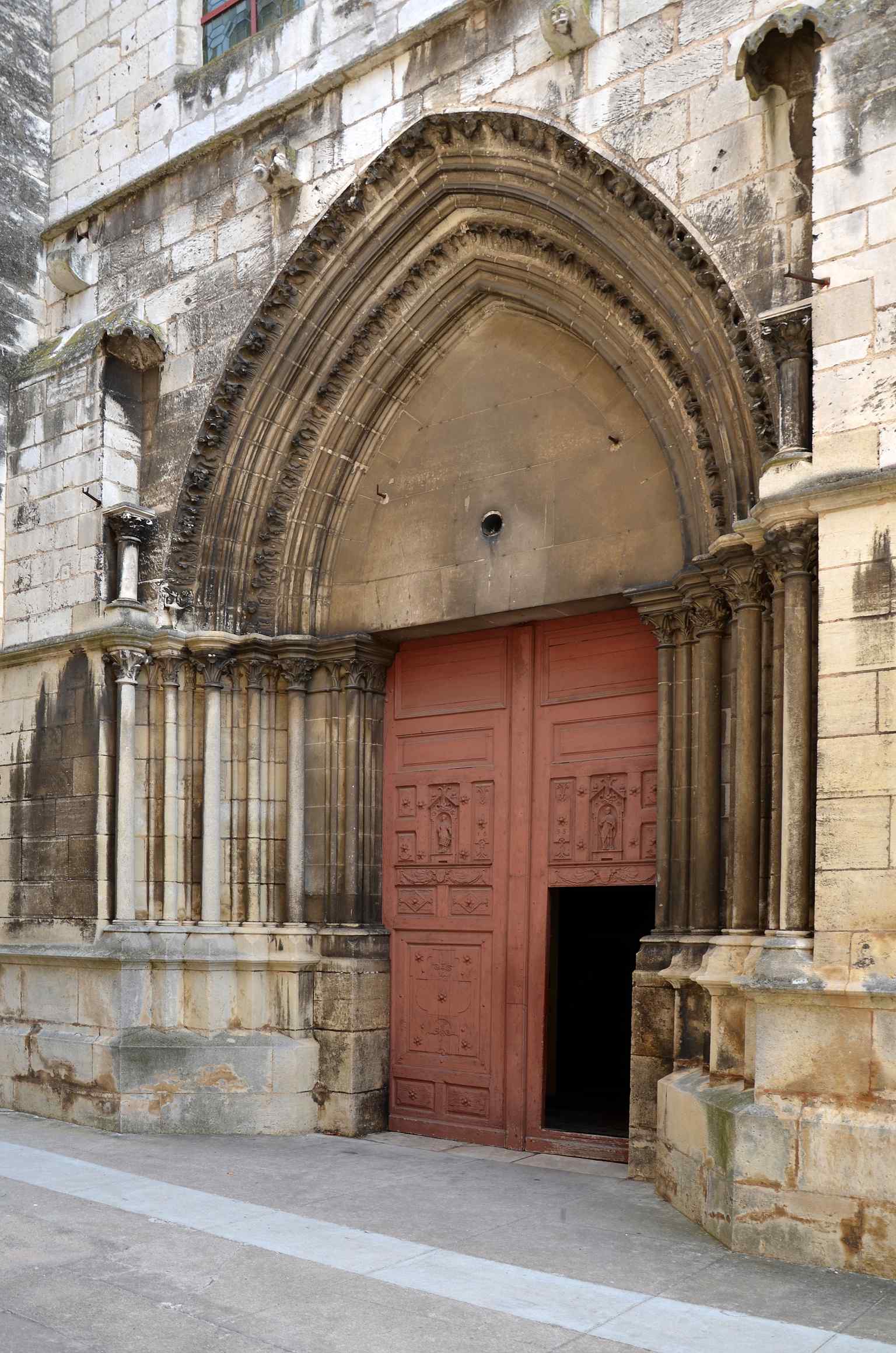
Take a look at your screen to see the exterior in the app. It wasn't until 1196 that the city expanded its defensive perimeter, finally scooping the Church of Saint-Eusèbe inside the boundaries of safety.
But being inside the city limits came with its own bizarre problems. Pull up the second image in the app to see the twelfth-century Romanesque bell tower. In 1411, city leaders decided to coordinate their night watchmen by purchasing a state-of-the-art, and wildly expensive, mechanical spring-and-bell clock. They installed it right up in that tower.
There was just one massive oversight.
Because the city's borders had expanded, this church was no longer centrally located. When the shiny new clock rang, its chimes completely failed to reach the other side of town. Half the population could not hear it, rendering the very expensive municipal experiment completely useless. The city stubbornly lived with this failure for decades until they were finally permitted to build a centralized clock tower in 1457.
The church's bad luck did not end there. In the sixteenth century, local parishioners proudly funded stunning Renaissance stained-glass windows to celebrate a community revival. In 1567, violent local uprisings left them smashed to pieces. The devastated parishioners painstakingly raised funds all over again, bought beautiful replacement glass, and installed it. Then, in 1612, a massive hurricane struck Auxerre and shattered the brand new windows.
By the late eighteenth century, the historic priory was dismantled. During the French Revolution, the church suffered the ultimate indignity of being converted into a secular prison. After serving as a jail, the building became the local headquarters for the Decadal Cult. This was the atheistic, ten-day-cycle religion established by the French Republic to replace Christianity. It took until 1801 for the battered building to be restored to Catholic worship.
And yet, the worst architectural crime committed here wasn't by rioters or hurricanes. In 1852, urban planners decided the building needed more symmetry. To perfectly align five lateral side chapels, they completely demolished a magnificent, flawlessly preserved Renaissance chapel. Today, nothing remains of that masterpiece except a single drawing.
Let us leave this bruised survivor behind and head toward the modern bustling heart of the city. We will make our way to Place de l'Arquebuse, which is about a six-minute walk from here.