
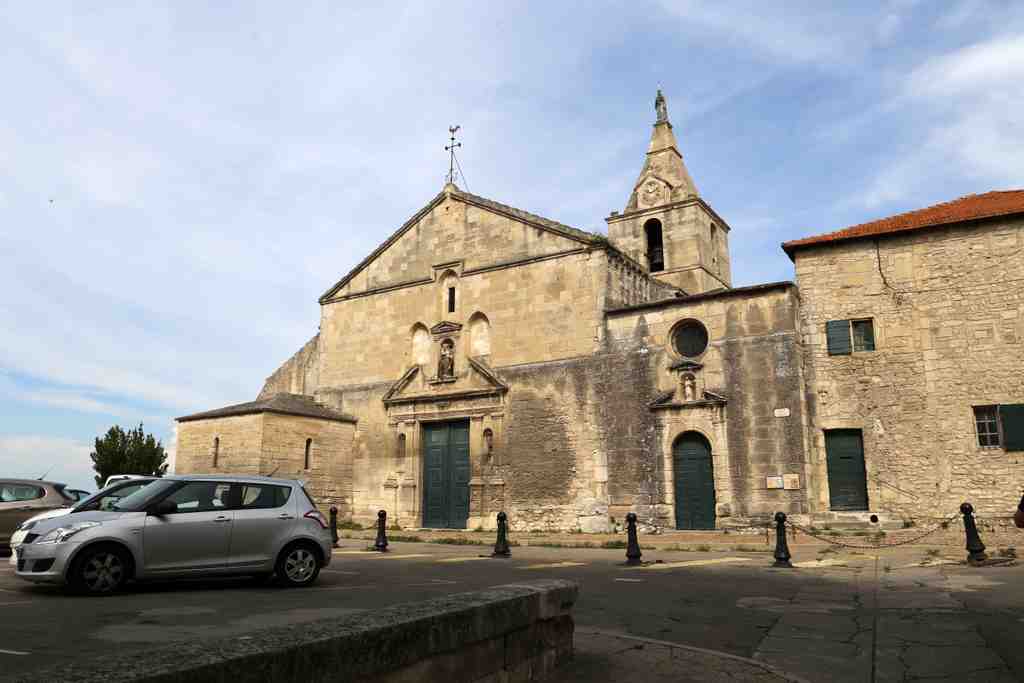
To spot the Church of the Major of Arles, look ahead for a large, weathered stone building with a simple, triangular façade, a small belltower topped by a pyramid, and deep green doors-it's just beside the parking area and stands out with its ancient charm.
Now, let’s transport you back in time-all the way to the year 452, when the very first church on this site was consecrated during a dramatic church council. Imagine the ground beneath your feet humming with ancient energy: there once stood a Roman temple here, devoted to a goddess called Bona Dea, or “the Good Goddess”-and you can still sense a whiff of sacred mystery in the air. In fact, an altar from that temple now slumbers just across town in the Arles Antique Museum!
As you look at the current Romanesque building, with its robust walls and unassuming Louis XIII-style façade rebuilt in the 1600s, you’re witnessing layer upon layer of history. Back in 1152, the old church got a makeover fresh out of the Provençal Romanesque style book-and though the building grew and changed over the centuries, three of those medieval nave arches still stand strong today, almost defying the quirks of time and fashion.
For centuries, this church was a local heavyweight-a parish so big it included the whole Crau plain, and with a congregation ranging from dignified townsfolk to sun-bronzed shepherds. And speaking of shepherds, legend has it that the church welcomed not only bishops, but herders and even a confraternity dedicated to Saint Veran, who was famous for his sheep-wrangling skills-patron saint of anyone handy with a crook!
But not everything was always peaceful. Fast forward to 1944, when bombs shook the city-old stones trembled, stained glass quivered, and the church’s ancient foundations needed mighty reinforcements in the 1980s to keep her standing. Yet the Major endured, braving not only wars but wild renovations, some of which landed beautiful columns in the bottom of the Rhône river (maybe they just didn’t want to leave Arles?).
Inside, the church is a wonderland of chapels and artistry: elaborate altars of colored marble, relics with stories longer than a Provençal dinner, and paintings depicting miracles (including a young man being resurrected-not something you see every day at church). There’s a vivid crucifix, a choir of statues, and a strange survivor-a forged iron mission cross, saved from angry crowds by a wise priest’s quick thinking.
Look up, and you'll spot the proud belltower, rebuilt in 1579 with a sharp pyramid and topped by a statue of the Virgin and Child-added in 1867, probably to make sure everyone knew who was boss! The bells themselves have a dramatic past; one used to call people to everything from prayer to curfew, and even tolled for condemned souls right up to 1820. Oh, and if you hear a deep gong, you can thank the good folks of Annecy, who recast the main bell after it cracked in the 1900s.
Every May 1st, the church sparks back to vibrant life as the Guild of Saint-George’s ‘gardians’-that’s our local cowboys-arrive on horseback, blessing their steeds and tipping their hats to tradition. Alongside this, the church cradles tales of precious relics: the jawbone of Saint Mark, for one, gifted from Venice for saving the city from famine, and treasures now housed in museums but once protected here.
And don’t forget the pipe organ, built in 1698, sounding once throughout these stone arches-though now it waits silent, dreaming of restoration. As you stand here, try to imagine the air alive with organ music, medieval incense, the soft murmur of prayers, and maybe the shuffle of hooves outside on festival day.
So as you gaze at this weathered guardian of Arles, remember-underneath every stone and behind every door, there’s a secret waiting for you to discover, and if these walls could talk, I bet they’d sing! Ready for our next stop?
Fascinated by the historical, description or the interior and furniture? Let's chat about it




