
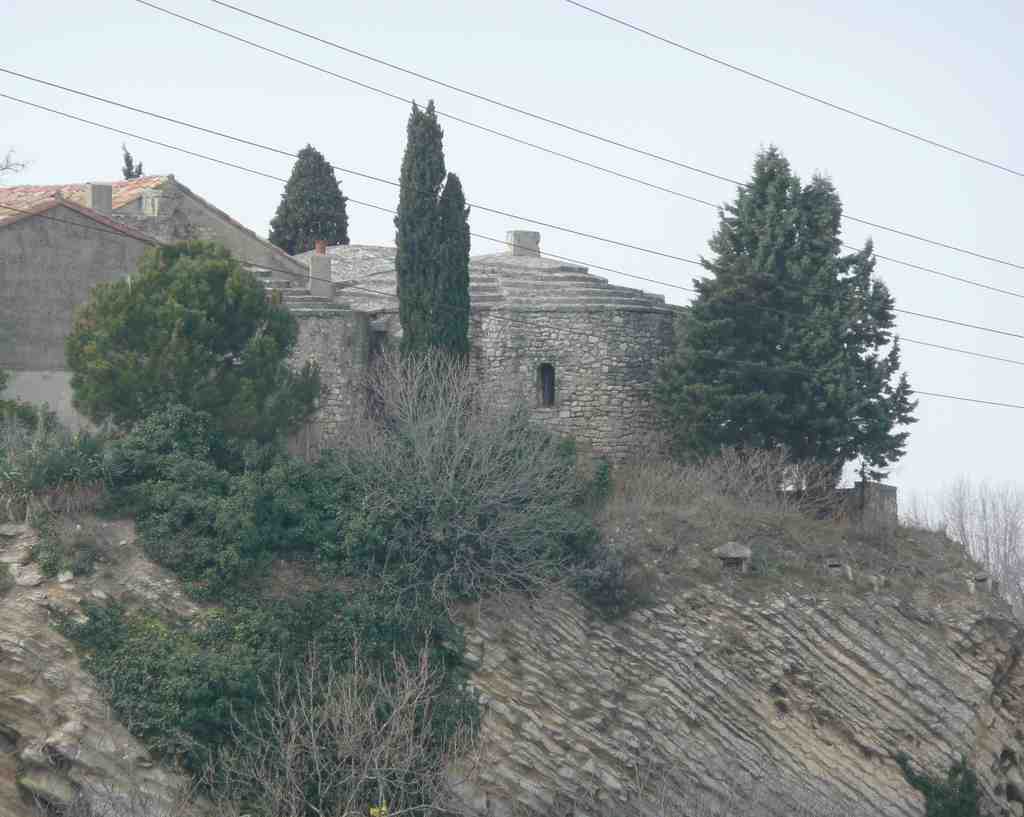
To spot the Church of Saint-Pierre-et-Saint-Paul de Mouleyyrès, look up along the slope to your right and you’ll see a small, ancient stone chapel perched dramatically at the edge of a rocky cliff, ringed by tall cypress trees and peeking out from behind thick greenery like an old secret watching over the railway below.
Now, take a good look at that rugged little church above you-it might look peaceful today, but its past is anything but quiet. Let’s jump back and feel the layers of time stacked right here on this hillside. Imagine standing here in the 5th century, the quiet broken only by the cries of birds and the hum of pilgrims making their way on the old Roman road that snakes through Les Alyscamps. Back then, a Roman temple to Mars was said to have stood hidden beneath the earth right where the church is now. But then, according to legend-because every great place needs a great legend!-Saint Denis himself, who became the first bishop of Paris, built the initial chapel, dedicated to both Saint Peter and Saint Paul. The truth? Archaeologists think a man named Petrus actually founded it, and you can even find his name on an old funeral inscription from around the year 530.
This church didn’t just sit quietly-it quickly became a hotspot for early Christians. It drew funerals, prayers, and the hope of eternal rest, so much so that people wanted to be buried as close as possible to these holy walls. You could almost imagine wagon after wagon, loaded with stone sarcophagi, rumbling towards this very hill, eager for a coveted plot. The air would be heavy with the scent of incense, and echoes of psalms would drift through the night.
Things got lively in the Middle Ages-just over there, beside the church, was a hospital for weary pilgrims journeying to Santiago de Compostela. The Chapel of the Trinity stood nearby, all set in a grove of hackberry trees that shaded this rocky plateau, giving rise to the local nickname, “Fabregoule.” Life here revolved around faith, travel, and the unseen presence of dozens-hundreds-of tombs beneath your very feet. The church was so important that in the 12th century, it was handed over to the powerful Chapter of Saint-Trophime.
But, oh, history loves to shake things up! As centuries passed, things changed. In the late 14th century, the once-proud church was handed to a lonely hermit. Imagine him, tending the crumbling stones, muttering prayers while wolves might have howled from the woods below-a bit of Gothic drama worthy of a novel. And then came the engineers! In the 16th century, during the turmoil of war, the citizens of Arles destroyed the church themselves, worried invading armies might use it as a stronghold. Talk about tough love!
But this little church just wouldn’t quit. After the wars, it rose again like a very determined cat with nine lives. Its spindly, clover-shaped old section-the original from the earliest Christian days-became the sacristy for a new church that took shape in the shadow of past destruction. But just when things seemed settled, the 19th century arrived in a rush of steam and steel. First, the canal, and then, in the 1840s, the railway carved through the hill, leaving the church teetering on what now looked like a cliff, tombs and all, high above the chattering trains.
Today, this spot is one of the last three survivors of a dozen ancient shrines that used to crown these rocky bluffs. Its walls are patched with centuries of change: a 17th-century facade, a heavily reworked doorway, hints of the old three-lobed apse, and secret marble slabs decorated with mysterious, ancient patterns-stars, crosses, circles-that belong to a vanished world. Archaeologists, like treasure hunters, uncovered stones and inscriptions linking these ruins to churches in Marseille and other faraway places.
So as you look up, take in the textured stone, the stubborn cypress trees, and the odd feeling of both solitude and history thick in the air. Maybe you’ll catch, on the breeze, the voices of pilgrims, the sighs of centuries, and-if you listen closely enough-the low rumble of the trains, just one more layer in the long, winding story of this little church on the edge of forever.




