
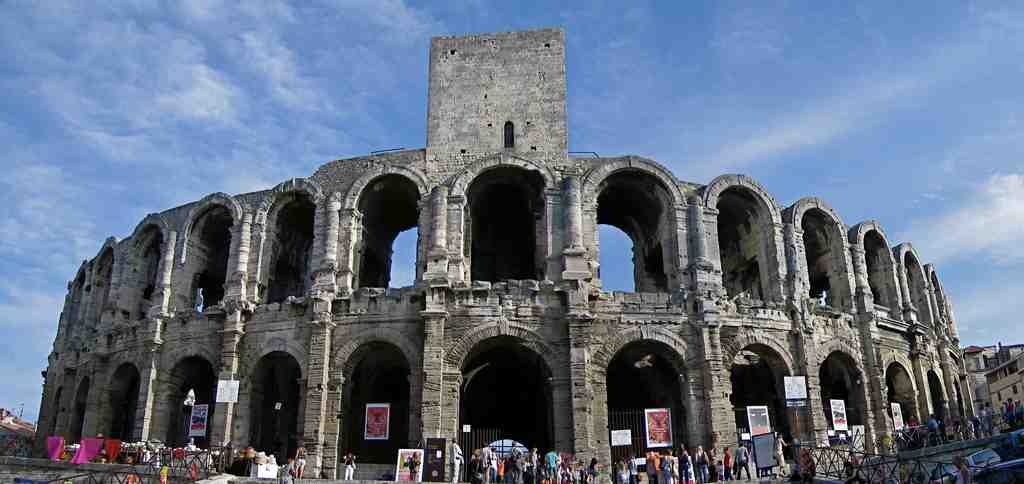
Look straight ahead for a grand oval structure of pale stone, crowned by two tiers of tall, ancient arches and topped by a square medieval tower-it stands dominantly against the sky, impossible to miss!
Welcome to the mighty Arles Arena! Imagine yourself back in Roman times, around the year 90 AD. The air is buzzing with excitement, the crowd is restless-nearly 25,000 spectators are packed into these vast stands, chattering loudly, all eager for the spectacle about to unfold. Built on the orders of Emperor Domitian, the arena was Arles’ answer to the Colosseum in Rome, designed as a place to host grand entertainments for the people of this Roman colony. The arena’s sixty rows of arches, which you can still see today, once rang out with the thunderous roar of excitement during gladiator games and wild hunts.
To create this Roman masterpiece, engineers leveled a whole section of the old town wall and raised the structure up on this hill. The arena’s clever design included sweeping corridors-think ancient traffic jams, but with tunics and sandals instead of cars! When the games began, the main elliptical arena below became a battleground for gladiators and beasts, surrounded by a sea of shouting and stamping feet.
But Arles Arena wasn’t just about sports; it was also a stage for power and spectacle. In 255, the emperor Gallus threw grand games here to celebrate military victories. Later, Emperor Constantine ordered wild animal hunts to celebrate the birth of his son-talk about over-the-top birthday parties! Even when kings like Childebert came to visit, they wanted to see a good old-fashioned Roman show. In those days, the arena was the beating heart of Arles, a true symbol of the Roman way of life.
Then history took a wild turn. As the Roman Empire faded, invaders and unrest swept through Europe. The arena’s noisy cheers faded, and this stage of glory became a fortress, complete with four defensive towers. Imagine over 200 homes and two chapels crammed inside, all protected by these soaring stone walls-every nook and cranny filled with the sounds of daily life.
Fast forward to the late Middle Ages, and things got even stranger-a doctor passing through Arles in 1495 was shocked to see poor families living inside, tucked beneath the ancient arches. Even King Francis I stopped by, scratching his royal head at how rundown this monument had become. Finally, in the 1800s, the city’s mayor decided enough was enough: the squatters were cleared out, homes removed, and the arena returned to its original purpose-bringing people together for spectacle and celebration.
In 1830, a celebration for the capture of Algiers marked the arena’s grand rebirth-festivities, drama and, of course, Arles’ own brand of bullfighting, a local tradition that lives on today. Not long after, this breathtaking monument was declared a national historic site and in 1981 joined the UNESCO World Heritage lineup.
These days, the Arles Arena is a superstar again, famous not only in France but around the world. In summer, you can hear the shouts and gasps of spectators as actors and athletes recreate ancient gladiator games. From lively music festivals to bullfights and theater performances, the arena is bursting with energy. If you listen carefully, you can almost hear echoes of Vincent van Gogh and Picasso, who both found inspiration here, or maybe catch the voices of TV crews and fictional car chases from films shot amid its shadows.
So, whether you dream of ancient heroes, medieval mystery, or modern-day excitement, take a moment to stand in awe-nearly two thousand years of adventure are built into these marvelous, towering arches.
Interested in a deeper dive into the description, description or the nowadays? Join me in the chat section for an insightful conversation.




