
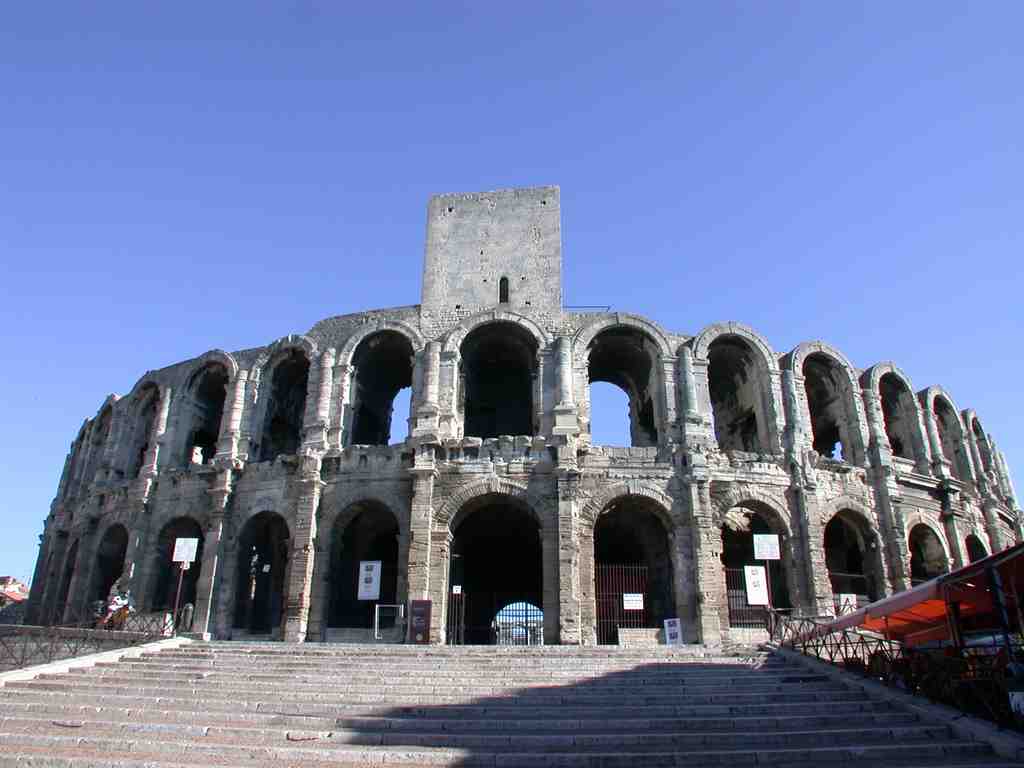
In front of you, rising above the broad stone steps, you’ll spot the massive oval of the Roman arena - a circle of weathered arches, with a tall square tower at its heart, making it impossible to miss as you look up from the stairs.
Long ago, the streets here would’ve thundered with the sound of Roman sandals and market cries, not to mention the occasional goat - even Caesar would have needed to sidestep! Picture Arles nearly 2,000 years ago: the city called Arelate, freshly rewarded by Julius Caesar himself, who was so grateful for their wartime loyalty against rival Marseille that he had warships built here - twelve mighty vessels rattled together in less than a month, their oars clattering as they won him a decisive victory. Not bad for a riverside city, right?
In those days, after Caesar’s win, Arles became a Roman colony, bustling with proud Roman citizens - real toga-and-designer-sandals types. The veterans of the sixth legion settled here, and the city’s fortunes soared. A grand city plan unfurled: temples, forums, and, of course, the arena you’re looking at now started to rise up. Even Augustus, Caesar’s adopted son, popped in to make sure his family’s prestige was stamped into every stone. The official name of the place? “Colonia Julia Paterna Arelate Sextanorum.” Try fitting that on a business card.
Back then, Arles was so important that Roman bigwigs scribbled its name in marble and dropped boulders for city walls - though, to be fair, those walls were soon too small for its growing population. The city kept expanding, eventually spreading even to the marshy lands of Trinquetaille over the river. Life was lively, with new roads like the Via Agrippa stretching north to Lyon, and ships constantly unloading barrels of grain and amphorae of wine.
Through the first and second centuries, Arles kept booming. Rich families rose to prominence - senators, shipowners, even the odd celebrity lawyer or philosopher. There were workshops, shipyards, and an industry motto that could’ve been: “What happens in Arles… gets exported to Rome!” The city’s port hummed with trade from the Mediterranean, and the mighty Barbegal water mills - a Roman industrial marvel - ground grain for thousands.
By the third century, Arles was famous for grand new builds, like the Roman circus and expanded neighborhoods filled with artisans. And as the centuries rolled on, major changes swept through: Christianity began to take hold, mixing with Roman gods and Egyptian goddesses - you had temples, churches, and even the occasional rumored miracle.
Now, don’t get too cozy - the story’s about to get dramatic. Invasions and sieges became the new normal as Alamans, Wisigoths, and Roman generals vied for a foothold. There were nights when flames and chaos lit the skyline, and times when citizens fled into places like the very arena ahead, seeking refuge from warriors at the gates. Picture life in a city where the job title “bishop” meant you might need a bodyguard!
Even so, Arles thrived as a spiritual and political capital, hosting great councils where emperors and bishops debated weighty issues - and probably fretted over missing their lunch. One legend echoes through these stones: Genès, a Roman court scribe who stood up for his Christian faith, was executed across the Rhône and buried out at Alyscamps, inspiring generations.
By the fifth century, Arles peaked as a regional “capital of Gaul,” bustling with more people than live here now. Emperors and usurpers vied for power; you could almost imagine them lining up to take their selfies in front of the arena, if only they had phones and less ambition. Despite wars, sieges, and even an assassination or two, Arles was prized for its markets, great assemblies, and its mix of cultures. For a time, this city shaped the very destiny of Western Europe. So, as you stand before these stones, you’re not just seeing ruins - you’re looking at the heartbeat of an empire, sometimes trembling but always alive with stories, shouts, and centuries of change.
Want to explore the 1st century bc bc: arles, roman colony, 1st century or the 2nd century in more depth? Join me in the chat section for a detailed discussion.




