
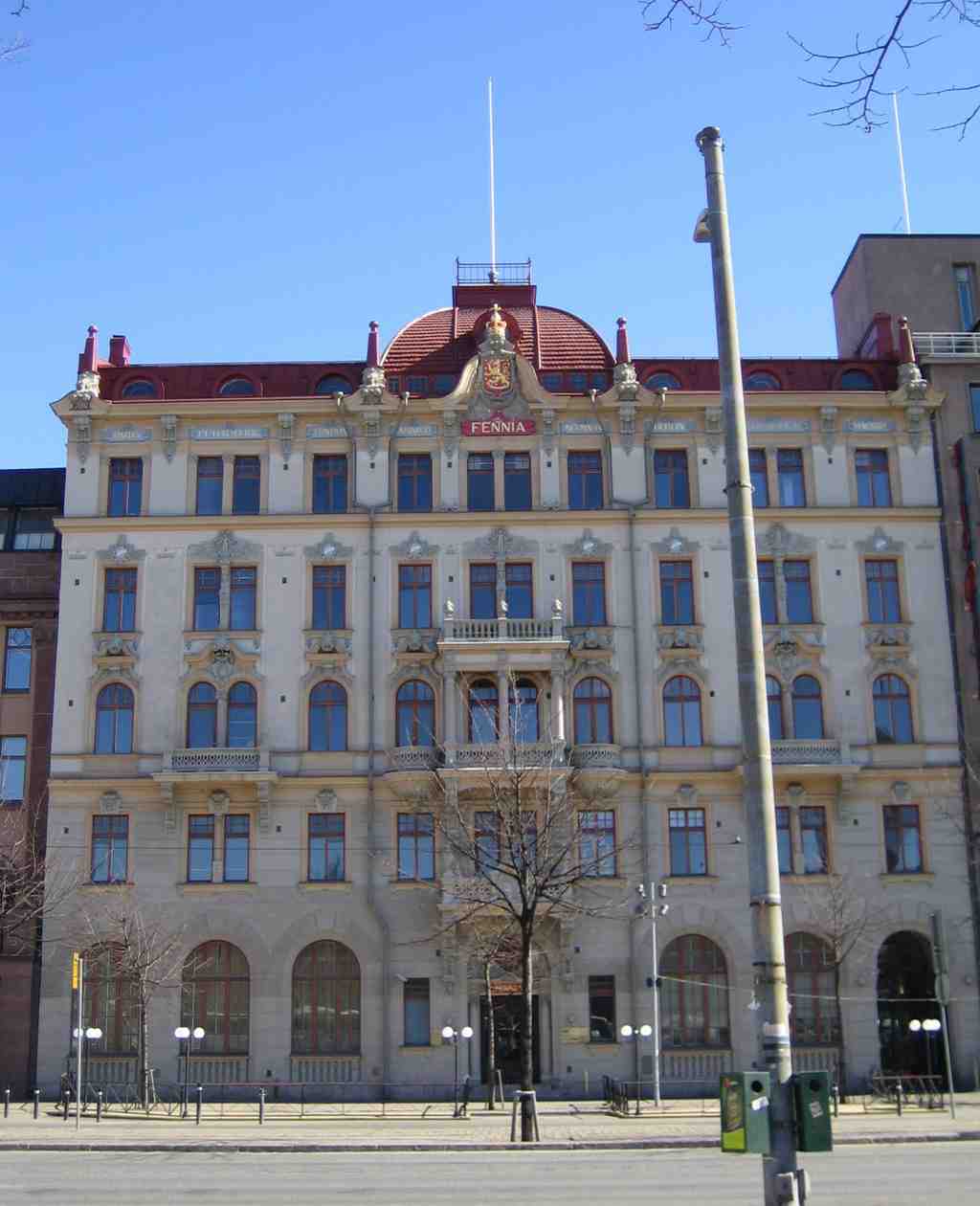
Fennia House is a pale stone building with a grand, slightly curved facade, tall rows of windows, and a large Finnish coat of arms set high above gilded names of European capitals.
There is something wonderfully candid about this building. It does not pretend to be modest. Completed in eighteen ninety-eight and opened as Hotel Fennia in eighteen ninety-nine, it stood on the eastern edge of Railway Square like a formal greeting to newcomers. The architects, Grahn, Hedman and Wasastjerna, gave it a Viennese-flavoured neo-baroque face - in plain terms, a style that loves theatre, ornament, and a certain metropolitan swagger. Look up, and you can still see the performance: Paris, Petersburg, London, Berlin, Stockholm, Madrid, all written in gold above the windows, with the year of completion inscribed in Latin. In that political moment, placing the Finnish coat of arms so prominently was a bold gesture too.
And yet the glamour rose from difficulty. This patch of the city had once been the muddy bottom of Kluuvinlahti bay. An earlier house here leaned so dangerously that people had to demolish it in the middle of the nineteenth century. Even Fennia’s builders wrestled with soft clay underfoot. Perhaps that is why the building feels so Helsinkian in miniature: poised, polished, and quietly defiant about what lies underneath.
The railway station had already made this district a zone of arrivals and departures. Before Fennia, a wooden hotel called Hotel de Post welcomed travellers here, and locals nicknamed it the Cuckoo Clock after the restaurant’s clock. Then a consortium of businessmen, including Paul Sinebrychoff, financed something larger and more ambitious. Fennia offered five floors of guest rooms, ceiling paintings in corridors and bedrooms, and even an electric lift - a small marvel at the time.
Its great impresario arrived later. In January of nineteen oh nine, the restaurateur Karl Edvard Jonsson reopened the place as Grand Hotel Fennia and staged the occasion with one hundred and fifty-seven waiters in dark green tails while Simon Steinberg’s orchestra played. Jonsson understood that a hotel near the station was never just a hotel; it was a declaration. He added splendour, including a winter garden under a pyramid-shaped glass roof, where a fountain sent water eight metres into the air and gardener C. T. Ward changed the flowers every week.
If you fancy a quick glimpse of how the corner transformed over more than a century, have a look at the before-and-after image in the app. Actors from the National Theatre came here after performances. Ida Aalberg’s fortieth anniversary celebration became one of the most dazzling society parties in Finland. In nineteen eighteen, during the civil war, the same building turned into a war hospital and, for a time, a headquarters. Young artists Bruno Tuukkanen and Eero Snellman even worked here on the final appearance of the Finnish flag. Later still, the Russian writer Aleksandr Kuprin arrived with his family after hardship and exile; his daughter remembered how the marble staircase and immaculate staff made their own poverty suddenly, painfully visible.
Lift your eyes once more to the gilded lettering and ask yourself what sort of city this facade was promising to the traveller stepping off a train.
Perhaps that is the final image to keep: a house of welcome standing on uncertain ground, forever changing its role yet never abandoning style. And with that, I shall leave you to the tour outro.




