
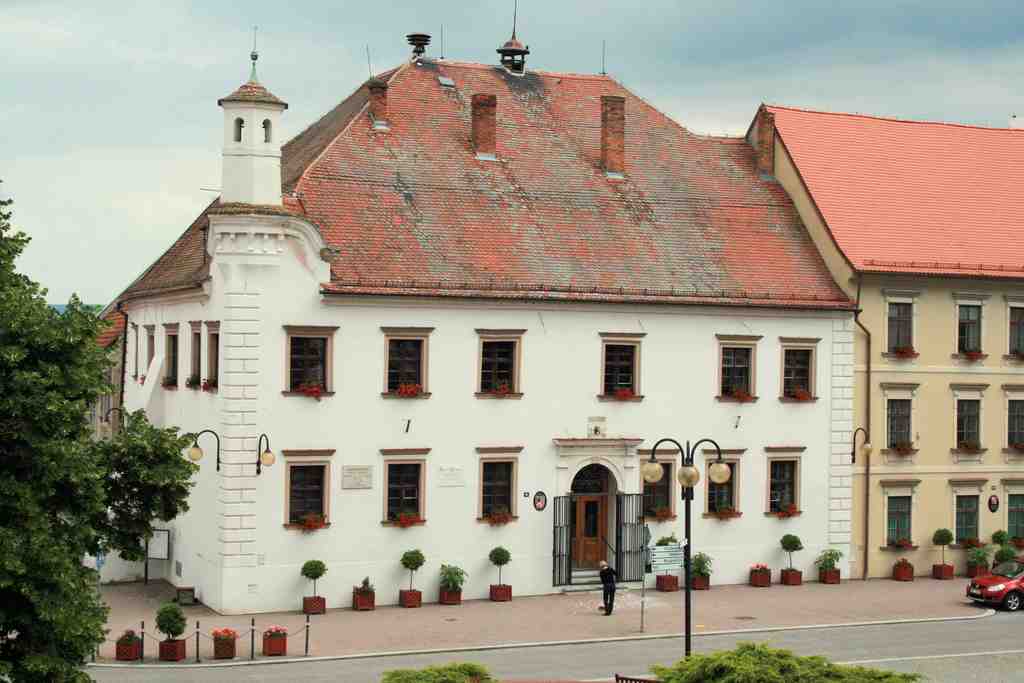
On your right, you will see a two-story white stucco building with a red tiled roof, anchored by a unique, six-sided white turret jutting out from its left corner.
This is the Town Hall, and it happens to be the oldest preserved building in all of Slavkov. It was built way back in 1592, resting right on top of older, rougher Gothic foundations. It is a classic piece of Renaissance architecture, a building style that focused on bringing back the harmony and mathematical precision of ancient Rome. Though, if you look at the main entrance, they got a little rebellious with the symmetry, placing the door off-center.
If you pull up the first image on your screen, you can get a great historical view of how that quirky hexagonal turret shapes the corner of the building.
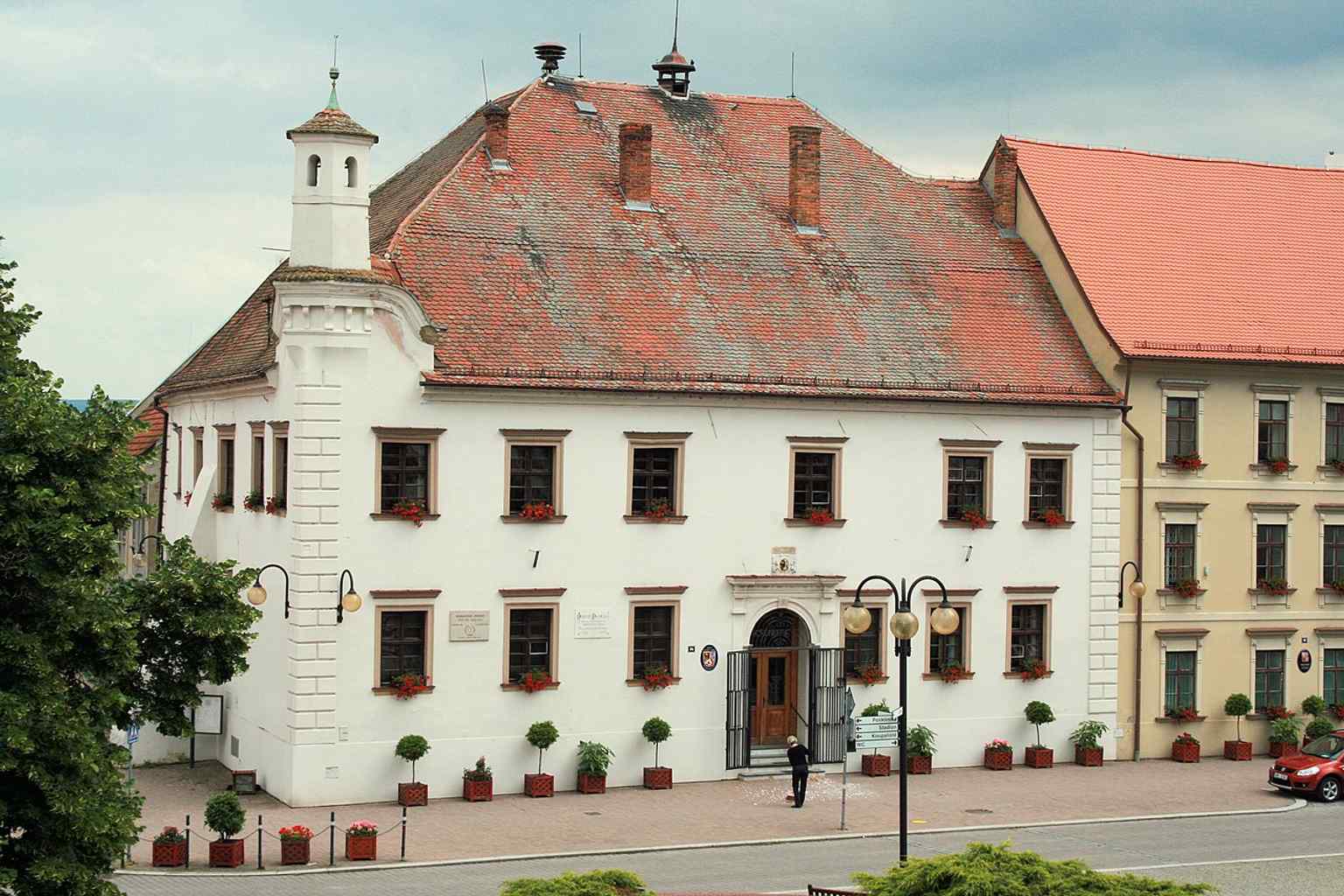
Look right above that main entrance. See the stone carving? That is the town coat of arms, and the inscription above it proudly shouts out the two mayors who were in charge back in 1592, Alexander Bradawichka and Petr Pekarz. Carving your name into stone so people remember your term in office four centuries later is not a bad flex.
But a Town Hall is not just a place for politicians to push paper. Back in the nineteenth century, this building was the ultimate multipurpose center. If you walked through the doors back then, you would find a working pub and the tavern keeper's apartment right on the left side of the ground floor. A literal pub inside city hall. And on the right side? The police station. You could grab a drink, start a brawl, and get arrested without ever leaving the building.
If things got really out of hand, the police would haul you up the side stairs from the street straight into the šatlava, a local lockup and jail up on the second floor. Meanwhile, just down the hall, the town council was holding their serious political meetings right next to the municipal treasury.
Things were actually much darker right outside. The sloping square in front of us used to be a natural amphitheater, and right out front stood a stone pillory. A pillory was a heavy post where criminals were locked by their neck and wrists for public humiliation, or even execution. So while the mayors were inside managing the town budget, harsh justice was being served right out front.
There are a couple of memorial plaques on the front facade worth noting. The one between the second and third windows honors Bernardino Ochino. He was a famous sixteenth-century Italian theologian who traveled all the way to Slavkov, only to tragically die of the plague here in 1564.
Over the years, this structure has protected everything from the town's water department files to museum artifacts hidden in crates to keep them safe from a military garrison during the Second World War. It still serves as the municipal office today, open for business on Mondays, Tuesdays, and Wednesdays.
This bizarre, brilliant building has truly been the beating heart of the town for centuries. Take your time here, and whenever you are ready, we will head over to our next stop.






.jpg)