
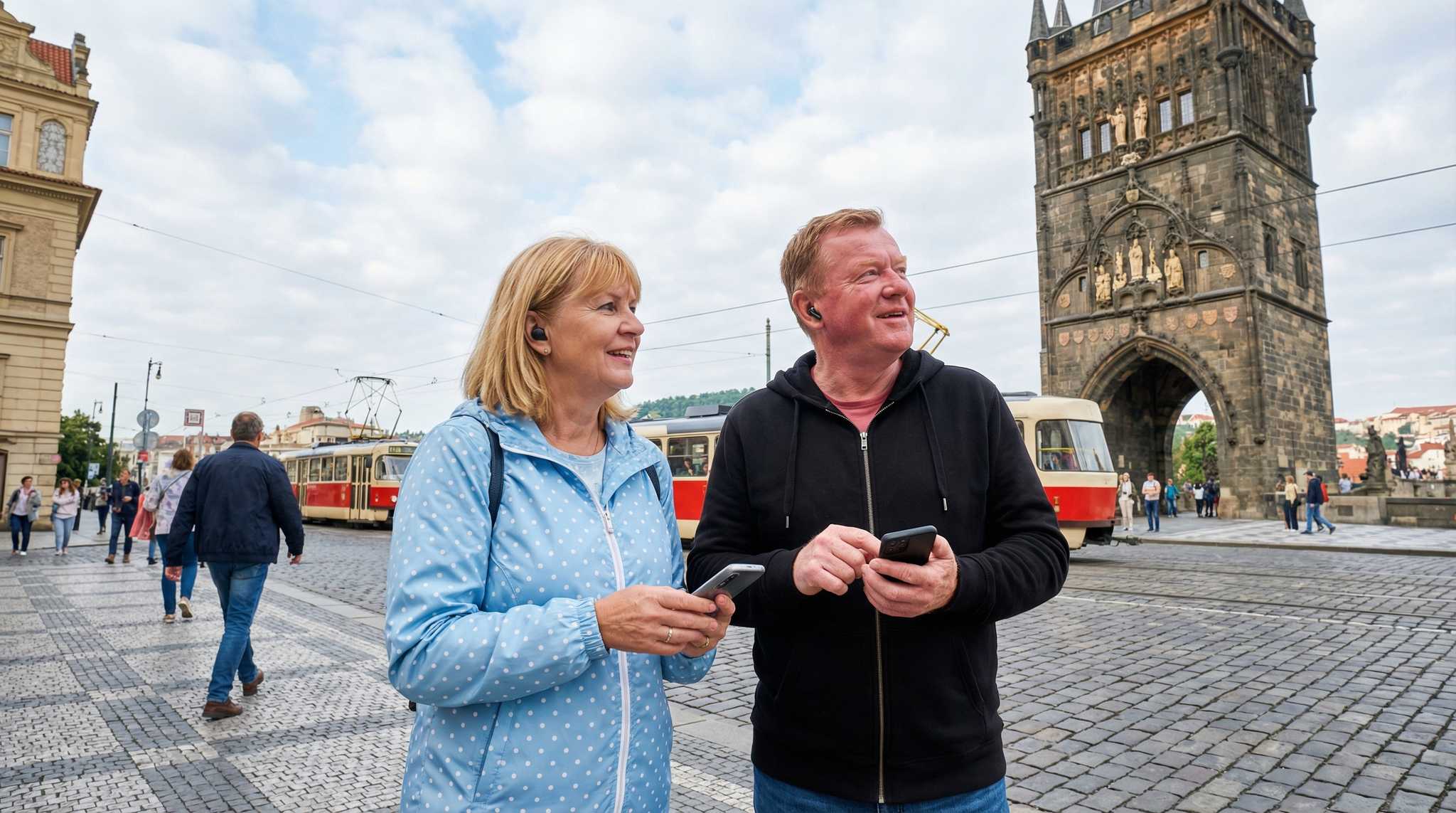
Prague Audio Tour: Bridges, Palaces & Legends of Lesser Town
Discover the enchanting heart of Prague on a captivating tour that takes you through the city's rich history and vibrant culture. Begin your journey at the majestic Valdštejnský Palace, a stunning Baroque masterpiece surrounded by beautiful gardens. Then, immerse yourself in the creative energy at the Academy of Performing Arts, a hub for artistic brilliance and innovation. Finally, marvel at the dazzling interior of St. Nicholas Church in Malá Strana, an architectural gem adorned with intricate frescoes and ornate details. This unforgettable tour promises a perfect blend of history, art, and breathtaking sights in one of Europe's most charming cities.
Tour preview
About this tour
- scheduleDuration 40–60 minsGo at your own pace
- straighten4.5 km walking routeFollow the guided path
- location_on
- wifi_offWorks offlineDownload once, use anywhere
- all_inclusiveLifetime accessReplay anytime, forever
- location_onStarts at Statue of John of Nepomuk, Charles Bridge
Stops on this tour
To spot this landmark, look to the north side of the Charles Bridge and find a striking bronze statue of a saintly figure in flowing robes, crowned with a halo of golden stars and…Read moreShow less
To spot this landmark, look to the north side of the Charles Bridge and find a striking bronze statue of a saintly figure in flowing robes, crowned with a halo of golden stars and holding a palm branch and crucifix. Now, let me whisk you back to 1683! Picture it: the bustling Charles Bridge, horses clopping, traders shouting, and the soft ripple of the Vltava below. Suddenly, looming above the crowd, appears the first Baroque saint ever installed on this famous bridge-none other than John of Nepomuk, cast in gleaming bronze. His face is kind but a bit serious, almost as if he knew his statue would become the superstar of Charles Bridge selfies centuries later. Sculptor Matthias Rauchmiller created the model, and then Jan Brokoff’s team turned it into a grand wooden masterpiece before sending it off to Nuremberg, where it was finally cast in bronze. Now, imagine this sculpture arriving like a celebrity, ready to take its place high above everyone, looking out over Prague day and night while boats and lovers pass beneath. A golden halo with five stars floats above his head-because who doesn’t want a little bling while guarding history? This is more than a statue-it’s a reminder of Prague’s mysteries. And here’s a secret: people say if you touch the plaque at its base, good luck will follow you-although I can’t promise you’ll win the lottery. Welcome to the heart of Prague’s history!
Open dedicated page →Look for a stately cream-colored building with dozens of tall windows and elegant stone columns flanking a grand wooden door, right ahead on your left. Now, take a moment and…Read moreShow less
Look for a stately cream-colored building with dozens of tall windows and elegant stone columns flanking a grand wooden door, right ahead on your left. Now, take a moment and imagine the gentle buzz of carriages rolling over cobblestones as you stand before the Liechtenstein Palace here on Kampa Island. This grand building was once the domain of the mighty Princely Family of Liechtenstein, who certainly knew how to throw a regal party. While it may look a little quiet today, palace walls remember balls with swirling dresses, candlelit dinners, and the occasional royal intrigue-after all, what’s a palace without a little drama? But here’s a plot twist: This isn’t even the most famous Liechtenstein Palace in Prague! That honor goes to its cousin over at Malostranské náměstí, which now rings with concertos and operas as a music conservatory. Yet, this building carries its own magic. On nights when Kampa Island is echoed only by your footsteps and a breeze stirs the water nearby, you might feel the energy of celebrations past-ghostly nobles peeking through those endless windows, checking if their invitations have finally arrived. Not bad for a family “spare palace,” right? Imagine having so much history in your backyard! So as you admire the palace, let yourself drift back to those glittering evenings-just try not to bump into any spectral party guests. Onward with our adventure!
Open dedicated page →To spot Kampa Island, look for a narrow channel of water surrounded by charming historic buildings and a big wooden waterwheel-just ahead of you, tucked between the river and the…Read moreShow less
To spot Kampa Island, look for a narrow channel of water surrounded by charming historic buildings and a big wooden waterwheel-just ahead of you, tucked between the river and the city lights. Welcome to Kampa Island-a little slice of magic floating on the Vltava River, right in the heart of Prague. Imagine mist rolling off the water on a cool evening, soft golden lights bouncing off the walls of cozy old houses-a setting straight out of a storybook. But Kampa almost stayed hidden! It’s separated from the rest of Malá Strana by the Devil's Stream, a manmade channel dug centuries ago to turn the mighty wheels of water mills. And here's the twist: legend says it was named for a clever, sharp-tongued lady who lived in a house called the Seven Devils-so if you hear some mysterious giggling, maybe she’s still around! Spanish soldiers once camped here during the Battle of White Mountain and, finding it rather comfortable, gave it the name “campus,” which became Kampa. Today, you’re standing amidst lush parkland and art. Just up ahead sits Museum Kampa, filled with bold modern art from Central Europe. There’s even a giant wooden chair looming over the river outside-don’t worry, it’s not for giants, just for making you feel like you’ve shrunk! Oh, and watch your step: Tom Cruise ran across these cobblestones filming Mission Impossible. If you sense mystery and excitement in the air, you know why-Kampa always has a story to tell!
Open dedicated page →
Show 11 more stopsShow fewer stopsexpand_moreexpand_less
- location_on4
Mostates over the Devil's
Buy tour to unlock all 18 tracksTo spot Mostates over the Devil’s, look right in front of you for a modest bridge lined with an ornate metal railing, crossing over a gentle stream and framed by historic…Read moreShow less
To spot Mostates over the Devil’s, look right in front of you for a modest bridge lined with an ornate metal railing, crossing over a gentle stream and framed by historic buildings-you really can’t miss it! Welcome to one of Prague’s best-kept secrets-the bridges over Čertovka, or as locals affectionately call it, “The Devil’s Stream.” Now, don’t worry, you’re not about to cross into another dimension or meet any horned creatures-the only devilish thing around here is how easily these bridges can charm you! Right beneath your feet, winding like a shadowy ribbon, the Čertovka canal slices across Kampa, carrying with it centuries of secrets, laughter, and maybe a few mischievous legends. So, picture this: centuries ago, enterprising folks had all sorts of big plans for this spot-some even dreamed of a grand boulevard stretching across Kampa. By the end of the 1800s, Jindřich Jechenthal, an ambitious businessman, wanted to extend the Malostranské waterfront right across the canal. City plans from 1910 had the same idea. But, thankfully for us walkers and romantics, those plans never came to life! Thank the “Club for Old Prague” for that-these defenders of the city’s historical soul stood their ground, determined to keep Kampa enchanting and Čertovka unburied. Their fight, sometimes dramatic (imagine meetings with coffee, arguments, and grand gestures beneath flickering gas lamps!), helped preserve the quirky bridges and footpaths you see today. Now, while you’re taking in the ironwork of this particular bridge, imagine splitting yourself into three or four people at once-because each bridge here has its own personality. Take the wooden footbridge to the Huť mill. It creaks under your steps like it’s whispering the secrets of old millers, or maybe plotting how to tip your coffee into the canal if you’re not careful. Or look for the restaurant bridge, a small, one-arch affair with colored keystones where guests once hustled past, bellies rumbling for a taste of traditional fare hidden just beyond Čertovka’s edge. The most famous crossing, though, has to be the “Lovers’ Bridge” by Velkopřevorský Mill. If you look a little further along, you’ll spot it-covered in love locks, proving that not even cold iron can escape Prague’s romantic spell. Legend has it, inspired by a tradition from the Milvian Bridge in Italy (where Saint Valentine supposedly met an unfortunate end-talk about dramatic love stories!), couples lock their names here and toss the key into the water below, sealing their love and secretly annoying generations of city engineers. Every one of these bridges has a tale-some used for sneaking into gardens, others for crossing into theaters or simply for delivering fresh bread in the dawn light. Over your head, you might even spot the sturdy road bridge, built for heavier ambitions, stretching from one side of the street to the other. Beneath it all, swans and ducks glide quietly, probably quite amused at how the humans above seem to spend so much time kissing, chatting, and taking photos. And as you stand here, try to listen: you might just catch the echoes of the past-footsteps, laughter, a distant love song, or perhaps that faint “click” of one more lock snapping shut on the bridge of the Devil’s Stream. Let’s keep moving, but give one last glance down at the water… just in case you spot a devilish little tail vanishing around the next bend. Onward we go! Ready to delve deeper into the southern bridge, 2nd bridge or the bridge at the grand priory mill? Join me in the chat section for an enriching discussion.
Open dedicated page → - location_on5
Gymnázium Christiana Dopplera
Buy tour to unlock all 18 tracksTo spot the Gymnázium Christiana Dopplera, look for a large, elegant, light-colored neo-Renaissance building on your left with tall arched windows on the bottom floor, rows of…Read moreShow less
To spot the Gymnázium Christiana Dopplera, look for a large, elegant, light-colored neo-Renaissance building on your left with tall arched windows on the bottom floor, rows of statues decorating the corners, and a grand entrance crowned with sculpted busts looking out across Zborovská street. Welcome to the doorstep of the Gymnázium Christiana Dopplera! Imagine you’re entering a time machine-but instead of buzzing electricity and flashing lights, you’ve got the gentle sound of Prague’s old trams in the background. This building is more than just a school; it’s a living slice of Prague’s ever-twisting history. Here, just off the streets of Malá Strana, stands a school packed with stories of brilliant minds, fierce competition, and more than a few quirky traditions. The building first opened its doors in 1901, looking rather majestic in its fresh neo-Renaissance style-those ionic columns and ornate railings probably made students feel a bit like they were going to school in a palace. Look up, right above the entrance: see the bust of Isaac Newton keeping an eye on everyone coming and going? He’s flanked by legendary scientists like Volta, Stephenson, and Liebig, all carved in stone, as if daring the students below to outdo their discoveries. Back in the early 1900s, this was a German Real-Gymnasium, and the hallways echoed with a mix of languages: German, Czech, some Yiddish-plus the muttered complaints of students facing surprise math quizzes. During those years, the timetable was packed with mathematics, physics, geography, history, and a touch of Latin or Greek for that extra scholarly flavor. Down in the gymnasium, you might imagine the lively noise of gym class mixed with the melodic strains of music lessons-because yes, singing and drawing were also part of the curriculum. By 1918, this was one of only four German secondary schools in Prague. After the post-war border shuffle, the school landed-quite accidentally-on the Malá Strana side. But life here wasn’t all equations and conjugations. In the dark days of the late 1930s, the school’s history took a tragic turn: many of the Jewish students who once filled these classrooms met a fate too sad to imagine. World War II swept through, and the building changed hands. After the war, Střední průmyslová škola stavební-essentially, the construction high school-moved in. It must have been an odd sight: the statues of scientific greats gazing down on blueprints and bricks. Now fast-forward to 1993, when the school finally moved back here to Zborovská Street and became Gymnázium Christiana Dopplera, named for-you guessed it-the famous physicist Christian Doppler, inventor of the Doppler effect. (So next time you hear an ambulance zooming past and the siren changes pitch, thank Mr. Doppler... and maybe this school, too.) These walls have witnessed the transformation of Czech education: the collapse of Communism, the return of democracy, nervous kids prepping for their maturita (the big final exam), and the school’s new focus on science, math, foreign languages, and IT. You might spot proud plaques for international wins-like students bringing home medals in world-class astronomy, math, and physics competitions. But it’s not all serious business. Under one director, the school became famous for its wild physics prep courses: FYGYK and FYGYZ, which sound more like magical spells than study sessions. Student inventions, city-wide competitions like Doppler’s Wave and the Prague Arrow, and the “per partes ad astra” motto-by parts to the stars!-encouraged students to shoot for the moon, or at least for a very tricky equation. And if you’ve ever wondered where some of Prague’s best brains get their start, here’s your answer. The alumni list reads like a who’s who of Czech public life: politicians, mathematicians, chess grandmasters, actors, and even the founder of the famous Porg private school. There was even a tiny scandal in 2009 when a couple of report cards were sneakily “improved”-proving that, whether in science or shenanigans, this school is never boring. Think about that for a moment: You’re standing where generations of young minds have solved problems, dreamed big, and giggled in the hallways. The faint whisper of chalk on a blackboard, the tap-tap of typewriters giving way over the years to the click of modern keyboards, it’s all part of the living memory of this place. So, next time you hear about the “Doppler effect” or see a student racing by with a suspiciously large stack of textbooks-remember, you’re standing on history’s threshold, still buzzing with possibility! Want to explore the present, placement of pupils in international competitions or the transcribing report cards in more depth? Join me in the chat section for a detailed discussion.
Open dedicated page → - location_on6
Memorial to the Victims of Communism
Buy tour to unlock all 18 tracksTo spot the Memorial to the Victims of Communism, look directly ahead for a line of haunting bronze figures standing solemnly on a steep stone staircase at the base of Petřín…Read moreShow less
To spot the Memorial to the Victims of Communism, look directly ahead for a line of haunting bronze figures standing solemnly on a steep stone staircase at the base of Petřín hill. Alright, traveler, as you stand before these statues, let’s bring history to life-though not in a zombie movie sort of way! Here we are at a place where silence speaks louder than words. These six bronze figures each seem to echo with a faint metallic murmur as the wind moves through their hollow frames. See how they stand, one after another on the stairs, each figure looking a bit more worn away than the last? That’s no accident. Artist Olbram Zoubek and architects Jan Kerel and Zdeněk Holzel wanted you to really feel the weight of history here. Imagine Prague between 1948 and 1989: the city beautiful, but shadowed by an iron grip. The statues represent the countless men and women destroyed-not just in body, but in spirit-by the Communist regime. Each figure is missing more of itself, symbolizing years of repression, fear, and loss. Yet despite the decay, every figure is upright, a silent act of rebellion that says, “I’m still standing.” Maybe not ready to dance, but still standing! And let’s talk numbers, because there’s a bronze strip below your feet engraved with staggering facts. More than 200,000 Czechs and Slovaks arrested, almost 171,000 forced into exile, thousands perishing in prison, and hundreds shot or executed because they simply wanted to escape or speak freely. It’s more chilling than a Prague winter. Nearby, a plaque reminds us: “The memorial to the victims of communism is dedicated to all victims, not only those who were jailed or executed but also those whose lives were ruined by totalitarian despotism.” It’s a reminder that every ordinary life changed by fear and suspicion mattered. Of course, the story doesn’t end there. When the memorial was unveiled in May 2002, it kicked up almost as much drama as a spy novel. The President at the time, Václav Havel-a famous dissident-wasn’t even originally invited! He showed up the day before, as if Prague itself whispered for him to come. Some critics called the statues kitschy, and others wondered where the women were. In 2003, the memorial was even damaged by mysterious blasts, the culprits vanishing into thin air. Yet, like those statues, the memory remains: battered, maybe, but never bowed. So, as you turn to walk away, take a moment to listen to the silent stories of those who stood tall, even when the world tried to break them.
Open dedicated page → - location_on7
Oetting Palace
Buy tour to unlock all 18 tracksTo spot Oetting Palace, look for a light peach-colored building with elegant decorative windows and two archways at the base, sitting right ahead of you on Josefská…Read moreShow less
To spot Oetting Palace, look for a light peach-colored building with elegant decorative windows and two archways at the base, sitting right ahead of you on Josefská street. Alright, you’re standing before the illustrious Oetting Palace-though for much of its life, it’s had an identity crisis, sometimes called Lobkowicz House, depending on the century! The palace before you has a past as twisty as Prague’s alleys, stretching all the way back to 1406. Imagine standing here in the Middle Ages, catching the smell of fresh-cut meat, because at one time there was a slaughterhouse on this very spot-nothing like a palace and a steakhouse rolled into one, right? After a great fire and a series of not-so-friendly neighborhood husite uprisings, the original house was destroyed, but the tale didn’t end! In 1548, Ladislav of Lobkowicz decided this would be the perfect plot for his Renaissance palace-complete with hidden passageways and a secret corridor to the church of St. Thomas next door. Imagine sneaking through in the middle of the night when you didn’t want to be seen! Years rolled on. There was a dramatic blaze in 1723, and the Lobkowicz family called in Prague’s top architect to resurrect their palace bigger and baroque-ier than ever. Fast forward to a brisk purchase in 1841 by Prince Oettingen-Wallerstein, and voilà-the name you see now. As if it hadn’t had enough facelifts, the palace got a fresh neoclassical wing in 1887, and later, Prague’s inquisitive students filled the halls when it became a gymnasium. Can you picture all the restless young scholars bustling in the cobbled courtyard, maybe daring each other to peek inside the “haunted” baroque stables? Today, Oetting Palace is home to the Czech Chamber of Architects-a fitting destiny for a place whose every brick tells a story in style. So next time someone says their house has good bones, just tell them about this palace: Renaissance bones, baroque skin, and a neoclassical wardrobe!
Open dedicated page → - location_on8
Winged Lion Memorial
Buy tour to unlock all 18 tracksLook ahead for a large, fierce bronze lion with enormous wings, set atop a circular granite and concrete plinth covered with metal panels - you can’t miss it roaring out into the…Read moreShow less
Look ahead for a large, fierce bronze lion with enormous wings, set atop a circular granite and concrete plinth covered with metal panels - you can’t miss it roaring out into the park with benches and willow trees just behind. As you stand before the mighty Winged Lion Memorial, imagine you’ve stumbled upon a scene right out of a storybook - only this tale roars with real courage and historical grit. Here, just above the soft crunch of gravel beneath your feet, a two-meter high bronze lion rears up on a circular pedestal that looks a bit like a jet engine taken right out of a vintage war movie. The air feels charged with the energy of long-ago propellers and the bravery of men who once soared through the most dangerous skies in Europe. Why a winged lion? Well, this beast is no ordinary lion - it's a symbol of freedom, and also the badge of the Czech Air Force, complete with aircraft-style rivets running along the plinth just like those on the legendary RAF Spitfires. Here, rippling in the stone, are the names of every single Czechoslovak who served in the Royal Air Force during World War II - 2,507 men and women, each with a story of guts and grit. Picture the chaos and fear of 1940: warplanes roar over London, dodging German bombers, with pilots from all over Europe defending the freedom of a continent. Among these were Czechs and Slovaks, who after their homeland fell to Nazi invasion, refused to give up. Instead, they crossed borders and oceans to slip into RAF blue uniforms, joining the crucial Battle of Britain and the many missions that followed. I bet when they took to the air, hearts pounding in cockpits, adrenaline buzzing, you could almost hear-for a brief, terrifying moment-nothing but the hiss of engines and the rattle of gunfire. Not all who served were aces or daredevil pilots: many kept the planes flying, organizing, maintaining, and even translating between units-people with grease on their hands and courage stitched into their uniforms. Sadly, not everyone came back. About a fifth of these brave souls made the greatest sacrifice. For those who returned to Czechoslovakia, peace didn’t always bring joy. When the communist regime took over after 1948, these former heroes were suddenly treated as traitors, their bravery shadowed by suspicion. The injustice would take decades to fade. This monument isn’t just a pile of rock and bronze, but a powerful thank you from the British community to the Czechs and Slovaks who stood against tyranny. Imagine the grand day it was unveiled in 2014: there was music by the Royal Air Force College band, the sharp beat of the Queen’s Royal Hussars’ drums, speeches from dignitaries, and, just as the curtain dropped-look up!-a Spitfire swooped through the Prague sky, its engine’s howl echoing through the city as it saluted old heroes below. Some locals might have grumbled about the lion’s new perch here, but that roar of defiance was just right - because the monument, and those it honors, will always stand proudly, the very definition of courage with wings.
Open dedicated page → - location_on9
Waldstein Palace (Wallenstein Palace)
Buy tour to unlock all 18 tracksYou’re looking at a grand palace with white stone walls and a sea of orange-red rooftops, accented by sculpted windows and nestled in a lush garden-just look for the long, low…Read moreShow less
You’re looking at a grand palace with white stone walls and a sea of orange-red rooftops, accented by sculpted windows and nestled in a lush garden-just look for the long, low building opening onto a beautiful pond with statues and trimmed greenery. Now, picture yourself transported back to the early 1600s. In this very spot, the air would be filled with the thump and clang of hammers, the murmur of workmen, and the scent of freshly hewn stone. This is the Valdštejnský palác: a palace built not just for luxury, but to make the rest of Prague-and even the mighty Prague Castle-feel a bit jealous. It all began with a man named Albrecht of Wallenstein, who, believe it or not, started out as a nearly broke minor noble. Through some clever marriages and excellent business deals, he rose to become one of the richest men and most powerful generals of his era. By 1623, he’d decided he needed a home to match all that ambition, so he set out to build a palace that would make everyone’s jaws drop. They say Wallenstein’s goal was to overshadow even the emperor’s residences, and if jealousy were measured in bricks, he was definitely on the right track! The palace was constructed at lightning speed between 1623 and 1630. How? Well, by clearing away 23 houses, multiple gardens, a city gate, and even a lime kiln-talk about a home renovation! And as if that wasn’t enough, he brought in the era’s top talent: Italian architects, lavish sculptors, and painters who went wild with baroque energy and bright flourishes. Inside, Wallenstein wanted it all: marble, golden frescoes, twisting staircases, and a main hall grand enough that you’d expect a Roman emperor-or at least Wallenstein’s favorite horse, who, by the way, was not only painted twice but also stuffed after its passing and put on display! Standing here, imagine grand balls and diplomatic meetings unfolding in richly decorated chambers, with flickering candlelight glinting off stucco lions’ heads-Wallenstein’s family symbol, staring out from doors and porticos as if to remind everyone whose palace this was. The gardens you see before you were designed in an absolute geometric style, perfect lawns split by crisp hedges, vibrant flowers kept bright behind glass in an orangery, and fountains spraying beside statues copied from the works of Adrian de Vries. Originally, these statues were so stunning that, when Swedish troops stormed Prague in 1648, they simply carted them off as spoils of war-so, what you see today are mostly copies! Of course, fortune didn’t always favor Albrecht of Wallenstein. His rise was dramatic, but his fall even more so. After some dicey adventures as commander-in-chief, by 1634, the emperor decided Wallenstein was a traitor. He was assassinated-no happy ending for this ambitious duke. His grand estate was confiscated, and the echoes of his footsteps faded away. Some say at night, when the wind whistles through the palace arches, you can almost hear his spurs jangling, still plotting to outdo the castle up the hill. Despite years of turmoil-wars, theft, even cracks in the walls-the Valdštejn palace survived. For centuries, it sheltered Austrian aristocrats, ministries, and finally, the Czech Parliament’s Senate, which moved in after a major restoration in the 1990s. The EU even gave the palace an award for its careful restoration, which returned much of its original grandeur, from the lavish main hall and echoing marble to the beautiful Baroque gardens. Today, on weekends from spring to autumn, you can wander through its historical rooms and lush grounds-free of charge! And every summer, music, theatre, and laughter spill from under the grand arches during concerts and performances. Keep your eyes open for the new bronze statue of Wallenstein himself-forever keeping an eye on the castle just up the hill. So as you stand here, breathe in the scent of clipped hedges and pond water, and imagine the swirl of history, plots, and parties passing right under your nose. Who knows? Maybe with a dash of Wallenstein’s ambition, you’ll feel like a noble too!
Open dedicated page → - location_on10
Morzin Palace
Buy tour to unlock all 18 tracksTo spot Morzin Palace, just look for a cream-colored baroque building with two giant stone figures holding up the entrance and two colorful flags fluttering above a grand wooden…Read moreShow less
To spot Morzin Palace, just look for a cream-colored baroque building with two giant stone figures holding up the entrance and two colorful flags fluttering above a grand wooden door. Now, take a moment to imagine yourself in the early 1700s, wandering these cobblestone streets when Prague was still buzzing with tales of noble families and mysterious architects. Today, Morzin Palace stands proud before you, but it was once just a patchwork of old townhouses before Maximilian von Wallenstein sold it off in 1668. The Morzin family, who clearly knew a thing or two about making an entrance, decided to build a palace fit for their name. Enter Václav Morzin-a man with big dreams and an even bigger sense of humor-who hired the legendary architect Jan Blažej Santini-Aichel. Just one year later, the palace was complete, and it looked so grand that even the pigeons strutted with extra swagger. But the real stars of this show are the two columns at the entrance, sculpted as chained Moors-a playful pun on the name Morzin that has stumped tourists and delighted locals for centuries. Today, this palace has swapped noble festivities for diplomacy, proudly serving as the Embassy of Romania. So, as you stand here, imagining balls and secret deals of the old days, give a little wink to those stone giants-they’ve been holding up this palace (and maybe a few secrets) for over three hundred years!
Open dedicated page → - location_on11
St. Nicholas Church
Buy tour to unlock all 18 tracksTo spot St. Nicholas Church, look for a towering Baroque masterpiece right in front of you, its massive green copper dome and tall belfry rising above the red rooftops and creamy…Read moreShow less
To spot St. Nicholas Church, look for a towering Baroque masterpiece right in front of you, its massive green copper dome and tall belfry rising above the red rooftops and creamy tan facade. Ah, you’ve arrived at St. Nicholas Church in Malá Strana, the most jaw-dropping example of Baroque architecture in Prague! Just imagine-you’re standing where a Gothic church from the 13th century once stood, home to whispered prayers, ancient secrets, and more than a few drafty corners in winter. After 1620, the Jesuits took over and, thinking the old church needed a serious makeover (the medieval version of “let’s renovate!”), they dreamed up a structure that would outshine anything in town. Now, take in that grand, wavy facade-all curves, counter-curves, and drama. That’s Prague Baroque turned up to eleven, thanks to the father-son architect duo, Christoph and Kilian Ignaz Dientzenhofer. It’s like dad and son entered “Prague’s Next Top Architect,” and both won. The massive nave you’re standing by has vaults shaped like a web of intersecting ellipsoids, vaulting above so high and elegantly that you half-expect a choir of angels to start singing right now. The real drama wasn’t just in stone and plaster. The project took decades, shifting hands and plans, fueled by the generosity of the noble Count Wenceslaus Kolowrat-Liebsteinsky, who loved the church so much he donated his entire estate. Was he showy? Not at all-the real Count didn’t want his name plastered on the front! Instead, after the church was finished, they slapped his uncle’s coat of arms on the building. Imagine paying for a whole cake and then letting your uncle blow out the candles. Above you, that central dome-more than 70 meters of height-gleams with dreamy, golden light, decked with frescos by Jan Lukas Kracker and František Xaver Palko. Peek (if you can!) at the swirling figures and hope you don’t get a neck cramp looking up. The church’s interior isn’t just paintings though; it’s packed with lavish sculptures by František Ignác Platzer that peer down at you from every arch and corner (don’t worry, the saints don’t bite). But wait, here’s an aural treat-the Baroque organ, bursting with 4,000 pipes, some stretching up to six meters long. It’s not just any organ-Mozart himself played it in 1787. Imagine those first thunderous notes, rolling through the dome and straight into the Prague night, and the awe-struck faces of all who listened. Mozart’s Mass in C was first performed right here, echoing beneath this very dome, making the church a temple of music as well as faith. History, as always, added a twist. After the Jesuit Order was abolished in 1775, the church became the heart of Lesser Town parish. But during the Communist era, the drama turned Cold War: the church tower became a secret lookout post! Agents peered from behind those windows, spying on embassies and watching the street below, unseen by anyone walking by. You can almost picture a man in a trench coat lurking upstairs, binoculars in hand-shh! Nowadays, St. Nicholas is a place where art, music, and everyday life come together. Masses fill the space with song and solemnity every week, and during warmer months, the mighty organ rings out daily as concerts delight visitors from all over the world. The belfry, with its breathtaking panoramic views of Prague, was finished in a swirling Rococo style by Anselmo Lurago - perfect for photos, even better for daydreaming. So, while you stand here and soak it all in, remember: you're in the company of centuries of stories, sounds, and secrets. And don't stare up at that dome too long, or the saints might start winking back!
Open dedicated page → - location_on12
Academy of Performing Arts in Prague
Buy tour to unlock all 18 tracksIn front of you, you’ll spot a grand, creamy-yellow building with a distinct pair of dark, steep slate rooftops topped by whimsical green medallions-just look for the lively…Read moreShow less
In front of you, you’ll spot a grand, creamy-yellow building with a distinct pair of dark, steep slate rooftops topped by whimsical green medallions-just look for the lively corner where red awnings peek over a bustling café, right beside the tram tracks. Imagine you’re standing outside the Academy of Performing Arts in Prague, AMU-a place where creativity practically oozes through the old stone walls! Founded right after World War II, in 1945, this building has seen enough drama, music, dance, and camera action to fill a thousand movies. Legend has it, artists and writers dreamed up this school while Prague was still echoing with the taps of dancers’ shoes and the distant hum of a cello in the chilly post-war nights. Instead of turning a maestro’s school into another sleepy institution, they built an academy for the bold, the expressive, and-let’s admit it-the occasionally dramatic. Inside these historic halls roam more than 1500 students, guided by 350 educators and researchers, all part of the largest art school in Czechia. The Academy is like a three-layer cake: there’s FAMU, where future film legends learn their tricks, HAMU, where music fills every corridor and dancers leap higher than a Prague pigeon, and DAMU, the birthplace of many a world-class theatre star. Students come here to carve out their own slice of fame in Bachelor, Master’s, and Doctoral programs-or just to figure out how to do a dramatic monologue without tripping on stage. And there’s more beneath the surface than meets the eye. In addition to the main building, hidden from view, are rehearsal studios, sparkling photography labs, echoing concert halls, and even a grand hall dedicated to Bohuslav Martinů, the famous Czech composer. You might catch the sound of a jazz band jamming away or a dancer rehearsing late into the night (and hopefully, not causing too much of a scene in the library). Throughout its history, AMU has been a cradle of innovation, especially when the film and television wave hit Europe. The Film and TV School, FAMU, quickly became a hub for the creative visionaries behind the Czechoslovak New Wave-directors like Miloš Forman and Jiří Menzel wandered these corridors before heading to the big screen. If Prague’s cobblestones could talk, they’d probably gossip about all the famous directors and actors who stumbled out of AMU’s doors, clutching half-finished scripts and a thousand ideas. And don’t let the stately appearance fool you: this academy loves a bit of chaos! Whether it’s the latest theatre experiment in the DISK Theatre, jazz echoing through nearby halls, passionate debates in the Language Centre, or a wild festival like Skrznaskrz where all the arts fuse together, AMU is buzzing from morning until long after sunset. Even Norodom Sihamoni, the King of Cambodia, was once a student here-now that’s what I call a royal performance! AMU isn’t just limited to what happens inside this building. Imagine students heading to training centers by the river in Poněšice or venturing out to Beroun for creative retreats-a bit like Hogwarts, but with fewer magic spells and more dramatic lighting. Meanwhile, the academy’s huge library, brimming with over 180,000 treasures-books, DVDs, and rare recordings-gives students the world at their fingertips so long as nobody loses their library card again. So next time you sip coffee under those bright red awnings, know that you’re surrounded by future Oscar winners, ballet prodigies, and the composers of tomorrow’s soundtracks. Maybe you’ll even overhear a snippet of a new play or a song drifting out from an open window, carried on the breeze and tram bells of Prague. And who knows-standing here, you might just catch the silent start of someone’s next big break. For further insights on the faculties, academics or the facilities and student services, feel free to navigate to the chat section below and inquire.
Open dedicated page → - location_on13
Embassy of the United States, Prague
Buy tour to unlock all 18 tracksTo spot the Embassy of the United States, look for a grand cream-colored palace with a tall wooden arched doorway, an American flag flying boldly above the entrance, and an ornate…Read moreShow less
To spot the Embassy of the United States, look for a grand cream-colored palace with a tall wooden arched doorway, an American flag flying boldly above the entrance, and an ornate colorful crest perched just above that. Imagine you’re standing outside this impressive gateway, the flag fluttering in the breeze, and just behind these walls lies a true blend of Czech history and American spirit. The Schönborn Palace, as this building is called, has seen centuries of stories - but let’s zoom in on one of its most dramatic chapters. Picture Prague in March 1939: the city’s air thick with tension, the clatter of hurried footsteps echoing off the cobblestones as Germany takes control of Czech lands. Here, inside these stately walls, U.S. ambassador Wilbur J. Carr taps out a telegram - a message that would ring out across the Atlantic, speaking of the end of a nation as the world knew it. Only days later, on orders from home, the embassy must close its doors, leaving the fate of American citizens and diplomats hanging in the balance. What drama! If only these walls could talk - though, between us, they probably speak Czech, not English. Skip ahead through decades of history, revolutions, and the fall of the Iron Curtain. Finally, in 1993, the Czech Republic is born in what they call the Velvet Divorce - no messy split, just a gentle handshake between two new nations. America, ever quick with a warm welcome, is right there, handshake ready, eager to celebrate new beginnings in this very spot. Today, besides being a place for diplomacy and serious business, the embassy hosts the American Center, a hub buzzing with ideas, lectures, and even the smell of old books - think of it as the nerdy, fun cousin of the embassy. As you gaze at the flag above those carved doors, imagine the countless stories, secrets, and friendships built right here - and if you listen closely, you might just hear the faint echoes of history swirling in the Malá Strana air.
Open dedicated page → - location_on14
Embassy of Germany, Prague
Buy tour to unlock all 18 tracksLook for a grand pale yellow Baroque palace with a golden crest above the entrance, rows of white-framed windows, and statues perched across the roof, standing confidently on…Read moreShow less
Look for a grand pale yellow Baroque palace with a golden crest above the entrance, rows of white-framed windows, and statues perched across the roof, standing confidently on Vlašská street-if you spot German and European Union flags fluttering above the door, you’ve found the German Embassy! Now, imagine yourself right here in front of the embassy, in the heart of Prague’s Malá Strana-take a deep breath and let your mind wander back to the late 1980s. The air would have been thick with uncertainty and hope. Picture the courtyard behind those grand gates, suddenly filled with tents, sleeping bags, and the chatter of hundreds-then thousands-of East German refugees. They’d climbed over the fence, desperate to escape from their tightly locked homeland, searching for a taste of freedom. It must’ve felt a lot like an unexpected music festival, but with hidden glances and hushed voices instead of guitars. The embassy, housed in the elegant Palais Lobkowicz-just look at that sculpted facade-became a symbol of dreams and daring. During September 1989, the palace grounds turned into a sea of humanity, all waiting for a miracle. Can you smell the fear and hope blending in the air, with people squeezed together, improvised washing lines hanging between branches, children darting between bushes, parents trying to reassure them that someday, soon, they’d be free? One night, after nail-biting negotiations, West German Foreign Minister Hans-Dietrich Genscher stepped onto the embassy balcony-the one you see above the entrance-and announced the word “Ausreise”-departure! The cheering was so loud, it must have rattled Vienna’s teacups. That announcement changed thousands of lives and cracked open one of the Iron Curtain’s doors. The ripple of freedom spread: not long after, the Berlin Wall fell, and revolutions swept through Europe. If you peek at the garden behind the embassy, you’ll spot something peculiar-a golden Trabant car on four legs, created by artist David Černý. It’s as if the famous little East German car finally grew legs for its own escape. And there you have it, standing where history turned and hope found a way over the wall! Well done adventurer-what a journey these stones have seen!
Open dedicated page →
Frequently asked questions
How do I start the tour?
After purchase, download the AudaTours app and enter your redemption code. The tour will be ready to start immediately - just tap play and follow the GPS-guided route.
Do I need internet during the tour?
No! Download the tour before you start and enjoy it fully offline. Only the chat feature requires internet. We recommend downloading on WiFi to save mobile data.
Is this a guided group tour?
No - this is a self-guided audio tour. You explore independently at your own pace, with audio narration playing through your phone. No tour guide, no group, no schedule.
How long does the tour take?
Most tours take 60–90 minutes to complete, but you control the pace entirely. Pause, skip stops, or take breaks whenever you want.
What if I can't finish the tour today?
No problem! Tours have lifetime access. Pause and resume whenever you like - tomorrow, next week, or next year. Your progress is saved.
What languages are available?
All tours are available in 50+ languages. Select your preferred language when redeeming your code. Note: language cannot be changed after tour generation.
Where do I access the tour after purchase?
Download the free AudaTours app from the App Store or Google Play. Enter your redemption code (sent via email) and the tour will appear in your library, ready to download and start.
If you don't enjoy the tour, we'll refund your purchase. Contact us at [email protected]
Checkout securely with 


