
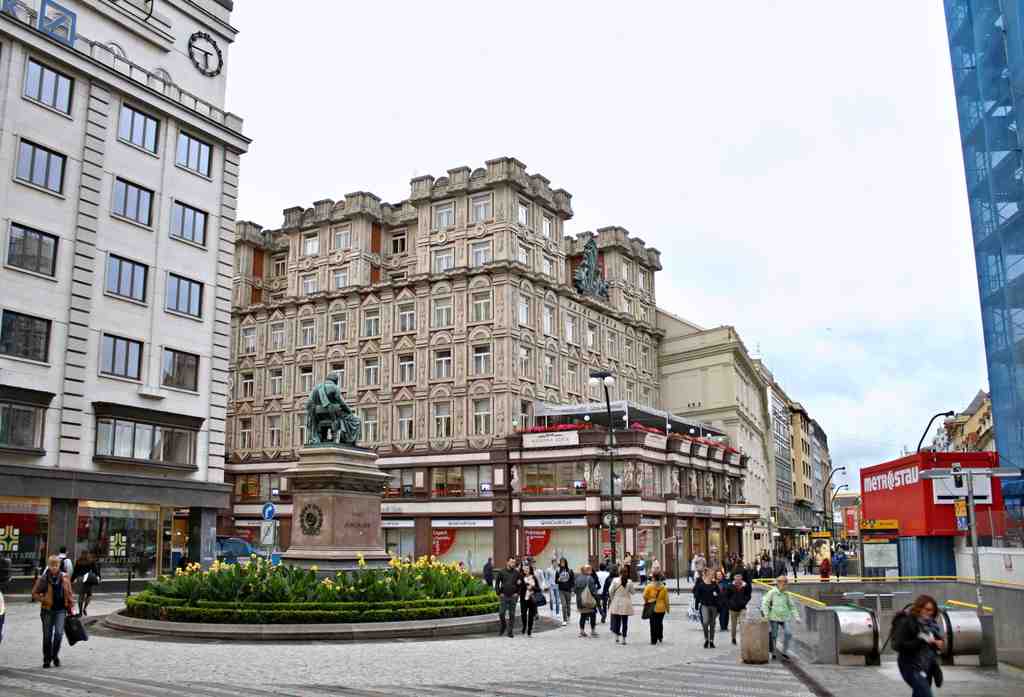
To spot Jungmann Square, just look ahead for a bustling plaza surrounded by tall, ornately decorated buildings and a large statue of a seated man right at the center, framed by a bed of flowers and crowds of locals and tourists.
Now, as you stand here with the chatter of the street and the distant rumble of the metro below, let your imagination whisk you back through centuries! This lively spot-Jungmannovo náměstí-wasn’t always full of banks, coffee shops, and people racing to the next appointment. Picture it in the Middle Ages, right outside the ancient walls of Prague’s Old Town. The land was known as “Na Písku,” or “On the Sand,” because it was basically, well, a big sandy patch.
But even sandy spots can have big dreams. In the 14th century, the mighty King Charles IV brought in a troop of Carmelite monks who set out to build a majestic monastery and a church dedicated to Our Lady of the Snows. Imagine a construction site teeming with cloaked monks, carts rattling over cobblestones, and the clang of stone on stone as they tried to rival the biggest churches in Europe. The church you see peeking behind you was only ever meant to be the presbytery-the best part was left unbuilt when the Hussite Wars erupted. Talk about giving up halfway through a home renovation!
Here’s where the story really heats up: In the 15th century, radical preacher Jan Želivský, with a fiery voice, stood right here, gathering crowds beneath those medieval walls. On July 30, 1419, he led his followers from this very spot, torches flickering and tension crackling in the air, to what became the First Prague Defenestration-let’s just say that people didn’t like politicians much, and some of them left the town hall very suddenly... through the window.
For centuries after, this square witnessed periods of neglect and revival. The monastery fell into ruin, but in 1606, the barefoot Franciscans moved in, and the area took on a gentler, more spiritual character. In the 1800s, you’d hear locals call it “Františkánský plácek” or the “Little Franciscan Place.” But its name changed in 1878 when they rolled in a grand statue-look right at it: that’s Josef Jungmann, poet and linguistic champion, gazing with intense thought. Jungmann lived just down the road and is famous for rescuing the Czech language from obscurity. Rumor has it he spent so long translating dictionaries that he turned down dinner invites for years. No wonder he’s sitting!
But that statue, believe it or not, once stood in the absolute center of what was then a chaotic crossroads of horse-drawn carts, honking trams, and, eventually, rattling buses. The square has always been the beating heart of the city’s transport. In the early days, people boarded the oldest tram route in Prague, heading from the river right through here to Karlín. Buses and even the city’s infamous “trolleybuses” jostled for space around the statue. In fact, from 1949 to 1966, this was the last stop for travelers arriving by Prague’s then state-of-the-art electric trolleybuses-imagine the crowd, the hustle, the sudden hiss as the trolley sticks lost their grip on the wires.
Then, in 1985, with the arrival of the metro, the square took a new turn. The statue was gently nudged aside, shops spilled out onto the cobbles, and soon, flowerbeds and winding walkways replaced screeching brakes. Today, as you stand in the modern hush of the pedestrian zone, you can easily miss that this place was once as rumbling and rowdy as a train station.
See those elegant facades surrounding you? Behind them lie old townhouses filled with shops, stories, and secrets. If you peek south, the insurance building marks where old bell-makers’ workshops once stood. Just a few steps away, the František Garden waits behind iron gates, still inviting tired souls in for a quiet moment-if you listen closely, you might even hear the echoes of monks chanting from centuries ago.
So the next time you walk through Jungmann Square, remember: every footstep here treads on layers of Prague’s history-sandy markets, royal dreams, revolutionary fires, tram bells, and the forever thoughtful gaze of Josef Jungmann. I hope you don’t mind that I didn’t try to defenestrate you along the way-though if you want to make a dramatic exit, the nearest metro is just behind you!


