
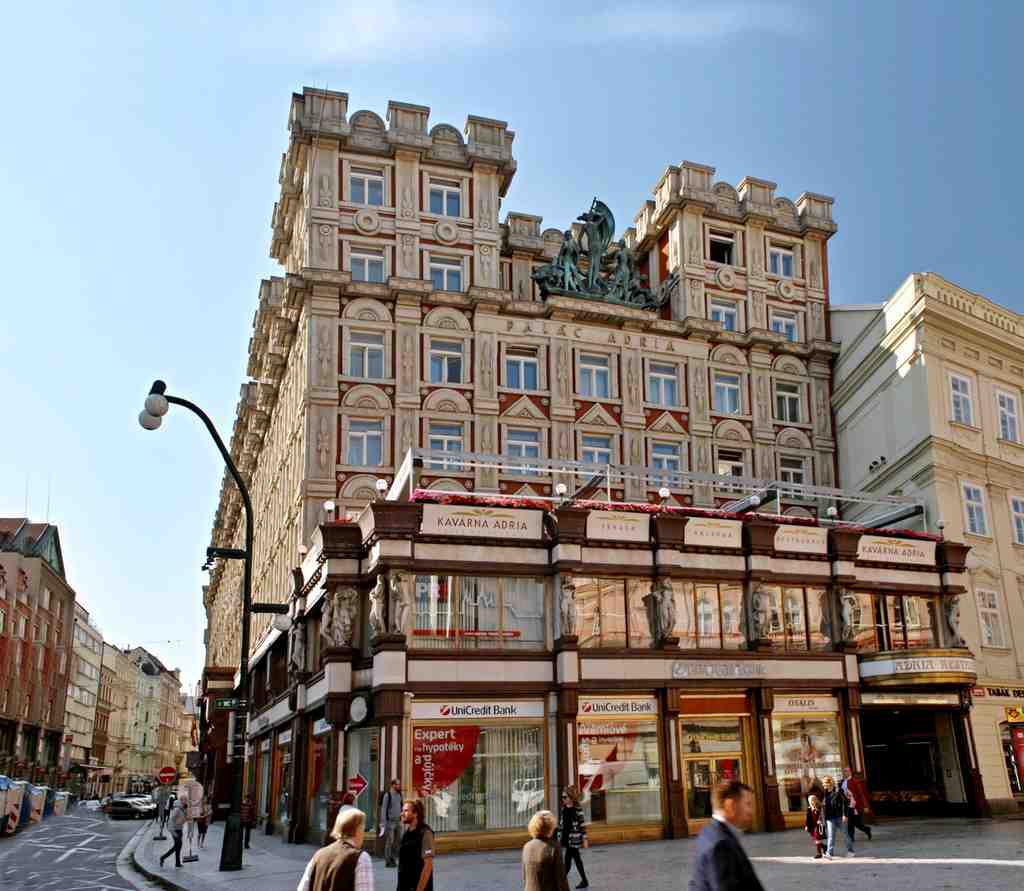
To spot the Adria Palace, look for a grand, ornate building with a strong geometric façade, decorated with playful round shapes and a gathering of sculpted figures high above its entrance, right at the busy corner where Jungmann Square meets Národní Street.
Welcome to the incredible Adria Palace! Take a second to gaze up and let your eyes follow the wild parade of rounded shapes and the epic cluster of dancing statues just above the busy street. Hard to miss, right? If the building seems like it wants to throw a party, that’s because it’s been the life of this corner since 1924 - all decked out in a flamboyant style called “rondocubism”, a Czech twist that mashes up cubism with grand, rounded forms. Imagine architects Josef Zasche and Pavel Janák at their desks, doodling with compasses and straightedges as the streets outside buzz with the energy of 1920s Prague.
Back in those roaring twenties, the Adria Palace was the hot new headquarters for an Italian insurance company, Riunione Adriatica di Sicurtà. Clearly, Italians don’t do boring, so they hired the city’s best sculptors - Otto Gutfreund, Jan Štursa, Bohumil Kafka (no, not that Kafka), and even Adolf Mayerl, who added ten marvelous dancing figures between the windows. You can almost imagine those statues coming to life, waltzing through the night when everyone’s gone home.
But Adria wasn’t just a fancy office: it had a secret world beneath its stylish surface. Hidden below was the grand Adria cinema, opening in 1925 with a splashy gala showing “The Hunchback of Notre Dame.” The city’s elite showed up in tuxedos and gowns, and the underground space could seat almost 1,000 guests. Soon enough, in 1927, magic happened here - Prague’s first-ever sound films crackled onto the screen, complete with strange, fuzzy animal noises. Turns out, early sound technology was so fuzzy, people actually preferred mooing cows and barking dogs over whispered love scenes..
The story of the palace has plenty of drama. As the winds of history shook Prague, Adria’s cinema changed names and hands - from Adria, to the German-controlled “Moskva” during WWII, and back to a Czech stage after the war. Later, it became home to avant-garde performances, experimental film clubs, even the legendary Laterna magika, where film mixed with live theater. In the surging crowds of November 1989, the palace’s elegant halls were suddenly filled with hurried voices: it was the headquarters of the Civic Forum, the epicenter of Prague’s Velvet Revolution.
Today, Adria Palace is still buzzing - a home to theaters, cafes, and everyday city life. Next time you pass by, take a peek at those sculptures; you just might catch one of them sneaking a sly wink at you. Now, ready to waltz onward to our next stop?


