
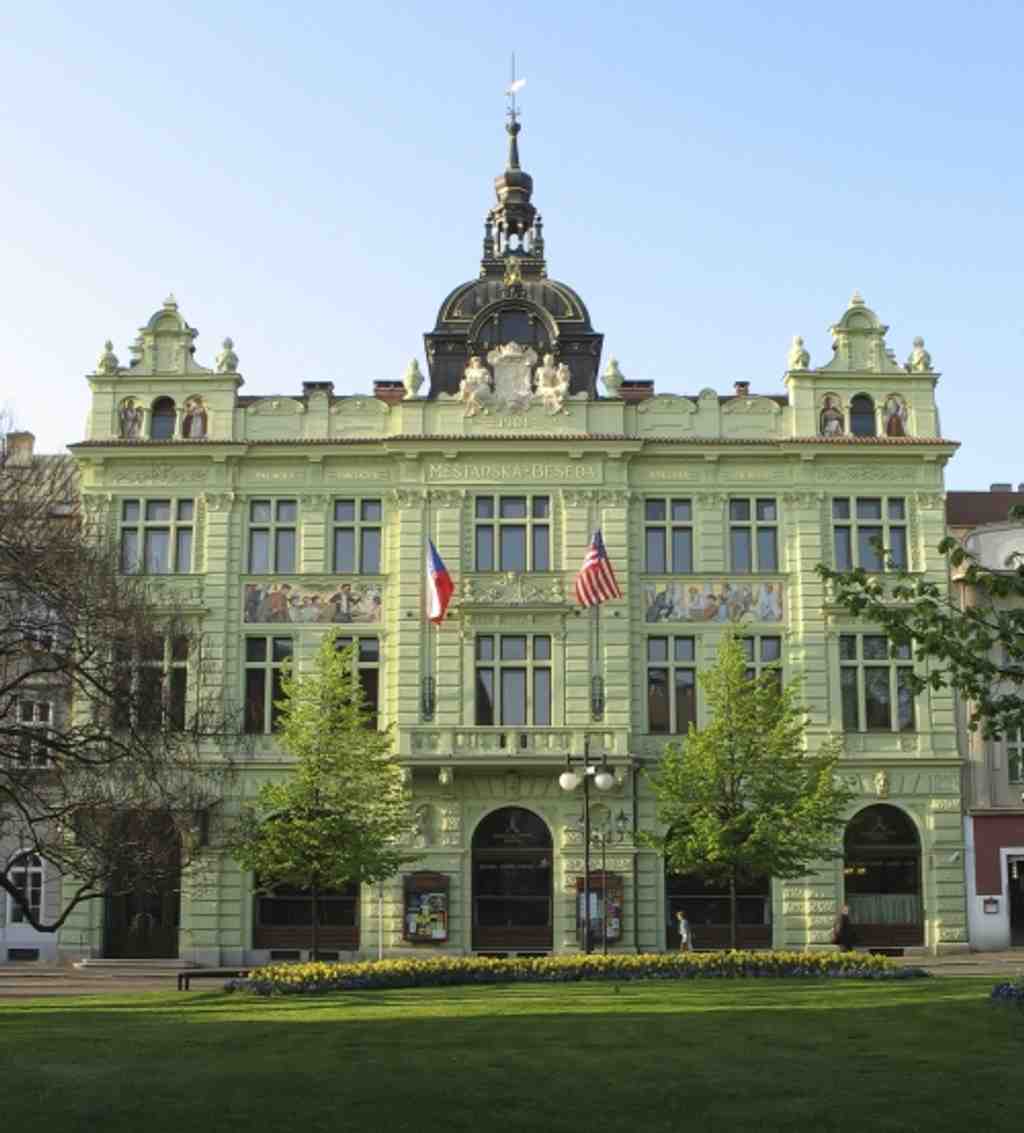
Just ahead, you’ll spot Měšťanská beseda by its pale green neorenaissance façade, crowned with a striking onion-shaped golden dome and lively painted panels above its windows-just look straight ahead between the trees, framed by buildings on either side.
Now, let’s take you inside the story of this magnificent place… Imagine arriving in Pilsen in 1901, when Měšťanská beseda first opened its elegant doors. You would have heard the lively sounds of music, laughter, and the gentle clink of glasses from the famous art nouveau café inside. The air would be heavy with excitement-a new center for the city’s social life had just been born!
Believe it or not, the name “Měšťanská beseda” didn’t originally belong to the building, but to a club of forward-thinking townsfolk, founded in 1862. By the late 1800s, they decided they needed a grander house for their cultural dreams, so they held a competition. Out of 24 designs, Alois Čenský’s vision won, securing this prime, if a little cramped, spot in Kopecký Park. The club demolished the old state building (which once held a financial office and a Czech school, if you fancied a lesson!) and, faster than a waiter can serve Czech coffee, local builder František Kotek completed the place in just over a year.
Standing before you, its front is a real showstopper-symmetrical, with two side wings and a glorious golden onion dome in the center. Feast your eyes on the allegorical paintings above the windows-they almost seem to dance as they tell stories of concert, lecture, unity, and nobility. Above, the Czech lion stands proudly-after decades of being removed and replaced, it finally returned to its rightful perch during the most recent restoration. If you look closer, you might spot names of great Czech heroes like Palacký, Havlíček, Smetana, and Neruda, spelled in gold above the third floor windows. The entrance, with its glass panels and a small awning, invites you toward tales of waltzes, protests, secret meetings and smoky debates.
The story of the building is a real rollercoaster. During World War I, the air here must have crackled with patriotism. In 1918, as Czechoslovak independence was declared, city leaders gathered in the halls for secret negotiations. Meanwhile, the puppet theatre next door performed a cheeky play called “How Kasparek Buried Austria,” openly mocking the fallen empire!
But fate wasn’t always so kind. During the Second World War, things took a darker turn. In January 1945, the building echoed with worried footsteps as young men born in 1927 were registered for forced labor in Polish mines. After 1948, new owners modernized it so thoroughly, they just about put the “ow” in “renovation”-art nouveau decorations vanished under latex paint and plastic panels. Yet in the 1990s and early 2000s, a major restoration returned the building to its original beauty-right down to its stucco faces, painted walls, and the noble lion once again roaring above the main entrance.
Inside, a maze of halls and salons awaits: there’s the atmospheric secession café, a favorite spot for writers, actors, and maybe a daydreaming president or two. The grande ballroom, with its glowing chandeliers, has seen everything from masked balls to weighty political speeches-the ghosts of composers and poets practically dance in the air. You might even imagine yourself stepping into a concert, the golden script above the stage reading “Pilsen for itself.”
Throughout history, famous visitors graced these spaces: President Masaryk strolled the halls in 1921, and the legendary inventor František Křižík once witnessed his own name honored here. In modern times, the city ensured everyone can enter-including those who need wheels, rather than just swing shoes.
So, as you gaze up at this jewel of Pilsen, imagine the years of applause, secretive whispers, and joyous laughter that have bounced off these walls-because in Měšťanská beseda, every echo tells a story.




