
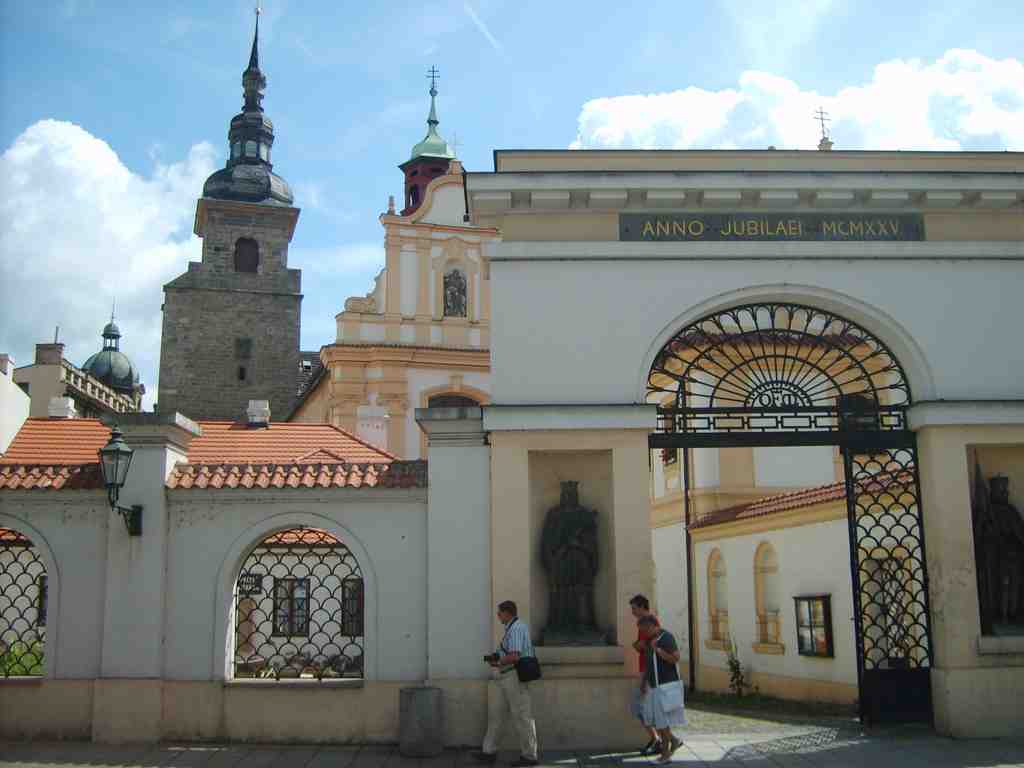
Look ahead for a creamy baroque façade topped with ornate statues and a dramatic arched gate; behind it rises a stone tower and a mix of red-tile rooftops-this is the Franciscan Monastery, just through the open, inviting entrance.
Welcome to the Franciscan Monastery! Take a good look at those ancient walls, because you’re now standing before one of the oldest stories in Plzeň-this monastery and the Church of the Assumption were founded way back around the year 1300, just as Plzeň itself was coming to life. Imagine the city then, a jumble of wooden homes in the shadow of these very stones, with monks shuffling about, their sandals echoing on vaulted stone corridors.
The story here is like a dramatic saga with more plot twists than a telenovela! Not long after being built-by around 1380-the friars found themselves thrown out in 1419, thanks to the fiery preaching of a certain Václav Koranda. But, as in all good stories, they made their grand return just a year later, probably muttering, “Did you miss us?” under their breath.
Just when they settled in, the monastery was battered during the Hussite siege in 1433-1434. Picture flames licking at those old stones, smoke curling into the sky, the sound of axes against doors, and the determined friars holding tight to their faith. Restoration took half a century, financed by generous gifts-a sort of medieval “crowdfunding.” But twists kept coming: in 1618, during Mansfeld’s siege, the place was battered again. Let’s just say if monasteries could talk, this one would have a raspy voice!
As you look at the façade, you might notice the mixture of Gothic bones and Baroque beauty. The grand tower at the end of the 16th century, and later, the elaborate Chapels of the Holy Trinity and St. Anthony, were the work of Italian baroque architect Jakub Auguston and his nephew-a family business of making churches fancier! By the early 18th century, the monastery’s western front was entirely Baroque and sporting all the drama and glamour that style could muster.
Step inside (well, in your imagination for now): the church boasts a triple nave, divided by big, unadorned pillars, ending in a five-sided choir that’s been here since the 1300s. Picture the main altar glittering in 1696 Baroque fashion, with a copy of a Rubens painting that looks like it’s just one cherub short of flying off the frame. And tucked away is the “Franciscan Madonna,” carved from wood around 1420, perhaps the only resident here who truly never left!
But the monastery isn’t just a church-it’s a little city of rooms! Cloisters form a peaceful, square courtyard-imagine monks bent over manuscripts in a small scriptorium or preaching from a lavishly carved pulpit built in 1543. If these walls could blush, they’d remember the restoration efforts after centuries of fires, wars, and reformations that cut the community smaller and smaller.
Then came April 1950, and a new chapter: during communist “Action K,” the monks were evicted, the place transformed into first a youth home, then a museum, its spiritual heart pausing for decades. But like a stubborn friar in a storm, the monastery survived. Post-1989, the building was given back to the Church and beautifully restored throughout the 1990s, its Gothic bones and Baroque face polished for a new era.
Today, part of the monastery is the Museum of Sacred Art, while the rest still hums with quiet religious life, home to the diocese and a handful of monks. So while the battles are gone, the spirit lingers. Take a breath, listen for the whispered prayers of centuries past, and know you’re standing in a spot where Plzeň’s history chose to make itself unforgettable!
Wondering about the church of the assumption of the virgin mary, monastery cloister or the chapter hall and chapel of st. barbara? Feel free to discuss it further in the chat section below.




