
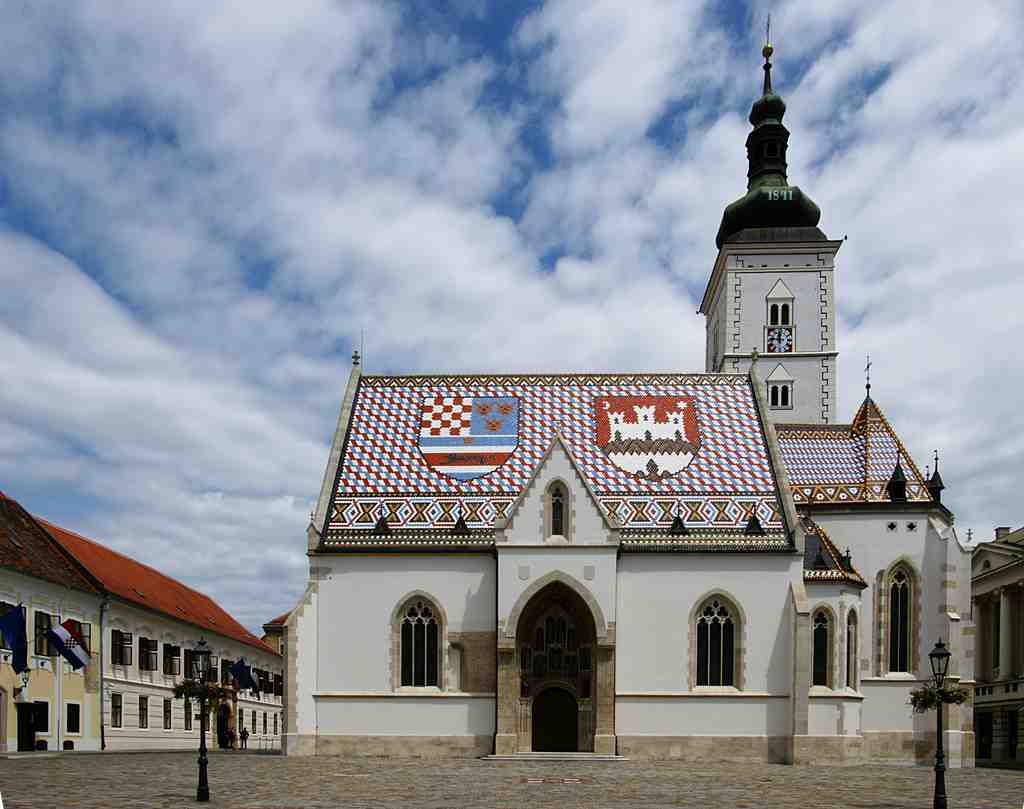
You’ll spot the Church of St. Mark straight ahead by its dazzling, patterned roof tiles in red, white, and blue, featuring two bold coats of arms, and a tall white bell tower with a green onion dome rising above the square.
Now, let’s take you on a journey-welcome to the very heart of old Zagreb, the legendary Church of St. Mark! Imagine standing here, centuries back, as villagers bustled about and market stalls crowded this square. This might look like a pretty painting come to life, but the real art is in its rollercoaster of history. That colorful rooftop? It’s not just for show. Those vivid tiles display two coats of arms-Croatia, Slavonia, and Dalmatia on one side, and the great city of Zagreb on the other. It’s a bit like the city’s personal superhero cape-if only more superheroes wore glazed ceramic!
The Church of St. Mark is a true time traveler. Parts of its Romanesque facade hint at a time so distant it would make your smartphone shudder: we’re talking about the 13th century! Built in the middle ages as Gradec’s parish church, St. Mark’s took shape with massive round columns inside, supporting its three aisles and its dramatic eastern clover-shaped ending. Medieval life here wasn’t just prayer and peaceful contemplation-if you’d shown up for Sunday service, you might have witnessed someone fastened to the "pillar of shame" out front as punishment, clangs of metal echoing through the square as the wrongdoer contemplated their life choices.
This spot has withstood the ravages of fire and earthquakes-trust me, every old building here thinks of itself as a disaster movie star. In 1502, the bell tower crashed after a strong earthquake. And just when the townsfolk thought they’d fixed it, another earthquake or fire would sweep through-Zagreb’s version of Groundhog Day. Through each twist and tumble, something new was added: after a fiery roof collapse, they blessed it with a baroque onion dome, while inside, local legends like sculptor Ivan Meštrović and painter Jozo Kljaković worked their magic-think “Game of Thrones” meets Croatian Renaissance.
The southern portal is the crown jewel of all Croatian Gothic portals, with fifteen statues perched in eleven niches, staring out with silent stone wisdom. But don’t let their stony faces fool you-they’ve seen centuries of drama, from peasant uprisings to royal processions. Just imagine the clang of swords and stomp of boots as Ambroz Matija Gubec, the leader of a peasant revolt, was crowned here with a red-hot iron crown for all to witness-a far cry from your everyday church bake sale.
When the 19th century rolled around, the church got a neogothic makeover thanks to Vienna’s Friedrich Schmidt and his pal Hermann Bollé, who basically gave it a “gothic meets Croatian” facelift with the radiant tile roof we see today. In fact, that rainbow of tiles was only added in 1878, and each glazed piece was crafted by the famous Zsolnay workshop in Hungary-so you could say the roof traveled before it was cool.
Inside, music has always been the soul of St. Mark’s. Since 1359, the organ has played, with every new instrument pushing technology-and volume-to new heights. The latest organ, built by Eisenbarth in Passau and assembled with utmost care, boasts 41 registers and took years of teamwork, meticulous adjustment, and not a little bit of organist pride (or squabbling!) to get just right.
And if you want to see how far the fame of St. Mark’s has spread, hop on a plane to Canberra, Australia, where a tiny replica-complete with those painstakingly tiled roofs-welcomes curious Aussies and Croatian expats. Talk about a Croatian building with frequent flyer miles!
In its wounded stones, St. Mark’s keeps stories of battles, earthquakes, renovations, bold heroes, ingenious artists, and more than a few noisy bird visitors on its famous rooftop. And after all this, the church stands ever proud as one of Zagreb’s most enduring and colorful symbols-a beacon of faith, artistry, and community, crowned with a roof that would make any Instagram filter weep with jealousy.
Intrigued by the description of the church, the foundation of the parish of st. st. mark's church and the construction of the church or the renovations and interventions? Make your way to the chat section and I'll be happy to provide further details.




