
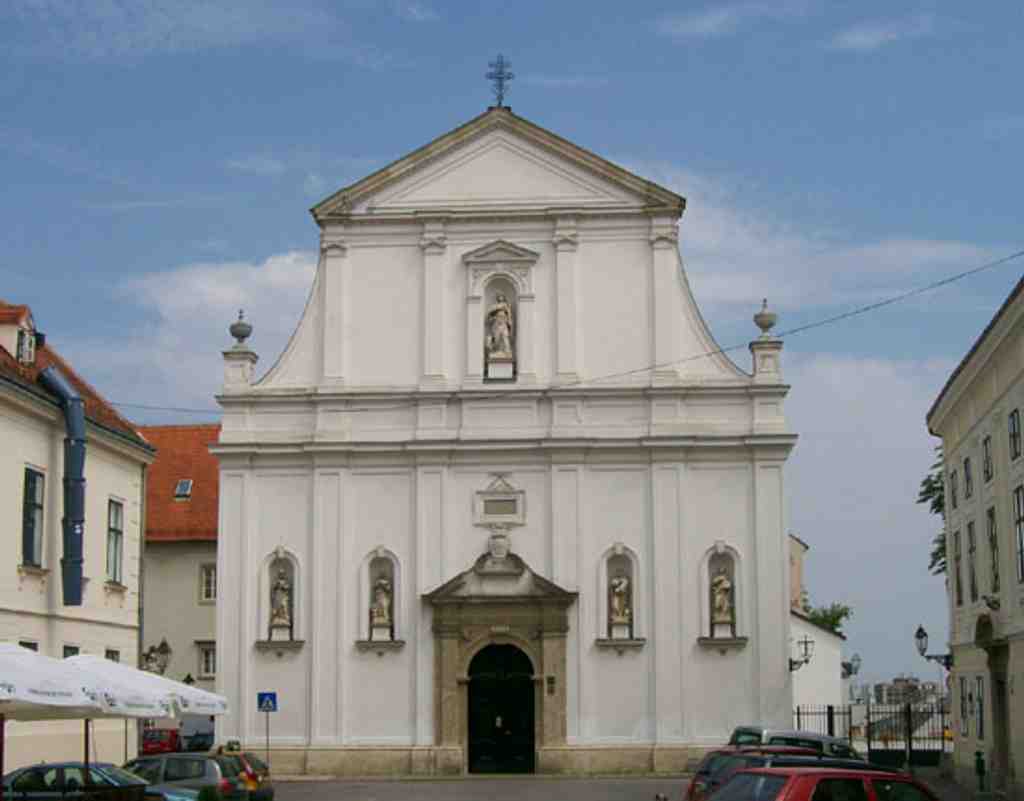
To spot the Church of St. Catherine, look for a bright white Baroque facade with elegant statues and a triangular roof, standing proudly at the open square-its historic shape will quickly catch your eye among the surrounding buildings.
Alright, take a deep breath and step into the square-can you smell that mix of rain on the cobblestone and fresh pastries from a nearby bakery? Now, gaze at the striking white wall before you. This is the Church of St. Catherine of Alexandria, Zagreb’s most famous Baroque church. If you listen carefully, you might almost hear the ghosts of old Jesuits singing hymns amid the hush of history.
This church wasn’t always so grand! Back in the 1300s, there was a much smaller Dominican chapel here, and believe it or not, it also doubled as a military storage during those times when Ottoman invaders were a real threat. Talk about being ready for anything-prayers in the front, and arrows in the back! Fast-forward to the 1600s, Jesuits arrived in Zagreb, looked at the humble old church, and basically said, “We need an upgrade.” Between 1620 and 1632, they built the much bigger and more elegant church you see now, complete with a monastery next door. Today, that monastery houses the Klovićevi Dvori Gallery.
But the Church of St. Catherine has never had it easy. Twice, it burned down-first in 1645, then again in 1674. That second fire was a real disaster; everything turned to ash, right down to the foundations. Local noble families helped rebuild, and in return, they could either display their lavish family crests inside or even secure a cozy spot for their final rest, with their names set in stone on the church floor. Not your typical “thank you” card, right?
After the Jesuits left in 1773, the church spent a decade in the care of St. Mark’s parish, and by the late 1800s, it was proudly serving as the city’s university church. Over the years, the interior became a true Baroque wonderland-there’s one stretched nave, six side chapels, and an altar area for celebrating the most majestic mass you can imagine. The chapels themselves are tiny treasure troves. You’ll find elaborate wooden and marble altars from the 1600s and 1700s, with colorful frescos and stucco decorations from 1732 coating the dome and walls like wedding cake icing.
If you were lucky enough to step inside before the church closed for repairs, you’d hear your footsteps echoing on centuries-old stone. Glance at the high main altar and you’d find a painting by the Ljubljana artist Jelovšek, showing St. Catherine brilliantly debating philosophers-she was good enough to win prizes for public speaking, never mind the theology!
Now, let’s go detail-hunting. The pulpit is from 1690-gifted by Bishop Mikulić, topped with a statue of Pope Leo the Great, and surrounded by famous religious teachers. Down below, carvings of the four Evangelists keep an eye on all the worshippers, making sure no one sneaks out early. In the chapels along the sides, you’d find Apollonia, the patroness of dentistry (ouch!), St. Barbara, St. Dionysius and his fellow martyrs, and Ignatius of Loyola himself, depicted on marble and glorious canvas. Each chapel was sponsored by a different patron, so there’s a rolling parade of saints, noblemen, and historic artists, all crammed into these sacred corners.
The church has had its share of disaster in recent memory, too. In March 2020, a powerful earthquake shook Zagreb, sending chunks of plaster, wooden benches, and ceiling frescos tumbling to the floor. As workers scrambled to shore up the building, a second earthquake struck near Petrinja, and the destruction got worse-the ceiling above the altar collapsed, smashing benches and the chandelier in a noisy tangle of ancient art and fresh heartbreak.
And yet, even after all this, the Church of St. Catherine is a main player in Zagreb’s classical music scene, hosting concerts that make the old walls sing with life again. Organ lovers, don’t miss this: the church’s organ, built by Ferdo Heferer in 1890, is a marvel of craftsmanship, with every mechanical click and swell designed to soar through the vast, decorated nave.
So as you stand here, let your imagination wander-picture priests sweeping the altar, artists climbing ladders to paint angels on the ceiling, nobles arguing over where to put their family crest, and citizens gathering for concerts, trembling at each earthquake but always rebuilding. The Church of St. Catherine is proof that faith and art both have a way of rising from the ashes-sometimes twice!
Eager to learn more about the damage to the church after the earthquake, the appearance of the church before the earthquake or the organ? Simply drop your inquiries in the chat section and I'll provide the details you need.




