
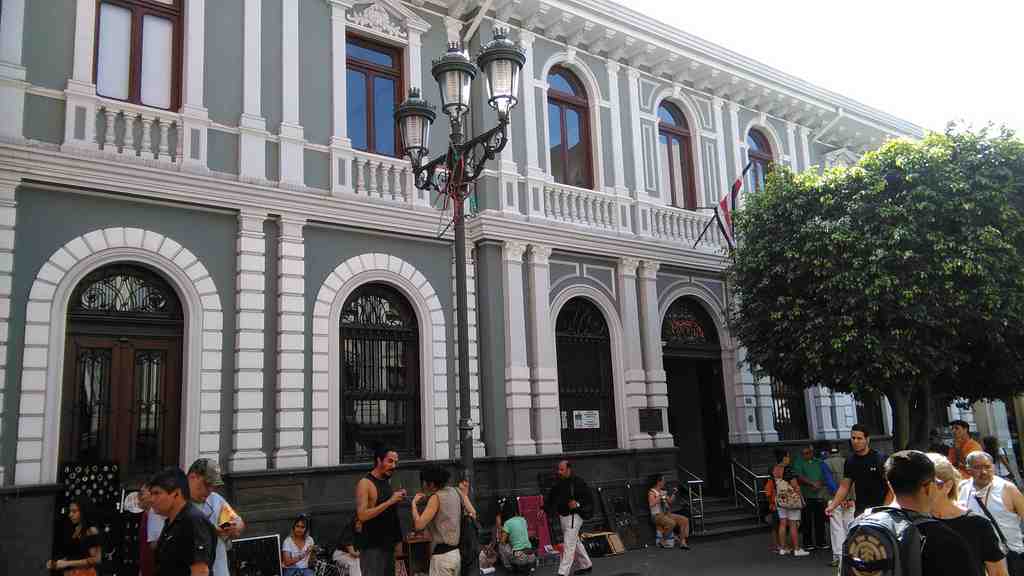
Look to your left at the stately two-story building painted in slate-grey and white, featuring a row of tall arched windows on the ground floor and a classic black streetlamp standing guard on the sidewalk.
This is the Costa Rican Academy of Language. It sounds incredibly formal, doesn't it? You might picture a dusty room full of elderly men in stiff suits debating where to put a comma. And for a long time, that is exactly what it was. But if you look closer, this building is actually the site of a fascinating tug-of-war between elite prestige and the gritty reality of the streets.
For eighty-six years, this Academy was actually homeless. It’s true. The guardians of the language were nomads, borrowing desks in libraries and embassies, or meeting in tiny, uncomfortable offices until the government finally granted them this heritage building to end their pilgrimage. But the lack of a roof wasn't their only issue; it was who they left out in the cold.
Consider the story of María Isabel Carvajal. You might know her by her pen name, Carmen Lyra. She wrote Cuentos de mi tía Panchita, the collection of folktales that is practically the bedrock of Costa Rican literature. Every child here knows her stories. Yet, she was never invited to join this club. Why? Because the Academy of that era couldn't look past the fact that she was a woman, born out of wedlock, and an outspoken communist. She died in exile, excluded by the very institution meant to honor the country's best writers.
But institutions evolve. Over time, the people inside these walls stopped trying to be gatekeepers for a European ideal and started fighting for the dignity of how Costa Ricans actually speak.
One of the great champions was a man named Carlos Gagini. He argued that the Academy shouldn't just imitate models from Spain but should embrace the "tico" way of speaking-the folklore and the language of the street. This shift led to some incredible diplomatic battles.
There was the "Gallego Incident." The Royal Spanish Academy in Madrid-the mothership of the Spanish language-had a definition in their dictionary for the word gallego, or Galician. It said that in Costa Rica, the word was a synonym for "stupid" or "slow-witted." Can you imagine? The Academy here was furious. They launched a full investigation, proved that nobody used the word that way anymore, and demanded Madrid delete the offensive definition. And they won.
Then there was the battle over the verb sapear. The dictionary defined it as criminal slang used by the underworld. A brilliant academic named Alberto Cañas, known as "Don Beto," stepped in. He argued that here, sapear isn't criminal; it’s what a little brother does when he tattles on his sister for stealing a cookie. It’s a family word, not a gangster word. By fighting these battles, they turned this space from a tower of judgment into a defender of the local voice.
Leaving these linguistic warriors behind, we are going to head toward the heart of the city's social life.
Walk straight ahead about one minute toward the large, pale building on the corner, the Gran Hotel Costa Rica.




