
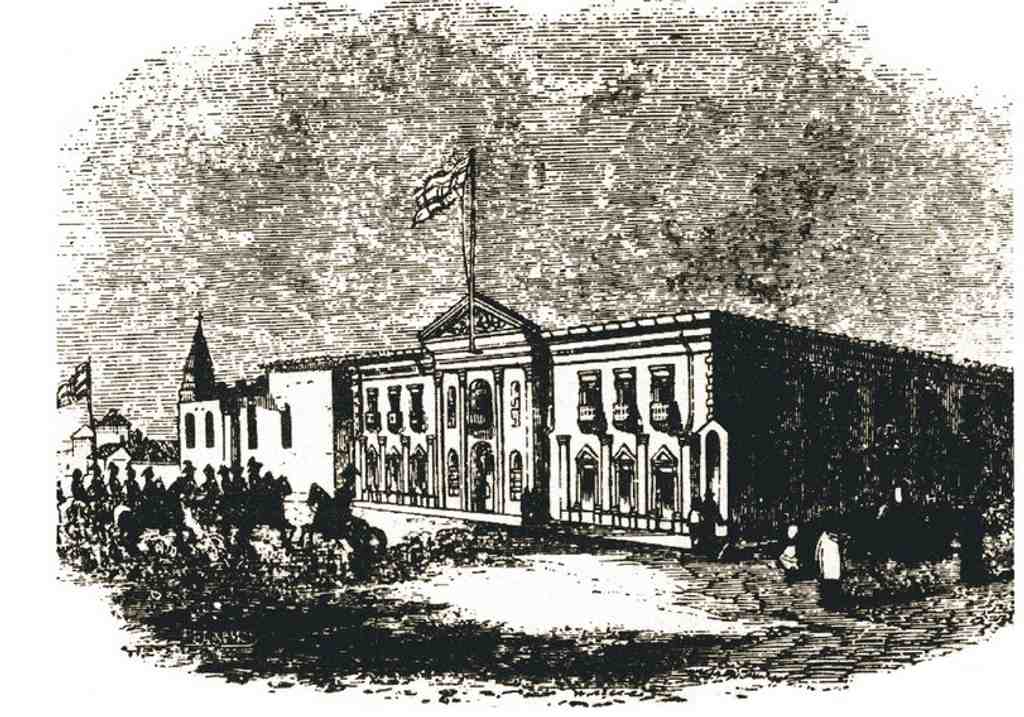
Take a look at the image on your screen to visualize what once dominated this corner. You are looking at a grand, rectangular two-story structure featuring a central triangular pediment and a long row of arched windows that give it a rhythmic, stately appearance.
Now, look up at the modern building standing in front of you. It is hard to believe, but for one hundred and two years, the magnificent National Palace from that sketch stood right here. This site is a ghost of Costa Rican history.
The story begins with President Juan Rafael Mora Porras, the visionary leader who transformed this nation from a collection of villages into a sovereign republic. In the early 1850s, riding the wave of a booming coffee economy, Mora Porras wanted a building that shouted "legitimacy." He hired the German engineer and architect Franz Kurtze to make it happen.
Kurtze didn’t just stack bricks. He used what was then cutting-edge technology: a combination of stone masonry and cast iron. We are talking about galvanized nails, corrugated sheets, and forged balconies imported all the way from England, with crystal glass brought in from Belgium. The style was Neoclassical. That is a fancy way of saying they copied the look of ancient Greece and Rome-columns, symmetry, and grandeur-to make their young, fragile government look as eternal and stable as the Roman Empire.
But this palace wasn’t just for show. It was the stage for the country's survival. In February 1856, President Mora gathered Congress right here to warn them about William Walker. Walker was a "filibuster," which in this context means an American mercenary who was trying to conquer Central America and turn it into a slave-holding empire. When Walker sent men to this palace to negotiate, Mora didn’t even let them in the door. He called them delinquents and kicked them out of the country. That defiance happened right where you are standing.
However, the walls of the Palace also witnessed the ultimate betrayal. Despite saving the country, Mora Porras made enemies among the powerful coffee elite. In 1859, a coup d’état was launched against him. He was arrested at his home and dragged as a prisoner to this very Palace-the same building he had inaugurated just four years earlier.
The tragedy gets darker. Mora was exiled, tried to return, and was eventually executed by firing squad in 1860. The history books tell us that the soldiers ordered to shoot him had tears running down their faces because they loved him so much. His enemies even left his body on the beach, hoping sharks would dispose of it, until a French consul stepped in to give him a proper burial.
The Palace survived that political storm and even a massive earthquake in 1924 that forced Congress to move out temporarily. But it could not survive the march of what some called "progress." In 1958, President José Figueres Ferrer ordered the demolition of the National Palace to make room for the Central Bank of Costa Rica, which sits here now.
There was no crumbling ruin or safety hazard cited; it was simply wiped away. Historians call this the "lost memory" of the capital. It was an act that many at the time considered barbarism, erasing the tangible symbol of the state’s consolidation.
We can no longer walk through its halls, but standing here, we can honor the ambition and the turbulence that forged this nation. Now, let’s leave this site of lost heritage and head to an institution dedicated to preserving culture in a different way.
Our next destination, the Costa Rican Academy of Language, is just a four-minute walk away.




