
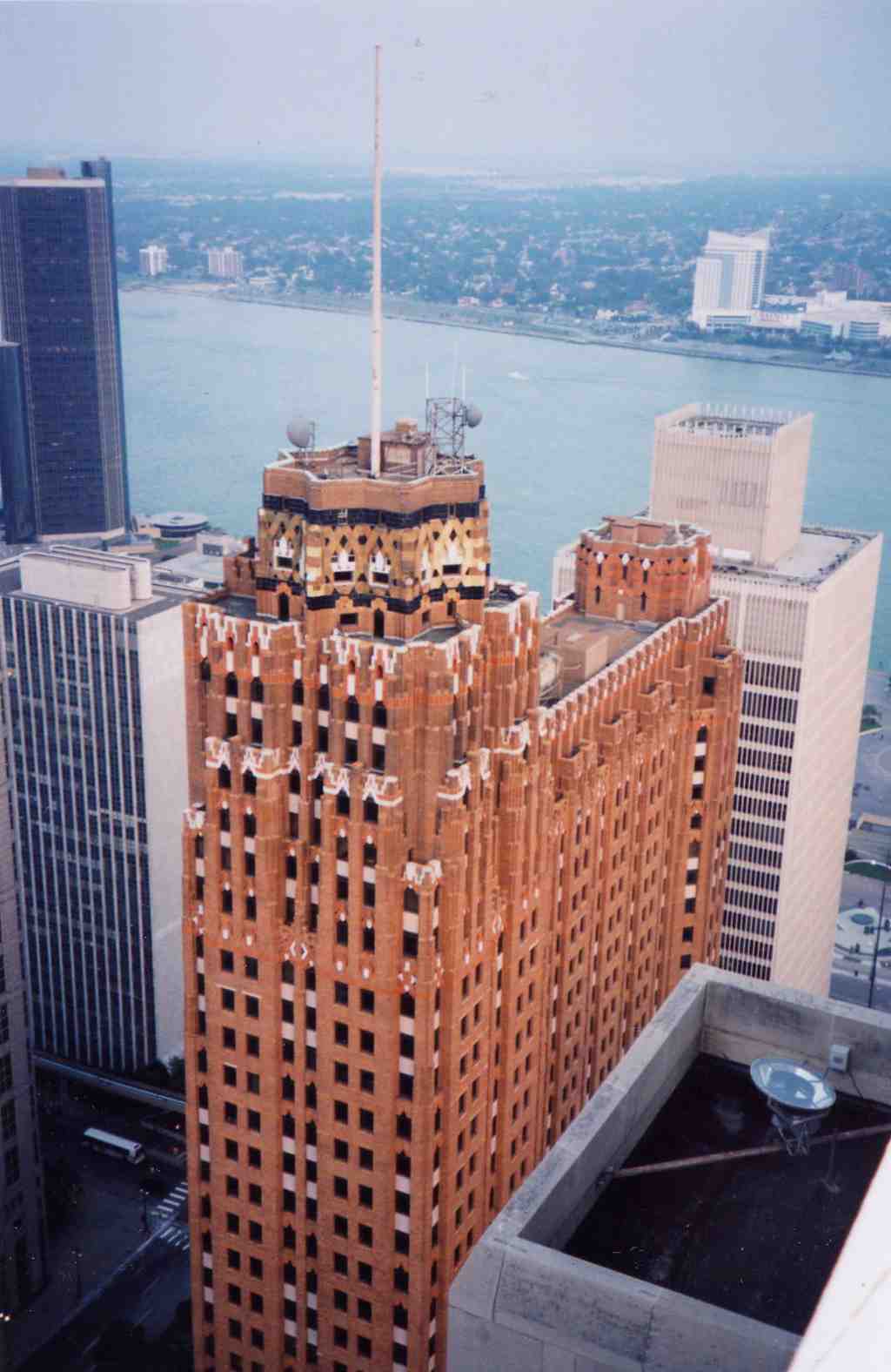
If you look ahead, you’ll spot a towering, orange-brick skyscraper with dazzling geometric patterns near its crown-just look for the dramatic spire and colorful brickwork standing tall against the skyline.
You’re staring at Detroit’s own Cathedral of Finance-no, not a church for money worshippers, but the legendary Guardian Building! This 43-story Art Deco masterpiece rose up in just over a year, from 1928 to 1929, when Detroit was bursting with big dreams and the sound of jazz spilled out onto the streets. When it opened, it was the Union Trust Building, and its architect Wirt C. Rowland had a vision: why should banks look dull and boring when you could have a skyscraper that shouts style from every brick? Step closer and feel that 1920s energy -this building was made to impress.
Check out its main frame, marching up 32 glorious stories before two dramatic, uneven spires shoot even higher-one of them all the way to 632 feet! They say it looks like a cathedral, and standing here, you can imagine the sense of awe people must’ve felt when they first gazed up. The base, made from sturdy granite and stone, stands like a fortress, and if you peek at the Griswold Street entrance, two fierce sculptures by Corrado Parducci are ready to guard the doors.
The outside is a riot of color; those orange bricks aren’t just any bricks! They became so famous as “Union Trust Brick” that the manufacturer renamed them “Guardian Brick” once the building itself changed names. Wirt Rowland didn’t stop at bricks-oh no, he supervised every single detail outside, handpicking limestone, terra cotta, and tile to make sure the entire surface sparkles like a jewel box. It’s as if the building is saying, “Ordinary metal? No thanks!” The Guardian was one of the very first skyscrapers to use Monel metal (that’s a high-tech metal, for you trivia buffs) on all the exposed trim, swapping out boring old brass and bronze to create a future-forward shimmer as dazzling as Gatsby’s smile.
But the magic doesn’t end on the outside. If you could step inside the doors, you’d be hit by the glow of Pewabic and Rookwood tile glimmering from a soaring, three-story vaulted lobby. That’s right-a lobby that feels like you’re entering a sacred hall instead of just a banking office. There’s a Monel metal screen-a kind of see-through wall-with a Tiffany-designed clock gleaming in the center, like a fancy timekeeper at a royal ball. And wait until you spot the murals: mosaic pine trees, scenes of Michigan’s mighty industries, all painted by Ezra Winter. Above the front desk, a grand message declares this building a home for “faith and understanding” in the world of money. Talk about high ideals-imagine waiting in line at the bank surrounded by this much drama!
In the banking hall, Rowland tried to hush the chaos of busy bank tellers by stretching a giant hand-painted canvas ceiling overhead, mounted on horsehair mats for soundproofing. The result? A hush you could practically feel as stacks of cash changed hands.
The Guardian has always been about innovation-when it opened, the elevators could stop perfectly at each floor and open the doors automatically. You no longer needed an elevator operator: futuristic stuff for the roaring twenties! And let’s talk about Native American motifs: if you start noticing zigzags, chevrons, and earthy colors, that’s no accident. Rowland and artist Mary Chase Perry Stratton wove those patterns into both the floors and the ceiling, touching on the region’s deep history.
Of course, the Guardian Building hasn’t always been about banking. During World War II, it buzzed around the clock as the U.S. Army Command Center for Detroit’s vital wartime production. Can you picture the urgent clatter of typewriters, the tense phone calls, and the smell of strong coffee wafting through these ornate halls?
Decades rolled on and so did America’s love affair with skyscrapers. By the 1980s, this beauty had become home to Michigan Consolidated Gas Company, and in 1986, a grand restoration returned her lobby to its original jaw-dropping glory. These days, she’s a bustling hub for Wayne County’s offices and a home for everyone from city planners to coffee shop regulars. Even MichCon’s president, Stephen E. Ewing, helped polish every tile until the place glowed once more. Today’s tenants range from lawyers to transportation companies-even a café offering James Oliver Coffee for a fresh pick-me-up after all this history.
So as you stand here, you’re not just looking at another tall building. You’re gazing up at a living time machine-one that’s seen Detroit’s fortunes rise, fall, and rise again, all while holding tight to its place in the skyline. And if you listen closely as the wind whistles around the spires, you might just hear echoes of the city’s dreams, old and new.
For a more comprehensive understanding of the architecture, innovations or the tenants, engage with me in the chat section below.


