
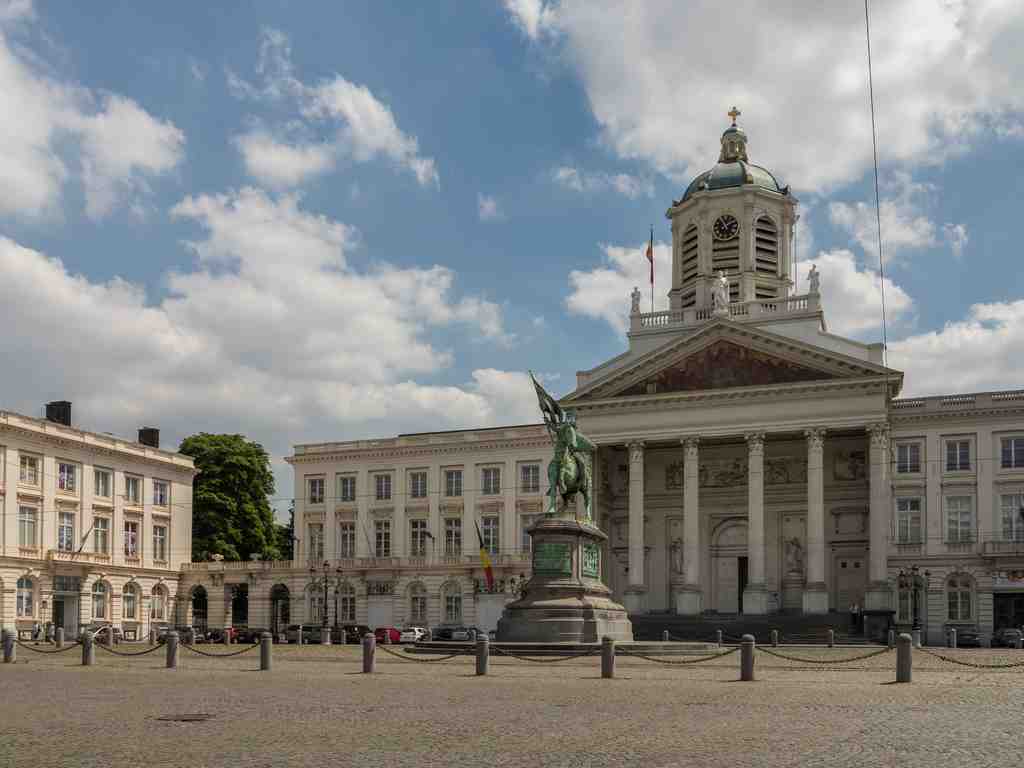
Right in front of you, Place Royale stretches out as a grand rectangular square paved in stone, dominated by a striking statue of a knight on horseback in its very center, with a gleaming white neoclassical church topped by a dome as its impressive backdrop-just look ahead and you can’t miss the symmetry and elegant façades all around.
Welcome to Place Royale-or should I say, Brussels’ favorite royal hangout spot for over two centuries! Imagine yourself standing on what was once the real hub of power, drama, and, sometimes, a bit of royal misfortune. Back in the Middle Ages, this very spot housed the mighty Palace of Coudenberg, home to counts, dukes, kings, and even emperors who pretty much called the shots around here for centuries. But fate wasn’t too kind to the old palace: on a freezing night in February 1731, it burned so fiercely that only the ashes and a stubborn nickname remained-the Cour brûlée or “Burnt Court.” For over forty years, this place was just a scorched reminder of lost glory, waiting for a new chapter to begin.
Luckily, in the late 18th century, the city decided to replace the ruins with something far more fashionable-and a little less flammable. With a little inspiration (and maybe a touch of envy) of French royal squares, the vision was born for an elegant new square fit for parades, power, and pomp. Austrian Governor Charles Alexander of Lorraine, not wanting to fall behind those fancy French cities, kick-started this project, and soon, led by architects Barré and Guimard, Place Royale began to take shape between 1775 and 1782. Suddenly, all the orderly lines and symmetry you see today rose from the smoke-filled past, and voilà, the square became one of Brussels’ most prestigious addresses.
It didn’t take long for this new square to attract some drama of its own. At first, Charles Alexander himself got the honor of standing in the center-in statue form, that is-dressed like a Roman general. But Brussels likes a little revolution with its history! French revolutionaries toppled his statue in spectacular fashion, and when the Austrians tried to stand him back up, he got knocked down again. Eventually, the French melted him down for coins and replaced him with a so-called “Liberty tree.” Spoiler alert: the tree didn’t last, either.
But the square wasn’t empty for long. In 1848, that impressive rider who greets you today-Godfrey of Bouillon, the fearless crusader knight-claimed his spot at the heart of Place Royale. His statue was the first of its kind in Brussels and still stands tall, bravely waving a standard like he’s leading a charge into history. And don’t miss those bronze bas-reliefs at the base! One side shows Godfrey’s legendary siege of Jerusalem, the other a set of laws for the new kingdom-talk about multitasking.
Surrounding you, the architecture channels pure 18th-century confidence with eight stately pavilions. Each corner once housed the who’s who of Brussels-lottery offices, breweries, countesses, even an abbey. Today, you’ll find the BELvue Museum, the Royal Museums of Fine Arts, and the enchanting Musical Instruments Museum all just steps away. Some buildings even have cellars built atop secret medieval streets-now an archaeological site! If you had X-ray glasses, you could spot the ghostly outlines of ancient halls beneath your feet.
And don’t forget the star of the show-the Church of St. James on Coudenberg right ahead. With its mighty white columns and domed bell tower added later, it has seen its share of pageantry, including Leopold I, who took the very first oath as King of the Belgians right here. Need another claim to fame? During the French revolution, the church briefly became a “Temple of Reason”! Only in Brussels do churches get career changes.
Today, Place Royale isn’t just a crossroads for cars and trams; it’s a living patchwork of centuries, where royal parades once trotted, cannons defended barricades, and the city still meets to celebrate-or protest, depending on the day. Restoration work is underway, too, hoping to tip the balance from cars back to pedestrians, keeping those classic paving stones (and the unsuspectingly tricky traffic circle) just as Brussels intended.
So, as you gaze around, you’re standing right where leaders plotted, revolutions sparked, and more than a few statues lost their balance-let’s just say, you might want to keep an eye on that crusader in the middle!




