
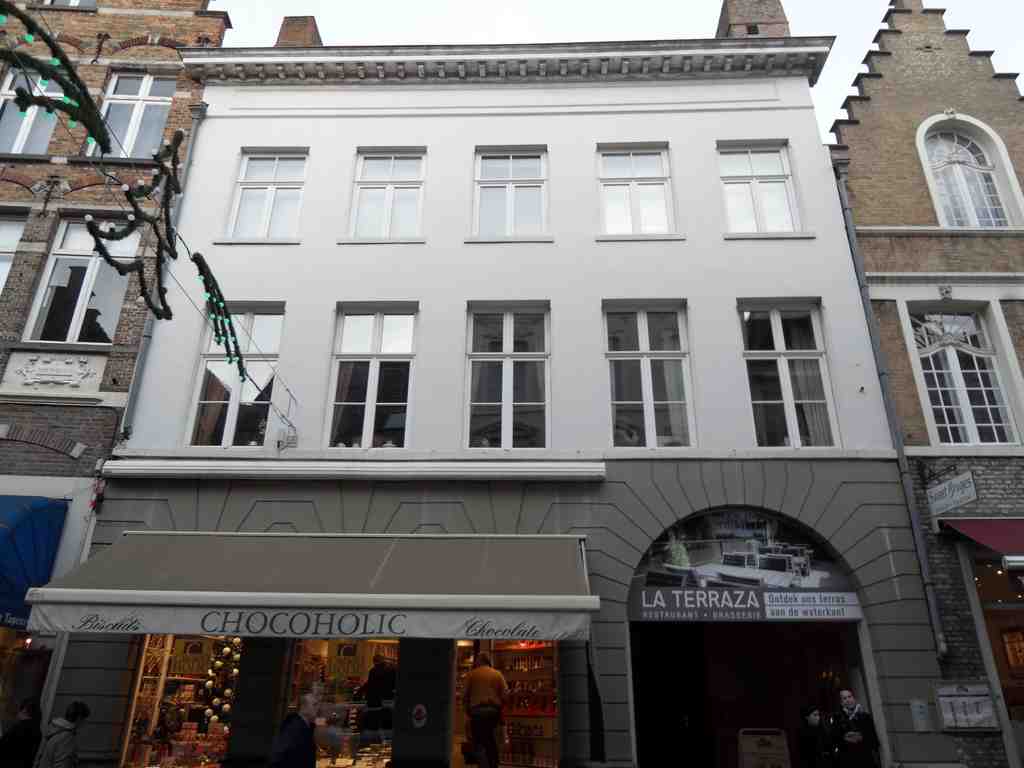
Look to your left for a smooth, white-plastered three-story building defined by a wide grey archway on its ground floor and a decorative horizontal ridge along its flat roofline.
It is so easy to let our imaginations run wild when we see a dark medieval doorway. Today, the basement of this building houses a museum of medieval torture, complete with wax figures and iron racks. It is a brilliant bit of marketing, twisting the very real, very mundane truth of an old medieval storage cellar into a sensationalized dungeon just to thrill passing visitors.
The true story of the Old Stone, or Oude Steen, is actually far more fascinating than the plastic skeletons downstairs. This is the oldest preserved house in all of Flanders. When archaeologists tested the ancient oak beams in the cellar using tree-ring dating, they found the wood was cut over eight hundred years ago, right around the year twelve hundred.
Back then, stone buildings were incredibly rare. Because it was constructed of solid, local grey-green fieldstone instead of wood, the locals simply called it the Great Stone. It is true that in the early days, official stone buildings sometimes held temporary lock-ups. But the official county prison moved away to a completely different location by the thirteenth century.
The dark, damp, vaulted cellar was almost certainly just a secure storage space for wealthy merchants and a foundation for the home above. But a gripping myth of dark deeds and hidden dungeons is highly profitable... isn't it? The museum's claim that this was the oldest continuous prison in Bruges is a perfect example of how the past is often bent and exaggerated to serve the desires of the present. People want a dark, thrilling story, and someone is always willing to invent one to sell tickets.
The real drama here was political. By the late fourteen hundreds, the building belonged to a city mayor. During a violent local rebellion, the mayor backed a foreign duke instead of his own citizens. When the duke was captured by the people of Bruges, the mayor had to flee into the night for his life. His escape saved his neck... but it cost him his property. The city confiscated this house, officially branding it the forfeited goods of a traitor.
It was eventually sold off to private citizens. For centuries, it was a perfectly ordinary, if grand, home. It housed doctors, textile merchants, and even a seventeenth-century schoolmaster who lived here with his twelve children, running a private school for the local elite.
By the nineteenth century, a family of furniture makers named Van Waefelghem bought the property. They held onto this house for nearly two hundred years. One of their sons, Louis, was born right here and grew up to be a world-famous musician in Paris. He played the viola d'amore, a beautiful, multi-stringed antique instrument that produces a haunting, echoing sound.
Today, the descendants of that very same family still own the building and run the waffle shop on the ground floor. They decided to lease out the ancient basement to the torture museum, proving that the legacy of this historic site is still being shaped by enterprise.
We are leaving these fabricated legends behind us now. Just a two-minute walk ahead is a very real symbol of civic pride and violent rebellion, the towering Belfry of Bruges. Let us go take a look.




