
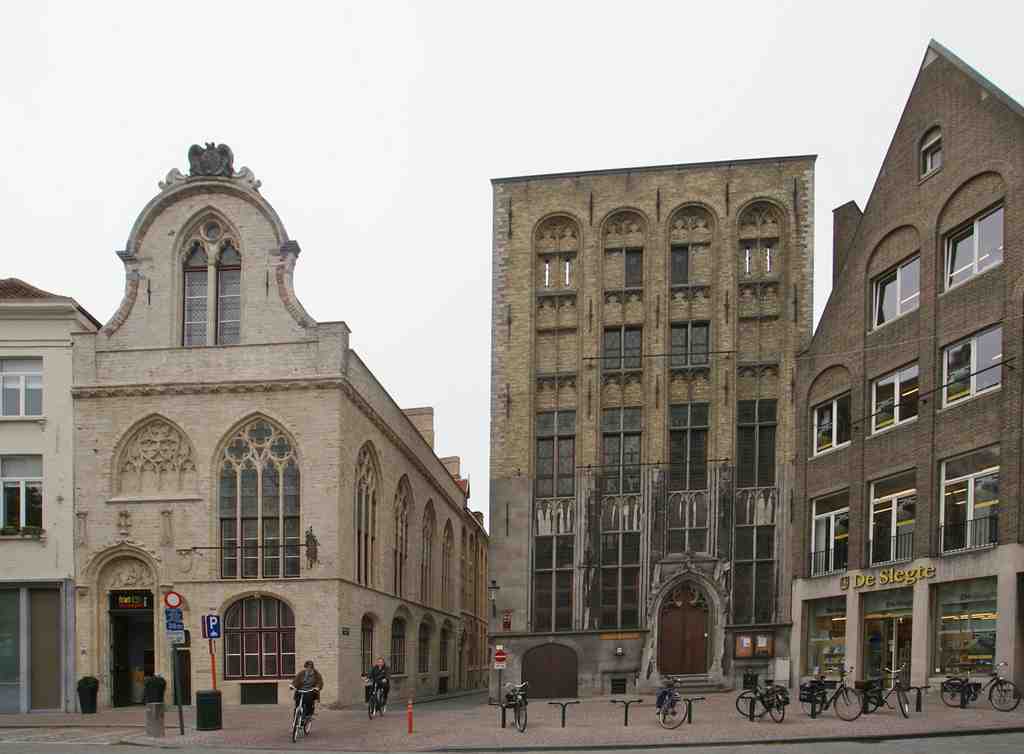
Look to your left and you will see a towering, flat-fronted building constructed of pale greyish-brown brick, defined by a striking grid of tall arched windows and a large, pointed wooden doorway at its base.
Leaving the grand residence of Court Bladelin behind, we now stand at the very epicenter of medieval economic ambition. This quiet intersection, known as the Old Beursplein, was once the ultimate manifestation of Bruges' financial power. Back in the thirteenth century, an incredibly ambitious entrepreneur named Robbrecht van der Buerse ran a popular inn right on this spot. Robbrecht quickly realized his inn could be much more than just a place for travelers to sleep. He began offering his deep cellars as secure storage for foreign goods, and soon started mediating complex deals between northern German traders and the newly arrived Italian merchants.
Before long, this very square became the daily headquarters for the Genoese and Venetians, who rented the grand buildings right next door to conduct their daily business. The atmosphere here was intensely loud and chaotic, filled with a chorus of different languages and the frantic waving of hands. Trading opened and closed each day with the ringing of a city bell.
They were not trading heavy crates of wool or spices out here, but rather slips of paper. This daily exchange of vital market information, along with the buying and selling of international debt, effectively created the world's very first stock market. Local money, like the silver coins known as pond groten, was traded against foreign currencies in a relentless pursuit of profit. Because the Van der Buerse family crest featured three leather money pouches, visiting merchants started calling this financial ritual going to the Bourse. That name spread across the continent and is still the word used for stock exchanges in many countries today.
But all this staggering wealth brought dangerous political games. Robbrecht backed the French crown during a violent local workers uprising. When his side lost the famous Battle of the Golden Spurs in thirteen oh two, the city brutally confiscated all of Robbrecht's properties as punishment. He fled into exile, waiting three agonizing years before a peace treaty finally allowed him to return and reclaim his business.
A century and a half later, this square became the stage for an even darker display of absolute control. The Duke of Burgundy, a ruthless ruler named Charles the Bold, crushed a rebellion in the distant city of Liege. As the ultimate humiliation, he stole their sacred stone monument of civic freedom and planted it right in the middle of this bustling financial square. It was a clear, chilling warning to the wealthy men trading here. Any rebellion would be met with total destruction.
There is still a quiet human touch left behind on these walls. If you examine the side of the main building, right between the ground-floor windows, you can still spot the carved symbols of the medieval stonemasons. They left these marks so the foreman knew exactly who to pay for their hard labor.
Centuries later, the intense shouting of international merchants was replaced by something entirely different. In two thousand and six, a local radio station moved into this historic building, broadcasting music twenty four hours a day from the very same rooms where the fate of European wealth was once furiously debated.
Let us continue toward Jan van Eyck Square, just a two minute walk away, to discover exactly where all this tremendous wealth flowed into the city via the water.




