
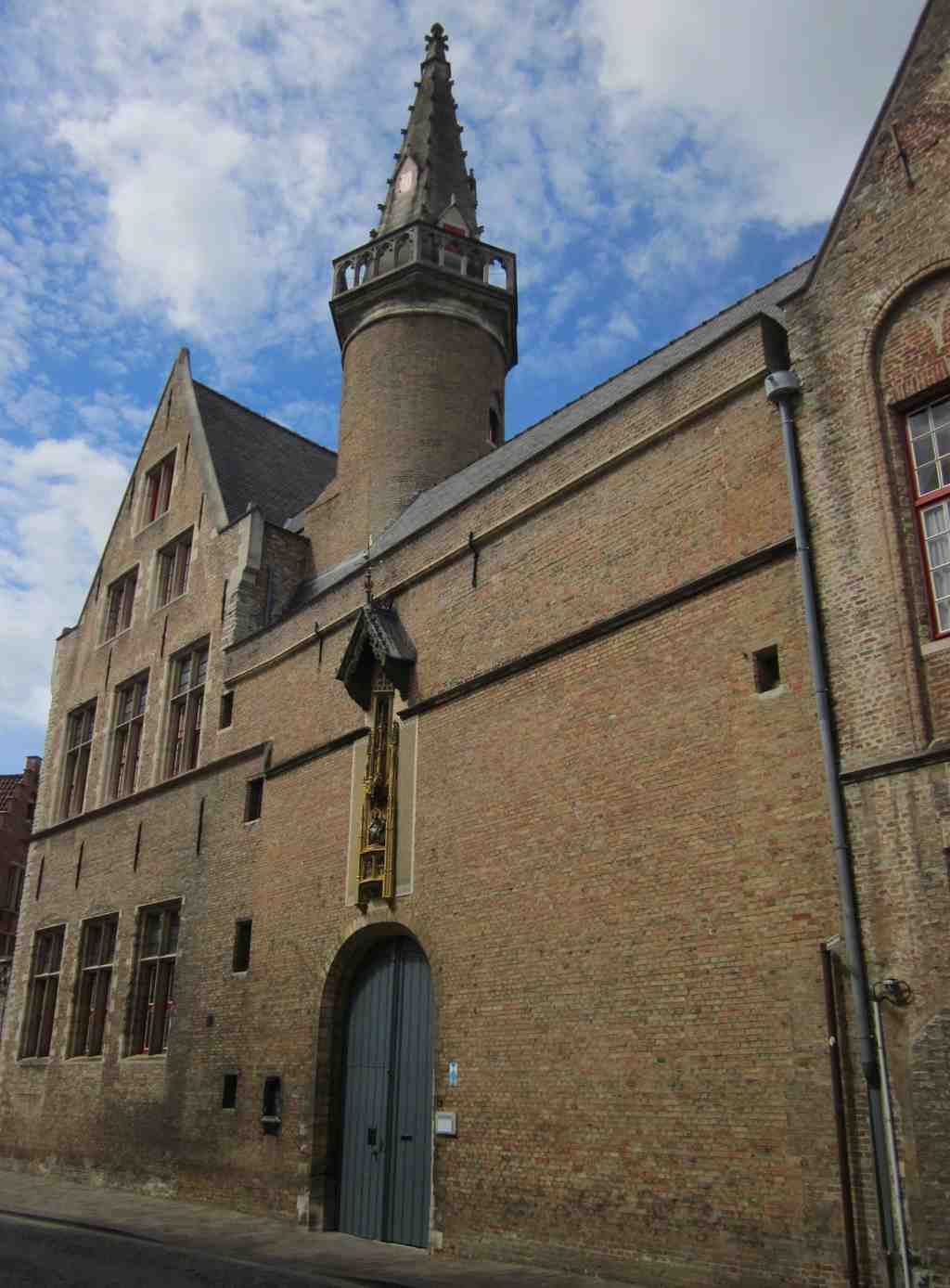
Look for Court Bladelin on your right, an imposing palace made of pale brown brick, marked by a towering, pointed stone spire and a grand arched wooden doorway with an intricate golden shrine set right above it.
This grand home was built in 1435 by Pieter Bladelin. The story of this building is perfectly tied to the city's deep obsession with economic ambition and legacy. Pieter was the ultimate self-made man, rising from modest roots to become the treasurer of the Order of the Golden Fleece, an exclusive chivalric club for the highest nobility. Despite his immense, almost unimaginable wealth, which in today's money would easily make him a multi-billionaire, he had a heartbreaking problem. He and his wife Margaretha were childless. With no biological heirs, Pieter decided his legacy had to be carved in stone. He poured his vast fortune into an absolute frenzy of construction, even building a completely new, bustling town called Middelburg from scratch. He frankly admitted in his final will that he had often acted entirely without scruples to amass his vast fortune. I suppose this towering home was his attempt to buy a little earthly immortality, and perhaps some heavenly forgiveness.
But the gossip surrounding this palace gets even juicier after Pieter's time. In 1472, it fell into the hands of the famous Italian merchants, the Medici family. These legendary Florentine bankers brought high finance and high art to Bruges, setting up a branch right here under the management of Tommaso Portinari. Portinari's time in this house reads like a dramatic financial thriller, full of incredible highs and devastating lows. He was a phenomenal patron of the arts, commissioning masterpieces like the world-famous Portinari Triptych, a massive three-paneled altarpiece. To celebrate his incredibly wealthy bosses, he even had two beautiful portrait medallions of Lorenzo de Medici and his wife embedded right into the facade of this building, originally painted in striking dark brown and azure blue.
But as a banker... well, he was a complete disaster. While he lived in breathtaking opulence here, he made incredibly reckless loans to the Duke of Burgundy to fund the Duke's endless wars. The Duke simply never paid him back, leaving the bank in absolute turmoil. Lorenzo de Medici, back in Florence, realized the Bruges branch was bleeding money and cleverly sold it to Portinari himself in 1480 just to unload the toxic assets. The gamble failed miserably, and the entire banking operation collapsed. The branch went completely bankrupt, dragging Portinari down with it. He died penniless, a world away from the dazzling luxury he once enjoyed in this very courtyard.
The palace's later history carries a deeply bitter irony. Decades later, a nobleman named Lamoral of Egmont grew up playing in these very halls. In 1568, he was brutally beheaded by the occupying Spanish regime for his political resistance. Just three years later, those same Spanish rulers seized this beautiful childhood home and turned it into a Mount of Piety... which is just a fancy historical term for a pawnshop. They created it specifically so Spanish soldiers could trade their looted goods for quick cash. It is a chilling reminder of how the ruthless chase for power leaves lasting scars on the beautiful stones of this city.
Now, let us continue our walk. We are heading toward the very spot where modern capitalism was truly born. The Old Beursplein is just a short, two minute walk away from here.




