
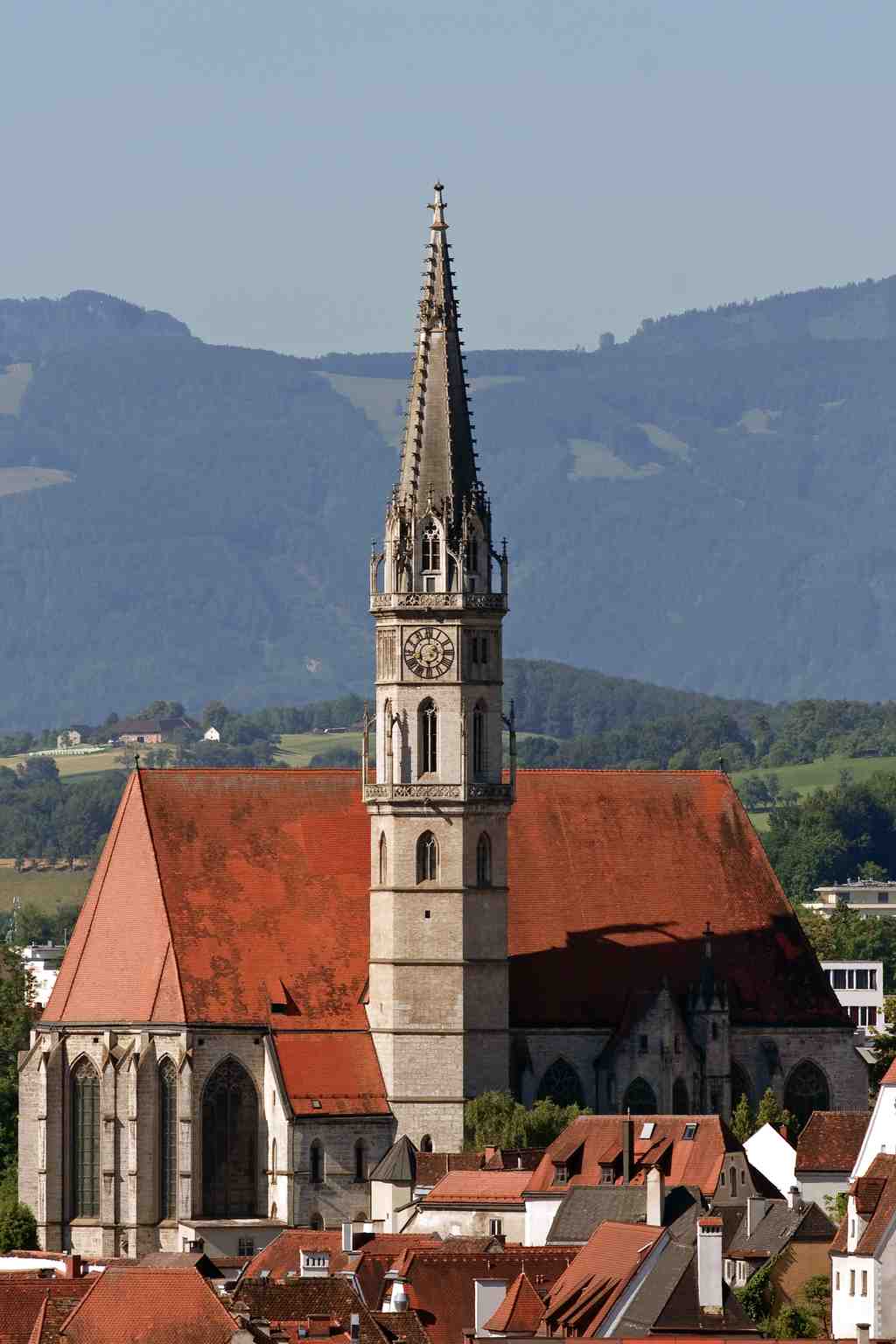
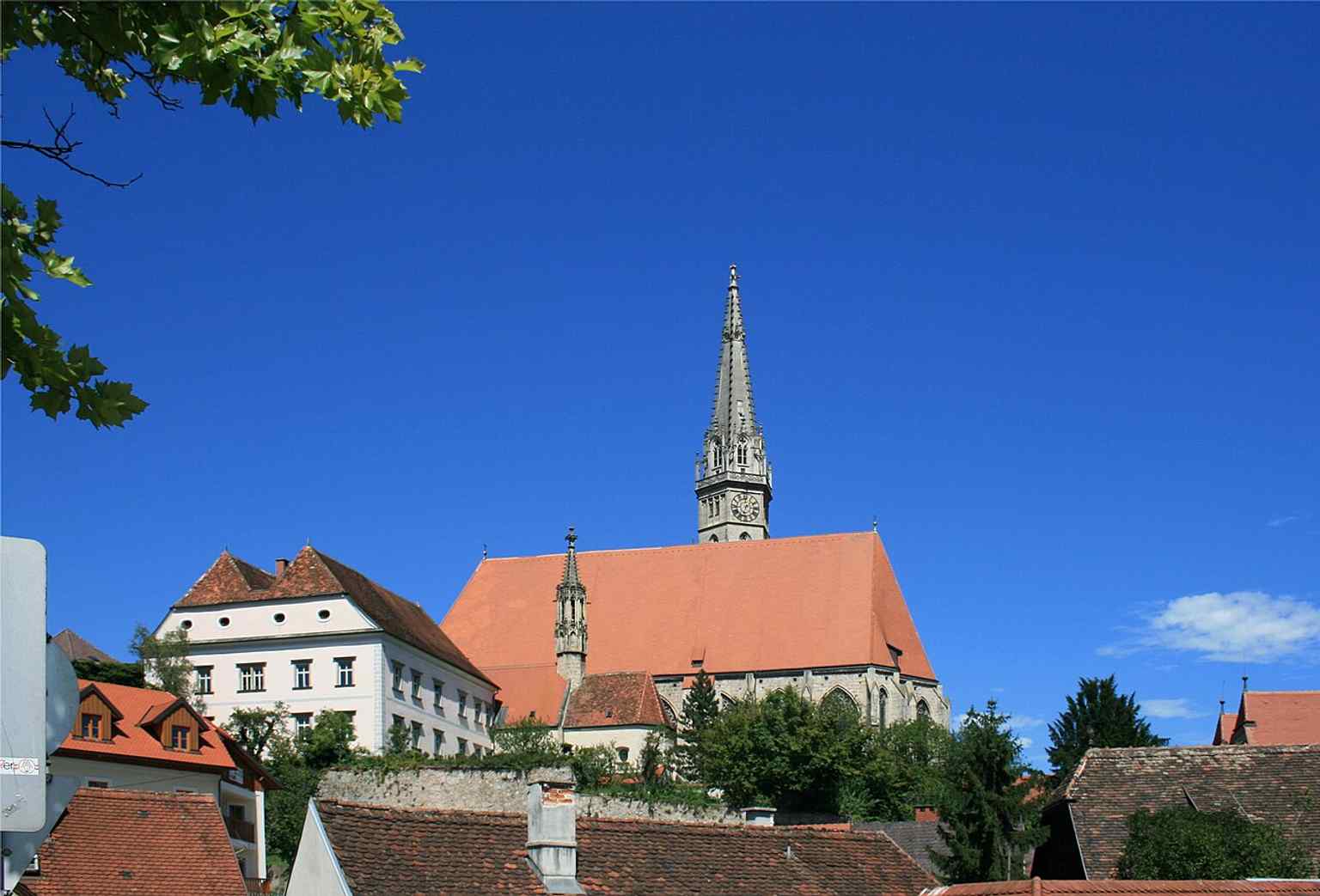
On your left rises a pale stone Gothic church with a long, steep roof, sharp buttresses, and an eighty-meter six-sided tower that stands up like a very confident exclamation point.
This is Steyr’s parish church, dedicated to Saint Giles and Saint Coloman, and it has been the city’s main sacred building for a very long time. The first church here likely reaches back to around the year eleven hundred. We can name it securely by twelve seventy-five, and by around thirteen hundred it had become the town parish church... just in time to suffer through Steyr’s regular problem: fires.
One blaze damaged it in thirteen oh three. Then, in the fifteenth century, a booming iron town needed a bigger church, so Steyr ordered a complete late Gothic rebuild. In fourteen forty-three, the Viennese master builder Hans Puchsbaum took charge of the new choir, the sacred eastern end of the church. After he died, Laurenz Spenning vaulted the choir and added the tower, which had not even been part of the original plan. Because apparently one giant statement piece was too tempting to resist.
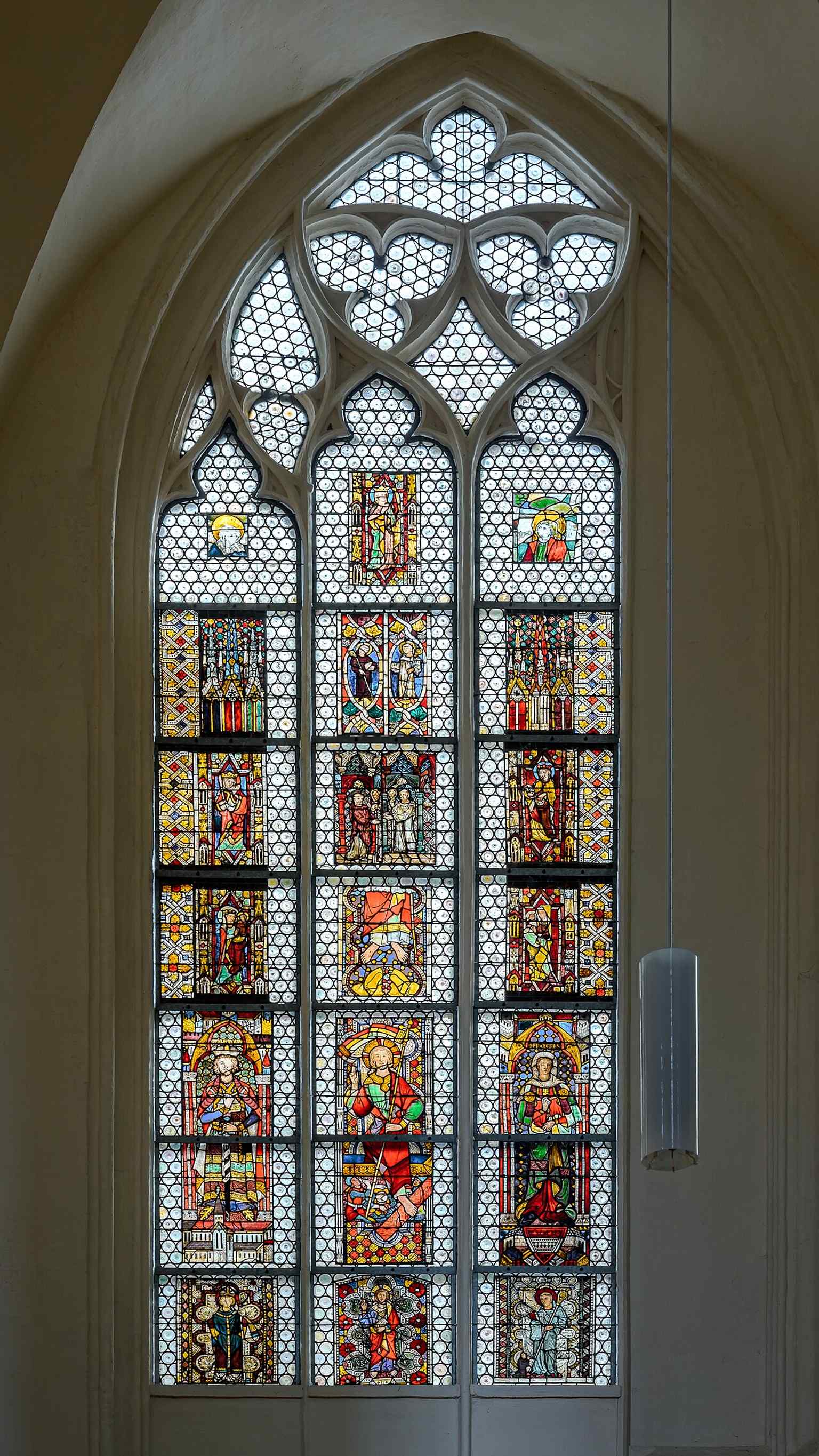
Construction dragged on for decades. Then in fifteen twenty-two, disaster returned. A city fire spread from the public bath, caught the church’s timber roof and scaffolding, and destroyed the roof, most altars, windows, paintings, the pulpit, and even the bells. Nothing says “nearly finished” like total combustion.
The church changed with the city. In the later sixteenth century, Lutheran preachers worked here, and the western porch took shape in that period. Around the turn of the seventeenth century, Benedictines from Garsten steered it back into Catholic hands and gave it Baroque furnishings. Then the nineteenth century swung the pendulum again. Adalbert Stifter, serving as a monument conservator, pushed a “regothicizing” campaign, stripping out much of the Baroque work to recover the medieval character. After the tower cap burned in eighteen seventy-six, Friedrich von Schmidt designed the current neo-Gothic stone top, completed in eighteen eighty-nine.
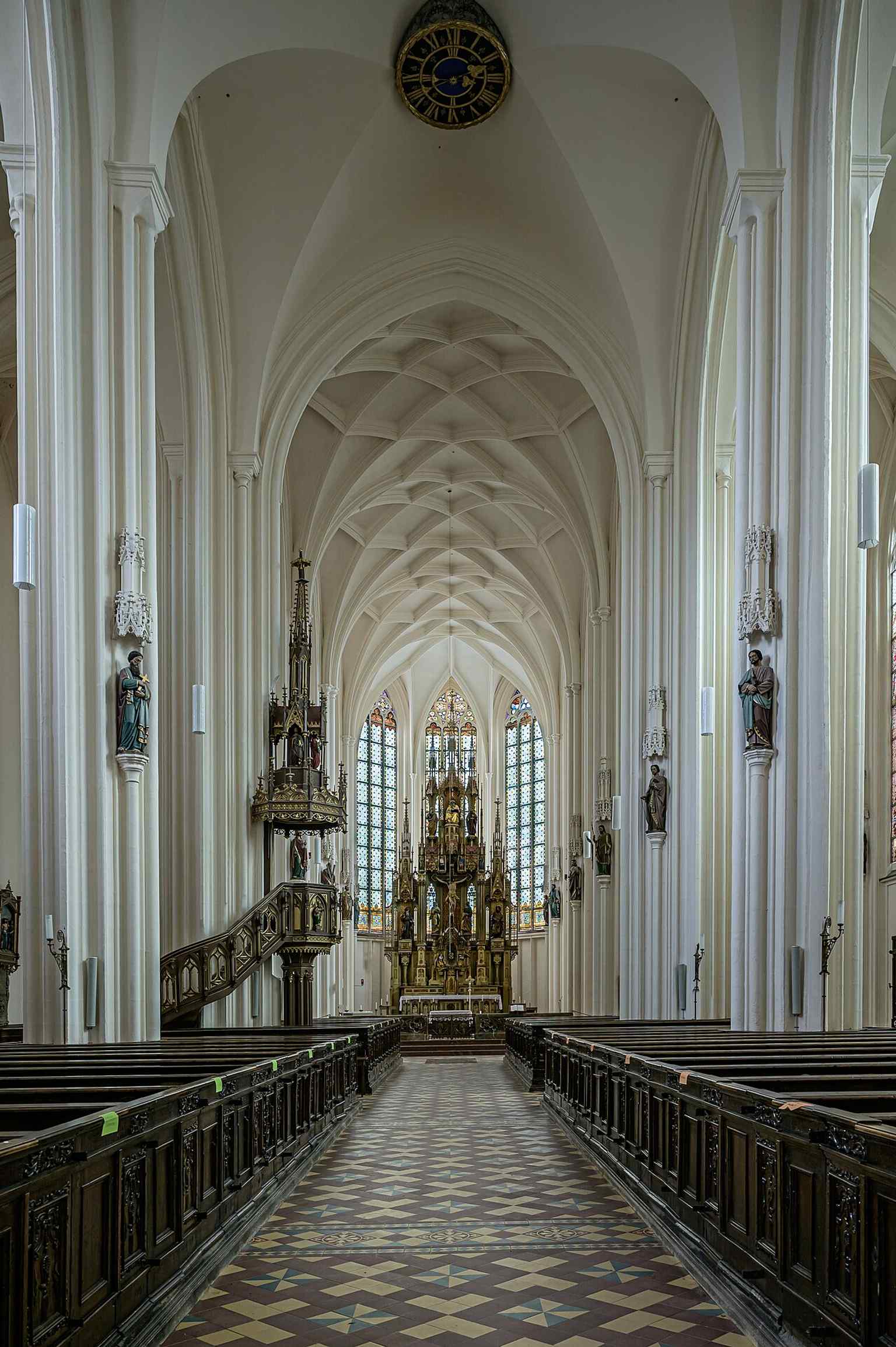
The church kept evolving even recently. Exterior restoration ran from the nineteen eighties into the early nineteen nineties, and interior work from two thousand nine to two thousand fifteen repaired the windows, roof structure, and Gothic bays, and returned the white-and-yellow color scheme inside. If you want, check the before-and-after image in the app to see how the scaffolding vanished and the full Gothic hall came back into view. And if you look at the interior photo on your screen, you’ll see that bright restored space for yourself.
One more local claim to fame: Anton Bruckner spent summers in Steyr from eighteen eighty-four onward, lived across from the church, played here, and influenced the organ’s nineteenth-century rebuild. Steyr even gave him its first monument in eighteen ninety-eight. The man got a statue before that became normal.
This church is really Steyr in stone: ambitious, repaired, and stubbornly upright.
Take one last look at that tower... and when you’re ready, we can continue to the next stop.






.jpg)


