
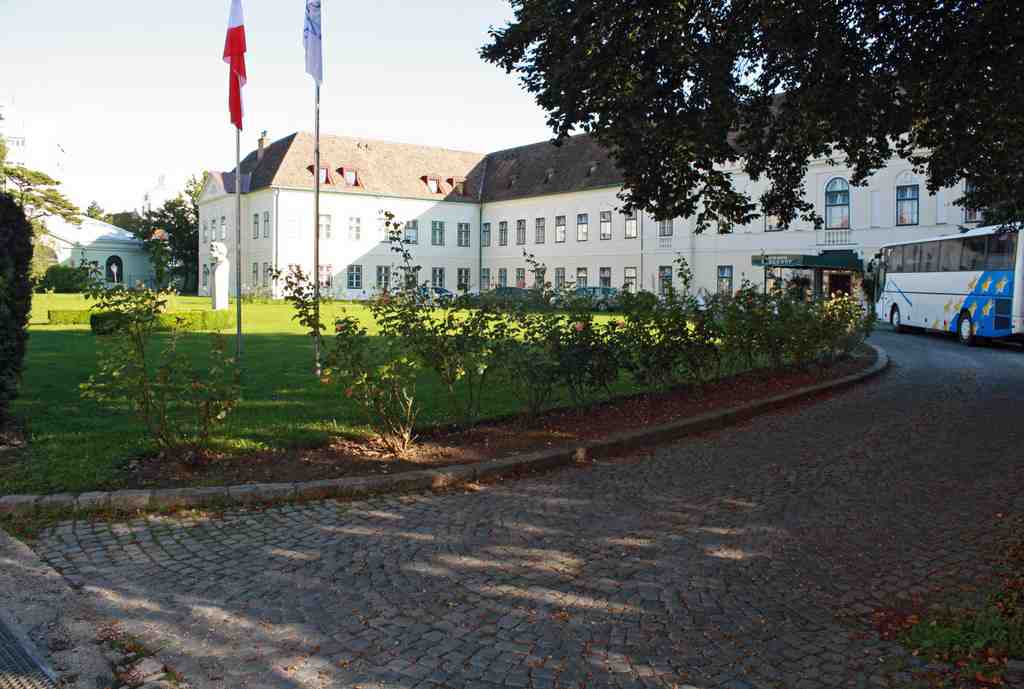
In front of you stands a grand, pale yellow, U-shaped building with rows of elegant arched windows, a red-tiled roof, and a sweeping driveway leading up to flagpoles and a formal garden-just look beyond the cobblestone path and you’ll spot the Sauerhof’s dignified entrance.
Now, imagine you’re arriving here not just as a traveler with a smartphone, but as a guest in a place where centuries of drama, comfort, and intrigue ripple through the air. Sauerhof’s story stretches all the way back to the 12th century-so if these stones feel like they’ve seen it all, that’s because they basically have! Picture dusty horse-drawn carriages rumbling up the path and nobility stepping out, trailing rich cloaks and whispers of palace gossip behind them.
The property was handed around like a well-worn poker chip among the powerful for hundreds of years. It was owned by knights like Hans der Flens and noblemen such as Hans Röttinger, then snapped up by Emperor Maximilian II as a dazzling residence for his son-eventually future Emperor Rudolf II. You can almost see the royal advisers fussing over which curtains would impress the visiting archdukes the most.
In 1583, Georg Saurer von Sauerburg became the new master of the estate, gifting the building its memorable “Sauerhof” name. Back then, the garden featured a small wild bath house built entirely of wood, where the most exclusive guests could relax. It’s even said lunch at the “Sauerhof-Traiterie” was such an event that you’d never know which famed artist or composer you’d be sitting next to-Beethoven, Carl Maria von Weber, and Antonio Salieri were all known to have dined here. Just imagine Beethoven enjoying a quiet holiday spa, perhaps grumbling about the food being too bland or the music playing in the lobby!
But don’t let the peaceful setting fool you. In 1683, during the second siege of Vienna, the entire place was destroyed. I suppose you could say the guest reviews were less than glowing that year-“Hotel was razed to the ground, 0 out of 5 stars.”
Time and money kept flowing into Sauerhof, and by 1822, it was transformed into a luxurious hotel resort, complete with a fine restaurant and a chapel, surrounded by an English-style garden masterpiece. Throughout the 19th century, ownership changed hands again and again-aristocrats, a military hospital for soldiers, and even, for a short while, the off-duty officers of Archduke Albrecht. Imagine the buzz on those grand staircases at the height of summer, officers swapping stories of campaigns while sipping mineral water and trying to pretend they didn’t miss home.
War always had its own plans for grand hotels, though. During both World Wars, Sauerhof was turned into a military hospital-a place where the old luxury must have mixed with the serious hush of recovery and hope.
After World War II, everything changed again. Soviet occupation left Sauerhof in ruins, stripped bare, eerily silent. When Austria regained its freedom, the building was a battered shell. And after decades of failed plans (a rheumatism center that never opened, a conservatory for Omani students that never materialized), it became a hotel again-in true Austrian style, re-opening with a flourish and a lineup of ministers for the ribbon cutting. Of course, financial disasters and unexpected owners seemed determined to keep Sauerhof’s history a little spicy-at one point, even an advisor to the Sultan of Oman took charge, although turning it into a college for musicians didn’t work out either.
Today, behind that calm façade and the freshly mown grass, there’s a lingering spirit of all those eras-a residence, a palace, a place of healing, a grand hotel, and, just occasionally, a nearly empty building waiting for its next chapter. If only hotels could write their own booking reviews: “Had a few rough centuries, but plenty of stories to share if you’ll listen.”


