
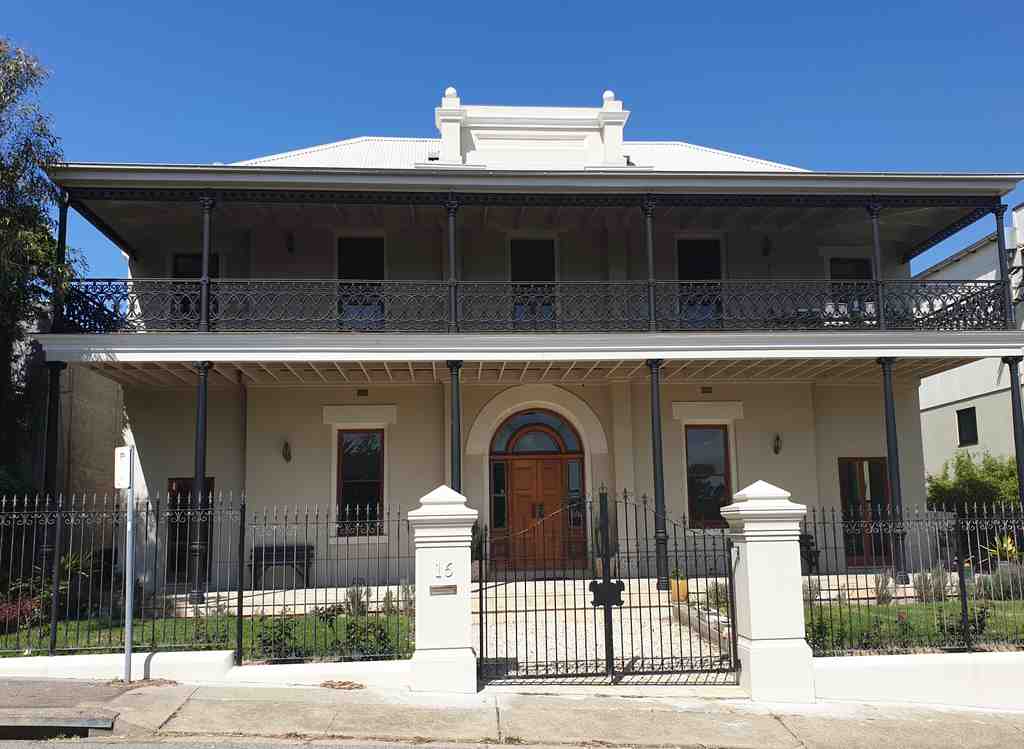
You’re standing in front of a grand two-storey Victorian Italianate building with a brick exterior, elegant stone brackets at the roofline, and an old verandah trimmed with decorative iron columns-look for the long, symmetrical facade just across Bond Street from the park, facing north towards the harbour.
Let’s imagine it’s the late 1800s-the air is thick with the salty tang of the harbour, and the noisy clatter of coal and cargo fills the docks nearby. Across the way, sailors loiter, their faces weathered from endless days at sea, searching for a clean bed and a little peace. This building, Coutt’s Sailors’ Home, was their answer-a sanctuary built in 1882, dreamed up by Reverend James Coutts, who, after witnessing the hardships faced by wayward mariners, decided it was time Newcastle looked after its sailors the way a mother hen watches her chicks. The city rallied around, and a parade of naval volunteers and brass bands marked the laying of the foundation stone, with the whole town given a holiday to celebrate.
Much like a ship that’s sailed through every storm, this place has had a wild journey of its own. At first, the Home offered a safe place from the grog sellers and rowdy streets, with broad stairs and a grand bay window looking out over the harbour, reading rooms filled with tales from afar, and dorms set beneath soaring ceilings. Imagine the laughter echoing down those halls as sailors, just off ships that crossed the world, swapped stories and played cards. Reverend Coutts would have been proud-though his marble plaque inside can’t seem to agree with the actual year it opened (a little mix-up, or maybe just a bit too much rum?).
But the wind soon changed. By the early 1900s, sailors started choosing other boarding houses-maybe the food was better, or a few too many rules cramped their style. People floated ideas for a navigation school to give new mariners their start, but in the end, it was mostly the sound of creaking floorboards and the occasional party, like that ball where Newcastle’s finest danced across polished floors.
When Newcastle’s shipping days began to wane, so did the Home. By the 1930s it was struggling, and government schemes came and went. The building turned into a health clinic-the famous Sister Kenny ran a pioneering polio treatment centre here in the 1930s, teaching the world that gentle movement could save crippled limbs. But the clamor of the trains and the sooty air from the Zaara Street Power Station soon chased the new patients away as well.
What followed was a game of musical chairs: the Home became government offices, storing everything from typewriters to air raid gear. The old chapel-once a place for sailors to pray for loved ones far away-was even shamefully turned into the men’s loo (no holy water there, I’m afraid). Scandals, arguments, and failed plans swirled like a sailor’s yarn. The city flirted with turning the Home into a Maritime Museum and even an Aboriginal art gallery, but repairs were always expensive, and nobody stepped up until Alastair and Diane Kinloch bought the worn-out building in 2014 and lovingly turned it into their residence.
Over the years, this place has seen it all: it stood at the edge of the old convict lumber yard-imagine the clang of hammers and the grumbling of chains as prisoners built Newcastle’s future stone by stone. It cradled sailors blown in from every corner of the globe, then patients, government officials, and even an outrageously misplaced toilet block. Through it all, it has kept a noble, slightly faded charm: those cast-iron columns and original doors are the bones of history, carrying stories and secrets in every creak of the floorboards.
So, as you stand on Bond Street, take a moment to look up at its timeworn balconies and feel the breeze that once carried the hopes of men who knew the sea’s fury. Coutt’s Sailors’ Home isn’t just bricks and mortar-it’s Newcastle’s heart, built for protection, adventure, laughter, and the odd misadventure or two. And really, isn’t that what every good landmark is all about?


