
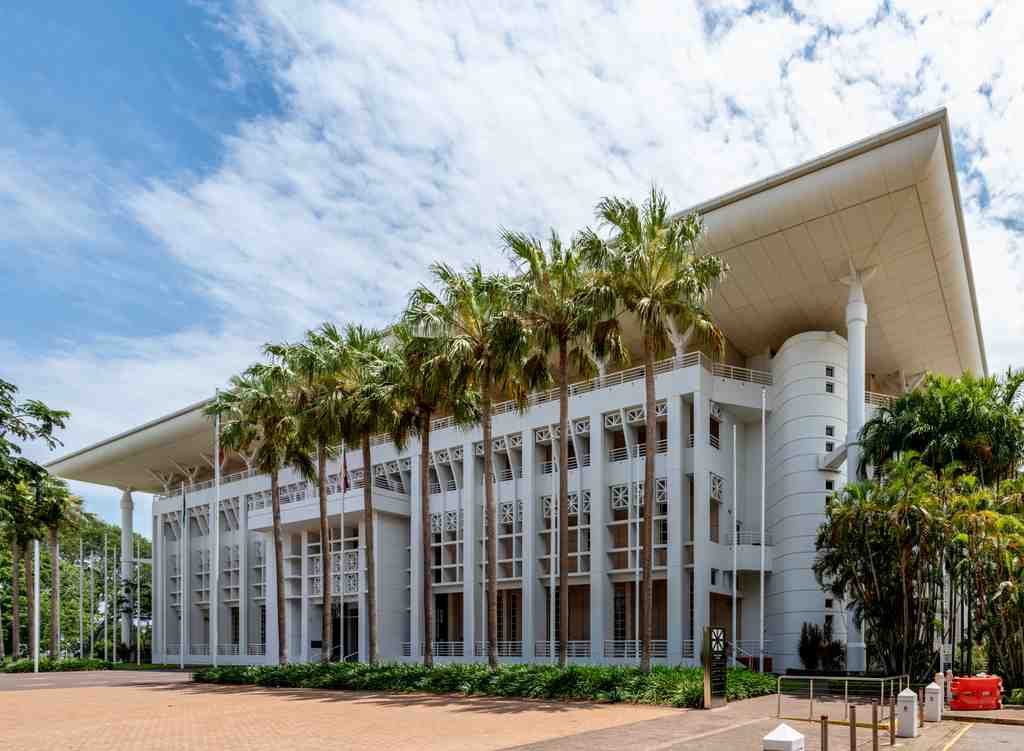
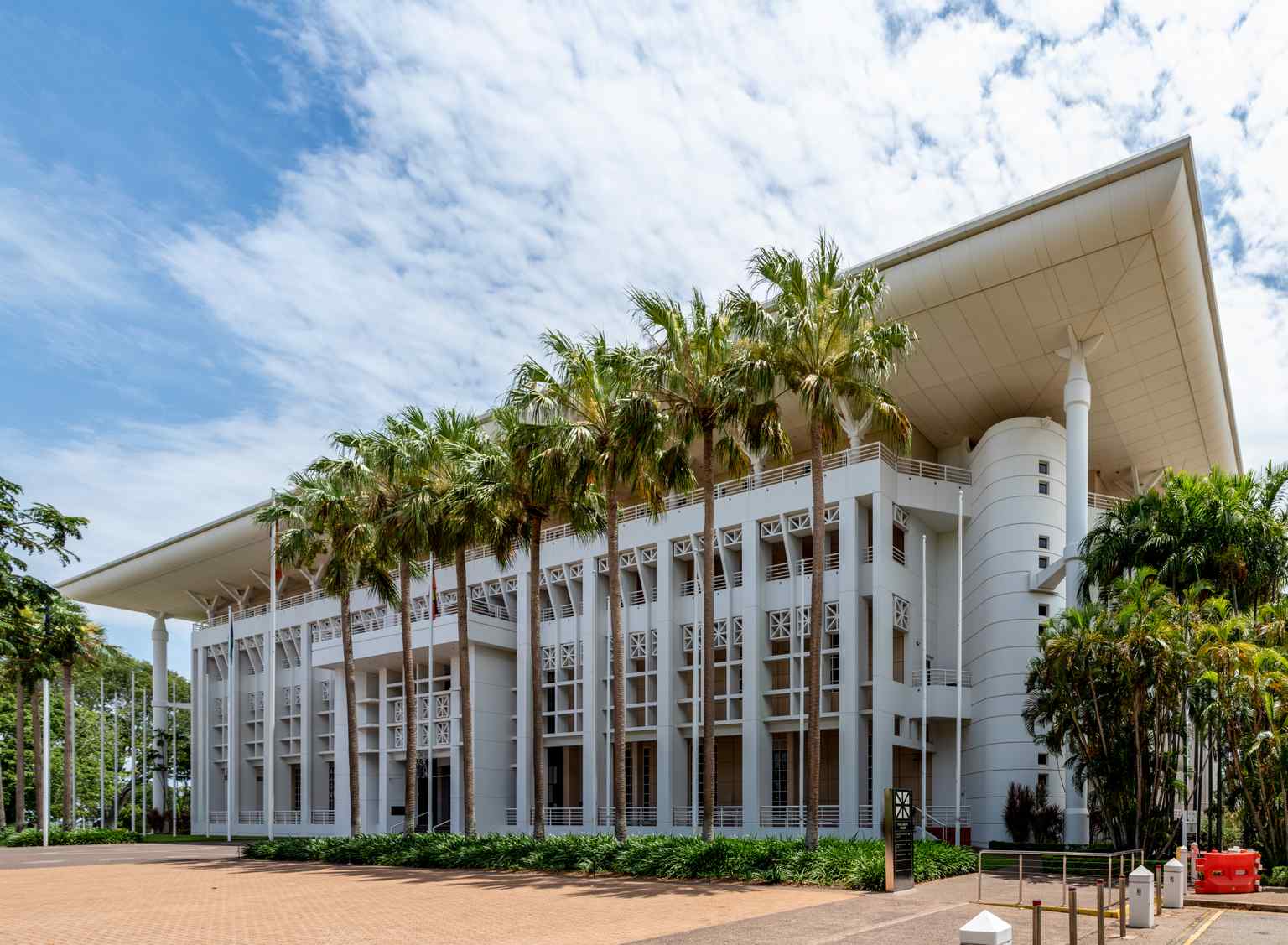
Look to your right at the stark white concrete facade of Parliament House, characterized by its distinctly layered grid-like shape and the massive flat parasol roof stretching out over the top. It is an imposing, deeply modern building. If you glance at your screen, you can see why locals quickly gave this layered, postmodern tropical design a rather cheeky nickname. They call it the Wedding Cake.
But long before these grand white columns rose, the ground beneath your feet held a very different kind of power. Thinking back to the distant authority we discussed earlier, back in 1873, this exact spot was the Palmerston Post and Telegraphic Office. It was the crucial junction linking Australia’s undersea cable from Java to the Overland Telegraph. For decades, it was the solitary thread connecting an isolated frontier town to the rest of the world.
That historic post office stood until a dark day in February 1942. During the very first Japanese air raid on Darwin, a bomb scored a direct hit right here. If you step inside today, you will find a plaque on the floor marking where the bomb fell, along with a jagged piece of actual shrapnel recovered that same afternoon, forever anchoring this modern political building to the grim realities of wartime loss.
For decades after, the Northern Territory's government was nomadic. The Legislative Assembly even spent years meeting in a temporary concrete building nearby. But a frontier town never stops reinventing itself. Between 1990 and 1994, they built this permanent home for about one hundred and seventy million dollars.
The ambition came at a heavy human cost. In March 1991, a construction crane collapsed. Two workers, Peter Malmstedt and Andrew Snow, lost their lives. Their sacrifice is honored nearby on the Speaker's Green, where a beautiful mosaic fountain of a Sturt's Desert Rose blends a symbol of the territory's resilience with a permanent expression of public grief.
Nature has always been a formidable architect here. The grand parasol roof you see on your app does not just diffuse eighty percent of direct sunlight, it is heavily fortified against extreme forces. In 1974, the devastating cyclone we learned about earlier shredded the previous government buildings here. In a true display of frontier grit, the politicians met just eight days after the devastating storm, passing urgent laws under a roof full of holes with live electrical wires dangling around them.
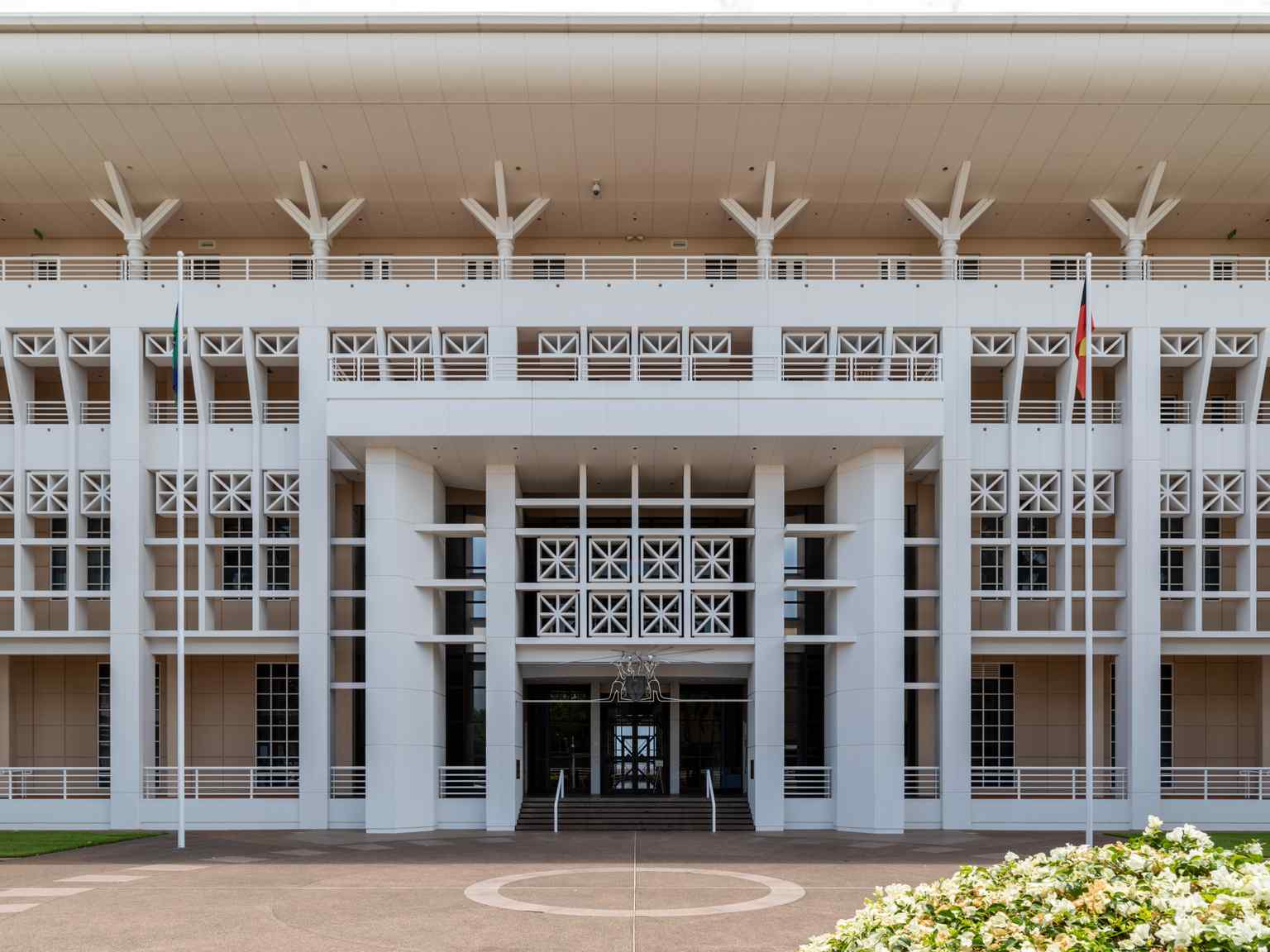
Today, this seat of self-governance still sees its share of passion. In 2015, over two hundred angry residents, some even riding on horseback, stormed these front steps. They were loudly protesting hydraulic fracturing, a controversial drilling method to extract gas from the earth, on their lands. It was a dramatic scene that proved the fierce spirit of the Darwin Rebellion is still very much alive.
The building is open every day of the week from morning until evening if you would like to explore the historic lobby or the Northern Territory Library inside. But for now, from these grand halls of power, I invite you to step down into a quiet space just ahead honoring the women who truly sustained this land, as we transition right next door to Damoe Ra Park.





%2C%20Parliament%20House%20--%202019%20--%204336-8.jpg)
%2C%20Parliament%20House%20--%202019%20--%204343.jpg)