
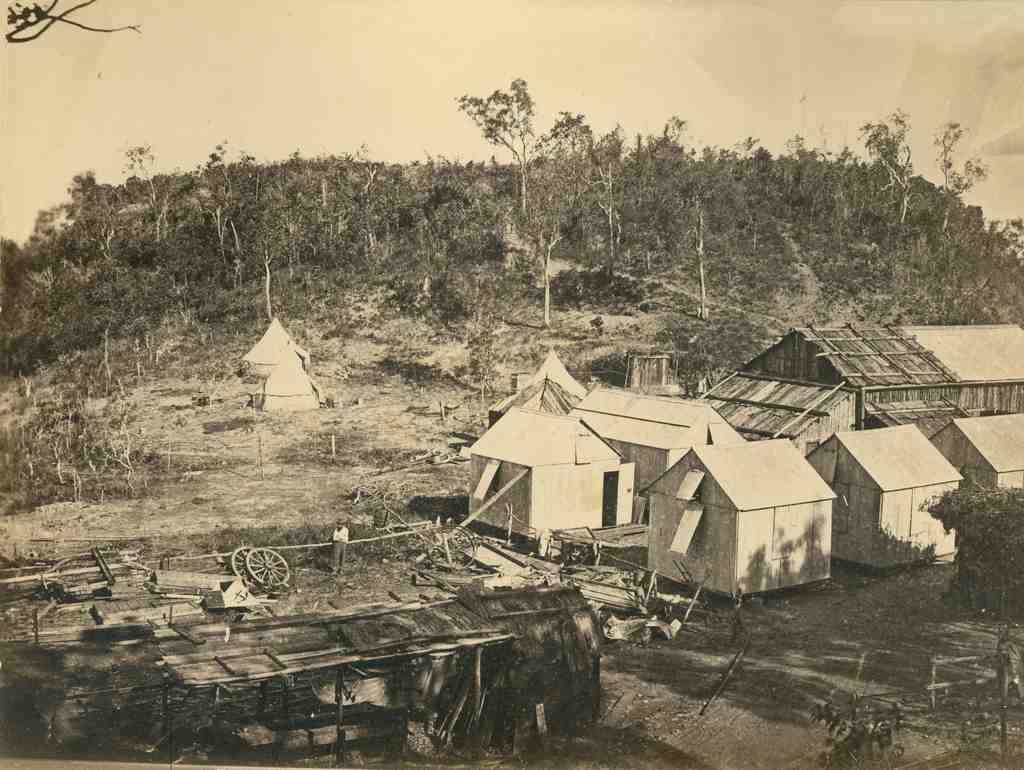
On your right is a modern waterfront parkland, but the image on your screen shows the landmark that once stood exactly here, a rugged, earth-mound hill featuring a rounded crest and simple, slanted-roof timber cabins. This vanished place was Fort Hill. In 1869, George Goyder and about one hundred and fifty men waded ashore here, pitching tents and building rough log cabins in the gully to map the land and mark the start of permanent European settlement.
But this land already belonged to the Larrakia people, the traditional custodians of these coastal waters. The sudden arrival of the expedition sparked a tragic friction, and the fatal spearing of a young man named John William Ogilvie Bennett became a heavy symbol of this deep colonial conflict. Bennett was a twenty-three-year-old draughtsman... a skilled worker who drew the technical maps. While compiling an atlas at a nearby camp, he and his companion were attacked.
His companion survived, but Bennett suffered a fatal wound to his lung. He was rushed back here, where a doctor named Dr. Peel attempted to surgically remove the wooden spear tip under chloroform, a common early anesthetic gas. Tragically, the young man did not survive. He was carried to the top of Fort Hill, becoming the earliest European burial in the settlement. His original wooden headstone noted, rather heartbreakingly, that he had treated the local people with familiar kindness.
Bennett was not left alone for long. He was soon joined in that very same grave by Richard Hazard, a forty-two-year-old camp cook who succumbed to severe rheumatism, a deeply painful inflammation of the joints.
For decades, their shared grave stood on the hill as a lonely monument. Yet, a settlement built on constant transformation rarely leaves its landscape untouched. During the Second World War, the military excavated massive, steel-lined tunnels straight into the side of Fort Hill to hide oil from Japanese bombers. The budget ballooned from two hundred and twenty thousand pounds to eight hundred and fifty thousand pounds... equivalent to tens of millions of dollars today. But in a bitter irony, by the time the tunnels were finished in 1945, the bombing threat was gone. The tunnels never held a single drop of oil.
Eventually, even the earth itself was consumed. In 1965, the entire hill was leveled and pushed into the sea to create a massive iron-ore wharf for exporting minerals.
The blood spilled here at Fort Hill set the tone for a turbulent century, leading to the seat of colonial power. Let us reflect on that as we make our way to Government House, which is about an eight-minute walk from here.




