
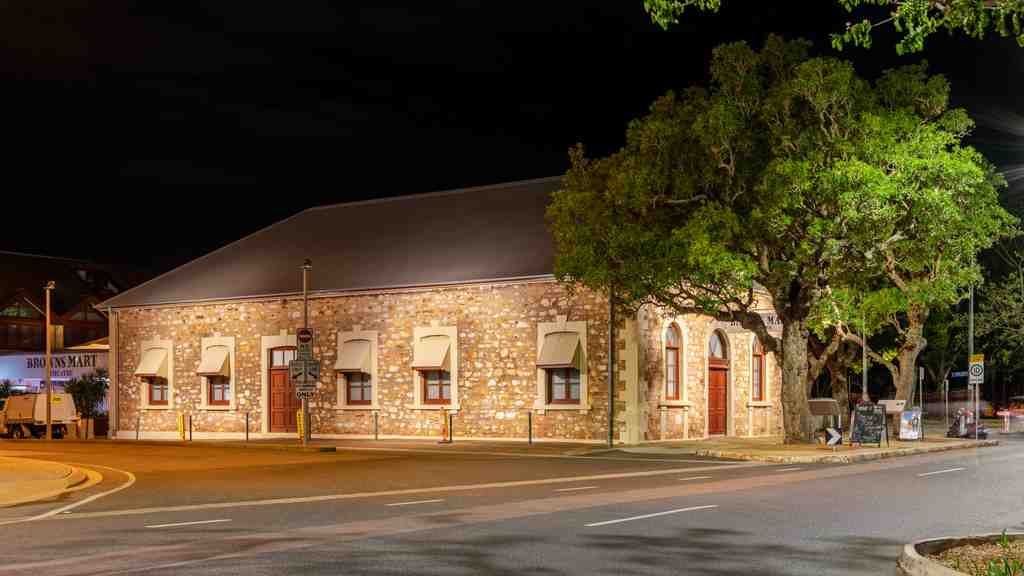
You are looking at a rectangular building constructed from rugged, light-colored stone, featuring a simple sloped roof and distinctive semi-circular arched windows and doors along its facade.
For well over a century, people have called this place Brown's Mart, after a local trader named Victor Voules Brown, but historical records tell a different, hidden story. It was actually commissioned and built in 1885 by Vaiben Louis Solomon, an influential figure from an Orthodox Jewish family who built it as an emporium, and who would later become the Northern Territory's very first politician.
If you take a look at your screen, you can see this beautiful stone structure in all its enduring glory.
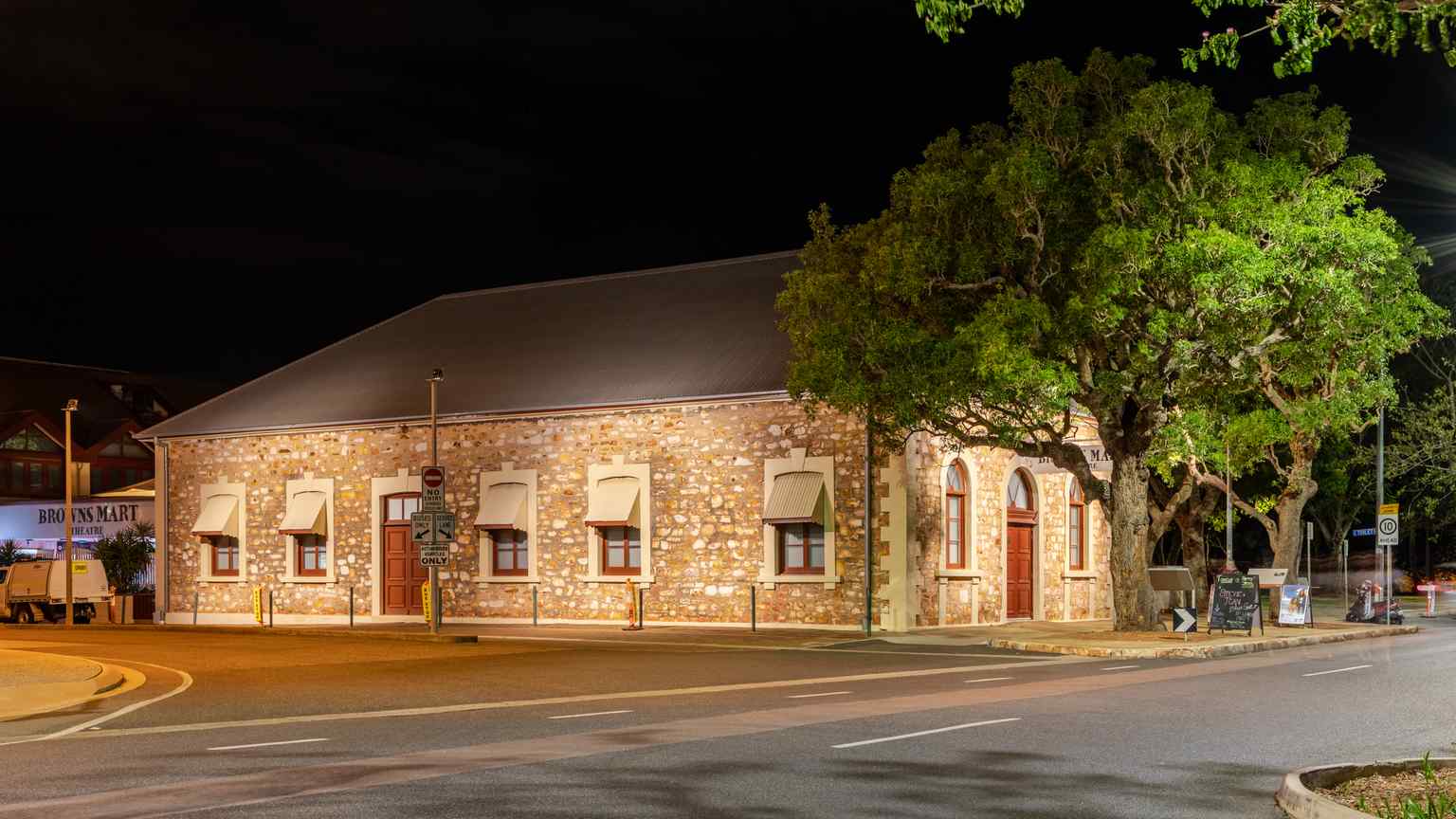
The building was crafted using porcellanite, which is a hardened, local clay rock that gave it a sturdy presence, unlike the flimsy corrugated iron mostly seen in early settlements. Those heavy stones were manually hewn by Chinese laborers. Decades later, when the building faced the very real threat of demolition, it was the memory of those hardworking Chinese laborers that locals fought to protect, successfully arguing that the building should remain standing as a living memorial to their sheer physical effort.
The survival of this stone structure mirrors the unyielding adaptability of Darwin itself. Over the decades, these walls have housed a mining exchange, a banking branch, and even a bustling naval workshop where torpedoes were repaired during the constant threat of the Second World War. Time and time again, the town repurposed whatever it had to survive the harsh frontier, completely reinventing this space to suit the era. No matter what nature or conflict threw its way, this building stood firm, shifting its identity right alongside the people who needed it.
Well, mostly firm. In 1972, a passionate amateur theater group saved the building from the wrecking ball to create an arts hub. They were armed with an eight thousand dollar grant, which is roughly ninety thousand dollars today. The group commissioned an architect to design a dedicated theater layout and an administration block. They had just finished stage one, including a highly prized new air conditioning system, when a devastating cyclone hit on Christmas Day in 1974. The brutal storm completely tore the roof right off the building, leaving the brand new theater exposed to the elements. But the community refused to let it die. They painstakingly reconstructed the venue, and performances triumphantly resumed.
Today, it is a profoundly personal space for storytelling, hosting works by local artists that explore everything from migrant grief to the celebration of finding a new home. The people of this frontier have always found ways to rebuild and to entertain themselves, no matter how harsh the environment around them might be. Speaking of finding an escape through entertainment, we are now going to head toward our next stop, the Star Theatre, which is just a short three minute walk away.





%2C%20Browns%20Mart%20Theatre%20--%202019%20--%204401-3.jpg)