
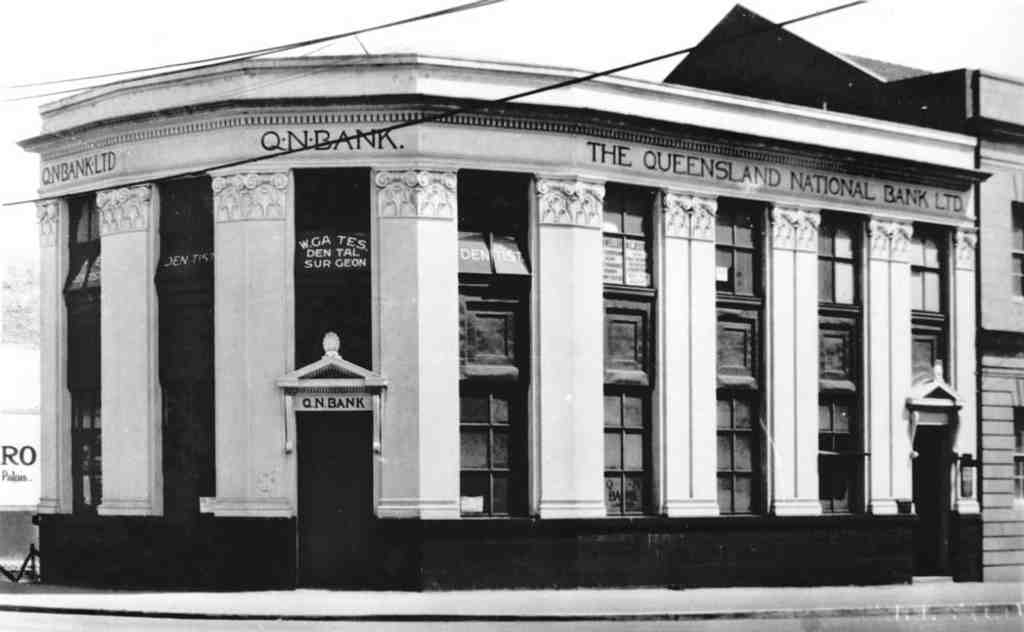
To spot the Queensland National Bank, look for a solid, two-story, cream-colored building right on the corner, decorated with tall, elegant columns and bold BANK lettering up along the roofline-hard to miss as it proudly wraps around the junction of Melbourne and Grey Streets.
Alright, adventurer, as you stand in front of this striking corner building, close your eyes for a second and imagine it's 1929-flappers might be passing by with their cloche hats, men tip their hats as trams clang and rattle down the street, and the air buzzes with the energy of a city hinting at greatness. This isn’t just another brick-and-mortar relic; this is the Queensland National Bank, built in the roaring ‘20s when optimism soared as high as the cost of real estate during the land boom.
Back in those days, the suburb of South Brisbane was alive with promise, and this very piece of land had already played host to many chapters of city drama. The original lot-one of thirty snapped up during Brisbane’s feverish land rush of 1854-changed hands more than a well-worn deck of cards. From the hands of William John Loudon to Patrick Maunsell, then passing into the care of the Pikes, the ground beneath your feet has seen the wild gamble of dreams and investments for generations.
But by 1927, the Queensland National Bank, known for having the ambition of a border collie chasing a ball, saw opportunity gleaming on this corner. They snapped up the “gem” of the street, determined to win over every importer, merchant, and savvy investor who trundled through South Brisbane. As you look up at the giant pilasters-those hefty, decorative columns breaking up the walls-you can still feel that spirit. Legend has it, the place was built to shout, “Trust your savings with us; we’re not going anywhere!”
And that was no empty boast. For decades, this corner survived every twist of fate: floods in the 1890s that had locals rowing boats instead of riding trams, the hustle and bustle of growing shopping strips, the expansion of tram and railway lines that made this area pulse with pedestrian life. Baynard’s Corner, right here, became a crossroads of commerce-a place so busy that even if you were in a rush, the aroma of fresh bread from nearby bakeries or the clang of the tram bell would make you slow down, just to take it all in.
When the bank building opened its doors in 1929, behind its opulent copper doors, things were not all strict business. I like to imagine stern-faced tellers with waxed mustaches passing secret jokes about the competing Commonwealth Bank just next door. The two banks, separated only by a thin wall but joined by fierce rivalry, watched each other like chess masters-even racing to greet the same merchant clients as the tram doors hissed open outside. In truth, the Queensland National Bank wasn’t just following the money-they were trying to outdo their rivals at every turn.
But South Brisbane was always shifting. Before the bank, there were boarding houses on this ground, buzzing with travelers and workers, filling the streets with laughter (and, probably, the odd snore so loud it rattled the windows). Later, state offices moved in, including the powerful Chief Protector of Aboriginals and people sorting water supply mysteries-adding a touch of government drama to the daily life here.
The same walls that once sheltered thick-walled strong rooms, fiercely guarded by staff with keys jingling on their belts, would later house an accountancy firm, Roger Ng & Co. Even after the last notes and coins were counted out from the bank’s tills, the building refused to fade into history. Instead, as people criss-crossed Melbourne and Grey, it became a signpost of days gone by and better yet, a survivor.
So, as you stand here, take in the building’s pale render, the way its corners angle gracefully, how the named frieze runs like a crown along the top. Imagine the echo of footsteps, secret shuffles behind those sash windows, and the click of heavy ledgers opening to record someone’s fortune-or misfortune. The Queensland National Bank didn’t just witness South Brisbane’s rise; it banked on it.
And if these walls could talk, I bet they’d whisper about booms, busts, and the odd mischievous prank played between neighboring banks! Almost a century later, the building remains, holding the stories and secrets of South Brisbane’s endless evolution, a true testament to resilience and the occasional lucky gamble.




