
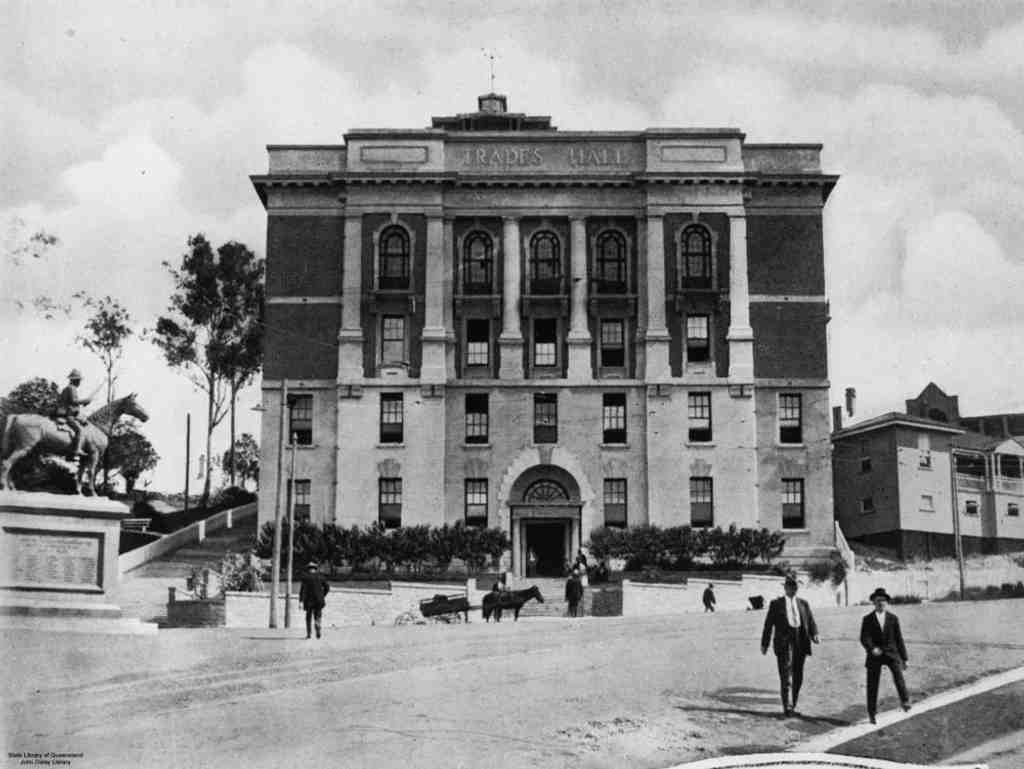
To spot the Brisbane Trades Hall, just look for a sturdy, elegant, cream- and brick-coloured building with grand pillars and big arched windows right at the front, standing proudly at the top of a slope with a statue on horseback nearby.
Now, as you stand here where many feet have marched and many voices have been raised, let me take you back to the early days of the Brisbane Trades Hall. Imagine it’s the late 19th century-horse-drawn carts are clattering on cobbles, and the air is stiff with the expectation of change. On April 4th, 1891, a crowd of hopeful unionists surged through the streets, banners waving and boots pounding from Ann Street, up Queen Street and then up, up, up Edward Street to lay the foundation stone of their brand-new Trades Hall. What a party it must have been, with cheers echoing off all those solid stone buildings-no microphones needed!
As the city grew and unions gained strength-two-thirds of the workforce, can you believe it?-a bigger, grander hall was needed, thanks in part to a cheeky little problem: the weight of their old hall was pressing down on the tunnel underneath it! Talk about too much union muscle. So, in 1920, Queensland’s Lieutenant-Governor, William Lennon, laid the foundation stone for the second building, right here, in a spot overlooking Edward Street, perfectly placed for everyone to spot flashes of protest signs or catch the rhythm of a rally.
For decades, this hall buzzed with meetings and ideas, the air thick with debate, laughter, and maybe a few heated arguments over tea and biscuits. It was more than politics; it was about friends and families, learning, and fighting for a fair go. In the 1960s, it even turned a little groovy, housing the FOCO club and a bookshop to feed all those hungry minds.
But all stories turn a page. In the 1980s, the building was sold, and the Trades and Labour Council moved across to Peel Street, needing another new home. Today, the original building is gone, replaced by a modern high-rise, but if you listen really closely, you might just hear the distant stomp of determined boots and a faint echo of union songs rising where the old hall once stood.




