
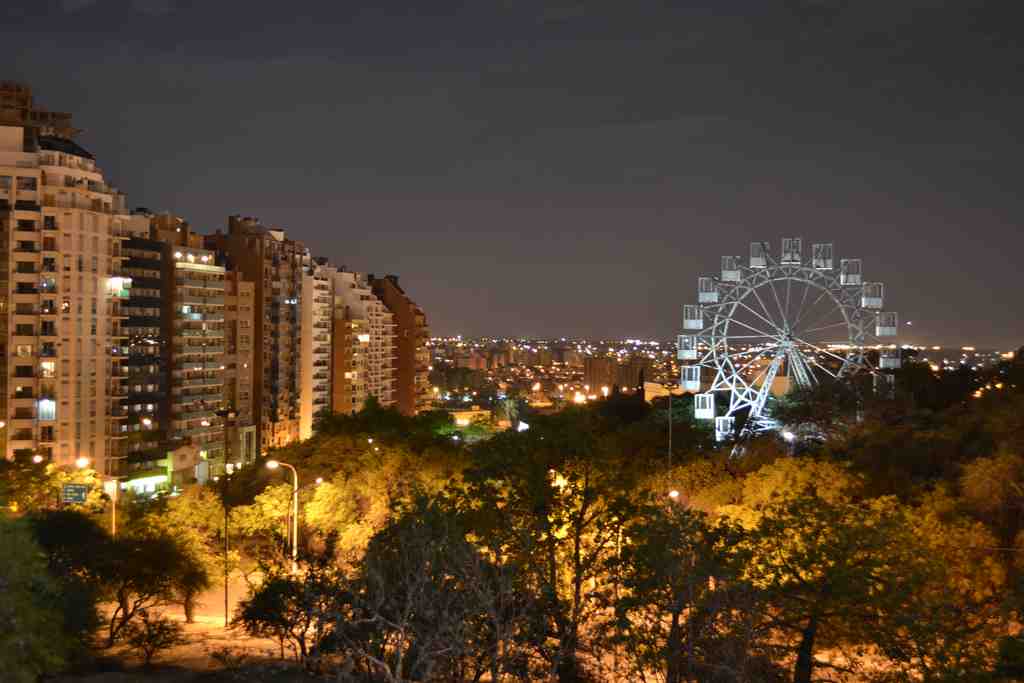
Look up at that towering circle of deep green wrought iron, standing on sturdy lattice legs with twenty passenger cabins hanging from its rim.
Welcome to the Eiffel Wheel! You are looking at a true survivor of history. This massive structure, twenty-seven meters in diameter, is a classic example of iron architecture from the turn of the twentieth century. Now, I know what you are thinking. Eiffel? Like the tower in Paris? Well, that is the million-dollar question.
Local tradition insists this wheel was built by the famous workshops of Gustave Eiffel. There was even a historian, Carlos Page, who claimed he saw a plaque on the original frame confirming it was prefabricated in the Eiffel workshops. However, that plaque is long gone, and other experts argue there is no paper trail proving the French engineer actually built fairground rides. Whether it is a genuine Eiffel or not, it has become an absolute icon here.
Its journey started far from here, in the city of San Miguel de Tucumán. Back in 1916, it was the star attraction of the "Mundial Park" during the massive centennial celebrations of Argentina’s independence. Two years later, the government of Córdoba bought it for twenty-three thousand pesos-which was a small fortune back then-and brought it here to Parque Sarmiento.
But here is where things went wrong.
When they reassembled the wheel here, they made a critical engineering mistake. Originally, the iron spokes were crisscrossed, just like the spokes on a bicycle wheel, which creates tension and strength. But in Córdoba, the workers installed them concentrically, radiating straight out from the center. It looked fine, but physics had other plans.
As the wheel turned, the lack of tension caused the iron to stretch and warp. The wheel actually stopped being a circle and started turning into an oval! It was slowly crushing itself. By 1938, the deformation was so dangerous they had to shut it down to prevent it from squashing the passengers. It stood silent for decades until 1992, when the structure finally gave up and collapsed, leaving a pile of twisted metal and broken cabins on the ground.
But Córdoba refused to let it go.
In 2003, after a complex study, it was rebuilt as a static sculpture. Then, just recently, the agency BioCórdoba performed a massive restoration. They installed a new motor and fixed the foundations, allowing this iron giant to spin again for the first time in years.
Take a moment to admire this resilient piece of history. When you are ready, we can head to the next stop, the Biodiversity Park, just a short walk away.




