
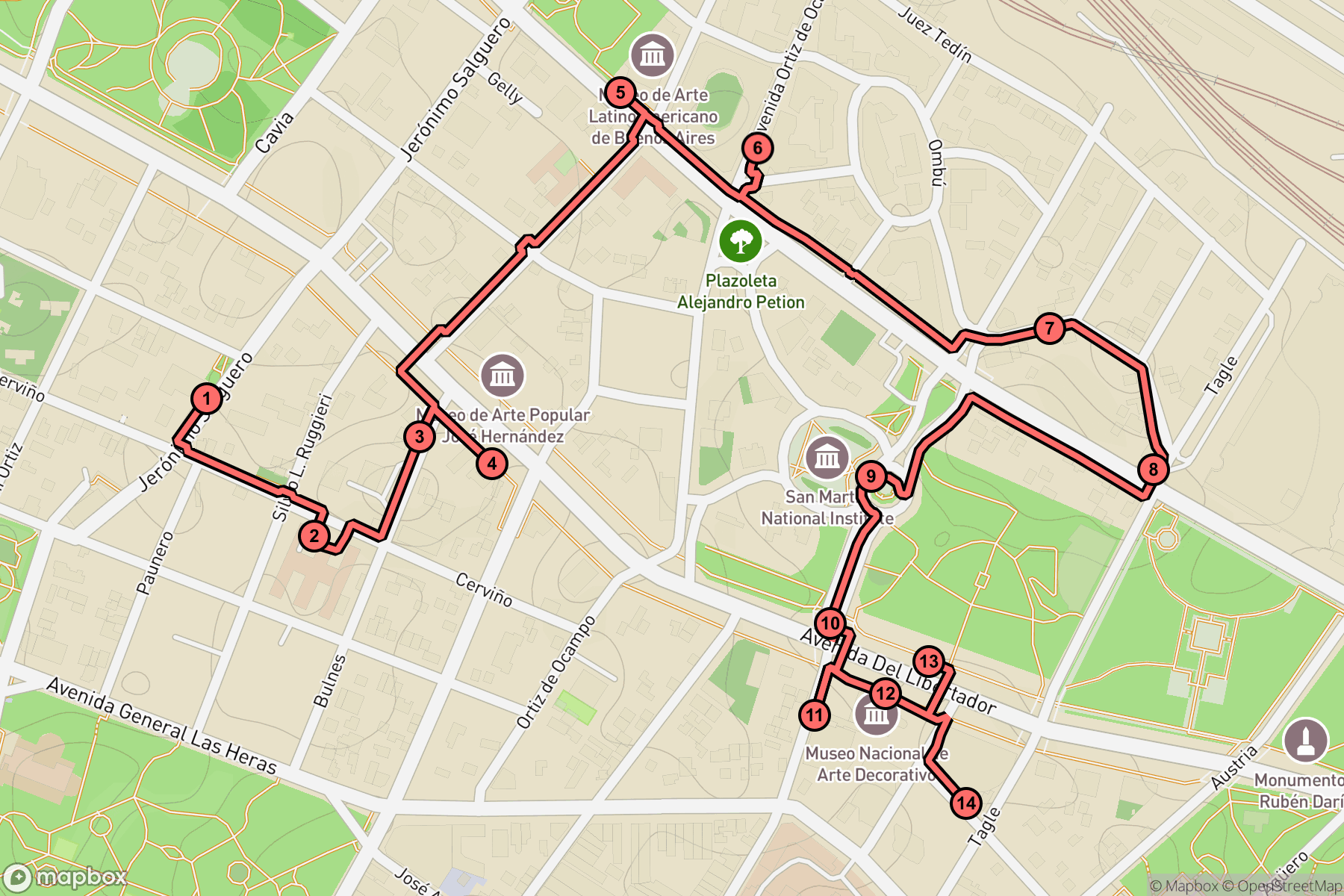
Buenos Aires Audio Tour: An Artistic and Cultural Odyssey
Gilded halls once whispered forbidden poetry while secret meetings shaped Argentina’s wildest chapters—Palermo’s quiet avenues pulse with invisible stories beneath the jacaranda bloom. This self-guided audio tour unlocks the city’s grand mansions, artistic sanctuaries, and hidden corners, revealing the drama most visitors rush past. Discover Buenos Aires through legends and lost memories no guidebook could capture. Why did a notorious writer risk everything under the watchful eye of the Argentine Academy of Letters? What priceless masterpiece vanished from the National Museum of Decorative Arts and sparked an international hunt? Which seemingly ordinary painting at the Museum of Latin American Art inspired a midnight rebellion among artists? Each stop draws you deeper into intrigue and wonder, weaving through palatial rooms and shadowed courtyards where passion, betrayal, and creativity danced for decades. Let Palermo’s heart unfold at your pace. Begin now and step through the city’s elegant façade into its greatest secrets.
Tour preview
About this tour
- scheduleDuration 70–90 minsGo at your own pace
- straighten2.5 km walking routeFollow the guided path
- location_onLocationBuenos Aires, Argentina
- wifi_offWorks offlineDownload once, use anywhere
- all_inclusiveLifetime accessReplay anytime, forever
- location_onStarts at Bellini Tower
Stops on this tour
lock_open 3 free previews · 11 unlock with purchase
Built as a residential building, it wasn’t always such a polished star in the neighborhood. Palermo once had smaller homes and winding streets, but Bellini Tower soared up and…Read moreShow less
Built as a residential building, it wasn’t always such a polished star in the neighborhood. Palermo once had smaller homes and winding streets, but Bellini Tower soared up and added a dash of modern luxury to the mix-it’s like the neighborhood put on its best suit and said, “Look at me now!” Imagine the stories inside: people sipping their morning coffee with a fabulous city view, maybe even spying a tango dancer practicing steps on a balcony. Who knows? Maybe someone up there is waving at you right now. So, take a deep breath, enjoy the sparkling glass and steel, and let’s see what other tales Palermo has in store!
Open dedicated page →Ah, look at that impressive façade in front of you-welcome to the Hospital General de Agudos Dr. Juan A. Fernández! But don’t let its modern look fool you-this building has more…Read moreShow less
Ah, look at that impressive façade in front of you-welcome to the Hospital General de Agudos Dr. Juan A. Fernández! But don’t let its modern look fool you-this building has more stories than an over-caffeinated novelist. Imagine yourself here in 1889, when this place first opened its doors-not as a hospital, but as the Dispensary of Hygiene and Municipal Syphilis Clinic. The neighborhood was nothing like today’s bustling Palermo. Instead, picture a dark, lonely spot, all unpaved streets, wild empty lots, and big weeping willows, with just a handful of worn-out houses scattered around. This was the city’s forgotten corner, where “women with no home, no name, and no honor” came to seek shelter and desperately needed medical care in a society that often turned its back on them. By 1893, under the watchful-perhaps slightly worried-eye of Mayor Miguel Cané, the hospital got a name change. No more “Syphilis Clinic”-it became the Hospital del Norte. But don’t be fooled by the fresh start; the hospital still carried an air of secrecy and scandal. If walls could talk, these would probably whisper in hushed tones and give you a wink. Fast forward to the early 1900s, and things got serious. In 1904, President Manuel Quintana officially welcomed the hospital into Buenos Aires’ general hospital system, slapping on the name Dr. Juan Antonio Fernández. Fernández was no ordinary doctor-he was the “Hippocrates” of Argentina, a teacher, war hero, and founder of the National Academy of Medicine. If hospitals had patron saints, his portrait would be in every waiting room. From 1907 onward, the hospital expanded: new surgery rooms, a maternity ward, and a children’s area. By 1937, the place was bursting at the seams, so much so that the whole old building was torn down and rebuilt, reopening in 1943 amid much fanfare-President Ramón Castillo himself was at the ribbon-cutting. Over the years, more specialties popped up-by 1948, you could see a doctor for just about anything, whether you were six or sixty. Today, this hospital is known for its emergency room, intensive care, infectious diseases, and trauma services. Not to mention, it’s a teaching hospital, training countless future doctors as an affiliate of the University of Buenos Aires. So, whether you walk by or walk in-may you only do the former-remember the generations of strength, struggle, and healing that make up these storied walls! Not bad for a place that started in the city’s wild “nowhere,” right?
Open dedicated page →Here we are, right in front of Torre Bulnes! Now, I know what you’re thinking: “Does this tower have a secret passage? A hidden treasure? Maybe just a good story?” Well, a little…Read moreShow less
Here we are, right in front of Torre Bulnes! Now, I know what you’re thinking: “Does this tower have a secret passage? A hidden treasure? Maybe just a good story?” Well, a little bit of everything-except the treasure, unless you count stories as treasure, which I do! Torre Bulnes stands proudly in Palermo, one of Buenos Aires’ most fascinating neighborhoods. Imagine the streets around you a century ago, when horse-drawn carriages trundled past and elegant ladies in wide hats paused to admire this tower’s architecture. Built in an era when Argentina was bustling with ambition and style, the Torre Bulnes wasn’t just any building-it was a sign of new heights, almost literally! Its striking shape and prime location became a landmark for locals navigating the city. Gossip once had it that influential families eyed this tower, hoping it might give them a bit of extra social “height.” And let’s be honest: who doesn’t want a good view and a better reputation? Torre Bulnes saw diplomats, artists, and big dreamers brushing past its doors-sometimes in a hurry, sometimes just to catch a sunset from above. Today, it’s a quiet observer of city life, but if you look up, you might spot a bird plotting to be the next great poet of Buenos Aires. Only in Palermo, right?
Open dedicated page →
Show 11 more stopsShow fewer stopsexpand_moreexpand_less
You’ve just arrived at the splendid Museo de Arte Popular José Hernández. Now, take in that elegant facade in front of you-that’s not just a museum, but a little piece of Buenos…Read moreShow less
You’ve just arrived at the splendid Museo de Arte Popular José Hernández. Now, take in that elegant facade in front of you-that’s not just a museum, but a little piece of Buenos Aires’ soul. Imagine yourself back in the early 20th century: the air is filled with the scent of blooming gardens and the faint echo of distant horses’ hooves. This building, originally a luxurious private mansion for Félix Bunge, was designed by Pierino Piccaluga, who clearly had a thing for mixing French and Italian styles. There are huge arched windows, fancy balustrades, and just a touch of aristocratic flare-perfect for Buenos Aires’ very own Little Paris, Palermo Chico. Now, this wasn’t just another pretty house. After Bunge passed away, the city inherited the property with a single grand wish: that it become a temple for Argentina’s folk culture. And boy, did it deliver! Step inside-if only in your imagination-and you’re surrounded by a treasure trove of handcrafted wonders. There’s glittering silverwork, cozy Mapuche ponchos, knives and saddles from gauchos, leather, wood, musical instruments-if it can be shaped by human hands, it probably lives here. The museum’s mission? To celebrate Argentine crafts and folk art as a vital part of national identity, not just as humble household items or trinkets tourists take home. The story of the museum is a patchwork of people and passions. In its earliest days, the house buzzed with the voices of Argentina’s folklore-loving elite. Intellectuals, artists, and even military men gathered for spirited discussions about everything from rural legends to Buenos Aires slang-sort of like a really cultured barbecue, minus the sausages. In 1937, the Municipality officially turned the mansion into a museum. For many years, it was run almost like a private club by the enthusiastic Asociación Folklórica Argentina. Imagine the lively debates: should the museum focus only on rural traditions like those of the legendary gauchos? Or should it embrace the whole smorgasbord of Argentine culture: city, country, indigenous, European immigrant? Let’s just say the only thing more heated than the debates was probably the mate they were passing around! The collections grew-and how! Items poured in, from acquisitions across the northern provinces to city workshops and even entire collections, like that of Carlos G. Daws, a famed collector whose love for all things gaucho meant the museum would soon need bigger shelves. In 2000, a unique haul of quirky crafts from the Center for the Promotion of Artisan Work arrived, along with pieces by the astonishing Hermógenes Cayo, who built his own cathedral in the windswept Puna. If that isn’t folk enthusiasm, I don’t know what is. But the museum isn’t stuck in time. It now holds traditional, contemporary, and even neo-crafts-think high-tech meets handmade. Neo-craft is the buzzword these days: collaborations that tangle together ancient skills and modern design, sometimes with a dash of recycled materials-yes, even folk art is going green! In 2021, the museum showcased new crafts that fizzle and pop with wild creativity, much like a firework in a pottery shop. The museum’s library is a true wonder, packed with over 14,500 books, rare manuscripts, and thousands of vintage records-imagine the crackle of old Argentine folk songs spinning in the background. But here’s the twist: throughout its long history, the very meaning of “folk art” has been fiercely debated. Is it just rural crafts? Art for the people? A tool of memory, economic survival, or pure expression? Just like a well-worn poncho, the answer has many layers-and like all great mysteries, perhaps it’s better left a little unraveled. So before you move on, take a last look: this place isn’t just a collection of beautiful objects or a house with fancy windows. It’s a living, breathing playground of creativity-a place where every handprint tells a story and every debate adds spice to Argentine life. And if you hear the faint music of old milongas or laughter from the past, don’t be alarmed-the spirits of the artisans are probably just glad to see another curious soul at their door. For further insights on the the collections, gallery or the the beginnings, feel free to navigate to the chat section below and inquire.
Open dedicated page →But step back to its birth in 2001. MALBA wasn’t just another museum opening; it was an act of faith and hope. Not an easy feat during a turbulent time for Argentina! A private,…Read moreShow less
But step back to its birth in 2001. MALBA wasn’t just another museum opening; it was an act of faith and hope. Not an easy feat during a turbulent time for Argentina! A private, non-profit endeavor, MALBA launched with a mission: to treasure, study, and share art from all over Latin America, from the earliest modernist whispers of the 20th century to the color-bursting, experimental works of today. Now it holds nearly 400 masterpieces by over 160 artists. To give you an idea-inside, you’ll find Frida Kahlo's thoughtful self-portraits and Diego Rivera’s poetic visions; the surreal forms of Wilfredo Lam, and the gigantic, exaggerated bodies of Fernando Botero. You might say the art here stretches from the mystical to the mischievous. Walk around back to Plaza Perú, and you’ll be on top of a brilliant secret-an underground expansion designed in 2011 by architect Carlos Ott, which keeps the plaza alight and buzzing while cleverly showing off the collection through glass ceilings. It’s like the art is trying to sneak a peek at what’s happening above ground! Inside, the sense of drama only intensifies. If paintings and sculptures could talk, they’d argue endlessly about politics and beauty, passion and power. The collection captures it all: the modernist revolution of the 1920s, the bold confrontations between art and politics of the 30s and 40s, the leap into abstraction and kinetic art, and finally, the pop and conceptual firestorm of the 60s and 70s. Stand in front of Tarsila do Amaral’s “Abaporu”-with its gigantic feet and tiny head-and try not to smile or wonder what inspired such a wild vision. Or lock eyes with “Diego y yo” by Frida Kahlo and feel the ache of love and loss across the decades. But MALBA never sleeps. With its cycling calendar, you’re as likely to trip into a blockbuster international show as you are to stumble upon a cutting-edge local artist installation designed just for the museum’s spirited architecture. Every three months, the walls are reborn with new stories. Its acquisitions program is always busy, hunting contemporary gems at international fairs and partnering with passionate donors to keep the collection alive and surprising. It’s not just a visual feast, either. Film buffs find themselves at home here, thanks to MALBA’s buzzing cinema, which hums with the latest independent Argentinian and Latin American films, and plays host to film festivals and retrospectives. Sometimes the audience’s laughter or gasp is almost as much an artwork as anything hanging on the wall! Literary fans get their own festivals and author talks, while designers strut their stuff in fashion and industrial showcases that rival anything you’ll find in New York or Milan. Not to be outdone on inclusivity, MALBA’s education program reaches out to every possible audience-kids, families, the elderly, people with disabilities, and those just beginning to discover what art can be. Sometimes they even take the show on the road to community centers, ensuring nobody is left out of the creative conversation. So, next time you wonder if one building can truly capture the poetic, fiery, ever-surprising spirit of a continent-MALBA is here to say, “Sí, absolutely!” And if you’re ready, let’s step inside and see whether the art will whisper or shout at you today. Intrigued by the building, permanent collection or the exhibitions and programs? Make your way to the chat section and I'll be happy to provide further details.
Open dedicated page →Picture a generous plot of land-over 4,000 square meters, stretching an impressive 70 meters along Figueroa Alcorta Avenue. For decades, the site had echoed with the shouts and…Read moreShow less
Picture a generous plot of land-over 4,000 square meters, stretching an impressive 70 meters along Figueroa Alcorta Avenue. For decades, the site had echoed with the shouts and laughter of athletes from the city’s oldest gymnasium, but by late 2003, those sounds faded to make way for marble delivery trucks and the scent of fresh mortar. Costantini’s company, Consultatio, was investing 16 million US dollars to design apartments with black and white marble lobbies, 14 floors of spacious dwellings, and a rooftop apartment for himself, with sweeping views reserved for the king of high society-or at least, for a king-sized ego. Sales were so fast that in just a week, every one of the 21 luxury apartments was snapped up. Picture would-be residents in a race to grab giant floor plans, all hoping to live in a building where the gym and pool are as posh as the drawing rooms, and where every car had one of the 56 underground parking spots. One lucky wine empresario, Mario Harold Peinado, would end up owning nearly 78% of the building-because what says “successful in Argentina” quite like taking over an entire luxury tower? But just as the last windows were polished and the chandeliers hung, a storm began brewing-no, not another weather event! Architects across Buenos Aires started arguing: should you really dress up a brand-new tower like a 19th-century Parisian palace in the 21st century? Luis Grossman from La Nación even called the design “schizophrenic,” puzzled that Costantini had gone from commissioning the ultra-modern MALBA-also designed by the same team, Atelman-Fourcade-Tapia-to a building that looks like it should come with powdered wigs and corsets. For weeks, newspapers were ablaze with snappy headlines and fiery retorts. Some loved Grand Bourg’s French flair, seeing it as a stylish tribute to Buenos Aires’ historic architecture. Others, like the celebrated architect Mario Roberto Álvarez, wondered if people only wanted nostalgia on the outside-because inside, residents still preferred the flashiest cars and the latest tech. He even joked about the “disguises” people seemed to crave, as if this were an epic costume party among the city’s elite. Another critic, with a tongue-in-cheek warning, asked if the building would cater to medieval royalty, with enough space for lords, servants, and, presumably, a dragon or two. Meanwhile, passersby watched the marble arches go in and the garden take shape, shaded by mature trees. Debates raged not just over style, but over city planning-did the tower’s “free-standing” layout break up the graceful rhythm of the street, or offer a welcome patch of green and light? The readers’ poll in La Nación was clear: 73% of voters liked their Parisian palaces, thank you very much. By September 2006, with the pool sparkling and the last penthouse window finally cleaned, the architects themselves stepped up to say: whatever the critics might grumble, residents loved living in a tower that combined high-tech comforts with old-world charm. Out there, Château Residences-more French-inspired towers-started sprouting across the city, but it was the arguments around Grand Bourg that still echoed in architectural circles. So, as you take in the detailing-the sweeping staircase, the grand garden on Juez Estrada, the marble-filled entryway-imagine all those debates and dreams swirling together. Grand Bourg is more than a home: it’s a fusion of style, ambition, and a city’s endless argument with itself. Even now, if you listen closely, you could almost catch a polite Parisian “ooh la la” mixed with an Argentine “¡qué quilombo!”-the perfect soundtrack for Buenos Aires’ ever-spirited soul.
Open dedicated page →If you think this avenue has always been about elegant buildings and fancy embassies, think again. In the mid-1800s, before it became the broad boulevard you see now, there were…Read moreShow less
If you think this avenue has always been about elegant buildings and fancy embassies, think again. In the mid-1800s, before it became the broad boulevard you see now, there were train tracks right here, hugging the edge of the Río de la Plata. Imagine the chugging and clanging of steam engines, smoke trailing behind as locomotives made their way towards San Fernando. The railway eventually moved east and, as the city expanded, these old tracks were replaced by new roads and a fresh vision for northern Buenos Aires. Avenue Figueroa Alcorta was finally finished for the grand celebrations of Argentina’s centennial in 1910 - it was first called Avenida Centenario, in honor of the country’s hundredth birthday. But the avenue has gone through more reinventions than a telenovela character: it was briefly named after the not-so-popular President José Félix Uriburu, before finally achieving its lasting tribute to José Figueroa Alcorta, the only person in Argentina to lead all three powers of government. That’s right, the man was a national legislator, then Vice President and President, then President of the Supreme Court. Talk about someone who always wanted the top bunk. As you walk, you’ll weave through some of Buenos Aires’ most iconic and beautiful neighborhoods. The avenue starts its journey in Recoleta, right where Avenida del Libertador splits. Here you’ll spot gems like the National Museum of Fine Arts and that giant metallic flower sculpture, the Floralis Genérica, which opens and closes its petals with the sun. The avenue boasts a curving pedestrian bridge, designed in the 1960s by César Janello. Now, if you’re thinking “Why so curvy?” - well, it was built for a 150th anniversary exhibition, then moved a hundred meters south to make way for a never-finished “Altar of the Homeland.” Funny how even bridges here have their own journeys. At one point, there were plans for an enormous Monument to the Shirtless Ones during President Perón’s era - imagine a statue reaching up 140 meters into the Buenos Aires sky! But like some Argentine dreams, it was left behind with a change of government. Entering Palermo Chico, the avenue brushes past elegant mansions and embassies where aristocrats used to toast to Parisian fashions. The area was designed in 1912 by landscape architect Carlos Thays specifically for the city’s elite, inspired by the grandest notions of French urban design. Many early mansions have vanished, replaced by modern apartment blocks, but a few historic homes still host embassies: Spain, Iran, Uruguay - you name it. In 2005, the controversial Grand Bourg Tower appeared, trying to look like an old French mansion with a dramatic flair, sparking some heated debates among local architects. Let’s just say not everyone found its mix of old and new quite as harmonious as a tango. Keep watching for unexpected delights: across from the embassies stands Palacio Alcorta, an entire city block converted to swanky residences, using a structure originally built in 1927 for - get this - a Chrysler car dealership with a circular rooftop test track! Imagine racing cars on the roof - talk about a penthouse with perks. Farther along, you’ll pass the world-famous MALBA museum, home to an impressive collection of Latin American art, then a cluster of shiny residential skyscrapers called Le Parc, one of which stretches up 170 meters. Next door is the Paseo Alcorta shopping center, and past the mounted police headquarters, the avenue rolls on into the gardens and lakes of Parque Tres de Febrero, with the legendary Planetarium and Japanese Garden adding a cosmic and serene twist. Near the Bosques de Palermo, you might just watch rowers and swans gliding by, while the solid hum of city life blends with birdsong and laughter. The avenue continues all the way through Belgrano, passing old British-built railway viaducts, parks, clubs, and universities, right up to the gates of the legendary River Plate stadium. From steam trains to shimmering skyscrapers, aristocratic mansions to ambitious public works - Figueroa Alcorta Avenue is where Buenos Aires struts its most impressive side, one block at a time. I hope your legs are ready, because along this avenue, the city truly rolls out the red carpet... and sometimes a traffic jam!
Open dedicated page →But Palermo Chico’s story is even juicier than its luxury real estate listings. The first chapter goes all the way back to 1848, when Juan Manuel de Rosas - who, let’s just say,…Read moreShow less
But Palermo Chico’s story is even juicier than its luxury real estate listings. The first chapter goes all the way back to 1848, when Juan Manuel de Rosas - who, let’s just say, was the kind of leader you didn’t want to upset - bought this land and promptly handed it over to his loyal aide, Nicolás Mariño. After a series of handovers, marriages, and property swaps (which, let’s be real, sounds a bit like a particularly dramatic soap opera), the land was hosting everything from horse farms to exhibitions. You can thank the aristocrat Saturnino Unzué for all those galloping horses. Fast forward to the early 20th century and you’ll find these streets bustling with preparation for Buenos Aires' Centenary celebrations. Spot the curves and diagonals? Those reflect Thays' radical vision for a city freed from straight streets and boring blocks. On one side of what is now Figueroa Alcorta Avenue, there was a symmetrical, elegant public plaza. On the other side, an almost whimsical, circular street plan around a block and a leafy passage called Ombú. These were the beginnings of a playground for architects: huge houses, little Tudor-style hotels, and even palaces like the Errazuriz Palace, which is now the National Museum of Decorative Arts (and yes, that’s coming up soon on our tour). Today, if you glance at the sleek buildings on Avenida del Libertador or Figueroa Alcorta, you’ll see the new face of Palermo Chico. But nestled between them are still the old mansions with their wrought iron gates and gardens, where millionaires and celebrities like Mirtha Legrand or Susana Giménez call home. Fun fact: the average neighbor here probably owns more staff uniforms than kitchen utensils. But the grandeur of Palermo Chico isn’t just its luxury. Notice the embassies? There’s enough diplomatic immunity here to host a secret summit. Spain, Switzerland, Morocco, you name it - they’re all neighbors. You might say local parties have pretty interesting guest lists. One curious note in this picture of opulence: the train tracks just a stone’s throw away divide this high society area from Villa 31, one of the city’s poorest neighborhoods. It’s an eye-opening contrast, a reminder of the many layers of Buenos Aires. Don’t miss Plaza Alemania at Libertador and Cavia, where Germany gifted a jaw-dropping marble and bronze fountain to Argentina - not something you get for your birthday every year! So, enjoy the tree-lined curves and imagine yourself living in one of these mansions. But fair warning: if you suddenly get an urge to host a masquerade ball or start raising horses, Palermo Chico has that effect on people!
Open dedicated page →Imagine the year is 1933. Buenos Aires is buzzing with excitement, and a group of military officers-led by Dr. José Pacífico Otero-decides they need a fitting tribute to General…Read moreShow less
Imagine the year is 1933. Buenos Aires is buzzing with excitement, and a group of military officers-led by Dr. José Pacífico Otero-decides they need a fitting tribute to General San Martín on the anniversary of the decisive Battle of Maipú. That battle wasn’t just a win; it was the turning point in the Chilean War of Independence. No pressure, right? Otero ran the Institute with pride until his passing, but the flame didn’t go out. His wife, Manuela Stegmann de Otero, knew this legend deserved more than a dusty shelf or a small plaque, so she set up an endowment to build a new headquarters. Now, get this: They didn’t just pick any old building. They planned a faithful reproduction of San Martín’s home in Le Grand-Bourg, France-a humble country house fit for a hero in exile. Yes, our Liberator spent his later years banished because of political intrigue, swapping the heat of Buenos Aires for the moody skies of France from 1834 to 1848. When the mayor of Buenos Aires caught wind of this noble project, he gave up a prime plot of land right here in Palermo-a place even wealthier than the general’s mustache was thick! Fast forward to 1944: The Institute becomes an official national treasure, and by 1946, a brand new headquarters welcomes visitors. Under President Juan Perón, San Martín’s legacy enjoyed a burst of national pride-his remains were even brought home from France to rest in the Buenos Aires Cathedral, surrounded by honor (and a bit less French cheese). The same year, it became possible to actually major in San Martín at university-not something you find on just any college course catalog. Just across the plaza, you’ll spot a unique monument, "The Eternal Grandfather," showing San Martín in his later years-not on a galloping horse, but as a wise elder. A reminder he was more than a soldier; he was a guiding spirit. And the influence of this Institute went global, with affiliates as far afield as Madrid, Rome, and even Los Angeles-and I like to imagine San Martín enjoys the sunshine there. Today, the Institute keeps San Martín’s story alive through history seminars, conferences, and a careful (sometimes very passionate) review of novels and paintings. As you stand here, picture all those years of hope, loss, and inspiration-surrounded by the whispers of revolution and the generous scent of fresh empanadas wafting through Palermo. This is not just a monument; it’s the beating heart of a legend that still shapes Argentina. And who says history can’t be heroic? If San Martín could see you here, I think he’d tip his hat-and then ask where to find the best yerba mate!
Open dedicated page →Picture Buenos Aires in the early 1900s, buzzing with scholars who felt that Argentine Spanish needed its own home base, not just a distant office in Madrid. But there was…Read moreShow less
Picture Buenos Aires in the early 1900s, buzzing with scholars who felt that Argentine Spanish needed its own home base, not just a distant office in Madrid. But there was tension, too. Some intellectuals suspected Spain just wanted a linguistic outpost, while others said, “Let’s create something truly Argentine!” So, after several failed starts-including one ambitious dictionary project that only got as far as printing twelve entries-the Academy was finally founded on August 13, 1931. Legendary writers, poets, and thinkers gathered under the presidency of Calixto Oyuela and soon, Argentina had its literary parliament. The Academy works closely with sister language bodies around the Hispanic world: from the stately halls of Madrid’s Royal Academy, to Hispanic-American and even the North American and Filipino Academies. Now, they all exchange notes on the finer points of “che” and “mate.” And if you ever wondered who hands out Argentina’s national literary awards or checks if some wild slang should make it into the official dictionary-this is where the magic happens! Or, as they call it, the “recta sustenta”-upholding the correct. So what goes on behind the façade? First and foremost, the Academy chases after every twist and turn of Argentine Spanish, cataloging new words and local quirks. It’s language detective work, complete with the occasional wild goose chase for regional expressions. They don’t stop there-they also shape literary culture, encouraging studies that keep the nation’s soul vibrant through narrative, poetry, and even theater. Picture a group of 24 top linguistic minds-each assigned a seat named after a classic Argentine writer-sifting through manuscripts, debating the latest novels, and publishing research. Here’s a secret weapon: the “Jorge Luis Borges” Library. Opened in 1932 and stuffed with nearly 130,000 books, rare journals, and even an Egyptian collection-because even language scholars enjoy a good mummy mystery! It houses first editions, huge correspondence collections, and some of the rarest Argentine literary works. Their archives are a playground for anyone obsessed with words, stories, or just the odd outrageous letter between famous authors. Through the years, the building has survived dictatorships and debates, literary contests and shifting presidents. During Argentina’s Revolution in the 1950s, some members had to steer clear of the government’s suspicious eye. Yet, the Academy carried on, determined to anchor Argentina’s identity through literature and language. Every year, the Academy awards the country’s finest writers-a sort of Oscars but with less red carpet and more typewriters. And if you ever hear a new piece of Argentine slang popping up in books or songs and wonder where it came from, there’s a good chance it sneaked its way into official existence via discussions right inside these walls. So, while the Argentine Academy of Letters might seem serene from the outside, inside it’s a flurry of debates, discoveries, and the never-ending adventure of words. And remember: if you ever need to settle whether something is truly Argentine Spanish or just a creative invention, you know whose door to knock on! Curious about the finnish, awards or the "jorge luis borges" library? Don't hesitate to reach out in the chat section for additional details.
Open dedicated page →You’re gazing at the Museo Nacional de Arte Decorativo, a building so grand it could probably convince your GPS you’ve suddenly landed in Paris. Picture this: the year is 1917,…Read moreShow less
You’re gazing at the Museo Nacional de Arte Decorativo, a building so grand it could probably convince your GPS you’ve suddenly landed in Paris. Picture this: the year is 1917, the French architect René Sergent is putting the finishing touches on this palatial marvel, as if he’d smuggled a slice of the Champs-Élysées right into Buenos Aires. But this wasn’t always a museum. Once upon a time, this was the fabulous home of Matías Errázuriz Ortúzar, a Chilean ambassador, and his wife Josefina de Alvear-think of them as early 20th-century tastemakers with an insatiable eye for art. They didn’t just furnish their home-oh no, they treated each room like a treasure vault. Their passion attracted the attention of the Argentine State, and by 1937, their stunning collection and the house itself had been swept into public hands. If you ever wondered what it’s like to go antique shopping with a government, now you know! Step inside and you’ll discover a treasure trove that stretches across centuries. Marvel at sculptures by masters like Rodin and Antoine Coysevox, and peek into miniature worlds painted in watercolor and enamel from the 16th to the 20th centuries. The furniture is another level-crafted by legends like George Jacob and Jean-Henri Riesener, each chair and table once whispering secrets from elegant soirées. The porcelain collection offers pieces from Sèvres, Limoges, even far-off Ming dynasty China! And let’s not forget about the paintings-there’s a veritable who’s who of art history hanging on these walls: El Greco, Manet, Fragonard, and more. If those tapestries could talk, spanning from Tournai to Gobelins, you’d probably need to pull up a chair for quite a long story time. The museum is alive today with both permanent displays and ever-changing exhibitions, so every visit brings something new. But if you want insider info on when to visit, just remember: Tuesdays to Sundays, 12:30 to 19:00. Don’t worry, there’s no secret password-just a sense of wonder!
Open dedicated page →Our story begins with an epic love match: in 1897, Matías Errazúriz, freshly minted ambassador and son of influential Chilean émigrés, marries Josefina de Alvear, socialite and…Read moreShow less
Our story begins with an epic love match: in 1897, Matías Errazúriz, freshly minted ambassador and son of influential Chilean émigrés, marries Josefina de Alvear, socialite and granddaughter of one of Argentina’s Independence-era heroes. Together, they dream up this mansion as Matías’ retirement home-because when you retire as ambassador to France, you can’t just move into a normal house, right? Instead, they hired French architect René Sergent in 1911, who traveled all the way from Paris just to make sure Buenos Aires got its own slice of Versailles. Imagine shipments of marble, giant mirrors, hand-carved panels, and woodwork coming in from Europe-so much so that even the gardens were designed by a French expert, Achille Duchêne! Of course, construction ran into a bit of a hiccup-the First World War. So, much like any home project, there were delays. Sergent’s team, the renaissance rockstars of interior design, were undeterred. They filled this palace with opulence: on the principal floor, the windows arch toward the garden, and round you’ll find allegories celebrating Music, Painting, and Sculpture-just in case the decorative onslaught didn’t make it clear what this house was all about. Step inside (in your imagination) and picture the Entrance Hall-walls pretending to be Paris stone, with luxurious stairs sweeping you to the main floor, and a gentle echo beneath your feet. The ceilings above you are covered with groin vaults. Anyone else feeling fancy already? But hold on, the real showstopper here is the Great Hall: the mansion’s nerve center and grand stage, where every party, every story, seems to echo on. Picture dazzling chandeliers hanging from a double-height ceiling, parquet floors adorned with maple and walnut stars, sunlight slanting through stained-glass windows, and walls dressed in tapestry and wood, channeling the grandeur of English Tudor halls. The dining room is a wink and a curtsy to the Palace of Versailles-its Hercules Room, to be exact-with marble from Italy and France, a perfect playground for the Errazúriz-Alvear dinner soirées. Through the Winter Garden and into the ball room, you travel from regal Baroque to dreamy Rococo, all gilded frames and mirror panels, soft golden light blurring the real world until you can’t quite remember where the walls end and magic begins. And if you wonder what happened after all this splendor-well, it’s a little bittersweet. When Josefina died in 1935, Matías, on his children’s advice, gifted their palace to the nation. By 1937, the mansion had found new life as the National Museum of Decorative Arts. Behind these doors, twelve grand halls display over 4,000 wonders-El Greco’s “Jesus Bearing the Cross Uphill,” Fragonard’s “The Sacrifice of the Rose,” Rodin’s “The Eternal Spring,” Ancient Roman statues, Chinese jade sculptures, French and Flemish tapestries, and the most important miniature portrait collection in the Americas. For a dash of modern flavor, you might catch a live choral concert or a seminar bustling in the background. And if you need a refreshment, don’t miss Café Croque Madame-the gardens are waiting for you to lounge like 20th-century nobility. So, as you stand here, imagine a time of candlelit music, whispered intrigue, and luxury without limits. And remember, in this house, it’s always a great day to be a little bit extra!
Open dedicated page →You’re standing at Plaza República de Chile, or as the locals like to call it, Plaza Chile. Surrounded by wide avenues-Figueroa Alcorta, Tagle, Del Libertador, and Mariscal Ramón…Read moreShow less
You’re standing at Plaza República de Chile, or as the locals like to call it, Plaza Chile. Surrounded by wide avenues-Figueroa Alcorta, Tagle, Del Libertador, and Mariscal Ramón Castilla-it’s the crossroads where city life mingles with trees, art, and stories of freedom. If you listen carefully-not that I’m suggesting you eavesdrop-you might hear the gentle crunch of orange gravel paths underfoot and the distant hum of Palermo’s leafy expanse. It’s hard to believe this place has only been called Plaza Chile since 1943, considering how much history it’s gathered since then. This plaza is a bit like Buenos Aires’ own outdoor museum. Take a look around: sculptures everywhere, honoring heroes who stitched together the region’s independence. There’s Alejandro María Aguado, San Martín’s steadfast friend and exile-lifeline. Then you’ve got the likes of Juan Antonio Álvarez de Arenales, Mariscal Ramón Castilla from Peru, Martín de Güemes-each a player in the saga of South America’s fight for freedom. And there’s San Sebastián’s Archer by Alberto Lagos-because every good plaza deserves at least one finely poised archer, right? Sharing the plaza is the Chilean Embassy, just next door. You’ll also find a powerful marble plaque to Salvador Allende, homage from Buenos Aires to Chile’s former president, just in time for his centenary in 2008. But the main star? It’s the monumental horseback statue in the center-Bernardo O’Higgins himself, co-leader with San Martín in Chile’s fight for freedom and absolute legend across the Andes. Giving him company is a grand statue of Nuestra Señora del Carmen de Cuyo, protector and honorary general of the Army of the Andes. Between the monumental trees, art, and echoes of past revolutions, Plaza Chile isn’t just a park-it’s a grand stage where Argentina and Chile celebrate their shared stories, one statue at a time. And honestly, could there be a better place to practice your diplomatic waving?
Open dedicated page →You did it! You’ve raced all the way to our fourteenth and final stop, and here you are, standing in front of the grand and powerful Argentine Automobile Club. Just take a moment…Read moreShow less
You did it! You’ve raced all the way to our fourteenth and final stop, and here you are, standing in front of the grand and powerful Argentine Automobile Club. Just take a moment to look up - doesn’t this massive structure look like it could house a fleet of racecars and maybe a secret superhero headquarters? If you suddenly hear the roar of engines coming from inside, that’s totally normal! Back in 1904, a passionate group of car-lovers, including everyone from bankers to inventors like Horacio Anasagasti, founded the ACA to celebrate Argentine motoring. Back then, the country was only just beginning to fall head over wheels for cars. Their first headquarters were a modest affair, tucked away in a small building on Rodríguez Peña Street - a far cry from the impressive sight you see today. But as Argentina’s love for cars grew, so did the club! During the 1940s - that golden age of both stylish hats and rationalist architecture - a team of renowned architects set out to build this landmark. Architects like Jorge Bunge and Antonio Vilar wanted to create something bold, modern, and a bit futuristic for its time. They picked a plot where the glamorous Armenonville once stood; that legendary restaurant and music hall had hosted some of the era’s biggest acts, setting the scene for the kind of grandeur that this neighborhood, Palermo Chico, was known for. By 1942, the Automóvil Club Argentino’s new headquarters opened with great fanfare. Imagine the celebrations, the smell of gasoline, fresh asphalt, and perhaps the nervous tension as dignitaries prayed someone wouldn’t accidentally set off a horn during the inauguration. The club took up a full city block, its main tower clad in dolomite stone with tall, elegant windows and a grand double-height hall. You might picture the swoosh of polished shoes on marble floors, while the elevators shuttled club members and guests up to a famous tenth-floor restaurant. Honestly, there’s probably still an echo or two of hearty laughter and toasts bouncing off these walls. But this isn’t just a place where enthusiasts met for coffee and a chat. The ACA became the heart of Argentine motorsport and road safety. They championed the national roadways law in the 1930s, trained thousands through their iconic driving school, and even built a museum for classic and race cars upstairs. If you sneak a peek inside the first-floor museum, you’ll spot glorious racing machines and memorabilia from Juan Manuel Fangio, Argentina's very own five-time Formula One world champion - the man who could make even a Fiat look like a winner. Their walls are lined with trophies, ancient race posters, and rally helmets that have probably seen more action than a Saturday night in Palermo. The ACA’s not just about racing, either. Need a map of Patagonia, a hotel in Ushuaia, or emergency road service in the middle of nowhere? They’ve got you covered from Bariloche to Buenos Aires and far beyond. And for lovers of automotive knowledge, the club’s library holds more than 20,000 books and magazines - everything from the finer points of engine tinkering to tales of epic road trips across Argentina. Let’s not forget the club’s legendary publications and awards! Since 1961, the Autoclub Magazine has kept road fans up to speed on all the latest in cars, travel, and racing - and it’s even won a Saint Clara of Assisi Award for its contributions. Plus, the ACA’s been honored by the illustrious Konex Foundation for both sports and community service. So, as you stand here, feel the pulse of over a century’s worth of automotive dreams, heroic road trips, and checkered flags - all echoed in these art-filled halls. If your feet start vibrating, don’t worry - that’s just a bit of motor-racing magic humming beneath the city, inviting you to hit the road. Thanks for joining me on this ride around Palermo. I hope you enjoyed the journey, and that your own engine is just getting started! For a more comprehensive understanding of the community contributions, national coverage or the headquarters, engage with me in the chat section below.
Open dedicated page →

Frequently asked questions
How do I start the tour?
After purchase, download the AudaTours app and enter your redemption code. The tour will be ready to start immediately - just tap play and follow the GPS-guided route.
Do I need internet during the tour?
No! Download the tour before you start and enjoy it fully offline. Only the chat feature requires internet. We recommend downloading on WiFi to save mobile data.
Is this a guided group tour?
No - this is a self-guided audio tour. You explore independently at your own pace, with audio narration playing through your phone. No tour guide, no group, no schedule.
How long does the tour take?
Most tours take 60–90 minutes to complete, but you control the pace entirely. Pause, skip stops, or take breaks whenever you want.
What if I can't finish the tour today?
No problem! Tours have lifetime access. Pause and resume whenever you like - tomorrow, next week, or next year. Your progress is saved.
What languages are available?
All tours are available in 50+ languages. Select your preferred language when redeeming your code. Note: language cannot be changed after tour generation.
Where do I access the tour after purchase?
Download the free AudaTours app from the App Store or Google Play. Enter your redemption code (sent via email) and the tour will appear in your library, ready to download and start.
If you don't enjoy the tour, we'll refund your purchase. Contact us at [email protected]
Checkout securely with 




