
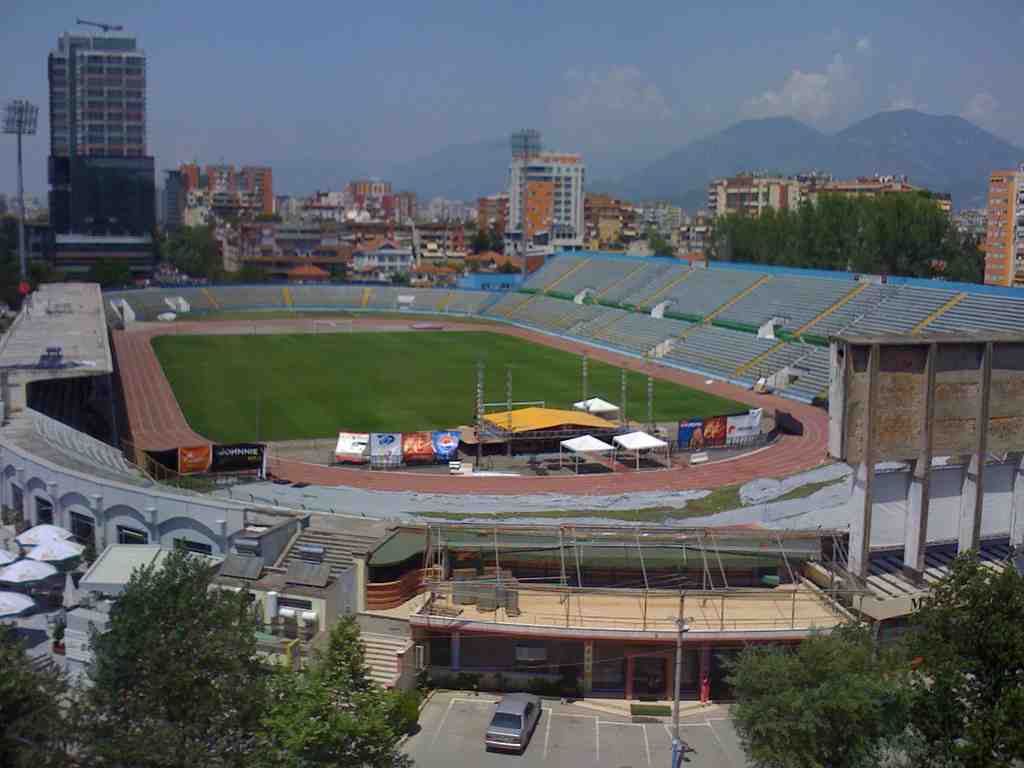
To spot the Qemal Stafa Stadium, just look ahead for a massive oval arena with faded blue and yellow seats surrounding a bright green football field, all nestled right in the heart of bustling Tirana with city buildings and mountains as its scenic backdrop.
Now, step right up and imagine this... You're standing at the very site where the pulse of Albanian football once thundered through the city! Back in 1939, while the world was swirling with uncertainty, a young Italian architect named Gherardo Bosio dreamed up a grand Olympic stadium for the people of Tirana. It was meant to be covered entirely in shiny white marble-guess you could say it was designed to be a real “rock star!” Even though life-and war-interrupted construction, this place was always filled with the energy of hope and determination.
Picture the scene: It’s just after World War II, and over 400 workers and 150 eager volunteers are racing against time to finish this giant, elliptical stadium. The marble only made it onto one stand, but the spirit of Albania was written into every stone. Galeazzo Ciano, an Italian dignitary, even placed the first stone in a ceremony back in 1939-setting in motion a decades-long story of sports, rivalry, and unity.
In 1946, crowds filled the stands to bursting for the big inaugural event: the Balkan Cup! The whole city buzzed as the Albanian national team took on neighbors like Yugoslavia, Bulgaria, and Romania. Can you hear the thundering roar as Albania takes the trophy on their own brand-new field? From that moment, the stadium became a symbol. Not just an arena, but a place where dreams were built and victories became legend.
Over the years, Qemal Stafa Stadium was the beating heart of Albanian football-the battleground for local teams like KF Tirana, Partizani, and Dinamo. It even got a facelift in 1974 for the 30th anniversary of Liberation Day, growing from a modest 15,000 seats to a giant amphitheater meant for over 35,000 shouting fans-though back then, you had to bring your own cushion!
Oh, and here's a bit of stadium magic: in the early 2000s, this very pitch earned a spooky reputation. Newspapers called it the “Qemal Stafa Curse,” because, well, visiting teams rarely managed to win here! Between 2001 and 2004, the Albanian side simply refused to lose at home, shocking big-hitters like Greece-fresh from their Euro 2004 win! Even in 1986, future World Cup semi-finalists Belgium were shown the door with a 2-0 defeat. Maybe the ghosts of those 400 workers never stopped cheering from the stands…
Like every hero, though, the stadium grew old. In the 90s, seats arrived-goodbye splinters, hello comfort! There were upgrades for journalists and even internet access for the super fans. But time marches on, and by the 2010s, the government and the Albanian Football Association were dueling over the stadium’s future: Should they rebuild or sell? After some heated debates (and surely a few missed penalties), the decision was made to pull down the old colossus in 2016.
But not to worry-like a phoenix from the ashes, the Arena Kombëtare now stands right here! It’s bigger, shinier, and fit for 22,500 roaring football fanatics. The athletics track is gone, making way for pure football action, and the arena meets UEFA’s highest standards. Now, the echoes of the past mix with the cheers of the present, where every match carries the weight of history: from marble dreams to modern glory.
So, standing here, you’re truly on hallowed ground-where heroes like Qemal Stafa are remembered, where legends took root, and where, for decades, teams from across Europe came and, more often than not, left scratching their heads and wondering, “How on earth did we lose here?” And if you listen carefully, maybe you’ll still hear the ghosts of games past chanting and cheering from the stands, urging today’s heroes to follow in their legendary footsteps!




