
Audioprzewodnik po St. Charles: Echa sztuki, dziedzictwa i ukrytych zabytków
Miasto, w którym huk parowców rzecznych mieszał się niegdyś z szeptami rewolucji; St. Charles kryje historie pod swoimi ceglanymi ulicami. Każdy wytarty kamień na Starym Moście St. Charles i każdy cień w historycznej dzielnicy skrywa sekrety czekające na odkrycie. Ta wycieczka z audioprzewodnikiem zaprasza do odkrycia wieków legend i podań. Odkryj nieopowiedziane historie o śmiałych ucieczkach, zakulisowych walkach politycznych i dziwnych zdarzeniach, które umykają większości turystów na zatłoczonych chodnikach. Kto wywołał rebelię, która wstrząsnęła korytarzami władzy w Missouri? Jaka tajemnicza postać przemknęła przez Pierwszy Kapitol Stanowy, zmieniając losy regionu? Dlaczego miejscowi mówią ściszonym głosem o północnym biciu dzwonu na moście? Przejdź się wzdłuż nabrzeża, weź udział w tajnych spotkaniach i odkryj St. Charles nowymi oczami i wyostrzonymi zmysłami. Prawdziwe oblicze miasta jest gotowe na poznanie. Rozpocznij swoją podróż i posłuchaj, jak zapomniane historie ożywają pod twoimi stopami.
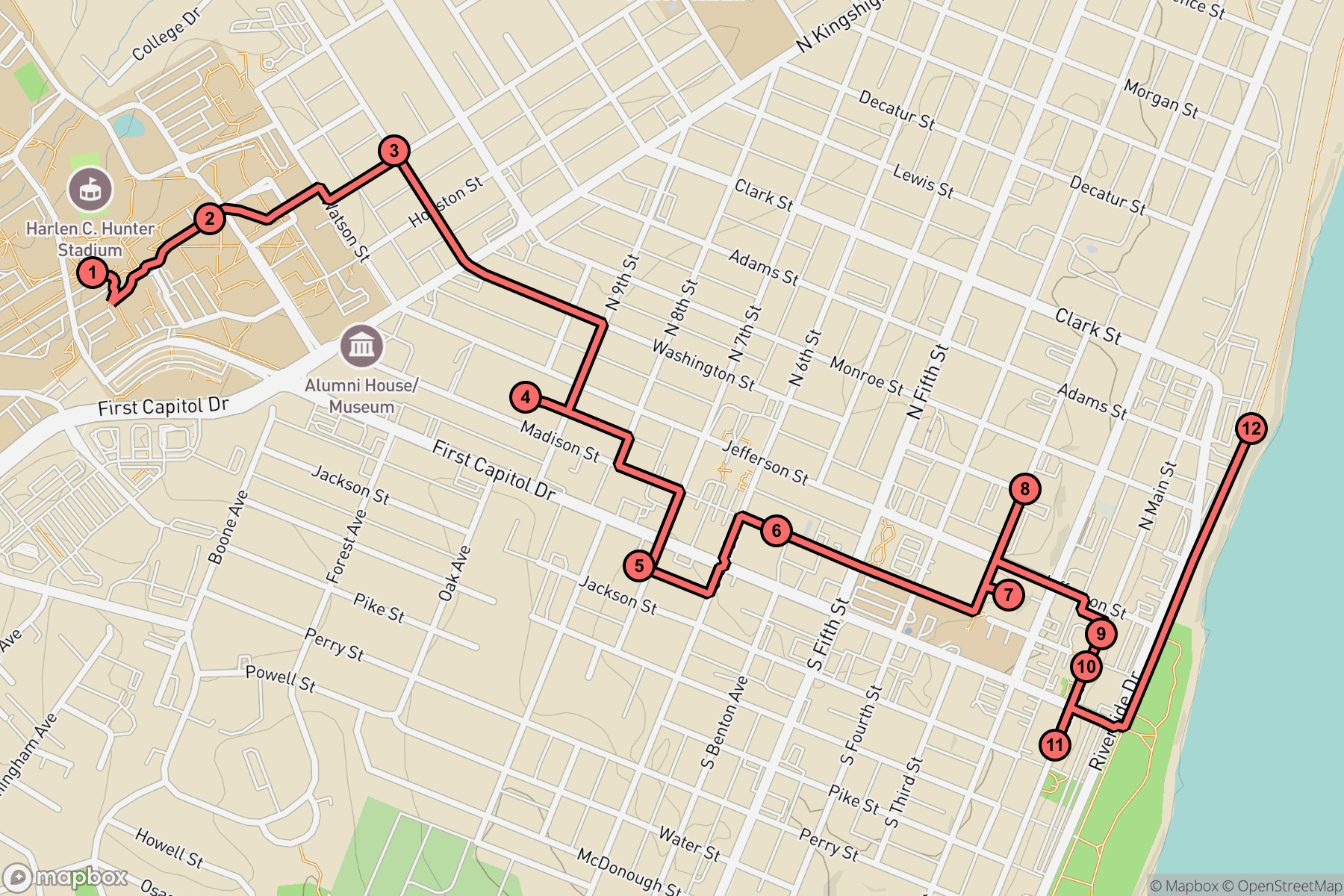
Podgląd trasy
O tej trasie
- scheduleCzas trwania 30–50 minsIdź we własnym tempie
- straighten4.0 km trasy pieszejPodążaj wyznaczoną trasą
- location_onLokalizacjaSt. Charles, Stany Zjednoczone
- wifi_offDziała offlinePobierz raz, korzystaj gdziekolwiek
- all_inclusiveDożywotni dostępOdtwarzaj ponownie w dowolnym momencie
- location_onStart przy Centrum Sztuki J. Scheideggera
Przystanki na tej trasie
You’re standing right in front of the J. Scheidegger Center for the Arts-one of St. Charles’ most dazzling jewels and, honestly, a place that probably has bigger backstage secrets…Czytaj więcejPokaż mniej
You’re standing right in front of the J. Scheidegger Center for the Arts-one of St. Charles’ most dazzling jewels and, honestly, a place that probably has bigger backstage secrets than your local coffee shop! Opened in 2008, this sparkling complex is the pride of Lindenwood University, and it’s about the size of two football fields stacked together-138,000 square feet of pure creativity. All of this came together thanks to a generous $2 million gift from Jerry Scheidegger, a guy who was so helpful, they literally carved his name into the building. Now that’s leaving a mark! Feel the excitement just outside as students rush between dance studios and the main entrance buzzes with theater-goers on a performance night. Inside the main Lindenwood Family Theater, you’ll find 1,200 plush seats waiting for everything from Broadway musicals to major speeches. It’s equipped with high-tech wizardry-think more lights, sounds, and special effects than a magician’s birthday party. If you wander over to the Emerson Black Box Theatre, it’s a cozier spot-just 250 seats and the stage moves around, so every show feels new. This is where experimental plays and creative performances try out their wildest ideas. And if you’re an art lover, the Boyle Art Gallery glows with pieces from local students to international artists. Even the walls get to show off a little. Education here is just as lively. Imagine students rehearsing next door with Steinway grand pianos, costume designers sewing up the next Shakespearean masterpiece, and TV crews bustling around an HD studio, ready for their moment on the air. Big names have pranced these stages too-Hal Holbrook, Liza Minnelli, Glen Campbell, and Patti LaBelle all left their mark. So whether you’re performing your debut, learning your craft, or simply soaking up the art, the J. Scheidegger Center buzzes with possibility-and probably more leftover glitter than anywhere else in Missouri.
Otwórz dedykowaną stronę →You’re standing before Lindenwood Hall-though if you’d been here in 1857, you’d need to watch out for mud instead of concrete! The core of this striking building, known back then…Czytaj więcejPokaż mniej
You’re standing before Lindenwood Hall-though if you’d been here in 1857, you’d need to watch out for mud instead of concrete! The core of this striking building, known back then as Sibley Hall, first rose from the red Missouri earth just before the Civil War. Picture its original three stories, bold and rectangular, all red brick and promise, while the area buzzed with the hum of student chatter and the occasional runaway horse. Over time, Lindenwood Hall grew, donning impressive brick wings-a little expansion here in 1881, another in 1887-until it finally earned its elegant U-shape, like a grand embrace welcoming generations of students. Now gaze up at that Classical Revival portico, the two-story columns giving the place a look somewhere between a stately home and a university that wanted to be a Greek temple when it grew up. Those curved, arched windows peer out like friendly eyes, keeping watch as fads and hat styles changed every decade. A low hipped roof crowns it all, sheltering countless stories, from candle-lit cramming sessions to modern-day college pranks. Named to the National Register of Historic Places in 1978, Lindenwood Hall remains a proud landmark of education and resilience. Quite the glow-up for a building that’s seen more than a few graduation caps-and maybe an awkward freshman moment or two!
Otwórz dedykowaną stronę →These 108 buildings have stories baked right into their bricks, stretching from 1902 to 1956. You’ll spot the whimsical rooflines and spindly porches of Folk Victorians, the…Czytaj więcejPokaż mniej
These 108 buildings have stories baked right into their bricks, stretching from 1902 to 1956. You’ll spot the whimsical rooflines and spindly porches of Folk Victorians, the strong lines of American Craftsman bungalows-maybe the homeowners were the original “DIYers!” Then, rounding a bend, you hit the brick and half-timbered majesty of Tudor Revival houses or the sun-soaked stucco and red tiles of Mediterranean Revivals. Every home here proudly flaunts its own personality. Added to the National Register of Historic Places in 2016, this district is an official time capsule of what made St. Charles tick, dream, and decorate. If you see a squirrel stop and stare, I’m pretty sure it’s just overwhelmed by all those architectural choices.
Otwórz dedykowaną stronę →


Pokaż jeszcze 8 przystankówPokaż mniej przystankówexpand_moreexpand_less
Built around 1855, this church wasn’t just a spiritual home; it was a safe haven. The little red bricks have watched generations come and go, through times of struggle, hope, and…Czytaj więcejPokaż mniej
Built around 1855, this church wasn’t just a spiritual home; it was a safe haven. The little red bricks have watched generations come and go, through times of struggle, hope, and change. But here’s a twist-the building’s story took a sharp turn in 1947, when it was renovated and became someone’s home! Imagine going to sleep in your living room knowing generations had sung, celebrated, and even debated under that same roof. In 1980, the African Church earned its spot on the National Register of Historic Places. If these walls could talk, I bet they’d have some good punchlines. After all, not every house used to ring with both hymns and alarm clocks!
Otwórz dedykowaną stronę →But climb those creaky old stairs in your imagination, and suddenly, things get serious. The second floor was where Missouri’s government was born. Lawmakers debated by…Czytaj więcejPokaż mniej
But climb those creaky old stairs in your imagination, and suddenly, things get serious. The second floor was where Missouri’s government was born. Lawmakers debated by candlelight, their voices mixing with the muffled sound of boots on wooden floors. During a heated November session in 1821, it was here they chose the permanent capital-moving it to the freshly minted City of Jefferson. Today, you can explore those same rooms and two floors of fascinating exhibits. Don’t worry, no government decisions required-just a sense of wonder and, for the brave, maybe a peek into the old gift shop for a souvenir!
Otwórz dedykowaną stronę →You’ve made it all the way to the Old St. Charles Bridge! As you stand here, picture yourself on the banks of the Missouri River-foggy mornings, steamboats gliding by, and a brand…Czytaj więcejPokaż mniej
You’ve made it all the way to the Old St. Charles Bridge! As you stand here, picture yourself on the banks of the Missouri River-foggy mornings, steamboats gliding by, and a brand new iron bridge stretching out across the water in 1904. The bridge didn’t just appear overnight, oh no. Construction started in 1902 and boy, was it a circus! Materials like lumber and steel didn’t always show up on time. Sometimes, storms would roll through and force the workers to pack up their tools. There was even a courtroom drama when a dispute broke out over where exactly the bridge could go. The workers-known as sandhogs-had to work deep inside the piers, sometimes ferrying supplies across the river because there was no storage space in St. Charles. It’s not every day your first commute is by boat to build a bridge! When it finally opened in time for the 1904 St. Louis World’s Fair, the bridge was a two-trick pony: part highway, part streetcar. Crowds gathered, cars rumbled across, and streetcars rattled by. Imagine the clang of the old toll gate-yes, you had to pay to cross until 1931. The streetcar station is actually still standing over at 2nd and Adams, like an old ticket stub to a grand show. In the late 1920s, electric lines were strung across the bridge. They even needed special insulators developed in New York, just to keep up with Missouri’s river humidity-talk about high-maintenance! By 1932, trolleys and tolls were history. The bridge served highways and travelers for decades, joining Route 40 and later Route 115. In 1959, it watched as the new U.S. Route 40 bridge stole the show. Officially closed in 1992 and brought down in 1998, this engineering marvel lives on in memory-and in the Historic American Engineering Record. So, next time you cross the river, give a quick nod to the bridge that turned everyday commutes into a true adventure. And remember: somewhere out there, a sandhog is still shaking his fist at a missed steel shipment!
Otwórz dedykowaną stronę →


Najczęściej zadawane pytania
Jak rozpocząć trasę?
Po zakupie pobierz aplikację AudaTours i wpisz kod realizacji. Trasa będzie gotowa do natychmiastowego rozpoczęcia – po prostu dotknij \"Play\" i podążaj trasą z nawigacją GPS.
Czy potrzebuję internetu podczas trasy?
Nie! Pobierz trasę przed rozpoczęciem i korzystaj z niej w pełni offline. Jedynie funkcja czatu wymaga internetu. Zalecamy pobieranie przez WiFi, aby oszczędzać dane mobilne.
Czy to wycieczka grupowa z przewodnikiem?
Nie – to samodzielny audioprzewodnik. Zwiedzasz niezależnie, we własnym tempie, z narracją audio odtwarzaną przez telefon. Bez przewodnika, bez grupy, bez harmonogramu.
Ile trwa trasa?
Większość tras zajmuje 60–90 minut, ale to Ty kontrolujesz tempo. Wstrzymuj, pomijaj przystanki lub rób przerwy, kiedy chcesz.
Co jeśli nie zdążę ukończyć trasy dzisiaj?
Żaden problem! Trasy mają dożywotni dostęp. Wstrzymaj i wznów, kiedy chcesz – jutro, za tydzień lub za rok. Twój postęp jest zapisywany.
W jakich językach są dostępne trasy?
Wszystkie trasy są dostępne w ponad 50 językach. Wybierz preferowany język podczas realizacji kodu. Uwaga: języka nie można zmienić po wygenerowaniu trasy.
Gdzie znajdę trasę po zakupie?
Pobierz darmową aplikację AudaTours z App Store lub Google Play. Wpisz kod realizacji (wysłany e-mailem), a trasa pojawi się w Twojej bibliotece, gotowa do pobrania i rozpoczęcia.
Jeśli trasa Ci się nie spodoba, zwrócimy Ci pieniądze. Skontaktuj się z nami pod adresem [email protected]
Bezpieczna płatność przez 


