Wycieczka audio po Queens: Historia, natura i innowacje
Stalowe globusy górują nad tajemniczymi ogrodami buntowników. W sercu Queens historie kryją się za lśniącym szkłem i ryczącymi wybiegami. To wycieczka audio z samodzielnym zwiedzaniem, która odsłania to, co codzienne, prowadząc prosto przez parki i bulwary Corona. Usłysz szepty kontrowersji wewnątrz Muzeum Queens i poszukaj niespodzianek w pobliżu ikon, które turyści mijają każdego dnia w pośpiechu. Każdy przystanek odkrywa warstwy pomijane przez zabieganych zwiedzających. Dlaczego skandal zmieniający świat rozegrał się zaledwie kilka kroków od Unisphere? Jakie zaginione zwierzę wywołało kiedyś panikę w Zoo w Queens po zapadnięciu zmroku? W jaki sposób jeden mural uwiecznia dekady cichego oporu politycznego? Ustal własne tempo i odblokuj wspomnienia pod gałęziami wierzb i mozaikowym niebem. Podążaj ścieżkami naznaczonymi protestem, zachwytem i sekretami, którymi dzielą się tylko miejscowi. Każdy zakręt prowadzi głębiej w nieoczekiwany Nowy Jork. Największe historie miasta czekają na widoku. Ruszaj naprzód i zobacz to, co było ukryte przez cały czas.
Podgląd trasy
O tej trasie
- scheduleCzas trwania 40–60 minsIdź we własnym tempie
- straighten4.5 km trasy pieszejPodążaj wyznaczoną trasą
- location_onLokalizacjaQueens, Stany Zjednoczone
- wifi_offDziała offlinePobierz raz, korzystaj gdziekolwiek
- all_inclusiveDożywotni dostępOdtwarzaj ponownie w dowolnym momencie
- location_onStart przy Stadion Arthura Ashe’a
Przystanki na tej trasie
Welcome to Queens. You are standing right in front of Arthur ash Stadium, the undisputed heavyweight champion of tennis arenas. It is truly a marvel. Holding over twenty-three…Czytaj więcejPokaż mniej
Welcome to Queens. You are standing right in front of Arthur ash Stadium, the undisputed heavyweight champion of tennis arenas. It is truly a marvel. Holding over twenty-three thousand fans, it is by far the world's largest tennis stadium. This colossal structure is named after Arthur ash, winner of the inaugural nineteen sixty-eight US Open and a tireless civil rights advocate. When the stadium was dedicated in nineteen ninety-seven, his widow noted the tribute served as a fitting present honoring his legendary humanitarian achievements, as well as what would have been their twentieth wedding anniversary. That barrier-breaking spirit lives on at the players entrance, where a plaque displays a quote from tennis legend Billie Jean King: Pressure is a privilege. That phrase actually comes from a moment of pure panic. During a year two thousand tournament, a very nervous six-foot-three Lindsay Davenport pleaded with King, her captain, to just say something to help her. King looked up and spontaneously fired back, Pressure is a privilege, and champions adjust. Davenport absorbed the impromptu wisdom and went on to win the match. Opening this two-hundred-and-fifty-four-million-dollar venue was a spectacle, featuring Whitney Houston singing at the inauguration. But New York City mayor Rudy Giuliani intentionally boycotted the gala. He protested an outrageous contract clause that forced the city to pay massive fines if airplanes from nearby LaGuardia Airport flew over and disrupted matches. Disruption, it turns out, is built right into the fabric of this place. This court has seen fierce drama, like the two thousand eighteen finals where Serena Williams clashed with the chair umpire over alleged hand signals from her coach, sparking a global debate about sexism and double standards in officiating. It also hosts the unexpected. In two thousand nineteen, a sixteen-year-old gamer named Bugha won a three-million-dollar grand prize here at the Fortnite World Cup, out-earning Wimbledon's winner that same year. AEW professional wrestling has packed these stands with deafening ovations, and in twenty twenty, this sweeping complex was even transformed into a massive makeshift hospital to relieve local medical centers during the pandemic. The most fascinating engineering feat is right above you. For years, unpredictable rain and wind delayed tournaments, so they desperately needed a roof. There was just one problem. The ground beneath you used to be a wetland swamp, and later, a sprawling industrial dumping ground. The soil was incredibly poor. To solve this, engineers designed two huge, eight-hundred-ton fabric panels made of a lightweight PTFE membrane, which is a super-strong, high-tech synthetic material. Those panels glide shut at twenty-five feet per minute, flawlessly controlling the environment. Here, a sweeping master plan of a high-tech stadium sits on a humble foundation of swamp and ash, brought to life by raw, unpredictable human emotion. As we will see, that battle between massive architectural ambition and the reality of the ground below defines this entire park. In fact, Arthur ash Stadium sits on the exact footprint of an earlier, equally ambitious dream. Right where you are standing, we will explore the ghost of the United States Pavilion.
Otwórz dedykowaną stronę →You are standing right where Arthur ash Stadium is today, but I want you to picture what was hovering right over this exact spot back in 1964. It was the United States Pavilion,…Czytaj więcejPokaż mniej
You are standing right where Arthur ash Stadium is today, but I want you to picture what was hovering right over this exact spot back in 1964. It was the United States Pavilion, and it was an absolute architectural fever dream. Imagine a colossal, glowing hollow square, 84 feet tall, floating in the air on just four massive concrete stilts. The exterior walls were built from translucent blue and green plastic panels that caught the sun and glowed brilliantly from the inside at night. It sat like a futuristic fortress over a moat filled with rushing fountains, accessible only by massive pyramid shaped staircases. Inside, visitors hopped into slow moving vehicles for an amusement park style dark ride called the American Journey. This sprawling 15 minute tour through history was scripted by the science fiction legend Ray Bradbury, and it featured over a hundred giant screens surrounding the track. This was the crown jewel of the 1964 World's Fair. The fair was an absolute titan of an event, sprawling across hundreds of acres with a grand theme called the challenge to greatness. It was a wildly expensive vision of a shiny, unified future where powerful governments and corporations told everyone exactly what tomorrow would look like. And the man pulling the strings of this entire utopian spectacle was Robert Moses. Moses was the incredibly powerful parks commissioner and the mastermind behind New York City highways, bridges, and public works. He actually did not care much about the fair itself, but he brilliantly used the massive event to funnel millions of dollars into transforming what was once a literal ash dump into his ultimate dream of a permanent, pristine park. To build the United States Pavilion, the federal government shelled out 17 million dollars, which is roughly 170 million dollars today. It was built to compel the admiration of mankind. But grand visions have a funny way of colliding with messy reality. On opening day, while the president delivered a soaring dedication speech, hundreds of civil rights activists organized a sit in right at the pavilion doors to protest racial inequality, forcing the leaders to face the very real struggles happening on the ground. When the fair ended in 1965, Moses wanted the pavilion torn down so he could finish his park, while preservationists begged to save it. But nobody wanted to foot the massive maintenance bills. So, the futuristic palace just sat there, rotting. The magnificent glowing panels were shattered and covered in graffiti. By the 1970s, the people had reclaimed this massive federal fortress in their own gritty way. A squatter brazenly replaced the padlocks on the doors and claimed the building as a personal castle. They stripped out the valuable copper wiring and stole the power transformer to sell for scrap metal. The ultimate symbol of top down greatness had become a decaying shell, completely surrendered to the chaotic, organic life of the city. A mysterious fire swept through the ruins in March 1977, sending huge plumes of smoke into the sky and destroying any hope of saving the structure. It was finally demolished, and the site was eventually flattened to build the tennis stadium in front of you. Some of these monumental structures refused to die, finding completely unexpected second lives in the hands of the community. Let us keep walking to see more. Our next stop, the Grandstand, is just a five minute walk away.
Otwórz dedykowaną stronę →Look to your left and you will see Grandstand, a massive stadium that looks perfectly round but actually has sixteen distinct sides, wrapped entirely in hundreds of smooth fabric…Czytaj więcejPokaż mniej
Look to your left and you will see Grandstand, a massive stadium that looks perfectly round but actually has sixteen distinct sides, wrapped entirely in hundreds of smooth fabric panels with an asymmetrical sweeping canopy rising high on one corner. You know, this pristine modern arena owes its soul to something beautifully chaotic. The original Grandstand, which used to sit on the east side of this facility, was born from the grandiose ambitions of the 1964 World's Fair. Back then, there was an enormous, oblong, octagonal structure called the Singer Bowl. When the tennis association took over the site, they did not just knock it down. Instead, they sliced that massive arena right down the middle to create two separate courts. The old Grandstand became a beloved, quirky carbuncle tucked away in the shadows, totally transforming a piece of highly planned World's Fair architecture into a rugged, organic hangout for everyday, die-hard fans. People affectionately remembered the old Grandstand as a half-hidden arena that felt like a secret club, accessible with just a basic ticket. You could camp out on those overcrowded benches for hours on end. It was cramped. It was loud. Players literally had to inhale the meaty fumes drifting down from a food court suspended right above the west stands. But that raw, grassroots energy gave the court a fearsome reputation as the house of upsets. One sportswriter even likened it to a sixteenth-century English bear-baiting den... a brutal, intimate pit where crowds packed in close to watch wild spectacles. When a top-seeded player started to falter, the famously rowdy Queens crowd would roar, practically howling for an underdog to claim a new victim. This wild energy fueled incredible tennis history. In 1987, nineteen-year-old German wunderkind Boris Becker was cruising with a two-set lead against American Brad Gilbert. But then Becker double-faulted, and the door swung open. The partisan crowd roared to life, carrying Gilbert to a grueling four-hour, five-set marathon victory. When it came time to build this brand new Grandstand in 2016, architects faced a massive challenge. How do you recreate that organic, community-driven intimacy in a carefully engineered modern design? They discovered that the deep shadow fans loved at the old Grandstand was actually just a happy accident... a massive silhouette cast by a neighboring stadium. To intentionally recreate that comfort, designers gave this new building its distinctive sweeping canopy, keeping most seats entirely in the shade. They even sank the court eighteen feet below ground level to ensure fans remained right on top of the players. And the drama absolutely survived the move. During a tense match in 2025, Daniel Altmaier used an underarm serve... a legal but sneaky tactic... against Stefanos Tsitsipas. Tsitsipas was so furious he intentionally fired a forehand shot directly at Altmaier at the net, striking him with the ball. During the post-match handshake, Tsitsipas warned him not to wonder why he was hit. The modern Grandstand crowd showered him with relentless boos, proving the raucous, gritty soul of the old court is very much alive right here. Now, let us leave the intense rivalries of the tennis courts behind and head toward the park's absolute showstopper, its most iconic, unmissable centerpiece. It is just a short six minute walk away.
Otwórz dedykowaną stronę →
Pokaż jeszcze 10 przystankówPokaż mniej przystankówexpand_moreexpand_less
Look to your right and you will spot a massive spherical framework crafted from gleaming stainless steel, shaped perfectly like a hollow globe and completely encircled by three…Czytaj więcejPokaż mniej
Look to your right and you will spot a massive spherical framework crafted from gleaming stainless steel, shaped perfectly like a hollow globe and completely encircled by three sweeping orbital rings. Stand directly in front of it and take it all in. Before this towering monument to the space age existed, the ground you are standing on was an absolute nightmare. This exact site was once the infamous Corona Ash Dumps, a blighted, smoldering landscape immortalized as the dark, choking valley of ashes in F. Scott Fitzgerald's The Great Gatsby. New York power broker Robert Moses wanted to erase that gritty history. For the 1964 World's Fair, he demanded a dazzling centerpiece that screamed progress. The spark came when designer Gilmore D. Clarke sketched a revolving globe on the back of an envelope while flying on an airplane. Industrial designers refined the idea, studying delicate wire sculptures at the Metropolitan Museum of Art to figure out how to make a massive metal structure appear elegant and light. The result is the Unisphere. Weighing nine hundred thousand pounds, it is the largest globe in the world. Building it was a technological marvel. The structure had so many interconnected, overlapping parts that engineers could not simply calculate the forces using standard math. If done by hand, it would have taken ten years. Instead, the builders used an early IBM computer to crunch over six hundred simultaneous equations just to balance the heavy stainless steel continents, which catch the wind like giant metal sails. Those three sweeping rings you see represent the first men in space and the first communications satellite. But while executives praised this top-down utopian vision, the real soul of the Unisphere belongs to the grassroots community. The globe was assembled by fifty Mohawk ironworkers. They pulled off this incredibly dangerous high wire act without a single injury. They even demanded a bit of recognition. During the fair, lights dotted the globe to mark world capitals. The ironworkers successfully lobbied to have a light placed on their home reserve of Kahnawake, making their community shine as brightly as Paris or London. Down below, the shiny future promised by the fair clashed with everyday reality. On opening day, civil rights activists protested right around this globe, fighting against job discrimination and police brutality. After the fair ended, the pristine corporate vision crumbled. The park was neglected. The reflecting pool became a concrete canvas for local graffiti artists. Eventually, dirt and bird droppings accumulated so thickly on the steel plates that actual grass began growing on the continent of Antarctica. Nature and the neighborhood were reclaiming the corporate symbol. During a freak tornado, the massive steel island of Sri Lanka was actually blown right off the globe, though it was thankfully rescued and reattached. Over time, everyday New Yorkers breathed new life into the Unisphere. Skateboarders turned the smooth, drained fountain base into a legendary skate spot. Movie fans flocked here to see the monument made famous by the film Men in Black. Take a moment to look around at the vast, green park that miraculously replaced those smoldering ashes. Next, we are taking a short two minute walk deeper into Flushing Meadows-Corona Park.
Otwórz dedykowaną stronę →Look at the sheer scale of Flushing Meadows Corona Park stretching out before you. At nearly nine hundred acres, it is a massive green expanse. But to really understand this…Czytaj więcejPokaż mniej
Look at the sheer scale of Flushing Meadows Corona Park stretching out before you. At nearly nine hundred acres, it is a massive green expanse. But to really understand this place, you have to look past the manicured lawns and concrete paths. Imagine this area twenty thousand years ago. Retreating glaciers carved out a lush, tidal wetland here. For centuries, the Canarsee and Rockaway Native American groups lived alongside a thriving salt marsh filled with waterfowl, fish, and fiddler crabs. Even in the late eighteen hundreds, this area was a beautiful waterfront resort where affluent visitors arrived by steamboat. Then came the relentless machine of industry. In the early nineteen hundreds, contractors looked at this complex ecosystem and saw only worthless swampland waiting to be exploited. A corrupt political outfit called the Brooklyn Ash Removal Company took over the meadows. Every single day, over one hundred railroad cars came rumbling in, dumping household coal ash, street sweepings, and raw garbage straight onto the wetlands. The locals called these uncovered, soot-spewing trains the Talcum Powder Express. Soon, the beautiful marsh was choked by a smoldering, rat-infested wasteland. One pile of refuse, ironically named Mount Corona, rose a staggering ninety feet into the air. If that sounds just like the famous Valley of ashs from F. Scott Fitzgerald's The Great Gatsby, that is exactly what this place was. While wealthy residents remained entirely insulated from the horror, the local Italian and Black American communities suffered daily through the noxious smoke. When a devastating polio outbreak struck the area in nineteen sixteen, desperate residents sued the ash company, blaming the horrific conditions. But the company’s powerful political connections ensured they escaped any legal consequences. By the nineteen thirties, a powerful city planner named Robert Moses decided to impose a new, grandiose vision on this broken landscape. He wanted to wipe away the ash dump and build a glorious, strictly organized venue for the nineteen thirty nine World's Fair. It was a monumental, forceful feat of top-down engineering. Workers operated in three daily shifts around the clock, leveling fifty million cubic yards of ash. They literally forced the natural Flushing River into underground pipes to control the water. Houses on the edge of the dumps were simply condemned, and everyday residents were forced out to make way for the grand design. Decades later, Moses doubled down for the nineteen sixty four World's Fair, projecting a massive one hundred million dollar profit, which is over one billion dollars today. But he blatantly broke international exhibition rules to achieve it, charging outrageous rent to exhibitors. This arrogant defiance led to a massive boycott by major nations and a spectacular financial failure, returning only twenty cents on the dollar to investors. Moses built his rigid utopia, but the land never completely surrendered. Because the marsh was just filled in rather than properly raised, the park still battles severe flooding today as the buried wetlands try to resurface. Yet, the community has organically reclaimed this engineered landscape. Instead of a pristine, untouchable monument, it is now a beautifully chaotic hub for local soccer leagues, cricket matches, and sprawling night markets that celebrate the diverse neighborhoods surrounding it. As we continue, look ahead for the towering, brightly colored observation decks of the New York State Pavilion. We are going to head over to those looming, futuristic ruins next. It is a brief four minute walk away.
Otwórz dedykowaną stronę →On your right, you will see a colossal ring of sixteen thick concrete columns supporting a crown of rusted steel cables, flanked by three soaring concrete pillars topped with…Czytaj więcejPokaż mniej
On your right, you will see a colossal ring of sixteen thick concrete columns supporting a crown of rusted steel cables, flanked by three soaring concrete pillars topped with saucer-shaped observation decks. It almost looks like the ruins of an ancient Roman stadium, but built by aliens. Look at this spectacular, ghostly structure. This is the New York State Pavilion, and it perfectly embodies the mid-century obsession with a flawless, space-age future. Back in the nineteen sixties, urban planners truly believed that cutting-edge technology, grand architecture, and sheer ambition could engineer a perfect society. They envisioned a gleaming tomorrow where everything was bigger, brighter, and soaring above the clouds, leaving the grit of everyday life far behind. Robert Moses, the mastermind behind the fair, wanted a monument that proved New York was the center of that shimmering future. Architect Philip Johnson gave him exactly that with the Tent of Tomorrow. Just imagine it in nineteen sixty four. Those concrete columns held a massive suspension roof made of multicolored translucent plastic panels, completely free of internal pillars. Sunlight would pour through the futuristic canopy, bathing the ground below in vibrant reds and blues. And what a ground it was. Covering the entire floor was a monumental map of New York State made of terrazzo. Over five hundred precast panels, each weighing four hundred pounds, formed the mosaic. It cost one million dollars to build, which is roughly nine million dollars today. To create it, students were hired to trace maps onto massive paper templates so that every single road, town, and local gas station was meticulously plotted out. Visitors could even pay fifty cents to ride the Sky Streak capsule elevators up those massive two hundred and twenty six foot observation towers for a panoramic view of the fairgrounds. The original grand plan dictated that the incredible terrazzo floor would be carefully packed up and moved to the state capital after the fair. But that top-down promise never happened. The politicians simply left it here. As the decades passed, the vibrant plastic roof shattered and was ultimately removed. The intricate map cracked and faded. It became a beautiful, melancholic ruin. But while the powerful abandoned this utopian dream, the community breathed organic, chaotic new life into it. In the nineteen seventies, locals transformed the empty tent into an outdoor roller rink. Because it was an open-air facility, tens of thousands of skaters glided freely beneath the massive, rusting cables. They rented skates for thirty five cents and rolled right over a clear plastic coating protecting the faded terrazzo map. It was a massive, unexpected success. Years later, when the pavilion fell into deep decay and the massive steel rim of the tent began to rust, it was not the city government that stepped in to save it. It was two local guys, John Piro and Mitch Silverstein. Heartbroken by the decay, they spent their own money and their own Saturdays hand-painting the red and white stripes back onto the base of the pavilion. The grand visionaries built it, but the everyday people of Queens refused to let it die. You can still see those three flying saucer observation towers reaching up toward the sky. They were once the highest point of the entire World's Fair. But as we leave these towering heights behind, we are going to look for something entirely different. We are moving from the clouds to a hidden secret buried deep beneath the dirt. Our next stop, the Underground World Home, is about a fifteen minute walk away.
Otwórz dedykowaną stronę →Right here to your right is the former site of one of the most bizarre exhibits of the 1964 World's Fair. While the rest of the pavilions celebrated a sparkling, united future…Czytaj więcejPokaż mniej
Right here to your right is the former site of one of the most bizarre exhibits of the 1964 World's Fair. While the rest of the pavilions celebrated a sparkling, united future above ground, this plot of dirt held a much darker vision. It was the Underground World Home. The Fair opened just two years after the Cuban Missile Crisis brought the globe to the absolute brink of nuclear destruction. That intense Cold War paranoia spurred a sudden, highly lucrative market for luxury bunkers, promising survival with all the comforts of a modern suburb. Architect Jay Swayze and millionaire Girard B. Henderson decided to capitalize on that terror. They excavated a massive fifteen-foot-deep trench right into the Flushing Meadows marsh and dropped in a six-thousand-square-foot, ten-room subterranean mansion. It was encased in twenty inches of steel and concrete, with a roof built to support two million pounds of insulating soil. This was not your average survival tin can. It was pitched as the ultimate escape from the unpredictable world above. But living in a sealed box can drive a person crazy, so Swayze installed a dial-a-view system. Instead of windows, occupants looked at backlit murals painted by Texas artist Mrs. Glenn Smith. By turning a dial, you could swap your faux window view from the New York City skyline to the Golden Gate Bridge. You even had a dimmer switch to simulate a rising sun in the kitchen, or cast a star-filled night sky over your underground patio. There was a snorkel-like air conditioning apparatus that purportedly filtered the air so well you only had to dust once a month. It was a complete, artificial utopia, a highly engineered bunker disconnected from the messy reality of human community. And fairgoers were not exactly buying it. First, you had to pay a dollar fifty just to get inside the exhibit, which deterred many tourists. And if you actually wanted to buy the house? The price tag was eighty thousand dollars, which is roughly eight hundred thousand dollars in today's money. Not a single home was commissioned. Swayze's partner, Henderson, remained a true believer in the nuclear threat. He eventually built an even more lavish fifteen-thousand-square-foot underground mansion in Las Vegas, buried twenty-six feet down, complete with a swimming pool, a putting green, and fake trees hiding steel support beams. For decades, a tantalizing urban legend floated around Queens. Historians and explorers whispered that Swayze, hoping to avoid high demolition costs, had simply emptied the home of its furniture and left the massive concrete shell completely intact beneath the dirt. The idea of a pristine luxury bunker sleeping silently in the dark fueled endless searches. But sadly, a 2017 archival discovery ruined the mystery. Documents proved the home was completely demolished on March 15, 1966. If anything at all is left down there, it is just the concrete foundation. The Underground World Home offered a paranoid fantasy of complete isolation, trading the vibrant, shared spaces of the city for a heavily armored, private cavern. But humans naturally crave connection, not sealed vaults. So let us head back up to the surface and look at something completely different. We are going to walk toward a highly elevated, equally strange structure that is just a five-minute walk away. Follow the path toward Terrace on the Park.
Otwórz dedykowaną stronę →Look to your right and you will see a massive, flat topped concrete structure suspended midair on four giant pillar legs, proudly displaying the red letters Terrace on the Park…Czytaj więcejPokaż mniej
Look to your right and you will see a massive, flat topped concrete structure suspended midair on four giant pillar legs, proudly displaying the red letters Terrace on the Park across its upper rim. We just left the quiet domestic dream of the Underground World Home, but up there, floating one hundred and twenty feet above the ground, is Robert Moses's ultimate space age fantasy. Moses, the president of the nineteen sixty-four World's Fair Corporation, wanted an aerial gateway. He imagined a futuristic transportation hub where VIPs would bypass the messy streets below and hopscotch across city rooftops in high speed helicopters. The Port Authority spent two point four million dollars to build it, about twenty-four million today. They designed it in the Brutalist style. Those four giant legs create a T shape on each side, standing for transportation. The plan was thrilling. Businessmen would land on the roof, ride an elevator down into an opulent restaurant called Top of the Fair, and dine on crab ravigote while looking down at the crowds. Inside, the artwork perfectly captured the grand ambitions of the fair. The famous cartoonist Rube Goldberg even painted a mural called How to Cure World's Fair Tired Feet, depicting a wacky, overly complex contraption of gadgets to soothe aching soles. But grand master plans rarely survive contact with reality. Helicopter travel was simply too expensive and impractical for the average fairgoer, who was already paying a steep admission fee just to access the restaurant. Diners complained about poor service, and by August of the fair's very first year, Top of the Fair filed for bankruptcy. Ultimately, the broader city vision of a sprawling network of rooftop helipads died after a tragic helicopter accident on a Manhattan skyscraper in nineteen seventy-seven. Yet, when the top down utopian dream failed, the local community claimed this floating concrete box and made it completely their own. In nineteen sixty-nine, it reopened as a catering venue named Terrace on the Park, entirely shifting its focus from exclusive sky high VIPs to neighborhood celebrations. Queens residents transformed it into a legendary party palace. The sheer scale of those enormous ballrooms meant people threw impossibly extravagant celebrations. One groom actually rode a live horse right into the building, and a boy celebrating his bar mitzvah was famously paraded into the ballroom on a real baby elephant. The building became deeply woven into Queens pop culture. In nineteen sixty-five, The Beatles landed a helicopter on that roof, then rushed to their concert in an armored truck to escape screaming teenagers. Years later, Fran Drescher, the future star of the sitcom The Nanny, married her high school sweetheart here. Around that same time, a young, unknown dancer named Madonna got a job running the venue's elevators. She was famously fired after just two weeks because she was caught having sex with a waiter inside the elevator car. You really cannot script that kind of local history. From a failed playground for airborne elites to a beloved stage for neighborhood weddings and wild teenage escapades, this hovering banquet hall proves that the best urban spaces are the ones the people adapt for themselves. Now, from luxury dining in the sky, we are going to look toward the final frontier of space. Let's walk about six minutes to our next stop, the New York Hall of Science.
Otwórz dedykowaną stronę →Approaching on your right, you will see a massive, amoeba-shaped structure made of curving concrete, completely windowless but covered in a striking grid of deep blue glass…Czytaj więcejPokaż mniej
Approaching on your right, you will see a massive, amoeba-shaped structure made of curving concrete, completely windowless but covered in a striking grid of deep blue glass panels. Welcome to the New York Hall of Science. Those panels use a technique called dalle de verre. The original architect, Wallace Harrison, designed this eighty-foot-tall, undulating wall without a single straight edge to give visitors the calming illusion of floating in deep space. Just a few minutes ago we were at Terrace on the Park, taking in another colossal remnant of the 1964 World's Fair. It is incredible to think that this entire area was once a blighted landscape. The powerful urban planner Robert Moses bulldozed those heaps to create a gleaming, top-down vision of the future. He wanted massive pavilions and grand monuments. At the time, this building housed exhibits meant to inspire awe, but they were also designed to manage some deep Cold War paranoia. Take Atomsville USA, an exhibit built right here in the original pavilion. It was a cheerful, hands-on atomic playground for children, complete with push buttons and games. The government was desperately trying to make nuclear energy feel domestic and safe. They were so committed to this idea that in 1967, the city allocated over ten million dollars, which is nearly one hundred million dollars in modern money, to build a sprawling Nuclear Science Center right here. The star attraction was going to be the Atomarium, a spiral theater where visitors would watch a real, live research reactor go critical. A demonstrator was literally going to stand on a clear plexiglass window directly over the reactor core. As you might expect, dictating that a live nuclear reactor be placed in the middle of a densely populated Queens neighborhood did not go over well. Local residents fiercely protested, and the project was entirely scrapped. Without that massive infusion of cash, the grand vision for this space began to rot. By the early 1980s, the adjacent Space Park, where towering Atlas and Titan rockets stood, was a vandalized mess covered in peeling paint and graffiti. Those rockets were built for the Air Force but never saw military use, and seeing them neglected felt like the end of an era. The museum itself was abandoned. When physicist Alan J. Friedman was hired to take over in 1984, he literally had to wade through an inch of standing water just to get inside. The building was a devastated, empty shell. But Friedman saw an opportunity to flip the script. Instead of imposing untouchable, top-down science fiction onto the public, he rebuilt the museum from the ground up to serve the actual community. He focused entirely on hands-on, interactive exhibits that kids could touch, pull, and test. It worked brilliantly. Now, the Hall of Science is a bustling, organic community hub. It even partners with a local preschool, turning the museum into a daily classroom for young children. The grandiose utopian dreams of 1964 collapsed, but what grew in their place is so much more vibrant and real. Instead of a sterile world of tomorrow, this space now pulses with the chaotic, joyful energy of the people who actually live here. And speaking of vibrant local energy, our next stop is just a six minute walk away. We are heading to the Queens Night Market, which actually sets up right in the parking lot here. Let us go check it out.
Otwórz dedykowaną stronę →Look to your right at that wide flat expanse of paved asphalt, marked by rows of white canopy tents standing just behind a low metal barrier. This space might look incredibly…Czytaj więcejPokaż mniej
Look to your right at that wide flat expanse of paved asphalt, marked by rows of white canopy tents standing just behind a low metal barrier. This space might look incredibly simple compared to the massive concrete rockets of the Hall of Science we just saw, but this is the Queens Night Market. What happens here is a spectacular victory for the people of this borough. Instead of some billion dollar master plan handed down by politicians, this market is a triumph of pure grassroots energy, transforming an everyday patch of park into a chaotic celebration of Queens' incredible diversity. It proves that the most powerful things in a city are not built by committees, but by neighbors sharing their culture plate by plate. It all started with a guy named John Wang. He was a university trained corporate lawyer who was utterly burnt out and just two weeks away from leaving New York for good. But he had a wild idea. He remembered the buzzing, community focused night markets of his childhood in Taiwan, and decided to recreate that magic right here. He had zero background in event planning. He just poured his life savings into the project and gave himself exactly one year to succeed or fail. Opening night in April 2015 was an absolute, glorious disaster in the best way possible. Wang and his tiny crew were completely unprepared. Massive, crushing crowds flooded the park, completely overwhelming the forty vendors. It was so instantly popular they eventually had to start ticketing the early preview nights just to keep the sheer volume of people from breaking the event. Wang instituted a strict five dollar price cap on all food, which is now six dollars. He actually called it his personal rebellion against how insanely unaffordable New York City had become. But keeping it that cheap required brutal personal sacrifice. Wang did not take a single day off for five years. He ran it with no staff for eight years and did not even break even until year three. Today, they rely on corporate sponsors to subsidize the vendors so the food stays cheap. The true heart of this market is the vendors, who represent over eighty countries. Wang's wife, oral historian Storm Garner, preserved their incredible stories in a university thesis that became a published cookbook. You learn about people like Maeda Qureshi, who ran a stall called The Pakistand to raise money for charities. When the pandemic hit in 2020 and the market paused, the community was devastated. Qureshi actually paused her stall to work full time as an intensive care unit nurse in Elmhurst. Meanwhile, immigrants like Danny Atehortua from Colombia used the massive crowds here to launch Arepalicious, which is now a permanent physical restaurant. Now, let us walk toward a building that has seen almost every single era of this park's sprawling history. We are heading over to the Queens Museum, just a six minute stroll away.
Otwórz dedykowaną stronę →Leaving the vibrant, community-driven energy of the Queens Night Market behind, look at the monumental concrete structure on your left. This is the Queens Museum. But when it was…Czytaj więcejPokaż mniej
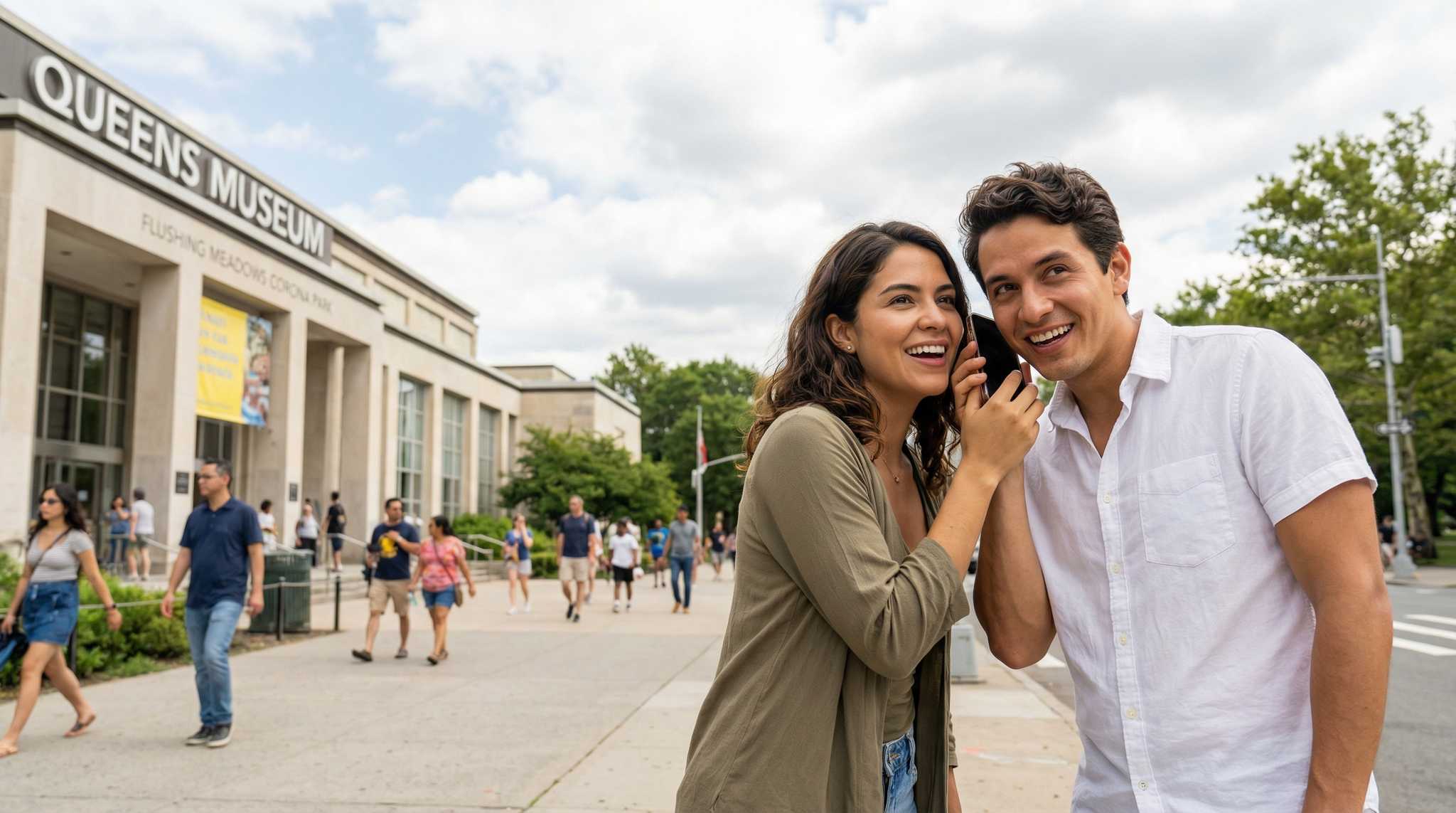
Leaving the vibrant, community-driven energy of the Queens Night Market behind, look at the monumental concrete structure on your left. This is the Queens Museum. But when it was constructed for the 1939 World Fair, it was known as the New York City Pavilion. Mayor Fiorello La Guardia wanted a colossal monument to project the absolute power and efficiency of modern municipal government. It cost over one point six million dollars to build, which is roughly thirty-five million dollars today. It was the ultimate top-down vision of a perfect city. But the history of this place is a fascinating tug-of-war between grand authority and unpredictable reality. It has also seen profound tragedy. In the summer of 1940, a time bomb was found hidden in a satchel at the nearby British Pavilion. Two detectives from the bomb squad, Joseph Lynch and Ferdinand Socha, carried the explosive to a clearing. As they examined it, the device detonated, killing both men instantly. The terrorist attack remains unsolved, though investigators suspected Nazi or Irish Republican Army sympathizers. A memorial plaque outside still honors those officers. Following that first fair, this monumental pavilion became the ultimate example of repurposed spaces. Instead of government displays, it was divided into a massive public roller rink and an ice skating rink. But then, in 1946, the newly formed United Nations desperately needed a temporary meeting hall. The city ripped out the rinks and converted the space for the UN General Assembly. This very building hosted the incredibly tense 1947 vote that partitioned Palestine and led to the creation of Israel. The required two-thirds majority was uncertain until the very last minute, secured only after frantic, eleventh-hour backroom lobbying by Jewish Agency representatives. When the UN moved to Manhattan, the ice skaters returned. Then came the 1964 World Fair. Powerful urban planner Robert Moses reclaimed the building to house the Panorama of the City of New York. This is a breathtaking, nine thousand square foot architectural model of all five boroughs. Over one hundred skilled artists and model makers from a firm called Lester Associates spent three years crafting nearly nine hundred thousand individual miniature structures. During the fair, visitors paid ten cents for a simulated nine-minute helicopter ride over it. Today, the Panorama remains inside. It even serves as a poignant historical record. After the September 11 attacks, the museum chose not to remove the miniature Twin Towers from the model, leaving them as a haunting tribute illuminated by a single spotlight during the room's simulated night cycle. In the decades since, the building transformed into the Queens Museum. It has constantly evolved to reflect the people outside its walls. What began as a rigid showcase of government control is now a hub for local art and social justice, sometimes sparking fierce political controversies between activist directors and traditional board members over how best to serve the neighborhood. The museum proves that no matter how grandiose the original blueprint, the community ultimately shapes the space. Let us leave the concrete behind and walk toward a unique wildlife center that completely breaks the traditional rules of its kind. Just a five-minute walk away, we are heading to the Queens Zoo.
Otwórz dedykowaną stronę →Just a short walk from the Queens Museum, you will find our next stop on your left. Welcome to the Queens Zoo. Look at this incredible 11-acre sanctuary. It is a place where…Czytaj więcejPokaż mniej
Just a short walk from the Queens Museum, you will find our next stop on your left. Welcome to the Queens Zoo. Look at this incredible 11-acre sanctuary. It is a place where grand, sweeping blueprints finally meet the quiet, grounding rhythm of nature. This zoo was the brainchild of Robert Moses. You might remember him as the master builder who reshaped New York from the top down. As the 1964 World's Fair was wrapping up, Moses desperately wanted a zoo to cement his vision for a permanent, monumental park. In 1968, the city spent 3.5 million dollars to build it, which is roughly 30 million dollars today. But what makes this place so special is how it broke away from the rigid, concrete designs of the time. Instead of forcing animals into iron cages, the planners embraced a revolutionary, open-air concept. They used dry moats and cleverly hidden fences to create naturalistic habitats. The focus was entirely on animals native to the Americas. The designers essentially gave the land back to nature, allowing roh-zuh-velt elk, bison, and pumas to roam in environments that actually looked like their wild homes. If you peek through the trees toward the northeast corner, you will spot an incredible piece of architecture. It is a massive geodesic dome. This dome was actually built for the 1964 Fair and later served as a memorial for Winston Churchill. Today, it has been repurposed into a stunning, walk-through aviary. Under that historic netting, brilliantly colored macaws and native owls fly freely through a canopy of pruned pine trees. But creating a natural utopia in the middle of a bustling city was not easy. For decades, the zoo struggled with frequent power blackouts, severe underfunding, and bureaucratic neglect. By the late 1970s, city officials were openly deriding it as a poor man's zoo. The ultimate test came in 2003 when severe city budget cuts threatened to shutter the gates forever. The closure would have forced the relocation of hundreds of animals, including two orphaned mountain lion cubs that had just been rescued from Montana. But the people of Queens refused to let their neighborhood oasis disappear. Working-class families, local leaders, and wildlife lovers rallied together, gathering over one hundred thousand signatures on petitions. It was a massive community triumph. They proved that a park's true value is not decided by city hall budgets, but by the people who love it. Thanks to that grassroots fight, the zoo was saved and is now a world-class center for conservation. It is home to rare Southern pudu, which are the world's smallest deer, and a celebrated breeding program for vulnerable Andean bears. It is even a refuge for local urban wildlife, like Otis, a famous coyote who made headlines in 1999 for evading capture in Manhattan for weeks before finding a safe, permanent home right here. If you look toward the western side, you will even find a sprawling domestic farm featuring rare heritage breeds like Texas longhorn cattle and massive Flemish giant rabbits. Take a moment to appreciate this quiet haven before we keep moving. Just a one-minute walk away is our final stop, a beautiful, spinning piece of history saved from another era. Let us head over to the Flushing Meadows Carousel.
Otwórz dedykowaną stronę →Just steps away from the zoo, look to your right and you will spot a circular, open-air pavilion sheltering a classic wooden carousel, instantly recognizable by its brilliantly…Czytaj więcejPokaż mniej
Just steps away from the zoo, look to your right and you will spot a circular, open-air pavilion sheltering a classic wooden carousel, instantly recognizable by its brilliantly painted rim and rows of leaping, jewel-encrusted horses. What you are looking at is not just an amusement ride. It is a spectacular survivor from a completely different era. This machine's story begins over a century ago, during the Coney Island Golden Age. Back in the early nineteen hundreds, amusement parks were booming along the Brooklyn shore, and a Prussian immigrant named Marcus Illions was revolutionizing the craft of woodcarving. Illions literally fled the military by traveling in the belly of a transatlantic ship, spending the voyage sketching the live circus animals kept down below in the dark. He became the undisputed master of the Coney Island style, a carving technique famous for wildly dramatic, fantasy-driven beasts. Illions kept his own stables to study how an Arabian horse strained its muscles while running. He carved explosive energy into the wood, adorning his fiery steeds with real horsehair tails. The spinning wonder in front of you is actually a miraculous Frankenstein creation. When a group of investors decided they needed an attraction for the nineteen sixty-four World Fair right here in the park, they scoured a Brooklyn warehouse. They discovered the pieces of the legendary Feltman Carousel, which had been dismantled and dumped unceremoniously on its back to make room for a modern tower. The mechanics were totally shot. In a frantic pivot, the crew bought a second ride, the Stubbman Carousel, which had a perfect mechanical frame. They combined the two, loading the Stubbman frame with sixty-four jumping horses, a lion, and two lavish chariots from Illions' workshop. They intentionally ditched many of the plain, stationary figures to maximize the thrilling, galloping effect. They pulled it off just in time for the summer crowds. For fifteen cents... which is about a dollar and fifty cents today... fairgoers could take a spin on what quickly earned the nickname the Galloping Ghost. It was a resurrected phantom blasting traditional tunes from a massive German military band organ. They even built a miniature boardwalk around it. Sadly, after a major corporate sponsorship fell through, a patent attorney had to finance the operation entirely out of his own pocket, and the ride barely made a dime. The World Fair eventually packed up its grand visions of the future and went home. The carousel, however, was permanently moved to this spot. Yet, as the decades passed, it struggled. By two thousand eight, it sat entirely shuttered and abandoned. But the local neighborhoods refused to let it rot. Queens residents and local block associations aggressively lobbied the city for years. It was an incredible community triumph when, in two thousand twelve, new operators finally took over. They sanded the historic floors, restored the brilliant paint, and surrounded the antique ponies with modern family attractions. Throughout our walk today, we have seen massive concrete pavilions and towering steel globes. Those were monumental, highly orchestrated attempts to dictate a perfect tomorrow. But the true heartbeat of this park is organic. It is the simple, enduring joy of local families gathering to ride a wooden horse. The future did not turn out quite like the planners imagined. Instead, it became something far more vibrant and beautifully human. As this carousel spins, it perfectly captures the everyday magic of Queens. Thank you for exploring with me today. Keep wandering, and keep wondering.
Otwórz dedykowaną stronę →
Najczęściej zadawane pytania
Jak rozpocząć trasę?
Po zakupie pobierz aplikację AudaTours i wpisz kod realizacji. Trasa będzie gotowa do natychmiastowego rozpoczęcia – po prostu dotknij \"Play\" i podążaj trasą z nawigacją GPS.
Czy potrzebuję internetu podczas trasy?
Nie! Pobierz trasę przed rozpoczęciem i korzystaj z niej w pełni offline. Jedynie funkcja czatu wymaga internetu. Zalecamy pobieranie przez WiFi, aby oszczędzać dane mobilne.
Czy to wycieczka grupowa z przewodnikiem?
Nie – to samodzielny audioprzewodnik. Zwiedzasz niezależnie, we własnym tempie, z narracją audio odtwarzaną przez telefon. Bez przewodnika, bez grupy, bez harmonogramu.
Ile trwa trasa?
Większość tras zajmuje 60–90 minut, ale to Ty kontrolujesz tempo. Wstrzymuj, pomijaj przystanki lub rób przerwy, kiedy chcesz.
Co jeśli nie zdążę ukończyć trasy dzisiaj?
Żaden problem! Trasy mają dożywotni dostęp. Wstrzymaj i wznów, kiedy chcesz – jutro, za tydzień lub za rok. Twój postęp jest zapisywany.
W jakich językach są dostępne trasy?
Wszystkie trasy są dostępne w ponad 50 językach. Wybierz preferowany język podczas realizacji kodu. Uwaga: języka nie można zmienić po wygenerowaniu trasy.
Gdzie znajdę trasę po zakupie?
Pobierz darmową aplikację AudaTours z App Store lub Google Play. Wpisz kod realizacji (wysłany e-mailem), a trasa pojawi się w Twojej bibliotece, gotowa do pobrania i rozpoczęcia.
Jeśli trasa Ci się nie spodoba, zwrócimy Ci pieniądze. Skontaktuj się z nami pod adresem [email protected]
Bezpieczna płatność przez 




