
Audioprzewodnik po Easton: Legendy, zabytki i Szlak Markiza
Ukryty szlak wodny napędzał niegdyś marzenia i dramaty Easton, łącząc fortuny i podsycając zaciętą rywalizację pod spokojną powierzchnią miasta. Poza gwarnymi ulicami i cichymi bibliotekami, w kamieniu i stali kryją się sekrety, czekające na tych, którzy są wystarczająco odważni, by ich szukać. Ta wycieczka z audioprzewodnikiem zabierze Cię w głąb barwnej przeszłości i teraźniejszości Easton, odsłaniając historie, które większość odwiedzających mija bezwiednie. Kto planował desperacką ucieczkę wzdłuż Kanału Pensylwanii, gdy zapadała północ? Jaka upiorna legenda sprawia, że półki w Bibliotece Publicznej Easton szepczą po zmroku? Czy jedna brzemienna w skutki rywalizacja w Kirby Sports Center zmieniła lokalną historię na zawsze? Niech ciekawość prowadzi Twoje kroki wzdłuż ścieżek holowniczych, między skąpanymi w słońcu regałami oraz przez komnaty triumfu i zamętu. Każdy przystanek odkrywa kolejną warstwę, a miasto z każdym zakrętem ukazuje swoje prawdziwe oblicze. Rozpocznij przygodę już teraz. Tętniące życiem serce Easton jest gotowe opowiedzieć swoją historię.
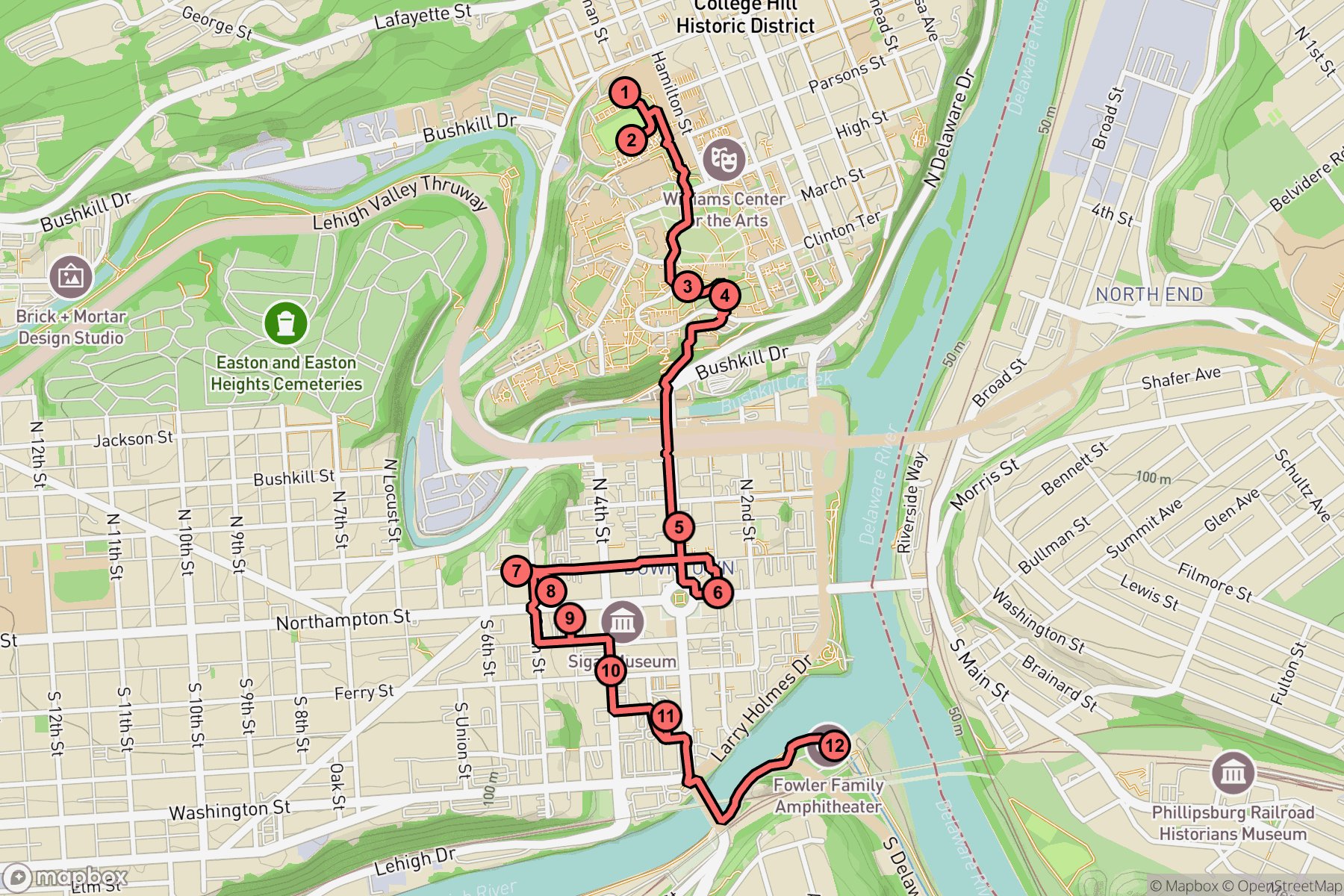
Podgląd trasy
O tej trasie
- scheduleCzas trwania 40–60 minsIdź we własnym tempie
- straighten4.4 km trasy pieszejPodążaj wyznaczoną trasą
- location_onLokalizacjaEaston, Stany Zjednoczone
- wifi_offDziała offlinePobierz raz, korzystaj gdziekolwiek
- all_inclusiveDożywotni dostępOdtwarzaj ponownie w dowolnym momencie
- location_onStart przy Kirby Sports Center
Przystanki na tej trasie
To spot Kirby Sports Center, look for the large, modern building with wide windows and a welcoming entrance just as you come up the hill near the heart of Lafayette College - you…Czytaj więcejPokaż mniej
To spot Kirby Sports Center, look for the large, modern building with wide windows and a welcoming entrance just as you come up the hill near the heart of Lafayette College - you can’t miss the buzz of students in team gear heading in and out. Now that you’re right here at the Kirby Sports Center, take a big breath and listen to the echoes of sneakers squeaking on glossy hardwood, the electric buzz of anticipation in a packed arena, and maybe even the faint thump-thump of a basketball being dribbled nearby. This place is more than just a building - it’s where the Lafayette College Leopards roar to life, especially on game night with over 2,400 seats swelling with fans, eager for the action. Back in 1973, imagine the fresh scent of new gym floors and bustling excitement as this center first opened its doors. The air must have tingled with the dreams of athletes and the snooping curiosity of students looking for a new hangout. Fast forward to 2000, and you’d spot construction crews hurrying to put on the finishing touches to a gleaming new expansion - a sprawling 110,000-square-foot addition! Suddenly, students could jog indoors on an elevated track, scale a 35-foot climbing wall, or battle it out on squash courts. The gym’s shiny, futuristic atrium offered a panoramic view of Fisher Stadium, and the new scoreboard blazed with color at every dramatic moment. Picture the scene during the 2000 Patriot League tournament: the roar almost lifts your cap off, banners flutter, and the clock ticks down. It’s that kind of building that gives everyone goosebumps, whether you’re an athlete, a fan, or just someone peeking in for inspiration. But that’s not all. Want to pump some iron? The fitness center here is packed with weights, cardio machines, and enough energy to power a small city. Need more drama? Well, the center may share its name with the F.M. Kirby Center in Wilkes-Barre, but make no mistake-this building is all about action, sweat, and athletic dreams, not Broadway shows and tap-dancing. Thanks to the generous Kirby Foundation, whose family seems to have more ties to Lafayette than shoelaces have knots, this center is a highlight for students, alumni, and anyone who loves a good game. Whether Jodie Frey, the director, is running a championship or scheduling an aerobics class, there’s a sense of ambition and community that makes Kirby Sports Center a true legend on campus. Ready for the next stop on our adventure?
Otwórz dedykowaną stronę →To spot Fisher Stadium, just look for the massive stands brimming with rows of red seats and the big, modern press box that sits above them, right across the field-if you see the…Czytaj więcejPokaż mniej
To spot Fisher Stadium, just look for the massive stands brimming with rows of red seats and the big, modern press box that sits above them, right across the field-if you see the towering light poles and hear a distant echo of cheers, you’re in the right place. Welcome to Fisher Stadium, where excitement fills the air with every snap of the football! Take a deep breath and imagine those 13,000 seats packed and trembling with roaring fans-if you listen closely, you might even hear the ghost of a referee’s whistle and a marching band warming up. This stadium didn’t just pop up overnight. It all started back in 1926, thanks to Lafayette alum Thomas Fisher, who almost single-handedly raised nearly half a million dollars through tireless fundraising and a good chunk of his own cash. Talk about team spirit! The very first game here saw the Lafayette Leopards stomp Muhlenberg College 35-0. Imagine the wild celebrations-there must’ve been more high-fives than the number of hot dogs in the stands. Back in the 1970s, the stadium shrank a bit to make room for the nearby Kirby Sports Center, but don’t worry-they made up for it with a whopping $33 million makeover in 2006 and 2007. That renovation brought cushy chair-back seats, a jumbo press box, fancy new restrooms (always a winner on game day), food stands, and a huge JumboTron in the northwest corner to replay every spectacular moment. And let’s not forget the turf-step onto that field with your mind, and you can almost feel the springy FieldTurf under your sneakers. On a chilly night in 2007, Fisher Stadium even flickered to life under the stars for its first-ever night game. The lights blazed down and Lafayette crushed Marist College, 49-10! Over the decades, announcer Jim Finnen boomed out names and plays for 50 years, becoming as much a local legend as the Rivalry itself. Speaking of rivalries, here’s where things really heat up: every time Lafayette hosts archrival Lehigh, the stadium grows with 3,500 extra seats until the crowd swells to 17,000. If only every home could expand when relatives visit for the holidays! Fisher Stadium isn’t just home to college showdowns-it also hosts one of the country’s fiercest high school rivalries: the Easton vs. Phillipsburg game. In 2006, this face-off turned national, landing a spot on ESPN2 for its 100th chapter, with Easton grabbing the win in electrifying style. Standing here, you’re stepping into nearly a century of tradition, grit, and glory. Every seat and blade of grass has a story-and today, you’re part of the next chapter. The only thing you’re missing is a foam finger and some nachos! Interested in knowing more about the the rivalry, hosting the easton-phillipsburg game or the panorama
Otwórz dedykowaną stronę →Standing in front of you at the south entrance of Colton Chapel, you’ll spot a proud, life-sized bronze statue of a young man in an 18th-century uniform, with one hand resting…Czytaj więcejPokaż mniej
Standing in front of you at the south entrance of Colton Chapel, you’ll spot a proud, life-sized bronze statue of a young man in an 18th-century uniform, with one hand resting casually on his sword and his gaze fixed confidently ahead-just look for the figure standing tall atop a square pedestal near the stone walkway. Before you stands the Statue of the Marquis de Lafayette, as grand as the stories they tell about him-take a moment to imagine a brisk November day in 1921, the air full of excitement and chatter as crowds gather for the statue’s dedication. Now, picture Daniel Chester French, the famous sculptor known for epic monuments like the Lincoln Memorial, proudly unveiling his work. With Lafayette’s sword drawn and chin lifted, French captures the energy of a “youthful soldier”-and let’s be honest, this guy looks ready to jump off his pedestal and give a history lesson. But here’s a twist worthy of a plot in a Netflix special. Back in 1885, French actually tried to win a national contest to make a Lafayette statue for Washington, D.C.-but, to his disappointment, the honor went to two French sculptors from France (honestly, a little on the nose, isn’t it?). Still, French never gave up on Lafayette. Fast forward a few decades, and he creates a plaster model for a Lafayette Memorial in Brooklyn. When Lafayette College needed a statue of their heroic namesake, French was happy to donate that original mold. With the help of a persuasive alumnus-think of him as the original college fundraiser extraoridnaire-a generous Philadelphian named Morris L. Clothier stepped up to bring Lafayette to life in bronze. The statue was cast by Gorham, one of the most famous foundries in America, and placed atop a dignified pedestal designed by none other than Henry Bacon, the architect behind the Lincoln Memorial. Suddenly, French got a second chance at Lafayette glory, and this time, he landed it at the very college that bears the Marquis’s name. The dedication was legendary. Distinguished guests filled the quad: the governor of Pennsylvania, a Supreme Court justice, the state’s attorney general-even the donor himself, who was given an honorary degree on the spot. Imagine it: solemn speeches, applauding crowds, and the shimmering sound of a new fountain burbling nearby as the sun lit up the bronze. And like Lafayette himself, who traveled across seas to fight for American freedom, this statue has weathered time-thanks to a big makeover in 2007. The college celebrated Lafayette’s 250th birthday by adding a new plaza, benches, and that same sparkling fountain. The quote carved on the base sums up the Marquis’s spirit: “I read, I study, I examine, I listen, I reflect and out of all this I try to form an idea into which I put as much common sense as I can.” Let’s hope he didn’t lose all his common sense on the battlefield! So, as you stand in front of Lafayette’s steady gaze, try to imagine the echo of old speeches and cheers bouncing off the stone. This statue isn’t just a tribute-it’s a bridge across centuries, a reminder that history’s heroes still have stories worth telling.
Otwórz dedykowaną stronę →
Pokaż jeszcze 9 przystankówPokaż mniej przystankówexpand_moreexpand_less
Look for a grand, rock-faced granite mansion perched atop a long, wide staircase, crowned with rows of dormer windows and gleaming white trim-when you see the towering stone…Czytaj więcejPokaż mniej
Look for a grand, rock-faced granite mansion perched atop a long, wide staircase, crowned with rows of dormer windows and gleaming white trim-when you see the towering stone façade with double French doors and a wide, inviting sunporch, you’ve found the Zeta Psi Fraternity House. Alright, let’s imagine ourselves back in the early 1900s! Picture this enormous granite house-nine windows wide, standing proud on nearly ten lush acres at 49 South College Street. If you think it looks a bit like an English manor or something straight out of a mystery novel, you’re not alone. Students once stood where you are, craning their necks to take in the sheer size of it all, probably thinking, “Wow, this is fancier than my parent’s place!” But let’s rewind even further-back to 1857-when the Tau chapter of Zeta Psi first arrived at Lafayette College. These ambitious young men were truly fraternity pioneers, founding only the third fraternity on campus! For decades, though, they didn’t have a place like this. Instead, meetings bounced around ramshackle rental rooms-sometimes even cramped into a brother’s downtown office. Their annual fraternity balls? Also held in borrowed spaces, where I imagine someone’s punch would always go missing right at midnight. Everything changed in the early 1900s when Lafayette College faced a housing crunch. The solution? Let the fraternities build official chapter houses. Zeta Psi leapt at the chance and by 1907, just after a frosty January convention, their grand vision for this chapter house won national approval. By 1910, men in heavy coats watched skilled stonemasons-local names like Amanndus Steinmetz and Streepy and Strickland-raise these thick granite walls, while Roosevelt Michler filled the inside with elegant, handcrafted fixtures. The doors finally opened, and suddenly, Zeta Psi was THE place to be. Not just a fancy dorm-the largest event space in all of Easton! Epic celebrations, whispered secrets, and laughter echoing through the halls. The grand sunporch gleamed in the sunlight, skylights streaming in on students reading, chatting, sometimes dozing in the warmth. That sunporch, by the way, was so inviting it made guests trip over their own feet on the way in-those stone steps are still here, so watch your step! I hear the porch on the west side was so attractive it stole attention, but alas, it’s gone now-its twin on the south side gets all the glory. Inside, you’d find a reception hall with a beamed ceiling, four dazzling chandeliers, and a library filled with built-in bookcases and a chandelier to match, just in case your studying needed extra sparkle. There was a billiard room for friendly rivalry-cue balls clacking late into the night-and a dining room with Colonial Revival mantles, tiled by the famous Moravian Pottery Works. But during World War I, the atmosphere shifted. The house transformed into a training ground for Reserve Officer Training Corps. Imagine marching boots echoing on the floors and the solemn hush of duty hanging in the air. The war years were tough; the chapter shrank and their big house started to feel too quiet. The 1920s brought revival-top grades, big wins in student government, and parties that made the walls ring with music again. Then, the grip of the Great Depression clamped down, dimming the lights and thinning the crowds, followed by World War II, when the fraternity’s ties to the community frayed and finances dried up. But even when the glory days seemed behind it, this resilient house waited for another chapter. Fast forward to 2014 and the house went silent again-this time, not because of war but because Zeta Psi was suspended. The college turned it into a dorm for first-year students-imagine dozens of wide-eyed freshmen tiptoeing through what used to be secretive chapter rooms and a bar in the basement. Some say the echoes of old parties and meetings still linger in those halls. But the best stories never end for long. In 2019, Zeta Psi’s Tau chapter returned-recognized, re-energized, and eager to fill this manor with new stories, old traditions, and maybe a few more epic parties. This is no ordinary college house-it’s a living time machine, a testament to resilience, reinvention, and the little joys of coming home to friends, laughter, and maybe a billiard tournament if you’re lucky!
Otwórz dedykowaną stronę →Look for a grand, light-colored stone mansion with a pointy roof, ornate iron railings, and a dramatic bay tower stretching right up from the sidewalk. Right in front of you…Czytaj więcejPokaż mniej
Look for a grand, light-colored stone mansion with a pointy roof, ornate iron railings, and a dramatic bay tower stretching right up from the sidewalk. Right in front of you stands the magnificent Herman Simon House-a place that looks like it was plucked straight out of a French fairy tale. Imagine it: the year is 1902, and a sharp, ambitious man named Herman Simon has just finished building this incredibly fancy limestone house with its soaring tower and fanciful porch. Simon was an immigrant from Germany who made it big in the silk business. If you listen carefully, you might almost hear the clinking of fine china from his dinner parties echoing through the halls. But Simon’s story had a bittersweet turn-he didn’t get to enjoy his castle for long. He passed away just eleven years after it was built. Fast forward to 1930, when the laughter of women and children replaced the hush of silk traders, as the house became home to the Easton YWCA. Decades later, the place took on a whole new life, transforming into the Third Street Alliance for Women and Children-a safe place still buzzing with energy and support today. So, as you stand here, let your imagination wander through more than a century of Easton’s history, where every stone and window hints at secrets of ambition, change, and new beginnings.
Otwórz dedykowaną stronę →You’re looking for a sturdy gray limestone building with black shutters and a reddish brick section at the back-just ahead of you, with a tree out front and two white front doors…Czytaj więcejPokaż mniej
You’re looking for a sturdy gray limestone building with black shutters and a reddish brick section at the back-just ahead of you, with a tree out front and two white front doors inviting you in for a trip back in time. Let’s step right up to the Easton House-believe it or not, this place was once the buzzing heart of the town, echoing with laughter, stories, clinking mugs, and maybe a few heated arguments about colonial politics! Built in 1753, this stone and brick inn wasn’t just a cozy spot for weary travelers to hang their hats; it was the scene of drama and debate almost every night. Imagine the smells of roasting meat and bread drifting out from candles lit in those thick stone walls, while George Taylor-the man who expanded the house in 1765-played host by the fire, serving drinks and listening in on the latest gossip. Taylor wasn’t just anybody; he signed the Declaration of Independence! But here, he was also a tavern keeper, welcoming people from all walks of life. Fast forward to the early 1800s, and this house echoed with the sound of gavels-yes, it became a courthouse too! Arguments over property, lost horses, and the odd scandalous secret were settled inside. If these old Georgian walls could talk, I bet they’d spill more beans than a gossiping bartender. Now recognized on the National Register of Historic Places since 1980, the Easton House stands strong as a silent witness to centuries of stories-just try not to challenge any ghosts to a drinking contest, OK?
Otwórz dedykowaną stronę →To spot the State Theatre, just look ahead for a grand, old building with an eye-catching stone facade, a splashy overhanging marquee, and a sense of drama that practically spills…Czytaj więcejPokaż mniej
To spot the State Theatre, just look ahead for a grand, old building with an eye-catching stone facade, a splashy overhanging marquee, and a sense of drama that practically spills out onto the sidewalk. Standing in front of the State Theatre, you can almost hear the excited buzz from crowds over a hundred years ago, all dressed in their best, jostling to enter as the giant marquee glows above. It’s hard to believe this place started its life as a bank-imagine, once people came here to deposit coins, now they come to splash out on moments of pure imagination! In 1910, it transformed from a spot for serious business to a vaudeville theater called the Neumeyers Vaudeville House, where slapstick comedy, toe-tapping dances, and maybe even a few dog acts stole the show. By 1926, the theater got a magnificent makeover, making space for even more laughter and applause with balconies and dazzling Beaux-Arts details-just look at that ornate ceiling and big, cozy rows of red seats. Legends (and probably a few lost ushers) say you can feel the energy of opening nights and the nerves of countless high school actors at the annual Freddy Awards, a local tradition since 2003. The State Theatre is more than a historic landmark-it's a living room for Easton’s wildest dreams, where history dances under the spotlight and every seat has a story to tell. Maybe yours is next!
Otwórz dedykowaną stronę →You’re looking for a stately rectangular sandstone building just ahead of you, with grand arched windows, a proud flagpole out front, and “Easton Public Library” carved above a…Czytaj więcejPokaż mniej
You’re looking for a stately rectangular sandstone building just ahead of you, with grand arched windows, a proud flagpole out front, and “Easton Public Library” carved above a set of tall wooden doors. Alright, close your eyes for just a second-no, on second thought, don’t close your eyes while walking, that’s how legends about haunted libraries start! But do take a moment to picture the early 1800s. Imagine Easton in 1811: dusty streets, horses trotting by, and townsfolk chattering about a brand-new idea-a place where books are guarded like treasures. That’s exactly how the Easton Library Company got its start, more like a private club where you had to pay for entry. Back then, only subscribers (and the occasional book-hungry high schooler) could pull a story from the shelf. The first "Library Hall" opened in 1815, on land donated by a generous resident named Samuel Sitgreaves, and it would serve Easton for nearly 90 years. But as time passed and the scent of adventure beckoned, the Civil War drained the town of many citizens, leaving the subscription library a little lonely and short on funds. Luckily, Easton's women had an idea: if books were for everyone, no one would ever run out of adventure. So, in 1895, they created a free public library, open for hours that must have felt as magical as midnight to anyone who’d ever felt shut out. By 1896, a new library was bustling for three glory-filled hours every afternoon and added bonus hours for night owls twice a week. Now, let your mind jump forward to the early 1900s. Enter Andrew Carnegie, the steel magnate with a soft spot for libraries. When Easton’s leaders sent him plans for a grand modern Renaissance building on a plot that, believe it or not, was once an old graveyard, he offered $50,000-on the condition that the city would keep the shelves stocked and the doors open. It was a lot of money, a small fortune back then! And so, in 1903, behind the stone façade you’re gazing at right now, Easton’s very own Carnegie Library opened its doors to a public eager for stories, lectures, and community gatherings. That first day, they welcomed visitors with 14,000 volumes-a collection that would soon burst at the seams! Growing pains came quickly. Shelves groaned under all those books, and by 1911, the library had secured another chunk of Carnegie cash for an addition, bumping its book-holding powers up to a mighty 80,000. Decades rolled by. More renovations came, including a massive storage expansion in 1941-can you hear the echo of construction drills and hammering as new stacks rose in the old halls? Now, here’s a twist-Easton’s library soon led the region when Pennsylvania chose it as a district library center in the 1960s. It became the beating heart of library life for both Northampton and Monroe counties. And as the city grew, so did the building, stretching to make room for new departments, new technology, and more eager readers. But the real magic trick came in 1985: the creation of the Marx Room, named after Easton’s first librarian, Henry F. Marx. If you venture inside, you’ll discover one of the most extensive local history and genealogy collections in Pennsylvania. Picture row after row of rare books-over 15,000 texts and treasures-waiting for historians, schoolchildren, and everyday explorers to unearth their secrets. There you’ll also find Easton’s oldest known map, hand-drawn in the 18th century, and-talk about patriotic spirit-the original Flag of Easton itself! That flag was first hoisted on July 8, 1776, when Easton joined just two other cities to hear the Declaration of Independence read aloud for the first time, just days after it was signed. Later, the flag traveled to war and back, finally coming home to the library for safekeeping. If walls could talk, these would surely tell stories of Revolution, peace, courage, and civic pride. And the story doesn’t end there. With new branches opening and the library joining a regional network in 2001, today’s Easton Area Public Library is about as alive as a library gets. Whether you’re a genealogist, a student, or just someone who loves that fresh-paper smell and the quiet thrill of turning pages, this building is proof that stories-and libraries-really can stand the test of time. So as you stand here, take a deep breath. You’re at the heart of Easton’s long love affair with knowledge and community. Now, how’s that for a plot twist?
Otwórz dedykowaną stronę →In front of you, you’ll spot a sturdy stone building with a sloped roof and many white-framed windows, set right against the busy intersection, a classic example of the charming,…Czytaj więcejPokaż mniej
In front of you, you’ll spot a sturdy stone building with a sloped roof and many white-framed windows, set right against the busy intersection, a classic example of the charming, historic architecture in the Easton Historic District. Alright, time for a stroll through history! Just imagine cobblestone streets beneath your feet and horse-drawn carriages rattling by. You’re standing in Easton’s historic heart, surrounded by over four centuries of stories packed into these 405 beautiful old buildings. Most of what you see sprang up between 1830 and 1910-so if the walls could talk, they’d probably need to clear their throats first! But it all began way back in 1752, when Easton’s first structures appeared. Merchants, teachers, priests, and bankers brushed shoulders here; the First Reformed Church, State Theatre, and even the old Wolf School all helped shape Easton into the community you see today. Keep your eyes peeled; some buildings held secret society meetings, while others-like the Benjamin Reigel and Jacob Riegel Houses-felt like castles to people used to log cabins. On certain nights, you’ll hear folks whisper that ghosts of former patrons still haunt the old Ormsby’s Restaurant, searching for the perfect dessert. This district was declared a national treasure in 1983, which just proves that Easton’s past isn’t stuck in a dusty attic-it’s alive in every stone and every story, right under your feet. And if you happen to feel a chill, don’t worry-it’s probably just history brushing by!
Otwórz dedykowaną stronę →Look to your left-you’ll spot a sturdy, two-story stone house with a slanted roof and shuttered windows, set right at the corner like it’s been keeping an eye on the street for…Czytaj więcejPokaż mniej
Look to your left-you’ll spot a sturdy, two-story stone house with a slanted roof and shuttered windows, set right at the corner like it’s been keeping an eye on the street for centuries. Imagine the year is 1757-the streets are muddy, horses clip-clop by, and you can almost smell the woodsmoke wafting from inside this handsome Georgian stone home. This is the Parsons-Taylor House, built over 250 years ago for William Parsons, who was basically the town’s early VIP, but it’s got an extra twist-America’s very own Founding Father, George Taylor, once lived and breathed here. Picture Taylor himself, pacing “his” rooms, caught up in the drama of revolutionary times, probably mumbling about taxes or tea. Inside, there’s a swirling, elegant staircase tying together four stories, as if daring secret messages to travel between floors. After Taylor’s death in 1781 (he actually died right here-spooky, right?), the home took on new life. Since 1906, the Daughters of the American Revolution have kept this place vibrant and cared-for, like guardians of its tremendous stories. In 1980, it officially made America’s National Register of Historic Places, so now everyone who passes by-just like you-can feel the echoes of history humming right through those thick stone walls. Makes you wonder: if those walls could talk, would they whisper a tale of revolution… or kindly ask you to wipe your feet?
Otwórz dedykowaną stronę →Look for a large, modern rectangular building with three stories, sitting just off South 3rd Street, with big glass windows and a parking garage above the bus bays in the…Czytaj więcejPokaż mniej
Look for a large, modern rectangular building with three stories, sitting just off South 3rd Street, with big glass windows and a parking garage above the bus bays in the back-just follow the sounds and sights of city buses coming and going! Welcome to the Fred A. Williams Easton Intermodal Transportation Center-Easton’s very own “grand central” for getting anywhere… well, at least anywhere with a bus stop! If you listen closely, you might catch the distant rumble of a LANta bus pulling in, -that’s the heartbeat of Easton’s travel scene. But believe it or not, not too long ago, all of those buses and bustling travelers were packed out on the open air of Center Square, dodging traffic and braving the elements. Imagine waiting for your ride in the pouring rain or during one of Pennsylvania’s icy winters, praying your coffee wouldn’t freeze before the bus even showed up! The city knew Easton deserved better. In 2010, plans hatched-big plans, involving the not-so-glamorous site of a closed-down Perkins Restaurant and an old Marquis Theatre. After a $3 million buyout and a whopping $34 million overhaul (now that’s a lot of coffee and bus tokens), this complex officially opened its doors in 2015. That modern three-story building in front? That’s not just a waiting room-it’s also where Easton City Hall decided to cozy up and move in, leaving their old spot in Centre Square for a view of buses heading off to Allentown, Bethlehem, even New York City. Inside, you’ve got a little bit of everything-a ticket office for bus passengers grabbing schedules, a restaurant where you can fuel up while buses pull up outside, and offices buzzing with city work. Step through those glass doors and you’ll likely catch the hum of voices echoing in the high-ceilinged lobby. Out back, the action heats up with a chorus of arriving and departing buses, travelers hurrying past, and the occasional suitcase doing a quick tango across the concrete. Fred A. Williams, who lent his name to this place, was a real local legend-a businessman who championed public transit and served for years on LANta’s board. If he were here, he’d probably wink and say, “Welcome aboard!” Whether you’re catching the daily Greyhound to Philly or dreaming of New York’s skyline on Trans-Bridge Lines, this center keeps Easton connected, buzzing, growing, and definitely not standing still.
Otwórz dedykowaną stronę →In front of you, you’ll spot a calm, tree-lined canal reflecting the blue sky, with a walking path to your right and a small, white gazebo beside the water-just follow the sound…Czytaj więcejPokaż mniej
In front of you, you’ll spot a calm, tree-lined canal reflecting the blue sky, with a walking path to your right and a small, white gazebo beside the water-just follow the sound of ducks and the peaceful flow of water, and you’ve found the Pennsylvania Canal. Now take a deep breath-imagine the air is heavy with adventure and history, not just the crisp scent of leaves. Welcome to the legendary Delaware Canal, otherwise known as the Delaware Division of the Pennsylvania Canal! This tranquil waterway might seem sleepy today, but once upon a time, it was the superhighway of its age, bustling with barges, hooves, and hopes. Picture it: it’s the early 1800s, and all around you, the world is racing to build delicate webs of canals to move precious anthracite coal and hustle up commerce. Across the river, New York’s Erie Canal has just opened, and Pennsylvania can’t let its neighbor steal the spotlight-so out come the shovels, the picks, and a hardy team of Irish laborers. Between 1829 and 1832, workers, using nothing more than sweat and muscle, dug a sixty-mile ribbon right alongside the Delaware River, carving a watery path from Easton to Bristol. The canal looks peaceful, but imagine it filled with barges stacked high with coal, lumber, gravel, and even limestone, destined for the energy-hungry factories of Philadelphia. On the return leg, finished goods and iron would travel north, keeping the wheels of industry spinning through dust, mud, and-occasionally-frozen winters that could grind everything to a halt. And if you picture a classic traffic jam, imagine instead a flotilla of barges pulled by sturdy mules, their hooves clopping patiently along the very towpath where you’re standing now. The canal isn’t just a Pennsylvania story-it's part of a much larger web. Here at Easton, it tied into New Jersey’s Morris Canal, and south of here, a clever network of locks, wheels, and even a cable ferry carried both cargo and dreams all the way to bustling New York City. At New Hope, engineers even built a water-wheel contraption to lift water from the Delaware River up into the canal, powered just by the river’s own current. The ingenuity wasn’t all gears and levers: to cross boats into New Jersey, a pair of cables and some wheely physics would make a barge sail diagonally across the river, steered by current alone! But behind the scenes, tension brewed: by the late 1800s, the thunderous arrival of railroads meant that the days of slow-moving canal boats were numbered. Coal was king, but rail could carry more-and faster. Still, the canal hung on, stubborn and gritty, until the Great Depression nipped away the last of the traffic in the early 1930s. It may have seemed the end, but as the weeds grew on the old towpaths, a group of passionate locals began to dream up a new future. The Delaware Valley Protective Association fought, pleaded, and persuaded the state to save the canal, even as others wanted to pave it over for cars. Thanks to a handful of historians, citizens, and a heroic guidebook, the canal was preserved, eventually honored as a National Historic Landmark. There’s still a hint of excitement: in the heyday of canal tourism, you could hop aboard a mule-drawn barge, guided by skippers with mariner’s licenses, clopping up to four and a half miles in either direction. The Americana, Independence, Liberty, Spirit of New Hope-these weren’t just boats, but the pride of a community, their bells and laughter echoing down the water the same way yours might today. Of course, nature plays tricks: floods in the 2000s battered the towpath, and it took federal help to restore the miles-long walking route. But through the toil of Friends of the Delaware Canal, volunteers, and park officials, the canal you see now survives as a living thing, equal parts park, museum, and memory. With every quiet ripple and each footstep you take on the soft path, you’re walking through almost two centuries of ingenuity, determination, and the occasional stubborn mule. So next time you stroll by and see a duck paddling by or someone jogging with their dog, give a little nod to the ghosts of canalmen, mules, and engineers-because, when it comes to the Delaware Canal, the journey has always been just as important as the destination.
Otwórz dedykowaną stronę →
Najczęściej zadawane pytania
Jak rozpocząć trasę?
Po zakupie pobierz aplikację AudaTours i wpisz kod realizacji. Trasa będzie gotowa do natychmiastowego rozpoczęcia – po prostu dotknij \"Play\" i podążaj trasą z nawigacją GPS.
Czy potrzebuję internetu podczas trasy?
Nie! Pobierz trasę przed rozpoczęciem i korzystaj z niej w pełni offline. Jedynie funkcja czatu wymaga internetu. Zalecamy pobieranie przez WiFi, aby oszczędzać dane mobilne.
Czy to wycieczka grupowa z przewodnikiem?
Nie – to samodzielny audioprzewodnik. Zwiedzasz niezależnie, we własnym tempie, z narracją audio odtwarzaną przez telefon. Bez przewodnika, bez grupy, bez harmonogramu.
Ile trwa trasa?
Większość tras zajmuje 60–90 minut, ale to Ty kontrolujesz tempo. Wstrzymuj, pomijaj przystanki lub rób przerwy, kiedy chcesz.
Co jeśli nie zdążę ukończyć trasy dzisiaj?
Żaden problem! Trasy mają dożywotni dostęp. Wstrzymaj i wznów, kiedy chcesz – jutro, za tydzień lub za rok. Twój postęp jest zapisywany.
W jakich językach są dostępne trasy?
Wszystkie trasy są dostępne w ponad 50 językach. Wybierz preferowany język podczas realizacji kodu. Uwaga: języka nie można zmienić po wygenerowaniu trasy.
Gdzie znajdę trasę po zakupie?
Pobierz darmową aplikację AudaTours z App Store lub Google Play. Wpisz kod realizacji (wysłany e-mailem), a trasa pojawi się w Twojej bibliotece, gotowa do pobrania i rozpoczęcia.
Jeśli trasa Ci się nie spodoba, zwrócimy Ci pieniądze. Skontaktuj się z nami pod adresem [email protected]
Bezpieczna płatność przez 


