AudaTours logoAudaTours

Wycieczka audio po Puerto Real: Kulturalna podróż po Puerto Real

Audioprzewodnik11 przystanków

Pod sklepieniami i wzdłuż zacienionych alejek Puerto Real odsłania sekrety namalowane dymem i kamieniem. Dusza tego miasta utkana jest z buntu, szeptów zaginionych kochanków i ech dobiegających zza kurtyny Teatro Principal. Wyrusz na wycieczkę audio z przewodnikiem, która odkrywa historie pomijane przez większość. Spaceruj we własnym tempie, gdy ukryte zakątki i kultowe zabytki ożywają skandalem, tajemnicą i oporem. Dlaczego wściekłe tłumy gromadziły się niegdyś pod kościołem św. Józefa w środku nocy? Kto wciąż przemierza zapomnianą Aleję Łuku w poszukiwaniu rozgrzeszenia? Jaki cichy pakt zawarto na balkonie przed pierwszym brzaskiem? Przemierzaj stulecia, w których brukowane ulice pamiętają każde powstanie i kłótnię kochanków. Każdy krok odsłania surowy dramat i nieoczekiwane piękno, zmieniając znane ulice w sceny naładowane legendą. Rozpocznij tę podróż już teraz. Pozwól, by prawdziwe serce Puerto Real poprowadziło Cię w swoje głębiny.

Podgląd trasy

map

O tej trasie

  • schedule
    Czas trwania 30–50 minsIdź we własnym tempie
  • straighten
    3.4 km trasy pieszejPodążaj wyznaczoną trasą
  • location_on
  • wifi_off
    Działa offlinePobierz raz, korzystaj gdziekolwiek
  • all_inclusive
    Dożywotni dostępOdtwarzaj ponownie w dowolnym momencie
  • location_on
    Start przy Zbiornik Wodny

Przystanki na tej trasie

  1. To spot the Water Box, look for a sturdy rectangular yellow building with white trim, topped by a curious domed roof decorated with intricate tilework, standing confidently among…Czytaj więcejPokaż mniej

    To spot the Water Box, look for a sturdy rectangular yellow building with white trim, topped by a curious domed roof decorated with intricate tilework, standing confidently among palm trees in the shade of El Porvenir Gardens. Welcome to one of Puerto Real’s most ingenious surprises! Imagine, right where you’re standing, carts creaking, horses snorting impatiently, and travelers bustling around-centuries ago, this spot was the busy ‘Laguna’ entrance to the town, full of wagons, porters, and the occasional gossiping neighbor. You’re looking at the Water Box-or as locals call it, La Caja del Agua-a structure built way back in 1780, when powdered wigs were all the rage and people thought a ‘selfie’ was just someone admiring themselves in the well’s reflection. But this was more than just a pretty face. Crafted by the skilled Antonio Ruiz Florindo, at the wish of Mayor Antonio Capriles (his name’s still carved into the façade, as if he wanted future generations to remember who paid the bills), the Water Box’s true job was vital: It was the town’s beating heart, controlling the water flow from Malas Noches-eleven kilometers outside of town and, despite the name, providing more water than trouble. For five long years, townsfolk and engineers worked to lay an underground canal across Puerto Real’s countryside, not just a small feat for the 1700s and definitely deserving a round of applause-or at least a relieved sigh from those tired oxen. Architecturally, it’s a marvel-a chunky cube with a vaulted dome, once topped with sparkling tiles featuring the town’s favorite saints: San Roque, San Sebastián, and the ever-watchful Virgin del Rosario. If you squint at the rooftops, you’ll spot charming niches decorated with traditional trianero tiles, a burst of color and faith overlooking the dusty comings and goings below. That dome isn’t just decorative: it was built to last, and if rainwater had a favorite playground, this would be it. Down at ground level, people once gathered here to fill buckets, wash vegetables, swap stories, and read the commemorative plaque marking the project’s grand opening in-drumroll-December 1781, courtesy of King Carlos III. As you stand here, imagine the celebration when fresh, clean water finally poured in after that epic engineering adventure. Fun fact: scattered through town, six quirky ventilator towers still peek into the sky along the old pipeline-they were the unsung heroes, keeping the water fresh and fixing pressure hiccups. Today, the Water Box is no longer working, but instead of fading away, it’s become something else entirely: a piece of living history in El Porvenir Gardens, a spot where stories and shade intermingle and every local has their favorite childhood memory about playing or picnicking right here. And hey, who said water can’t be fascinating? Welcome to Puerto Real’s first-and splashiest-monument!

    Otwórz dedykowaną stronę →
  2. Right in front of you, you’ll spot the wide stretch of orange sand edged by palm trees and a tranquil bay dotted with little fishing boats, so just look toward the water and the…Czytaj więcejPokaż mniej

    Right in front of you, you’ll spot the wide stretch of orange sand edged by palm trees and a tranquil bay dotted with little fishing boats, so just look toward the water and the open sky. Welcome to Playa de la Cachucha, a beach with a story almost as long as its tide! Imagine soft orange sand sliding between your toes, a gentle salty breeze tickling your face, and the distant call of seagulls echoing as you stroll along the promenade. This isn’t just any ordinary city beach-this is Puerto Real’s own sun-kissed backyard, a half-kilometer ribbon of sand sheltering centuries of local tales. Back in the 1950s, this wasn’t the busy, rejuvenated beach you see today. Instead, the shoreline was studded with shabby little huts called “casuchas.” Fishermen used these makeshift homes to stash their nets and gear after a long, salty day-if you listen carefully, you can almost hear their laughter and shouts mingling with the cry of the gulls. Some say Playa de la Cachucha got its name from those humble shelters. Others claim the beach was named after the small boats-“cachuchos”-anchored along this quiet bay. The truth, like the best secrets, probably floats somewhere in between. You’re standing on sand that’s seen more renovations than some celebrities’ faces! Thanks to efforts to protect the beach from the hungry tides, its original form has changed over the years. Engineers brought in new sand, built two rocky breakwaters at both ends, and beefed up the dry area so locals could throw epic beach parties and sizzling summer events here without worrying about losing ground to the waves. When the tide rolls out, you’ll spot a huge muddy flat, gleaming in the sun and marooned with dozens of tiny traditional fishing boats. At high tide, the swimming area shrinks to a narrow channel, and the scene changes entirely-nature’s own game of hide and seek! If you’re lucky, you’ll catch sight of not just chatty seagulls and sandpipers bustling along the shore, but a whole cast of feathered waders and marshland birds, thanks to the bay’s special protection as a Ramsar wetland and a natural park. So if you see a bird strutting around with attitude like it owns the place, don’t be surprised-it pretty much does. And it’s not just nature that gathers here; people do too! Each summer, the beach transforms into a buzzing arena for events-fancy some Rugby on sand? Keep an ear out for the shouts and laughter of the Watermelons Amateur Rugby Club as they host the annual Villa de Puerto Real beach rugby tournament. And if getting wet is your thing, you can join the swimmers-young and old-who take the plunge in the Travesía a nado Virgen del Carmen, racing 850 meters across the bay between the Puntilla del Muelle and Playa de la Cachucha. Don’t rush off yet! If you’re here in August, breathe deep-can you smell the smoky aroma of a massive barbecue? That’s the famous local chistorrá and communal cookout, where hundreds of neighbors gather with friends and family for an unforgettable fiesta, washed down with affordable drinks and hearty laughter late into the evening. A curious twist: once upon a time, the waters and muds of Playa de la Cachucha were thought to hold magical healing powers. From as early as the 1800s, visitors came for seaside baths at bathhouses like Perpetuo Socorro and Santa María, drawn not just by the good company, but by the hope that these mineral-rich waters might cure all manner of aches and pains. Even now, there are dreams of reviving this spa tradition-so maybe one day, this vibrant beach will be a place to heal both your sunburn and your spirits. So take it all in-the orange sand, the gentle tides, the rich flavors of the past and present, and remember, at Playa de la Cachucha, every grain of sand holds a story-maybe, just maybe, yours is the next one. If you're keen on discovering more about the etymology, characteristics or the thalassohyd properties, head down to the chat section and engage with me.

    Otwórz dedykowaną stronę →
  3. Look straight ahead for a church with a simple rectangular façade, a neoclassical stone doorway, and a striking square tower near the right end topped with blue and yellow tiles…Czytaj więcejPokaż mniej

    Look straight ahead for a church with a simple rectangular façade, a neoclassical stone doorway, and a striking square tower near the right end topped with blue and yellow tiles and a pointed spire-that’s your landmark! Now, close your eyes for a moment and imagine yourself standing here almost four hundred years ago. The air would be filled with the sound of hammers and chisels, the smell of fresh lime and stone as the Order of the Minims-humble friars devoted to Saint Francis of Paola-set about building their new home out on what was once a lonely promontory, on the very edge of Puerto Real. Back in 1628, these friars were new to town. Their first stop? A modest hermitage of Saint Benedict, which, like finding a good parking spot, they had to give up pretty quickly! They swapped spaces with some barefoot Franciscan friars and settled in here, beginning their ambitious project in 1639. Their mission was no simple feat: churches are grand things, and well, grand things cost a bit more than what you get from a passing hat. The friars became city negotiators, offering up family chapels and cozy burial spots to wealthy patrons in exchange for needed funds and treasures for their church. By the late 17th century, something truly wonderful happened: The famous sculptor Luisa Roldán, lovingly called La Roldana, was in Cádiz. She worked her magic, and it’s believed that her workshop sent two incredibly moving statues here-a serene, sorrowful Virgin de la Soledad, and a Christ in solemn repose. These are still cherished within these walls today, adored by everyone from local abuelas to passing history buffs (like you!). The church’s tall, square tower, glittering with blue azulejos, wasn’t always here. It was added in 1770, giving the building a bit of “look-at-me” flair. Over time, the wild edges of this outpost were tamed by city streets, and what was once a retreat for solitude gradually joined the town’s vibrant heart. By the 20th century, the old convent was torn down and built over, but the church and its tower withstood the march of progress. Now, the church stands as the headquarters for a solemn brotherhood and cofradia, fusing the spiritual heart of the past with the living pulse of Puerto Real today. Talk about history that refuses to fade into the background!

    Otwórz dedykowaną stronę →
Pokaż jeszcze 8 przystankówPokaż mniej przystankówexpand_moreexpand_less
  1. To spot the Teatro Principal, look for a stately building with a classic 19th-century façade, usually standing out on a street corner with an elegant, old-world charm and rows of…Czytaj więcejPokaż mniej

    To spot the Teatro Principal, look for a stately building with a classic 19th-century façade, usually standing out on a street corner with an elegant, old-world charm and rows of windows hinting at the grand horseshoe-shaped theater inside. Take a moment, right where you stand, to picture this place in its heyday-back in 1856, there was quite a buzz in Puerto Real! Imagine the shouts of workers, the clanging of hammers on wood and stone as they laid the foundation for this Italianate gem, all under the watchful eyes of architect Manuel García del Álamo. The elegant design was spearheaded by Antonio Matalobos, an ambitious businessman eager to bring some drama-literally-to the town. By 1859, the curtain rose for the very first show, with 650 excited people pressed into every nook and cranny. Since that sparkling opening night, the theater’s name has changed more often than a diva changes costumes! Teatro de Isabel II, Príncipe Alfonso, Teatro de La Libertad-you needed to keep your playbill up to date just to know where you were going. It finally settled down as Teatro Principal, and in 1984, it became part of the city itself, a sort of cultural “adoption.” Imagine stepping into the grand hall as it would’ve looked: elegant horseshoe seating, velvet, and a soft academicist décor-nothing too flashy, but with a whisper of old Spanish nobility hanging in the air. It’s always been a social hub, literally connected to the Casino next door, so you could slip into a show right after a spirited game of cards. But as decades passed, wood creaked, paint peeled, and the place started to look a little tired. In the 1980s, some seats even threatened to become a part of the show with dramatic wobbles! That’s when the big transformation began. Picture scaffolding rising, sawdust swirling, the whirr of power tools, and a whole cast of architects determined to rescue the building’s charm and upgrade its comfort. The town, the region, and the entire community rallied together, pooling funds to bring it back to glory. Walls were restored, wood replaced, and hidden gems-like the curved orchestra wall-were lovingly brought back to life. The number of seats shrank, so no more squeezing in, but comfort took center stage. In the back, the stage grew muscular with brand-new lighting and sound gear, and the old Casino space was incorporated for workshops, a mini cinema, rehearsal rooms, and even more dressing rooms-enough to host a troupe of actors, or a particularly dramatic family reunion. They even dug deep: underneath, workshops and storage rival a magician’s hat for hidden surprises. Of course, a good story likes a twist. The extension into the old Casinillo next door nearly turned into a soap opera, with court cases, official expropriation, and heated local debates. In true dramatic fashion, construction began after a final court verdict, and the theater continued to morph and grow over the early 2000s. And, because even theaters need spa days, another big refurbishment rolled around in 2010, scrubbing up the walls, modernizing yet again, and securing a new future for this old star. Now, as you stand outside, imagine hundreds of showgoers over the past 160+ years, streaming out onto the street after a performance, their laughter echoing beneath the lanterns and the Andalusian stars. Every seat here has seen tears, romance, political scandal, and the odd case of stage fright! Until the next curtain rises, Teatro Principal waits to transform another ordinary night in Puerto Real into a moment of magic.

    Otwórz dedykowaną stronę →
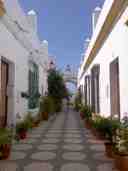
  2. Right in front of you, you’ll spot a narrow pedestrian alley lined with whitewashed buildings, flanked on both ends by graceful stone arches-just follow the row of colorful flower…Czytaj więcejPokaż mniej

    Right in front of you, you’ll spot a narrow pedestrian alley lined with whitewashed buildings, flanked on both ends by graceful stone arches-just follow the row of colorful flower pots along the ground to the archway that perfectly frames the sunshine beyond. Now, as you stand here, imagine a slice of Puerto Real almost unchanged since the 1700s. The Callejón del Arco was built with a special barley stone-the very rock that comes out of the nearby Bay of Cádiz. The two arches at either end have silently watched centuries go by, like the oldest gatekeepers at a costume party who never left! Because this street sits a little higher than sea level, if you walk to the arch at the far end, you’re treated to a picture-perfect balcony overlooking what used to be an open bay, before the waterfront was transformed with new buildings. Locals love their alley-out come the paint and whitewash for the walls, geraniums and rosebushes for their pots, and a careful hand to make sure each plant looks just right. This dedication makes the alley feel like a party every day, minus the confetti (unless it’s windy). It's a spot everyone wants to photograph, whether you enter from lively Amargura Street or the seaside paseo outside. This alley is pure Puerto Real: historic, beautiful, and proudly cared for by its neighbors-just try not to trip over a flower pot while you’re daydreaming!

    Otwórz dedykowaną stronę →
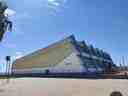
  3. Look for a large, futuristic building with angular blue and cream panels rising from the ground on your right-it almost looks like a giant sports spaceship ready to launch! Now,…Czytaj więcejPokaż mniej

    Look for a large, futuristic building with angular blue and cream panels rising from the ground on your right-it almost looks like a giant sports spaceship ready to launch! Now, let’s step back in time to 1984, when the Pabellón Municipal de Deportes de Puerto Real first opened its doors. Imagine crowds buzzing with excitement-this was the town’s very first sports center, and it quickly became the beating heart of local athletic life. Summers here from 1985 to 1991 brought thundering sneakers and the squeak of basketballs during the Héctor Quiroga tournaments. The top basketball players from all over Spain came to clash in this futuristic arena, and the energy was electric, with spectators holding their breath at every slam dunk and three-pointer. But wait-it’s 1991, and the Balkan War has shaken Europe. Through a twist of fate, the legendary Cibona Zagreb basketball team fled the conflict and found shelter right here, stunning locals as they played an entire season in Spain. The wooden floors echoed with both fierce competition and a sense of resilience. Over the years, rhythmic gymnasts twirled ribbons under the high roof and locals broke a sweat in the gym. Sadly, time wore on, and in 2022 the doors closed due to the building’s “ruinous” state-but the community dreams of its grand comeback, with almost three million euros needed for repairs. For now, it’s a silent giant, holding its epic stories and hope for the future just behind those blue-and-white walls.

    Otwórz dedykowaną stronę →
  4. To spot the Puerto Real Food Market, look to your right for a grand ochre stone building with tall white-arched windows and decorative black ironwork above sturdy old doors,…Czytaj więcejPokaż mniej

    To spot the Puerto Real Food Market, look to your right for a grand ochre stone building with tall white-arched windows and decorative black ironwork above sturdy old doors, stretching along the entire block on this narrow street. You’re standing in front of a living piece of Andalusian history-the Puerto Real Food Market! Just imagine eighteen-century merchants bustling in with crates of olives, oranges, and fish, their voices bouncing off the stone arches and echoing from the tiled ceiling. This is no ordinary food market; it’s the oldest covered market in all of Andalusia! Its neoclassical style isn’t just for show. Every stone in this square-shaped building was meticulously chosen back in the late 1700s, all thanks to the famous Andalusian architect Torcuato Benjumeda. The market’s story is a bit like a spicy paella-full of surprises. Back when Cádiz’s governor grew tired of endless market fiascos, he put out the call for a true professional. Benjumeda answered, drawing up plans so grand the project nearly bankrupted the town! In fact, the council spent almost a hundred years paying off the debts. Now that’s what I call a long-term grocery bill! From where you’re standing, picture the building swallowing up a whole city block. The market stretches with two facades-one seven arches wide along Calle Nueva, the other five along Calle Soledad. Peek through those arches and you’d find a maze: one big central hall, two vaulted side wings, and a sunny courtyard flanked by market stalls, with an open corridor looping around the entire square. Over the centuries, the market’s design was tweaked more than a chef taste-testing soup. They trimmed a whole upper floor, but those striking stone arches and delicate ironwork “eyebrows” above the doors survived every renovation. Inside, the central courtyard still hugs the backs of the old stalls, with a broad walkway where locals stroll while weighing up the freshest catch or the juiciest fruit. Of course, it hasn’t always been smooth sailing. By the 1990s, the market was showing more cracks than a dropped ceramic jug! Rain would trickle through the ceiling, and the slippery floor threatened to turn every visit into a dance routine. The town launched sweeping renovations in 1998 and the early 2000s-just enough to patch up some leaks, scrub the vendor’s stalls, and give the market a facelift. But with every project, there was drama. Just try telling a butcher or fishmonger to pack up shop “for a few weeks.” The vendors resisted-they didn’t want to lose a single day’s trade. Fast-forward to 2010, and the market received new floors and drains. Most vendors stayed put during the fixes, refusing to budge. I suppose you could say their commitment was… unsinkable. In 2022, an even bigger overhaul began, aiming to completely transform its look while preserving that iconic neoclassical spirit you see today. But there’s more! For a whole month in 2011, art took over grocery shopping. Sculptor Antonio Mota’s huge fiberglass statues of famous musicians and local legends filled the market-imagine shopping for tomatoes next to a two-meter tall Hercules or a giant pregnant María. So while you stand here, know you’re not just watching daily life in Puerto Real-you’re witnessing over two centuries of stories about stubborn vendors, big dreams, dramatic renovations, and community pride. The market’s doors and arches have watched generations haggle, laugh, and sometimes complain about the price of anchovies. I wonder if they ever considered charging extra for the drama!

    Otwórz dedykowaną stronę →
  5. To spot the Church of Saint Joseph, look for a pale, sand-colored stone building with a tall tower and an elegant octagonal dome rising above the rooftops-it’s hard to miss with…Czytaj więcejPokaż mniej

    To spot the Church of Saint Joseph, look for a pale, sand-colored stone building with a tall tower and an elegant octagonal dome rising above the rooftops-it’s hard to miss with its simple yet striking neoclassical lines. As you stand before this grand old structure, picture yourself stepping into the heart of Puerto Real in the late 1700s. The air is bustling with plans and hope-after all, the town’s carpenters have decided to build something bigger and more beautiful than their old, crumbling chapel. And they didn’t choose just anyone to get the job done; the celebrated architect Torcuato Cayón de la Vega himself drew up the plans. Construction kicked off in 1770, hammers clattering, and saws singing as the old hermitage of San Andrés slowly gave way to this new vision. But here’s where things get interesting-when Cayón passed away, his own apprentice (and godson!) Torcuato Benjumeda picked up the blueprints and drove the work through to completion in 1794. The building was finally blessed with its impressive name: the Church of Jesus, Mary and Joseph. Back in the day, this church was the stage for grand ceremonies, laughter, and even the odd grumble when the celebrations ran long. If you listen to the stories, you might imagine the townspeople flooding through the arched stone doorway, passing between massive pilasters, Admiring the bright dome and the balconies above as light poured in through the high windows. Fast forward to 1936, and imagine the whole community’s nerves when the nearby Church of San Sebastián was damaged during the Spanish Civil War. For a while, all of Puerto Real’s sacred ceremonies squeezed inside these very walls instead. It was a lifeline during those tough days-a true shelter in a storm. But wait, there’s more! As the years rolled on and the world changed, so did the church. By 1981, the Ministry of Culture officially recognized it as a Monument-putting it under Spain’s highest protection. But the story doesn’t end there; just a few years later, the building was deconsecrated. In a move fit for an epic trade-off scene, the town swapped three plots of land for the church, and San José was handed over by the Bishopric in 1988. By 1992, restoration work began to breathe new life into the old stones. Where hymns once echoed, now you’ll find art exhibitions and community events-imagine the joyful noise! Its architecture tells its own tale: three broad naves, a soaring octagonal lantern, and a stately facade topped with a hint of baroque flair. Look for the robust, unadorned stone pilasters, the gentle curve of the barrel-vaulted ceiling, and the tower with enough presence to guard not just you, but half the town! And that beautiful dome topping the crossing? It’s like the cherry on a neoclassical cake. So as you stand here, let your imagination fill the space with the memories of ancient voices, noisy celebrations, and the sense of continuity-a place where carpenters’ dreams, community courage, and a touch of artistic flair have survived century after century. Welcome to the Church of Saint Joseph, where history is never quite finished.

    Otwórz dedykowaną stronę →
  6. To spot the Church of San Sebastian, look for a tall, whitewashed tower with a pointed tiled roof standing proudly above the neighboring buildings-it easily catches your eye…Czytaj więcejPokaż mniej

    To spot the Church of San Sebastian, look for a tall, whitewashed tower with a pointed tiled roof standing proudly above the neighboring buildings-it easily catches your eye against the blue sky. Alright, get ready for a journey through time! Standing here at Puerto Real’s highest point, imagine you’re gazing not just at the town’s oldest and grandest church, but the stage for centuries of stories. Long ago, this site was only a humble hermitage-rumor has it, if you peek down Palma Street by the corner of San José, you can still spot a weathered wall and some chunky buttresses as its ancient fingerprints. Now, in 1592, while folks elsewhere were inventing strange new dances and chasing pirates, the townspeople crowned this church as their sacred heart. Back then, the masons went wild, mixing styles like a true Andalusian stew: Gothic for the pointed arches over your head, solid Renaissance for those broad, sunny naves, and even a bit of Baroque drama in 18th-century chapels twinkling under their domes. Now, here’s a detail for the romantics-see the main door facing Ancha Street? They call it “the brides’ doorway.” Picture the swirl of wedding dresses and nervous laughter echoing off these plateresque carvings. Up top, the Father watches over all, though the angels and saints are a bit worse for wear after centuries of weather. Oh, and let’s not forget the church’s sturdy tower-simple, strong, probably used by townsfolk to spot trouble coming, and always crowned by that tiled pyramid. During Spain’s Civil War, fire nearly destroyed everything, but thanks to Germán de Falla-who had the good sense (and famous relatives)-the church rose from the ashes and reopened in 1946. Listen closely. Sometimes, as you stand beneath the bells, you might hear their echo-like a memory rippling down the Camino Ceretano, where Roman travelers once tramped beneath the same Andalusian sun. If this church could talk, it would have quite a few stories to confess!

    Otwórz dedykowaną stronę →
  7. Here you are, standing in front of the home of the legendary Borriquita Brotherhood of Puerto Real! Imagine you’ve traveled back to a sunny, lively spring day in 1943. Picture…Czytaj więcejPokaż mniej

    Here you are, standing in front of the home of the legendary Borriquita Brotherhood of Puerto Real! Imagine you’ve traveled back to a sunny, lively spring day in 1943. Picture narrow cobbled streets full of anticipation, since this is where the first procession ever set out. There wasn’t a grand parade, mind you-a much humbler journey started from the old La Salle Buen Consejo school, just a few neighbors coming together, carrying their faith on small platforms. What began as a tiny spark of devotion in that school’s entrance has grown into one of the town’s most cherished traditions. By July of 1944, excitement was in the air. The official foundation was set in ink, with a crowd of 46 eager locals, church leaders, and teachers gathering for the first big meeting. It was like casting the actors for a play that would never truly end-with Reverend Manuel Barberá Saborido and La Salle’s brother Jerónimo Juan leading the charge. These early members picked their first board, presided over by Ramón Caramé Romero. You might say they kicked off their journey with a lot of faith... and just a dash of organizational flair! The story wouldn’t be complete without its stars. The main figure of Jesus riding a donkey-donated by a naval officer who doubled as Puerto Real’s mayor, Antonio Blanco Paz-formed the core of the “Paso de Misterio.” Later, the brotherhood added a lone apostle and even a local Hebrew: now, that’s what you call community participation! Over the years, more characters joined, courtesy of talented artists like Jaime Martrus y Riera and, more recently, additions from Jerez de la Frontera. Even their parade platform is a piece of art, hand-carved out of Brazilian mahogany and finished in 1990 by Diego Salvador Flores, a local craftsman with an eye for drama. And just wait till you hear about their music! In the beginning, borrowed bands provided the soundtrack, but since the ‘70s, this brotherhood grew its own band, transforming from cornets and drums into a full music group. Walk the streets on Palm Sunday and you’ll hear the symphony echoing through Puerto Real-though thankfully, the musicians have a little more stamina than their original donkey mascot. Let’s not forget Nuestra Señora de la Estrella. Crafted in 1963 by Miguel Laínez Capote, this beautiful Virgin statue received a glowing makeover in the 1980s-think of it as her own spiritual spa day. Her velvet blue canopy and richly embroidered banners were the talk of the town, though a sneaky rainstorm in 2001 delayed their debut. Every detail matters for these processions: shimmering candelabras, navy silk, and a band that could bring a tear to anyone’s eye. Of course, the Brotherhood loves to keep life interesting. In the 1950s, they introduced distinctive bright white and red robes for their penitents, and for a few memorable years in the ‘70s, processions boldly took to the morning hours-because who says you can’t combine faith with a good breakfast? Throughout it all, La Salle school has been more than a home-it's been family, providing the roots and guidance needed to help the Brotherhood thrive. In 1979, the community of Brothers was even named honorary big siblings; talk about earning some bragging rights at the reunion! By 2019, all this devotion, culture, and charity led to a golden moment-the city itself honored the Brotherhood with the prestigious Medal of Gold. So, next time you hear those bands tuning up or see the Virgin’s canopy shimmering in the sunlight, remember-you’re not just seeing a parade. You’re witnessing a living, breathing story, crafted by the hands and hearts of Puerto Real.

    Otwórz dedykowaną stronę →
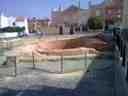
  8. To spot the Horno Romano de El Gallinero, look for the round, brick ruins surrounded by low glass panels just below street level, sitting right in the middle of a modern…Czytaj więcejPokaż mniej

    To spot the Horno Romano de El Gallinero, look for the round, brick ruins surrounded by low glass panels just below street level, sitting right in the middle of a modern residential area-it almost looks like an ancient pizza oven had a bit too much fun and decided to settle in the middle of Puerto Real! Now, as you’re standing here and taking in these ancient remains, let’s imagine the scene nearly two thousand years ago. Forget the parked cars and modern homes for a second-picture yourself swept back to the first century AD. Instead of quiet residential streets, this area would have been alive with the thud of clay, the crackle of fire, and perhaps the occasional shout from a Roman potter who, let’s be honest, was probably complaining about the heat! This circular structure you’re looking at is the belly of Puerto Real’s ancient industry. The Horno Romano de El Gallinero is a Roman kiln, what you could call the “factory outlet” of its day, churning out essential ceramic pieces-mainly amphorae, those classic big jars you might picture carrying olives or fish pastes across the Roman Empire. With a diameter of four and a half meters, this was no tiny backyard oven; it was big enough to bake pottery for an empire hungry for salted fish and other delicacies from Cádiz! But the story of this kiln is a little like a detective mystery. It first came to light thanks to the sharp eyes of an archaeologist, M. Ponsich, who noticed something curious while houses were going up in this new part of town. Every new discovery-whether bits of broken pottery, old graffiti scratched onto ancient pots, or evidence of a second, similar kiln (sadly now mostly destroyed)-added another clue about how bustling and important this area was. Pottery sherds scattered across the site told stories of discarded vessels, failed experiments (hey, not even Romans got it right every time!), and the busy business of feeding the empire. And while the potters were at work, the kiln was the heart of their world: Imagine the searing heat radiating from the praefurnium-basically the oven’s mouth-where wood was fed to stoke the flames. The pottery sat above the fire, supported by a central pillar and a series of stone arches, carefully designed to let the heat rise without letting the flames lick the clay. The potters would have worked quickly, braving the heat to stack their jars and amphorae just so, all while perhaps swapping a few jokes about “firing” their best friend if he cracked another batch. It wasn’t all smooth sailing for our ancient kiln, though! Over the centuries, storms and stray winds battered it, and it was gradually buried and forgotten by time. When modern buildings sprang up, the kiln was rediscovered, sometimes threatened by new construction, but eventually celebrated for its historic worth. After a few rounds of cleaning, patching, and a well-deserved makeover, it was ready for its close-up, finally presented to the public in 2011-though sometimes the signage still struggles to keep up! Standing here, you’re peering not just into a hole in the ground, but straight into the heart of ancient industry, invention, and the daily lives of people who might have been more like us than we think. Who would have thought a simple oven could survive so long, only to become a star in the 21st century? Now, that’s what I call being fired up for history!

    Otwórz dedykowaną stronę →

Najczęściej zadawane pytania

Jak rozpocząć trasę?

Po zakupie pobierz aplikację AudaTours i wpisz kod realizacji. Trasa będzie gotowa do natychmiastowego rozpoczęcia – po prostu dotknij \"Play\" i podążaj trasą z nawigacją GPS.

Czy potrzebuję internetu podczas trasy?

Nie! Pobierz trasę przed rozpoczęciem i korzystaj z niej w pełni offline. Jedynie funkcja czatu wymaga internetu. Zalecamy pobieranie przez WiFi, aby oszczędzać dane mobilne.

Czy to wycieczka grupowa z przewodnikiem?

Nie – to samodzielny audioprzewodnik. Zwiedzasz niezależnie, we własnym tempie, z narracją audio odtwarzaną przez telefon. Bez przewodnika, bez grupy, bez harmonogramu.

Ile trwa trasa?

Większość tras zajmuje 60–90 minut, ale to Ty kontrolujesz tempo. Wstrzymuj, pomijaj przystanki lub rób przerwy, kiedy chcesz.

Co jeśli nie zdążę ukończyć trasy dzisiaj?

Żaden problem! Trasy mają dożywotni dostęp. Wstrzymaj i wznów, kiedy chcesz – jutro, za tydzień lub za rok. Twój postęp jest zapisywany.

W jakich językach są dostępne trasy?

Wszystkie trasy są dostępne w ponad 50 językach. Wybierz preferowany język podczas realizacji kodu. Uwaga: języka nie można zmienić po wygenerowaniu trasy.

Gdzie znajdę trasę po zakupie?

Pobierz darmową aplikację AudaTours z App Store lub Google Play. Wpisz kod realizacji (wysłany e-mailem), a trasa pojawi się w Twojej bibliotece, gotowa do pobrania i rozpoczęcia.

verified_user
Gwarancja satysfakcji

Jeśli trasa Ci się nie spodoba, zwrócimy Ci pieniądze. Skontaktuj się z nami pod adresem [email protected]

Bezpieczna płatność przez

Apple PayGoogle PayVisaMastercardPayPal

AudaTours: Audioprzewodniki

Rozrywkowe, niedrogie, samodzielne piesze trasy

Wypróbuj aplikację arrow_forward

Uwielbiany przez podróżników na całym świecie

format_quote Ta trasa była świetnym sposobem na poznanie miasta. Historie były ciekawe, bez przesadnego scenariusza, i uwielbiałam możliwość zwiedzania we własnym tempie.
Jess
Jess
starstarstarstarstar
Trasa po Tbilisi arrow_forward
format_quote To był solidny sposób na poznanie Brighton bez poczucia bycia turystą. Narracja miała głębię i kontekst, ale nie przesadzała.
Christoph
Christoph
starstarstarstarstar
Trasa po Brighton arrow_forward
format_quote Zacząłem tę trasę z croissantem w jednej ręce i zerowymi oczekiwaniami. Aplikacja po prostu idzie z Tobą, bez presji, tylko Ty, Twoje słuchawki i fajne historie.
John
John
starstarstarstarstar
Trasa po Marseille arrow_forward

Nieograniczone audioprzewodniki

Odblokuj dostęp do KAŻDEJ trasy na świecie

0 tras·0 miast·0 krajów
all_inclusive Odkryj Bez Limitu