AudaTours logoAudaTours

Wycieczka audio po Lublanie: Dusza Lublany

Audioprzewodnik15 przystanków

Lublana skrywa swoje sekrety za cukierkowo-różowymi kościołami, wspaniałymi pałacami i wieżami lśniącymi w porannym słońcu. Zejdź nieco z utartych szlaków i odkryj, że każdy kamień na Placu Prešerena i każde ozdobne rzeźbienie na budynku Kresija kryje opowieści o dramacie i buncie. Ta wycieczka audio z przewodnikiem poprowadzi Cię przez tętniące życiem place, ukryte przejścia i milczące iglice, odsłaniając historie i skandale, których większość turystów nigdy nie dostrzega. Kto zaryzykował wszystko, gdy trzęsienie ziemi zniszczyło serce miasta? Jakie tajemnicze postacie zniknęły z rzymskokatolickiej archidiecezji podczas okupacji wojennej? Dlaczego bliźniacze posągi na fasadzie budynku Kresija zdają się patrzeć na siebie wilkiem, podczas gdy historia toczy się dalej? Przemierzaj stulecia, gdy echa utraconych imperiów i szeptanych rewolt wirują u Twoich stóp. Poczuj napięcie pod stopami, gdy starożytne rytuały, ogniste protesty i zakazane sojusze kształtują Lublanę na nowo za każdym rogiem. Gotowy, by odkryć, co naprawdę kryje się pod wypolerowaną powierzchnią Lublany? Zacznij słuchać już teraz — miasto czeka.

Podgląd trasy

map

O tej trasie

  • schedule
    Czas trwania 40–60 minsIdź we własnym tempie
  • straighten
    3.7 km trasy pieszejPodążaj wyznaczoną trasą
  • location_on
    LokalizacjaLublana, Słowenia
  • wifi_off
    Działa offlinePobierz raz, korzystaj gdziekolwiek
  • all_inclusive
    Dożywotni dostępOdtwarzaj ponownie w dowolnym momencie
  • location_on
    Start przy Plac Prešerena

Przystanki na tej trasie
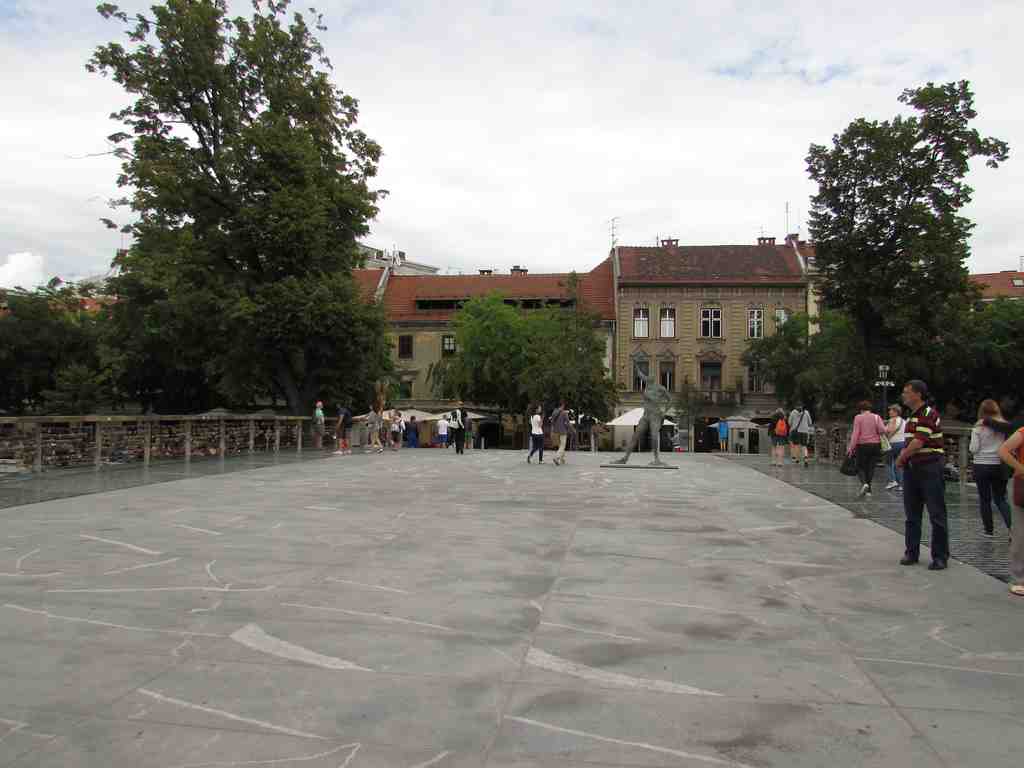
  1. If you’re trying to spot Prešeren Square, just look for the big open plaza paved with gray stones, surrounded by grand historic buildings-including a candy-pink church with twin…Czytaj więcejPokaż mniej

    If you’re trying to spot Prešeren Square, just look for the big open plaza paved with gray stones, surrounded by grand historic buildings-including a candy-pink church with twin spires (the Franciscan Church of the Annunciation) and a tall bronze statue of a poet on a stone pedestal right in front. Welcome to Prešeren Square, the very heart of Ljubljana! As you stand here, you’re not just at a crossroads-oh no, you’re at a living stage where stories have unfolded for centuries. Picture this: the square today buzzes with laughter and footsteps, echoing during festivals, concerts, carnivals, and maybe even the occasional dramatic protest or two. This round, granite-paved space hasn’t always been so welcoming-or so circular! Imagine back in the Middle Ages, when this spot was a much narrower funnel-shaped intersection, guiding villagers between city gates, the riverbank, and the foot of Castle Hill. There were times this place looked more like a spaghetti tangle of winding streets than the elegant plaza you see now! In the 17th century, the striking Franciscan Church-the rosy, twin-towered beauty on the south side-anchored the new open space called St. Mary’s Square, giving people a reason to pause and take a breath from their daily rush. The square took its current form when a powerful earthquake shook the city in 1895-rumor has it the ground shook so hard, even the statues were holding on for dear life! Most of the old houses crumbled, making way for ambitious new palaces and storefronts. Look around now-each corner of this square has stories etched into the stucco and stone, from the thumbprint of the fabulous architect Max Fabiani, who rebuilt and shaped the square as a hub, to Ciril Metod Koch, who jazzed up the Hauptmann House in totally trendy Secessionist style. And hey, if you need to do a bit of shopping, why not tell your friends you browsed at the historic Mayer or Nama department stores? Edvard Ravnikar, another creative mind, came along in the 1980s and gave Prešeren Square its distinct circular energy, paving it with a sunburst pattern of Macedonian Sivec marble. He even thought about putting a big fountain smack in the center, but the locals said, “No thanks, Edvard-we like it just the way it is.” Instead, Ravnikar’s radiant lines are like mathematical rays, drawing people into the square from all sides, especially since the city closed it off to car traffic in 2007. That’s right-this is pedestrian paradise, where only a lucky tourist bus is allowed through. But of course, the real headliner is France Prešeren, Slovenia’s national poet and namesake of the square. See his proud bronze statue on the east side? He’s got his muse perched above him-a symbol of inspiration reaching down to touch greatness. The monument arrived in 1905 (and was so impressive, it’s now a national treasure). Behind Prešeren, three birch trees were planted, marking an “energy center” for the city. If you suddenly feel poetic, blame it on those birches! Direct your steps toward the north end, and you’ll find a striking bronze model of Ljubljana from above-a 2.2-meter square, donated by the city’s Urban Planning Institute in 1991. Give it a look, and you’ll see the city as the architects and dreamers do-a puzzle of rivers, towers, and winding roads. And those benches nearby? The perfect place to rest and imagine yourself in one of the glamorous postcards that have featured this square for over a century. So take a moment and let the buzz of Prešeren Square work its magic. Whether you’re here for the Dragon Carnival or just a lazy stroll, you’re standing where every era left its mark-and if these cobblestones could talk, I bet they’d have some real poetic tales to tell!

    Otwórz dedykowaną stronę →
  2. To spot the Kresija Building, look straight ahead for a grand, cream-colored palace with a red roof, covered in ornate carvings and crowned by a round turret on the…Czytaj więcejPokaż mniej

    To spot the Kresija Building, look straight ahead for a grand, cream-colored palace with a red roof, covered in ornate carvings and crowned by a round turret on the right. Welcome to stop number two, the majestic Kresija Building! Right now, you’re standing where the old meets the new-this impressive structure marks the gateway into Ljubljana’s enchanting old town. Take a big breath and imagine the gentle breeze drifting through a city that’s seen centuries of stories. Now, back in the day-long before the gleaming Neo-Renaissance walls you see-this spot was all about babies and bandages! Yes, there was once a bustling hospital and a school here, including the first place in Ljubljana where doctors learned their craft in Slovene, all thanks to the famous Dr. Gerard van Swieten. Picture midwives catching babies, doctors rushing down echoey corridors, and townsfolk popping by for a quick check-up-though “quick” might have meant something different when they also taught surgery here! Just next door, St. Elizabeth’s Church rang its bells, until it disappeared in 1831-talk about vanishing neighbors. Fast forward to 1895, Ljubljana is shaken by a mighty earthquake, trembling like a jelly on a plate! Out goes the old, in comes the new: the city decides it’s time for something grand, and so enters architect Leopold Theyer. He draws up the palace you see now, with its fancy Baroque-meets-Renaissance exterior, sparkling balconies of wrought iron, and right above the entrance, the proud coat of arms of Ljubljana-guarded by not one, but two stone genii, sculpted by Alojzij Repič. Don’t worry, these genii won’t be granting wishes today, but they’ve certainly granted the building plenty of character! The Kresija Building has always been the beating heart of city administration-first for the Austro-Hungarian “Kreis” (that’s where its name comes from), later for Ljubljana’s district offices. And if you peek along the southwestern corner facing Stritar Street, you’ll spot two busts keeping watch: that’s Adam Bohorič, a clever Protestant grammarian, and Marko Gerbec, a doctor with a heart as big as his wig. During Slovenia’s race for independence in 1991, the building’s corridors echoed with whispers and the determined footsteps of secret defenders, the Manoeuvre Structures of National Protection-heroes remembered today by the plaque near the turret. So while you’re snapping a photo or just admiring the sunlight on the creamy façade, know this palace has seen everything from newborn cries to the celebrations of liberty…not a bad résumé for a building, right?

    Otwórz dedykowaną stronę →
  3. Look up ahead to spot the Roman Catholic Archdiocese of Ljubljana, with its grand white facade and twin clock-towered spires rising just above the street, and the large…Czytaj więcejPokaż mniej

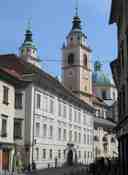
    Look up ahead to spot the Roman Catholic Archdiocese of Ljubljana, with its grand white facade and twin clock-towered spires rising just above the street, and the large green-domed roof peeking out behind. Welcome to the heart of Ljubljana’s spiritual life! You’re standing in front of the Roman Catholic Archdiocese headquarters, and, even if you’re not a fan of bells, I’ll bet you can’t help staring at those striking twin towers and elegant dome - it’s like the city decided to wear its fanciest hat today! But trust me, the story inside these walls is even grander than the view out here. Imagine the early dawn of the fourth century, when the ancient Diocese of Emona (Ljubljana’s Roman ancestor) first opened its doors to hopeful worshippers. Back then, you’d hear the low hum of prayer layered with the bustle of Roman streets - now that’s a soundtrack for history! Yet, life was anything but calm; over centuries the seat of the diocese moved and changed, weaving through tides of empires and politics until, in 1461, along came Frederick III, the Holy Roman Emperor. With a royal flourish, he created the Diocese of Laibach right here, which Pope Pius II quickly confirmed. Suddenly Ljubljana was more than just a city; it was becoming a center of faith. As you gaze at those towers, imagine the tension: In 1787, after years under the thumb of powerful religious neighbors like the Patriarch of Aquileia, Ljubljana’s diocese was lifted to the rank of archdiocese-a metropolis in the Catholic world! Everyone must have been celebrating, except, well… about twenty years later politics pulled the rug out from under their feet, and it got downgraded again. If only they had Yelp reviews back then for diocesan status! Dark days swept through during the Second World War. The Nazi occupation targeted clergy and religious orders, and within just six weeks, you’d find the archdiocese nearly silenced-only 100 out of more than 800 priests remained free, while the rest vanished into the nightmare of concentration camps or lost their livelihoods as properties were seized. This city’s prayers must have felt heavier than ever, echoing off cold stone and silent pews. But resilience is woven into these very walls. By 1961, Pope John XXIII restored Ljubljana as an archdiocese once again, and by 1968, it was back as a metropolis, spreading its influence far beyond these streets. Today, it’s the most important seat in Slovenia, with the Archbishop of Ljubljana acting as the Primate-the top banana of the nation’s Catholic hierarchy. Since 2014, Archbishop Stanislav Zore has held the post, stepping into shoes filled by many historic names (and, occasionally, stepping out when things got a little too dramatic, like the financial fiasco you won’t find in the Sunday bulletin). So the next time you spot those clock faces, remember: you’re not just looking at beautiful architecture, but a living story of faith, power, struggle, and hope. Not bad for a place that started in ancient Rome, right? And if you listen closely, you might just hear the whispers of those who shaped this city’s soul. Exploring the realm of the archdiocese, list of bishops of ljubljana or the list of archbishops of ljubljana? Feel free to consult the chat section for additional information.

    Otwórz dedykowaną stronę →
Pokaż jeszcze 12 przystankówPokaż mniej przystankówexpand_moreexpand_less
  1. Directly ahead, you’ll see a wide, modern footbridge with glass railings and mysterious metal sculptures, stretching across the river-just look for the locks sparkling along the…Czytaj więcejPokaż mniej

    Directly ahead, you’ll see a wide, modern footbridge with glass railings and mysterious metal sculptures, stretching across the river-just look for the locks sparkling along the fence, left and right, as you get close. Welcome to the Butchers’ Bridge-a place where history, art, and a touch of romance all come together over the calm waters of the Ljubljanica! You’re standing on what looks like an ordinary footbridge, but don’t let its sleek glass and steel exterior fool you-this spot has a backstory juicier than a Ljubljana sausage. Picture this: It’s the 1930s, and the legendary architect Jože Plečnik dreams up a grand, covered bridge for this very spot, meant to link the lively Central Market to the bustling Petkovšek Embankment. But just as the city was about to say, “Let’s do it!”, history had other plans-a little distraction called World War II put Plečnik’s dream on ice for over half a century. So, for decades, this place was simply an empty hint of what could have been, a gap in the city’s heart where locals would pass by and wonder, “What if?” Finally, the city dusted off the idea in 2009, and under the guidance of architect Jurij Kobe, a slightly less monumental-but much more modern-bridge was born. It opened on a summer day in 2010, with the entire city turning out to celebrate a bridge that took only a year to build, but almost 80 years to truly arrive. Butchers’ Bridge isn’t just a crossing-it’s a quirky outdoor gallery. As you stroll, notice the larger-than-life sculptures along the central walkway. On one side, Adam and Eve walk away from Paradise-sheepish and naked, after that unfortunate apple incident. If you spot a wild-eyed satyr jumping away from a snake, don’t be startled; he’s got his own troubles with temptation! And up ahead? That’s Prometheus-caught in dramatic mid-sprint, guts out (literally!), in one of history’s worst “thank you” gifts for giving fire to humanity. Sprinkled around are little frogs and shellfish peeking out from the fence. It’s almost as if the bridge dares you to take mythology a little less seriously. Look closer at the steel rails-see all the padlocks? Young lovers (and the young at heart) have started chaining their hopes and dreams to the bridge, just like on Paris’ Pont des Arts. Every lock is a tiny promise of forever-or at least, until someone brings a bolt-cutter! So whether you’re marveling at the art or pondering your own love story, remember: on the Butchers’ Bridge, everyone’s a part of the legend. Watch your step on the glass, keep an eye out for mythological mischief, and don’t forget to snap a photo before we stroll to our next adventure!

    Otwórz dedykowaną stronę →
  2. To spot the Dragon Bridge, look for the fierce green dragons poised on each corner of a broad stone bridge arching over the Ljubljanica River, just ahead of you with their wings…Czytaj więcejPokaż mniej

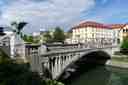
    To spot the Dragon Bridge, look for the fierce green dragons poised on each corner of a broad stone bridge arching over the Ljubljanica River, just ahead of you with their wings outstretched and ready to pounce. Ah, you’ve reached the legendary Dragon Bridge! Take a moment and let those dragons size you up - don’t worry, they haven’t eaten a tourist in years. Just listen to the city, with the gentle rumble of traffic and distant laughter echoing from Vodnik Square just north of you. This is no ordinary crossing. In the early 1900s, when Ljubljana was still under the grand moustache of the Austro-Hungarian Empire, the city decided that a new bridge would stand where an old creaky oak one had served locals and butchers for almost a century. The big oak bridge was damaged by a wicked earthquake in 1895, and Mayor Ivan Hribar-picture a man with dreams as big as his moustache-launched an urban makeover you’d see in those reality TV transformation shows. The bridge would be bold, modern, and absolutely unmissable… oh, and featuring dragons, of course. Now, let’s step back in time. It’s July 1900, and construction begins under the eyes of both Austrian and Slovenian engineers, with a few heated debates about the blueprints-if bridges could buckle from bickering, this one surely would’ve! Finally, local architect Ciril Metod Koch took charge. By October 1901, the people of Ljubljana gathered, breaths frosty in the autumn air, as Bishop Jeglič blessed the new bridge in front of bigwigs like the designer Jurij Zaninović, whose dragons you see here today, and even Emperor Franz Joseph’s representatives. Back then, it was called the Jubilee Bridge to honor the Emperor. But let’s face it, “Dragon Bridge” has a much nicer ring and more bite! What’s truly special beneath your feet is the bridge’s pioneering spirit. It was among the first in Europe to use reinforced concrete, and the Melan System, which let builders skip the usual piles of wooden supports. Ljubljana was the perfect place to try this brave new method because, well, if it didn’t work, only a few surprised fishermen in the river would notice. This leap of engineering gave Dragon Bridge the third-largest arch in Europe at the time! And those slabs under you? Ljubljana’s first ever paved with asphalt. That’s some seriously smooth history. But what about these dragons? Four fierce, sheet-copper creatures perch on the corners, and sixteen baby dragons peer out from the balustrades. Designed in Vienna but forever at home in Ljubljana, they look like they’ve just landed, wings raised, claws sharp. According to legend, Jason and his Argonauts, on the run after stealing the Golden Fleece, founded Ljubljana and fought a monster in the marsh-yes, a dragon! So if you feel watched, don’t mind the traffic cameras, it’s these mythical guardians. And, here’s a giggle for you: local legend claims that when a virgin crosses the bridge, the dragons wag their tails. You’ll have to keep an eye out-maybe you’ll witness it! Oh, and locals also cheekily call the bridge “mother-in-law”-something about its fiery personality! Through storms, renovations, and even an upgrade with super-light concrete in the 1980s, the bridge has kept Ljubljana connected, and its dragons have kept watch, scaring away nothing more dangerous than an overeager pigeon. When the bridge turned 100 in 2001, the whole city celebrated a century under the shadow-and protection-of these winged creatures. So while the cars zoom by and the river flows beneath, you’re standing at the crossroads of history, legend, and some serious city swagger. Take a photo, do your best dragon roar, and remember: here in Ljubljana, even the bridges have teeth!

    Otwórz dedykowaną stronę →
  3. Look up toward the top of the hill, and you’ll easily spot Ljubljana Castle’s sturdy stone walls, brown-roofed towers, and a tall white clock tower proudly flying two giant flags…Czytaj więcejPokaż mniej

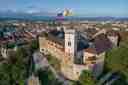
    Look up toward the top of the hill, and you’ll easily spot Ljubljana Castle’s sturdy stone walls, brown-roofed towers, and a tall white clock tower proudly flying two giant flags high above the city. Now, take a deep breath-can you smell the history? You’re standing before one of Ljubljana’s most impressive sites, perched right above the city with a view that has seen more centuries than most castles can dream of! Imagine, if you will, 1200 BC: this very hilltop is already alive with the sounds of ancient settlements, later becoming a lookout for Illyrian and Celtic tribes. Then the Romans showed up, probably marching in with their sandals and shiny armor, and turned the summit into a stronghold. Fast forward to the thunder of the Middle Ages. The first real Ljubljana Castle probably started out as a humble wooden-and-stone fort in the 11th century, but soon, the place is brimming with intrigue-not just knights and nobles, but lawyers brokering deals and rulers eyeing the city below. The castle pops up in the history books in 1161, on a piece of parchment. By the 13th century, the castle’s seen more owners than a well-loved horse: House of Sponheim, King Ottokar II of Bohemia, and eventually Emperor Rudolph of Habsburg, who must have been pretty pleased with his new hilltop view. Back in those days, having a big stone castle wasn’t just for showing off-it was a fortress, armed to the teeth and ready for anything: Ottoman invasions, peasant revolts, you name it. In the 15th century, they even knocked most of it down and rebuilt it stronger, with thick walls and a proper drawbridge. Don’t forget St. George’s Chapel, tucked securely inside-after all, if fire-breathing dragons were ever real, St. George would be the guy to call! As you gaze at the castle, picture it bustling as an arsenal in the 17th century, then smelling faintly of gunpowder and horse sweat as French armies barged in twice at the dawn of the 1800s. Soon after, it became a prison-imagine the clang of iron chains echoing off the cold stone when revolutionary prisoners like Silvio Pellico and Ivan Cankar shuffled inside, plotting their escapes. The warden back then? He doubled as a town crier, firing cannons high above Ljubljana to warn locals of fires or announce important visitors. The castle lost its shine for a while in the 19th century-no more royal banquets, just the grumbling of prisoners and rattling of old windows. It was part jailhouse, part military stronghold, until finally the city mayor, Ivan Hribar, bought it in 1905. His dream was to turn it into a museum, but instead, the castle became a home for poor families, who watched their children play beneath walls where knights once sharpened their swords. Only in 1963 did the families move out, making way for decades of careful restoration. And what a transformation! Today, the castle is a hive of activity, buzzing with weddings, concerts, culture, and the occasional cries of happily lost tourists. Beneath it runs a sleek funicular-listen, do you hear the gentle hum climbing the slope? Just 117 meters long, but it whisks you up the 70-meter hill almost effortlessly-much nicer than climbing up in full armor, I’d say. But don’t just stop at the famous lookout: from the Archers’ Tower, decorated inside with whimsical art inspired by Slovenian legends, to the dungeon, which once only opened to lower prisoners by rope, the castle’s stones hold secrets upon secrets. The Tower of Erasmus is named after a dashing robber-knight who not only stabbed a man at dinner, but then managed to escape from this very prison-nobody’s quite sure how, but maybe he slipped out through a hidden exit (or just left his jailer a really generous tip). On a sunny day, climb the spiral staircases to the panoramic tower-see the mountains shimmering on the horizon! Even on a cloudy one, listen for the wind winding through the battlements, carrying tales of dragon legends-the castle’s so famous, it shares the city’s coat of arms with a dragon on top. And who knows, maybe if you listen closely enough, you’ll still hear the medieval laughter, the clang of swords, or even a secret whispered among the stones. So, linger for a moment, touch the ancient walls, and let Ljubljana Castle sweep your imagination from prehistory to the present. If only those stones could talk-or at least tell you where the kitchen was, because after 900 years, even the ghosts must be hungry!

    Otwórz dedykowaną stronę →
  4. Ahead of you is the Old Square-look for a narrow, winding cobblestone street lined with colorful old houses, busy cafés, and the gentle chatter of people sitting…Czytaj więcejPokaż mniej

    Ahead of you is the Old Square-look for a narrow, winding cobblestone street lined with colorful old houses, busy cafés, and the gentle chatter of people sitting outdoors. Welcome to the Old Square, the very beating heart of medieval Ljubljana! Close your eyes for a second and imagine yourself centuries ago, when instead of modern chatter, you might hear the sharp call of market vendors or the steady beat of horse hooves on the stones. This is the city’s oldest square, where everything from daily life to grand legends began. The square might seem peaceful now, but in the Middle Ages it buzzed with monks, traders, bakers, even prisoners from the old jail-now replaced by cafés offering the world’s best people-watching. Take a look at the mix of houses around you. Earthquakes and fires tried their best to shake things up in Ljubljana, but what you see is a stylish blend of medieval stone and glamorous baroque facades. Don’t miss the grand Valvasor House, once a bakery and maybe even the birthplace of Slovenia’s most famous scholar-though historians are still scratching their heads about that one! There’s also the house with the swirly Rococo front, and the music academy in the old Stična Mansion-so if you hear a piano drifting through the air, you know why. Oh, and here’s a riddle: what’s big, green, leafy, and used to stand right in the middle of the square? The famous linden tree, forever remembered in a wild tale! Bad boy Povodni mož (the Water Man) once danced with a girl called Urška under its shade, then swept her straight into the Ljubljanica river. The well nearby-a replica of a 17th-century original-remembers these stories, and if you listen closely, you might just hear the echo of those old songs and the fountain splashing. Soak up the atmosphere, look out for hidden coats of arms above the doors, and grab a seat if you can-life at Old Square is all about enjoying the moment, just like the poets say. After all, this is a place where legends never really disappear; they just wait for the next curious traveler to come along.

    Otwórz dedykowaną stronę →
  5. Directly in front of you, you’ll spot the Shoemaker’s Bridge by looking for a low, white stone bridge with elegant balustrades and columns topped by round lamps - it stretches…Czytaj więcejPokaż mniej

    Directly in front of you, you’ll spot the Shoemaker’s Bridge by looking for a low, white stone bridge with elegant balustrades and columns topped by round lamps - it stretches gracefully across the narrowest part of the Ljubljanica River, just beneath Ljubljana Castle’s gentle hill. Now, as you stand by the bustling riverbank, imagine stepping back through centuries of Ljubljana’s history. You might hear the echoes of traders, the shouts of market vendors, and the slap of carpenters’ and cobblers’ hammers. This spot has always been the true heart of town, because here, where the river squeezes closest to the castle hill, people are always crossing, meeting, and doing business. In the earliest days, there was a sturdy wooden bridge here, binding together three of the old city markets. As you walked across, you’d dodge meat sellers and butchers chopping away by the railings, earning the bridge its old nickname - the Butchers’ Bridge. Imagine a busy, messy place, with meat being washed in the river and, frankly, a few questionable smells wafting through the air. Ljubljana soon realized that this location was less “fine dining” and more “potential health crisis,” so in 1614, the butchers were politely invited to relocate elsewhere (or, knowing city politics, not so politely). But the bridge’s story didn’t end there. When the old wooden bridge eventually burned, Ljubljana built another and welcomed a whole new set of craftsmen: the shoemakers. Now, the bridge echoed with the sound of leather being cut, soles being hammered and the endless chatter about who could repair your boots best. Imagine peeking into the tiny shoemaker stalls that lined the bridge, and perhaps smelling fresh leather instead of…well, washed meat. Time marched forward. By the 19th century, a stylish cast-iron bridge replaced the old wood. But the real showstopper came in the 1930s, when Ljubljana’s favorite architect, Jože Plečnik, gave the bridge its elegant, modern look. Picture the bridge as a kind of city square floating over the river, its wide, open pathway bordered by graceful stone balustrades and columns topped with three-globed lamps that glow at dusk. Plečnik imagined you’d not just cross - you’d linger, chat, maybe fall in love (or at least buy a good pair of shoes). So, as you stand here, you’re on a bridge that’s seen markets, floods, fires, city gossip, lovers’ meetings, and countless shoemakers. If you listen carefully, you can almost hear the centuries calling - and maybe, just maybe, someone offering you a good deal on a new pair of boots!

    Otwórz dedykowaną stronę →
  6. To spot the Slovenian Academy of Sciences and Arts, look for a stately cream-colored building with symmetrical windows, a triangular pediment above the entrance, and a prominent…Czytaj więcejPokaż mniej

    To spot the Slovenian Academy of Sciences and Arts, look for a stately cream-colored building with symmetrical windows, a triangular pediment above the entrance, and a prominent clock set high on its façade, directly in front of you. Welcome to the very heart of Slovenia’s intellectual world! As you stand before this elegant building, take in the deep cream walls, the sharp triangular roof with its red tiles, and that grand old clock staring down from above - almost as if it’s keeping an eye on you to see if you’ve finished your homework! This is the Slovenian Academy of Sciences and Arts, or, if you want to sound like a local, SAZU. Don’t worry - there’s no entrance exam required to listen! This place might look calm now, but picture Ljubljana back in 1938: the world was on the edge of change, and inside these very walls, the brightest Slovene minds gathered to create a hub of knowledge that still pulses through the country today. Scientists and artists, with their pens and lab coats, huddled here as the first members of SAZU, dreaming up ways to propel Slovene science and the arts onto the world stage. If these windows could talk, you’d hear heated debates about the mysteries of the universe, sighs over poetry, and, probably, a few complaints about the lack of good coffee for long nights of research. From the early days, the Academy’s job has been simple but grand: to gather the finest Slovene researchers and artists, give them a cozy spot to argue, encourage, inspire, and occasionally - just occasionally - show off. They nurture both science and the arts, making sure Slovenia never loses its sense of wonder or its knack for clever thinking. The list of activities is long: they set research policies, offer wise suggestions about language, literature, and even the future of Slovenian culture, and lend their voices in matters that shape the whole nation. But this home of brains and brushes didn’t just pop up overnight. The dream of a Slovene academy started soon after the University of Ljubljana was born in 1919. Imagine the city buzzing with intellectuals, a newly opened Scientific Society for Humanistic Sciences in 1921, and drafts for the law to create the academy vanishing into drawers all over town. It wasn’t until 1938 that the dream came true - and history hasn’t given them a dull day since. During World War II, the Academy became a beacon of cultural resistance. When silence hovered over occupied Slovenia, the Academy courageously broke through, refusing to let Slovene creativity be snuffed out. And yes, the politics of the time got involved - the name changed several times, presidents came and went, and for a while, the Academy lost its independence, even its members! Tito and other big names became honorary members - imagine bumping into Tito in the library while looking for a dusty book on physics. At one point, the Academy was practically dissolved, but like a good detective in a mystery novel, it never really disappears. In 1949, new regulations sprang up, and the Academy reemerged, ready for whatever was next. Fast-forward to today, and the Academy is a bustling hive of ideas, with a maximum of 60 full and 30 associate members, not to mention more than 80 corresponding members from all over the globe. Within these walls, six sections buzz with different passions: history, society, literature, science, nature, medicine, and the arts - each with its own group of members, dedicated to cracking the world’s riddles and celebrating its beauty. You might be interested to know that SAZU founded 17 major research institutes, with their own specialties, each adding a layer to Slovenia’s collective knowledge. The Academy also hosts the third largest library in Slovenia - just imagine the soft scent of parchment and the quiet shuffle of eager researchers swapping books with scholars around the planet. Today, the president and his team lead the Academy for a three-year stretch, with one possible encore if the applause is loud enough, keeping this place vibrant and ever changing. So, as you stand before this historic building, remember that inside its calm cream walls, the next big Slovene discovery might be taking shape right now. Who knows - maybe the next time you’re here, your own name might be whispered among these corridors, as one of Slovenia’s leading lights! Now, let’s tiptoe away before anyone asks us to join a committee - unless you’re keen on a spirited debate about poetry over physics?

    Otwórz dedykowaną stronę →
  7. To spot Congress Square, just look ahead for a wide open plaza lined with grand historic buildings-especially the one with a magnificent columned façade-and on your right,…Czytaj więcejPokaż mniej

    To spot Congress Square, just look ahead for a wide open plaza lined with grand historic buildings-especially the one with a magnificent columned façade-and on your right, parkland full of tall trees; this is the heart of Ljubljana’s public life. Alright, welcome to Congress Square, or “Kongresni trg”-if you want to sound like a local. As you stand here, take a deep breath and look around. You’re in the heart of scandals, celebrations, protests, and… well… stories about trees, monuments, and even sneaky Italian anchors! Imagine you’re standing in the middle of a chessboard-on all sides, the square is surrounded by some of the city’s most remarkable buildings and, just a few steps away, the green embrace of Park Zvezda. The air is lively here, the stories even livelier. But believe it or not, this space wasn’t always the civic stage it is now. Back in the day, about four centuries ago, a Capuchin monastery and its peaceful gardens filled this spot. Picture monks tending to their vegetables while old chestnut trees shaded quiet footpaths. Over time, the monks were ousted, their gardens replaced by something much grander. In 1821, something big happened-Ljubljana became the host of the famous Congress of the Holy Alliance. Think of it as an early 19th-century version of a big summit, with diplomat after diplomat, coaches rolling up, and just the hint of a European political gossip column filling the air. To impress all these dignitaries, the square was dramatically expanded, the former defensive ditch was filled in, and a new square was born, soon to be named for its star event: Kongresni trg. Who knew reshuffling a few city blocks could give birth to a city’s living room? Let your feet wander across the wide open space. In the 1800s, the mayor made sure the park was refreshed with neat rows of trees, and for most of its life, the area was blanketed with chestnuts. Then came the famous architect Jože Plečnik-Ljubljana’s personal magician. Inspired by sweeping European parks, Plečnik paved the central space, lined it with neat little concrete posts, and swapped chestnuts for stately plane trees. Not everyone was happy, though. When work began on the underground parking garage nearly two centuries later, construction workers found themselves in a botanical tug-of-war with old Plečnik’s trees-some were cut down, others nearly uprooted. If you hear a branch creak or a leaf rustle, it might just be the spirit of Plečnik sighing at the modern world. But let’s not get lost in the trees! Did you know that beneath your feet is not only a maze of historical foundations, but also a whopping 720-car garage? The city planners wanted cars out of sight, so now most of the square is for strolling, not circling for parking. If you step into Park Zvezda, notice the star-shaped paths-hence the name, “Zvezda,” or “Star.” The French were crazy about these symmetrical designs, and Ljubljana followed suit. Look for the old replica statue of an Emonan from Roman times, discovered when foundations for the Casino building were being dug in 1836. Talk about digging up the past! Nearby you’ll spot a monument dedicated to the women who bravely protested the treatment of prisoners during WWII-designed with input from Plečnik himself. And then there’s the “anchor monument.” Urban legend says it came from the grand Italian ocean liner Rex, sunk at the end of WWII. But guess what? That’s just a fishy tale! The real origin is less spectacular, though it now anchors (pun intended!) the city’s memory of the annexation of Primorska to Slovenia. The square’s seen a wild cast of characters-literally. At one time, a massive bronze equestrian statue of King Alexander I watched over the crowds, until Italian soldiers, annoyed with statues as much as with politics, hauled it away during WWII. And local gossips say cracks began to appear in the new paving only three months after its flashy reopening-maybe a little too much dancing during Mahler’s Symphony of a Thousand? With over a thousand musicians from Slovenia, Croatia, and Russia, you can just imagine the cheers echoing off the historic walls! Today, Congress Square is more than just a pretty plaza. It’s a UNESCO World Heritage site, honored for its unique blend of human-centered urban design and living city history. It’s also a canvas for protestors, dreamers, musicians… and, occasionally, a few very confused tourists wondering why there’s an anchor miles from the seaside. So, before we march off to our next adventure, soak it all in. Imagine the grand balls, passionate protests, and centuries of footsteps that have shaped this very spot. Congress Square isn’t just a location on a map-it’s Ljubljana’s stage, and you, my friend, are now part of the ongoing story. Interested in a deeper dive into the architecture, park zvezda or the gallery? Join me in the chat section for an insightful conversation.

    Otwórz dedykowaną stronę →
  8. To spot Emona, glance at the ground and nearby signs-you're looking for a rectangular grid, outlined with old stone walls, right where the modern city overlaps with ancient Roman…Czytaj więcejPokaż mniej

    To spot Emona, glance at the ground and nearby signs-you're looking for a rectangular grid, outlined with old stone walls, right where the modern city overlaps with ancient Roman streets; the map shows Emona's boundary as an old city-within-a-city, just southwest of Ljubljana Castle Hill. Welcome to Emona, where if you take a deep breath, you might just catch a whiff of ancient Roman bread-or, more realistically, the nostalgic scent of buried history beneath your feet. Imagine standing here nearly 2,000 years ago. Instead of buzzing scooters and café chatter, the air was filled with the clang of a blacksmith’s hammer, the calls of merchants hawking their wares, and the steady march of soldiers' sandals on stone streets. Emona, or Colonia Iulia Aemona, was a true Roman city-prepare to go back in time. Let’s step into the shoes-maybe sandals-of a Roman citizen. It’s the 1st century AD, and you’ve just arrived at Emona, the farthest eastern outpost of Italy proper. The city was carefully planned in a neat rectangle, with streets crossing at right angles, and a central forum bustling with gossip and fresh fruit. Emona was protected by mighty stone walls, some of which still peek out from the modern city today, thanks to clever renovations by architect Jože Plečnik. Think of Plečnik as Ljubljana’s own “time-travel architect,” blending Roman ruins with twentieth-century parks and a pyramid covered in grass. Yes-a Roman pyramid, Slovenian-style! Emona wasn’t built just anywhere. Its location, by the closely-flowing Nauportus River and underneath Castle Hill, made it perfect for Roman traders, connecting the north of Italy with the east of the empire. The citizens-mostly merchants and craftsmen-were surprisingly international, and could boast about luxurious mosaics and houses filled with statues. For a city its size, Emona was a happening place-5,000 to 6,000 strong, all worshipping their very own goddess, Equrna. Not every town gets its own goddess! Life was not always peaceful here. Close your eyes and listen-imagine the whistle of bitter cold wind in the winter of 408. The Visigoths, fierce warriors with impressive beards, set up camp by the city walls. Just a few decades later, the Huns stormed through with clattering hooves, led by none other than Attila himself! After that came the Langobards, the Avars, and Slavs. It sounds like the guest list for the world’s wildest block party, except with a lot more swords. Miraculously, ancient cemeteries show that locals and the so-called invaders managed to coexist for a while-imagine sharing a loaf of bread and awkward small talk in Latin and Proto-Slavic. Emona also shone as a beacon of early Christianity. By the late 4th century, this was the seat of a bishopric with deep ties to Milan. On Erjavec Street nearby, archaeologists uncovered a sprawling early Christian complex, where worshippers once prayed, whispered, and got baptized in solemn mystery. Eventually, the bishopric moved away, but the legend of Emona grew-sometimes even outgrowing reality. Over coffee in the 18th century, Ljubljana’s elite boasted that the city’s true founder was Jason, the fearless leader of the Argonauts, who supposedly named Emona for his old homeland while taking a travel detour from the Black Sea. Who needs Google Maps when you have Greek epic poems? History also tells us of great drama. After the Legio XV Apollinaris departed, Augustus and Tiberius established Emona as a colony, and it even got caught up in conflicts between powerful Roman emperors like Licinius and Constantine-the ancient version of a presidential scandal. When Emperor Theodosius I swept into town after a major victory, Emona’s citizens greeted him with wild cheers-just imagine the roar echoing off these stone walls! After the 6th century, life in Emona faded away, but its bones remain hidden under Ljubljana, whispering secrets to anyone who listens. Every new building project here stumbles across something-an old mosaic, a weathered tombstone, a forgotten wall. From the grid pattern in the streets to the mysterious boundary stones fished out of the Ljubljanica, this whole area is a living archaeological museum. Modern parks and playgrounds rest atop ancient ruins, blending today’s laughter with Rome’s echoes. So, as you stand on this ancient ground, remember: under every cobblestone is a story-of goddesses and generals, invading armies and epic legends, waiting for a curious listener. And if you hear a faint jingle (or just the tour guide’s next corny joke), it might just be Emona trying to get your attention from beneath your feet! Interested in knowing more about the historical descriptions, location and layout or the archaeological findings

    Otwórz dedykowaną stronę →
  9. To spot the Ursuline Church of the Holy Trinity, just look for a grand yellow-and-cream Baroque building with giant stone columns and a rounded, wavy roofline, standing boldly…Czytaj więcejPokaż mniej

    To spot the Ursuline Church of the Holy Trinity, just look for a grand yellow-and-cream Baroque building with giant stone columns and a rounded, wavy roofline, standing boldly where Slovenska Cesta meets the edge of Congress Square. Now, picture yourself here around 1720. Ljubljana’s streets are not as lively as today, but out of the dust and hammering, something truly astonishing rises - a church that looks almost like it’s wearing a gown of gold and ivory, its massive columns marching upward as if in parade. Designed by Carlo Martinuzzi, a clever architect from Friuli who must have believed size really does matter, this church became a beacon for the city. You might not know it, but your feet rest just above one of the most extraordinary altars ever carved, made out of rich African marble by the talented Francesco Robba - the same guy who created the glorious Fountain of the Three Rivers over in Town Square. He must have loved Ljubljana, or maybe Ljubljana just knew how to keep its artists happily busy. But the church has had its fair share of drama. The original bell tower was toppled by the massive earthquake of 1895. No worries! Resilient Ljubljana shrugged off the dust and built another in the early 1900s. Even the great architect Jože Plečnik had a hand here, designing part of the entrance stairs in 1930, adding his signature style like a cherry on top. Out front, the Holy Trinity Column stands tall. Imagine this: originally just a wooden pole in 1693, it became a gorgeous stone column in 1722, topped with dazzling marble saints crafted - you guessed it - by Robba. After earthquakes, facelifts, and even a complete move to this spot in 1927, it still creates a grand axis with the church and glows in every evening light. If you’d been here in the 1990s and paid for a coffee, this church would have been in your wallet - it was pictured on Slovenia’s 10 tolar banknote! So as you stand here, you’re not just seeing history, you’re part of the living legend of Ljubljana. And don’t stand too still or you might get mistaken for a marble statue - this place has a tendency to turn the everyday into the extraordinary!

    Otwórz dedykowaną stronę →
  10. To spot the building of the National Assembly of the Republic of Slovenia, look for a broad, square-shaped stone building with a striking entrance supported by five stone pillars…Czytaj więcejPokaż mniej

    To spot the building of the National Assembly of the Republic of Slovenia, look for a broad, square-shaped stone building with a striking entrance supported by five stone pillars and decorated with bronze sculptures just above a row of sturdy wooden doors. Ah, you’ve arrived at the heart of Slovenian decision-making! This impressive building before you is where the country’s lawmakers gather, debate, and sometimes, probably drink way too much coffee as they shape Slovenia’s future. The most eye-catching part is that grand entrance-look closely and you’ll see a parade of sculptures created by talented artists Karl Putrih and Zdenko Kalin. Imagine them, chisel in hand, carving out these powerful, muscular figures, meant to symbolize the spirit of the Slovenian people. Those five pillars holding up the entrance? They’re made from tough Pohorje tonalite, a stone almost as sturdy as the politicians’ patience during long debates! Step inside and you’d find the Grand Hall, a huge space packed with 150 seats, where echoes of heated arguments and passionate speeches linger in the air. But there’s more than just politics here-balconies, salons both “big” and “small,” art-filled corridors, a library, reading rooms, and enough offices to host an army of lawmakers and their assistants. And if someone gets hungry? There’s even a kitchen to keep things running smoothly-after all, big decisions require big sandwiches. Since 1991, the Assembly building has actually been connected to another building across the street, once home to the Communist Party’s Central Committee. There’s history in every stone here, and sometimes even a bit of drama. Back in 2010, students stormed these very steps in protest, tossing bottles and chairs until the grand bronze gateway took a beating. That incident alone broke so much glass it nearly cost as much as a small car to fix! And just when things seemed quiet, in 2011, a car plowed right into the entrance, knocking around some of those precious bronze figures. This is a place where history really does come crashing in-and where the pulse of Slovenia beats loudest. Now, shall we go see what’s next?

    Otwórz dedykowaną stronę →
  11. Take a good look at the building in front of you-this is the mighty National Assembly of Slovenia, or, as the locals say, Državni zbor Republike Slovenije. It’s Slovenia’s…Czytaj więcejPokaż mniej

    Take a good look at the building in front of you-this is the mighty National Assembly of Slovenia, or, as the locals say, Državni zbor Republike Slovenije. It’s Slovenia’s political heart, beating with 90 voices-each one an elected Member of Parliament. If these walls could talk, oh boy, would you hear a lot of debating, voting, and probably the occasional “who took my coffee mug?” echoing through the halls. Imagine stepping inside during a session: wood panels gleaming, the hum of whispered conversations, and the sharp, sudden rattle of the Speaker’s gavel calling everyone to order. Here, history is made, one vote at a time. The National Assembly is the main legislative body-in simpler terms, if Slovenia’s laws were pieces of a giant jigsaw puzzle, this is where the final pieces always drop into place. It’s a unique system, too. The Assembly’s 90 members are elected for four-year terms, but hold on, this isn’t your average pick-a-name-out-of-a-hat situation. Eighty-eight of those seats go through a party-list proportional representation system-like ordering from a political buffet, where seats get filled according to what the voters choose. But here’s the twist: there are two very special seats reserved for the Hungarian and Italian-speaking minorities. For them, the Borda count is used, a method so fair they could probably use it to split up the last slice of pizza at a family dinner. And these two minority seats? They hold an absolute veto when it comes to laws affecting their communities. Talk about having the final say! But work doesn’t stop at just being a legislative body. No, no-it’s a daily relay race of bills being handed off, discussed, amended, and (if they pass the finish line) signed into law. A bill can be introduced by the government, an MP, the National Council, or even by 5,000 regular citizens. Imagine a crowd of passionate Slovenians signing a petition, their voices combining into one big legislative “let’s do this!” You can almost hear the hurried shuffle of papers as the Speaker passes a fresh bill to the MPs, marking the start of the legislative procedure. Sometimes it’s a smooth ride-regular, three-step procedure with readings and debates galore. Other times, it’s a whirlwind: the urgent procedure, where things move so quickly that politicians probably forget their lunch (and maybe their coffee mugs, too). During tense moments, a suspensive veto might hit-a kind of “hold up!” from the National Council, which the Assembly can only override with an absolute majority. It’s democracy’s version of an emergency brake. Of course, the air here is never stale. History flows through every corner. The first Speaker, France Bučar, presided soon after Slovenia’s independence in 1990, and the baton has passed many, many times, through acting speakers, full-term Speakers, and now, as of May 2022, the 9th National Assembly presided by Urška Klakočar Zupančič. I like to think that with so many hands on the gavel, it’s probably the best-polished one in the country. Now, let’s talk representation. When Slovenians vote for MPs, there’s more math here than in your average bakery-the Droop quota, the d’Hondt method, open lists, closed lists... but don’t worry! At the heart of it, it means that the Assembly reflects the real tapestry of the people: various parties, diverse backgrounds, and a touch of gender balance too (every party must have at least 35% of their list from each gender). It’s democracy in all its beautiful complexity. But the story isn’t just numbers and rules. It’s a stage for aspirations and arguments, where policies that shape Slovenia’s future are born. From matters as grand as amending the Constitution (which requires a two-thirds majority-60 votes out of 90! Good luck!) to the nitty-gritty of harmonizing with European law, it all happens here. So, as you stand outside, picture the bustling sessions, flashes of tension, and the quiet moments when decisions echo into the nation’s daily life. One day, a law about cycling paths; the next, the future shape of the Slovene society itself. And one last fun fact: thanks to their absolute veto powers, the Hungarian and Italian minorities here could technically out-vote everyone on matters that concern them. Democracy-that’s knowing when to compromise, and when to say “no, grazie!” Have a last look before we move on-can you sense the pulse of debate and the soft, determined shuffle of democracy in action? It’s all happening right here, behind these stately walls. For further insights on the legislative procedure, list of speakers of the national assembly or the electoral system, feel free to navigate to the chat section below and inquire.

    Otwórz dedykowaną stronę →
  12. Straight ahead, you’ll spot a grand, cream-colored palace with a dramatic dome and three elegant arched doorways, standing tall at the end of a promenade shaded by rows of…Czytaj więcejPokaż mniej

    Straight ahead, you’ll spot a grand, cream-colored palace with a dramatic dome and three elegant arched doorways, standing tall at the end of a promenade shaded by rows of distinctive globe streetlamps. Welcome to the mighty Narodni dom-one of Ljubljana’s most splendid showstoppers, and a building that could make even the grandest peacock jealous of its feathers! Let’s step back to the late 19th century: imagine the sound of horse hooves clopping down Cankarjeva street and workers hammering away at stone under the ambitious plans of Czech architect František Škabrout, who won a design competition that drew entries from 17 eager architects. Built from 1893 to 1896, this neoclassical beauty was meant to be a home for all Slovenians-a lively palace buzzing with societies, theatrical plays, lavish dinners, and a big gymnasium in the ground floor to work off that cake from the restaurant out back. Inside, it was never just about art behind glass-Narodni dom rang with laughter, debate, and, yes, the occasional ballroom dance when music drifted through the garden. Its three-part layout, modeled after the great basilicas, turned it almost into a temple for culture. Over time, new tenants moved in, including the Slovenian Academy of Sciences and Arts, until they needed a bit more elbow room and packed up for Old Square across town. In 1933, the palace hosted its first grand exhibition as the National Gallery, and Ljubljana’s art scene was never the same again. But wait-it gets more interesting! In 1993, a bold expansion opened up, transforming the site with sleek modern architecture by Edvard Ravnikar, blending old-world glamour with shiny new glass. Then, in the early 2000s, architects Sadar and Vuga stitched the spaces together with a futuristic wing, for which they scooped up several awards. The original grand Robba Fountain once stood nearby, but now greets you inside the entrance hall, echoing the grandeur of days gone by. Recently, a massive renovation gave the palace even more space-a whopping 13,000 square meters in total, enough to display hundreds more masterpieces. The collection now features everything from Renaissance paintings to Slovenia’s treasured Zoran Mušič gallery, all crowned by two symbolic statues over the main entrance. So stand tall, Narodni dom! From noisy balls to silent contemplation of art, you've witnessed it all. Who says buildings can’t have a little drama too?

    Otwórz dedykowaną stronę →

Najczęściej zadawane pytania

Jak rozpocząć trasę?

Po zakupie pobierz aplikację AudaTours i wpisz kod realizacji. Trasa będzie gotowa do natychmiastowego rozpoczęcia – po prostu dotknij \"Play\" i podążaj trasą z nawigacją GPS.

Czy potrzebuję internetu podczas trasy?

Nie! Pobierz trasę przed rozpoczęciem i korzystaj z niej w pełni offline. Jedynie funkcja czatu wymaga internetu. Zalecamy pobieranie przez WiFi, aby oszczędzać dane mobilne.

Czy to wycieczka grupowa z przewodnikiem?

Nie – to samodzielny audioprzewodnik. Zwiedzasz niezależnie, we własnym tempie, z narracją audio odtwarzaną przez telefon. Bez przewodnika, bez grupy, bez harmonogramu.

Ile trwa trasa?

Większość tras zajmuje 60–90 minut, ale to Ty kontrolujesz tempo. Wstrzymuj, pomijaj przystanki lub rób przerwy, kiedy chcesz.

Co jeśli nie zdążę ukończyć trasy dzisiaj?

Żaden problem! Trasy mają dożywotni dostęp. Wstrzymaj i wznów, kiedy chcesz – jutro, za tydzień lub za rok. Twój postęp jest zapisywany.

W jakich językach są dostępne trasy?

Wszystkie trasy są dostępne w ponad 50 językach. Wybierz preferowany język podczas realizacji kodu. Uwaga: języka nie można zmienić po wygenerowaniu trasy.

Gdzie znajdę trasę po zakupie?

Pobierz darmową aplikację AudaTours z App Store lub Google Play. Wpisz kod realizacji (wysłany e-mailem), a trasa pojawi się w Twojej bibliotece, gotowa do pobrania i rozpoczęcia.

verified_user
Gwarancja satysfakcji

Jeśli trasa Ci się nie spodoba, zwrócimy Ci pieniądze. Skontaktuj się z nami pod adresem [email protected]

Bezpieczna płatność przez

Apple PayGoogle PayVisaMastercardPayPal

AudaTours: Audioprzewodniki

Rozrywkowe, niedrogie, samodzielne piesze trasy

Wypróbuj aplikację arrow_forward

Uwielbiany przez podróżników na całym świecie

format_quote Ta trasa była świetnym sposobem na poznanie miasta. Historie były ciekawe, bez przesadnego scenariusza, i uwielbiałam możliwość zwiedzania we własnym tempie.
Jess
Jess
starstarstarstarstar
Trasa po Tbilisi arrow_forward
format_quote To był solidny sposób na poznanie Brighton bez poczucia bycia turystą. Narracja miała głębię i kontekst, ale nie przesadzała.
Christoph
Christoph
starstarstarstarstar
Trasa po Brighton arrow_forward
format_quote Zacząłem tę trasę z croissantem w jednej ręce i zerowymi oczekiwaniami. Aplikacja po prostu idzie z Tobą, bez presji, tylko Ty, Twoje słuchawki i fajne historie.
John
John
starstarstarstarstar
Trasa po Marseille arrow_forward

Nieograniczone audioprzewodniki

Odblokuj dostęp do KAŻDEJ trasy na świecie

0 tras·0 miast·0 krajów
all_inclusive Odkryj Bez Limitu