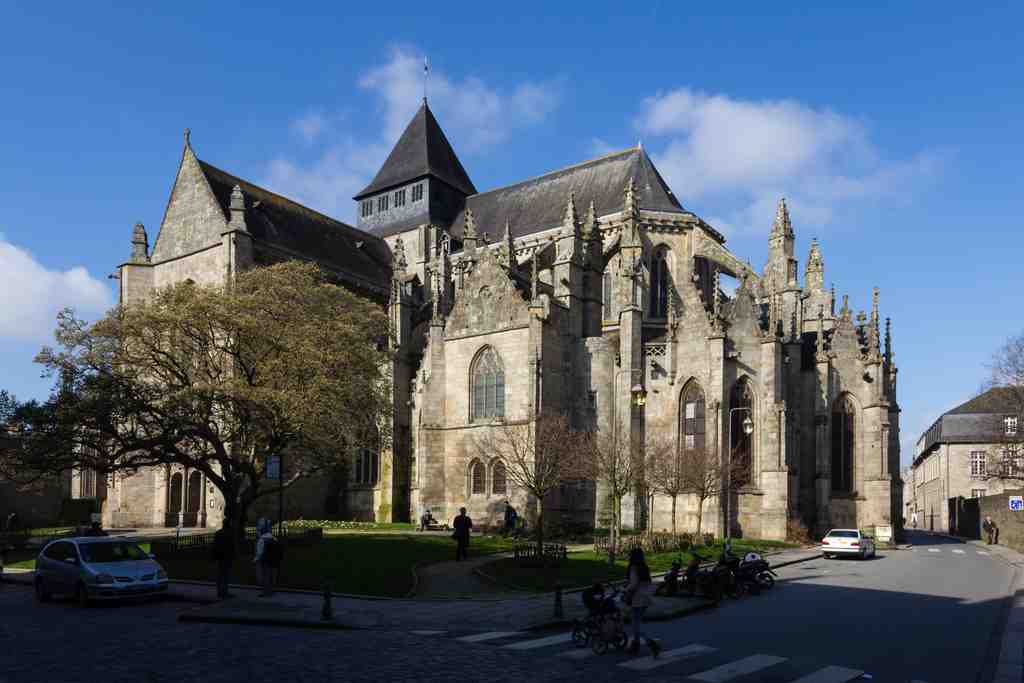
Wycieczka audio po Dinan: Legendy i blask Ville Intra-Muros
Armaty grzmiały niegdyś nad średniowiecznymi murami obronnymi Dinan, podczas gdy za witrażami kaplic knuto tajne układy. Każda kręta uliczka wewnątrz murów obronnych kryje cień buntu lub szept skandalu, czekając na twoją ciekawość. Wybierz się na tę wycieczkę audio z przewodnikiem po Ville Intra-Muros. Pozwól, by historie i sekrety ukryte w kamieniu zaprowadziły cię tam, gdzie inni turyści nigdy nie zaglądają. Dlaczego dzwony biły niegdyś na alarm ze szczytów Château de Dinan? Kto zniknął w burzliwą noc po ujrzeniu niesamowitego witraża w kościele Saint-Malo? Jaki tajemny symbol wyryto głęboko w zniszczonych murach, gdzie tylko najodważniejsi ośmielają się spojrzeć? Ten spacer zabierze cię wzdłuż potężnych murów obronnych i do cichych kaplic. Krok po kroku bitwy i tajemnice miasta wciągną cię głębiej, ukazując Dinan tak, jak nie zrobiłaby tego żadna mapa. Gotowy przekroczyć próg i odkryć ukryte serce Dinan? Twoja podróż zaczyna się teraz.
Podgląd trasy
O tej trasie
- scheduleCzas trwania 30–50 minsIdź we własnym tempie
- straighten2.1 km trasy pieszejPodążaj wyznaczoną trasą
- location_on
- wifi_offDziała offlinePobierz raz, korzystaj gdziekolwiek
- all_inclusiveDożywotni dostępOdtwarzaj ponownie w dowolnym momencie
- location_onStart przy Witraże kościoła Saint-Malo w Dinan
Przystanki na tej trasie
Look for a grand stone church with dramatic pointed arches and tall, slender stained glass windows clustered together - you’ll spot the St. Malo Church easily at the corner where…Czytaj więcejPokaż mniej
Look for a grand stone church with dramatic pointed arches and tall, slender stained glass windows clustered together - you’ll spot the St. Malo Church easily at the corner where the sunlight plays off its intricate spires. Now, as you stand outside this mighty church, imagine the world in the mid-1800s, the air humming with the echo of hammers and the clatter of horse-drawn carts, while all around you the aroma of baking bread drifts from village ovens. The Saint-Malo church had just finished its nave in 1865, and something magical was happening with its windows. Workers started installing the first stained glass panes, works of art designed not just to let in light, but to tell stories, spark hope, and stir awe. Back then, after fading away like an unwanted fashion trend, stained glass was having a comeback! You see, after dazzling everyone in the 12th and 13th centuries, the stained glass industry hit a rough patch. By the time of the Renaissance, most people wanted their churches to be bright and "modern"-so out came the colorful glass, and in went clear panes with simple patterns. And during the Revolution, anything with hints of feudal lords or kings was declared an enemy, so even more glass disappeared-talk about a fragile situation! But the 1800s were like a grand encore. France was booming: cities swelling, new churches going up, old ones growing new wings. People were leaning back into religion, and the neo-Gothic style was the latest craze-think pointy arches, spires that looked like icing on a cake, and glass that glowed like jewels. At Saint-Malo, both the so-called ‘neo-Gothic’ windows from the 1800s and ‘stained-glass paintings’ from the 1900s decorate the space, reflecting how attitudes shifted through time. Some windows even bring these two ideas together, with historical scenes framed in flamboyant Gothic architecture-a mash-up worthy of a medieval rock band. But here's the fun part: for decades, people didn’t really appreciate these stained glass works. In 1922, the French architect in charge of civil buildings looked at the neo-Gothic glass and shrugged-“not interesting at all!” he said. In 1950, another expert scoffed: "Just old figures, not worth a look." Even in 1974, as the windows started showing their age, yet another official called them “big, boring scenes from fifty years ago.” Ouch-glass can be sharp, but those reviews were even sharper! The twist came in the 1990s, when someone finally took a closer look and realized: actually, these are fantastic examples of the art of the time. What you see today is like a timeline in glass. Some windows shine with saints and biblical episodes, all wrapped in Gothic patterns, painted in rich colors. Others are dedicated to big moments for the city of Dinan or commemorate local heroes-one even honors the “children of Dinan who died for France.” There are windows filled with medieval landscapes, and others that switched to wild vegetation, thanks to the Art Nouveau trend in the early 1900s. After World War I, another window appeared-a patriotic one, where figures like Joan of Arc look serious and geometric, as if they've just stepped out of an Art Deco poster. Now, the making of these windows was a team effort. Glassmakers from Nantes, Chartres, Paris, and even Quintin all left their marks: look inside and you might spot a tiny signature, like a secret handshake between artists and the future. As for the selection and funding, that used to be a tug-of-war between the church, city officials, and even the mayor-sometimes the priest picked the design, sometimes local donors, rarely did they all agree, but they always managed to get the windows in. So next time you see sunlight piercing through those tall, colorful windows, imagine the centuries of debate, fashion changes, revolutions, and quiet persistence that got them there. And remember: even art that’s forgotten can one day shine brighter than ever! Fascinated by the revival of stained glass in the nineteenth century, historical background or the glass painters? Let's chat about it
Otwórz dedykowaną stronę →Right in front of you stands a grand stone building with tall white windows and decorative iron railings-just look for the three stories of classic French windows framed by a…Czytaj więcejPokaż mniej
Right in front of you stands a grand stone building with tall white windows and decorative iron railings-just look for the three stories of classic French windows framed by a slate roof and you’ll know you’ve found the Hôtel de Pontbriand. Picture yourself in 1774: Joseph-Victor du Breil de Pontbriand, a rather distinguished gentleman with ideas as bold as his wigs, is eagerly overseeing the finishing touches on his brand-new mansion. That stone above the window, proudly etched with “Spes Mea Deus,” means “God is my hope”-not a bad motto, especially when you’re trying to impress the neighbors. It’s more than just a well-dressed house; this was the last pillar-supported mansion ever built in Dinan before the city banned them only two years later. Talk about sliding in just under the wire! People must have whispered about that for weeks-“Did you see Pontbriand’s place? Pushed the rules right to the end.” Over time, this marvelous residence at 6, rue de la Lainerie, became a little slice of history, so much so that by 1961 it earned official protection as a historic monument. Imagine all the footsteps that have echoed past these windows: grand parties, secrets exchanged by candlelight, and maybe, just maybe, a resident who wondered what stories the next two hundred years would bring.
Otwórz dedykowaną stronę →Right in front of you, you’ll spot a massive stretch of stone walls snaking along the edge of the city, topped here and there by round towers and looking every inch the fortress…Czytaj więcejPokaż mniej
Right in front of you, you’ll spot a massive stretch of stone walls snaking along the edge of the city, topped here and there by round towers and looking every inch the fortress of legendary tales-just keep your eyes on the imposing, golden-grey ramparts rising above the leafy divide and you can’t miss them! Now, let’s take a moment to imagine the scene here nearly 800 years ago. Close your eyes and picture yourself standing on this spot, but instead of fellow tourists and locals, you’re surrounded by armored knights, galloping horses, the clang of blacksmiths, and the wary chatter of townsfolk. These ramparts are no ordinary walls: they were Dinan’s mighty shield, a ring of stone that wrapped the whole town up like an armored hug to keep it safe from would-be invaders, clever thieves, and anyone else with mischief on their mind. Let’s roll back to the Middle Ages: Dinan was perched here, watching over the River Rance from its prime position on an east-facing plateau. The city founders picked this very spot for its steep cliffs and tricky valleys-all nature’s own security system-but still, the northern side was as flat as a pancake, so that was a bit of a worry for medieval folks. That’s when the idea to build these formidable ramparts really took shape, starting with the lords of the Dinan family in the 1200s and later, with the all-powerful dukes of Brittany. The ring of wall stretches for about 2,650 meters-nearly 3 kilometers!-enclosing around 30 hectares of ancient streets and secret courtyards. By the fifteenth century, this made Dinan the third biggest fortress in Brittany, just behind Rennes and Nantes. But here’s the medieval plot twist: the ramparts of Rennes and Nantes have mostly vanished with time, while Dinan’s survive almost completely intact, earning the city a spot on the VIP list of France’s most exceptional fortified towns. Every two years, the whole town gets decked out in medieval style for the Fête des Remparts-think costumes, jousting matches, and a sudden craving for mead. But in between festivals, these walls have their own stories to tell. At various points, the ramparts bristled with new towers and gates-like the ones added during times of peace (when kings loved a little home improvement) and, later, when the threat of powerful artillery meant thickening the walls and expanding the moats. There was even a two-story underground gallery connecting the castle to distant towers, built by a nobleman with a flair for drama. You could say these builders had a real knack for “thinking outside the box”-or at least, outside the walls! The ramparts had a tough life, sometimes battered, sometimes forgotten. When Dinan’s strategic importance started to fade in the 17th century, the walls found themselves in the unusual business of holding prisoners instead of enemies, doubling as a makeshift jail. And in the years that followed, bits and pieces were knocked down to make room for new roads or were simply gobbled up by local gardens. During tense moments in the French Revolution, the walls sprang back to duty, manned by guards keeping out rebels-if those walls could talk, they’d probably have some pretty anxious stories from that era! Still, unlike so many old fortresses, the ramparts never quite received their final curtain call. In the nineteenth century, just as bits were disappearing here and there, efforts began to save what was left-so the story goes on. Today, standing right here, the stone beneath your feet echoes with centuries of battles, celebrations, secrets, and everyday life. So go on, give the wall a little pat... you never know if you’re standing in the footsteps of knights, dukes-or even a sneaky medieval gardener trying to steal a shortcut into town! Yearning to grasp further insights on the situation, construction or the transformation into a prison and destruction? Dive into the chat section below and ask away.
Otwórz dedykowaną stronę →
Pokaż jeszcze 2 przystankówPokaż mniej przystankówexpand_moreexpand_less
To spot the Clock Tower right now, look up ahead for a tall, ancient stone building with a sharp slate spire and a large round clock face, rising high above the nearby rooftops…Czytaj więcejPokaż mniej
To spot the Clock Tower right now, look up ahead for a tall, ancient stone building with a sharp slate spire and a large round clock face, rising high above the nearby rooftops and standing boldly at the heart of the street. Now, close your eyes for a second-or don’t, you might bump into something!-but use your imagination as we jump back more than 500 years. Picture Dinan in the late 1400s, a walled city bustling with merchants, craftsmen, and townsfolk in colorful medieval garb. That’s when this impressive tower’s story truly kicks off. At the time, the city was growing fast, and the streets were crowded with timber houses so close you could shake hands with your neighbor across the alley. In 1340, Dinan got its first governor thanks to Duke Jean III of Brittany. As the city became more powerful, it needed more than just strong walls-it needed a symbol of civic pride. Jump ahead to the reign of Duke François II and imagine the town’s “notables,” a council of wise (and maybe not-so-wise) citizens, meeting by candlelight and debating what Dinan needed most. Eventually, they agreed: “Let’s build a great tower! It will keep our archives safe, warn us of fires, and, of course, give us somewhere comfy to meet-preferably with a little fireplace for those chilly Breton evenings.” So, in 1471, a governor named Jehan II de Rosnyvinen stepped forward with a dramatic “let’s get to work,” and the first stone was laid just here, on what was then called Corduennerye Street. But Dinan’s tower wasn’t finished in a day. Now picture it: twenty years later, the famous Duchess Anne of Brittany decided she wanted to take the tower up a notch-literally. She sent her representative, the Vicomte de Rohan, to install a courthouse and, with much royal pomp, gave permission in 1507 to place a grand clock in the tower. Not only was the tower now a beffroi-a grand civic bell tower, like the famous ones in Flanders-but it got its first famous bell. This huge bronze bell weighed more than a small car and was affectionately named “Anne” after the duchess, with Anne herself as the godmother! Imagine the moment the bell first rang out, its deep voice echoing around the cobbled streets, announcing the hour to a town that hadn’t had the luxury before. For centuries, the bell-eventually renamed “Duchesse Anne”-marked city news, called councils to order, signaled fires, and (I bet) woke up more than one teenager for school. In 1906, after long and loyal service, that first bell was melted down and recast from the very same metal, ringing out once again for Dinan. Inside the tower, you’ll find a clock mechanism crafted in 1498 by Hamzer, a skilled clockmaker from Nantes. The clock ticked faithfully for centuries and, when it finally stopped, it was so treasured that it was moved into Dinan’s museum for safekeeping. It’s a reminder of the marvels of early engineering-no digital bits, just gears, springs, and a lot of elbow grease! And if you’re a music lover, listen closely: the tower holds not one, but five bells of varying character and pitch. There’s Noguette, fixed and stubborn, who refuses to ring for anyone; Françoise and Jacqueline, the lively pair that chatter out the quarters; and, of course, Duchesse Anne, who still chimes the hours with regal authority. These bells have rung for joy, summoned urgent meetings, and alarmed the town during great fires-including, in 1907, their final warning shout for Dinan’s last major blaze. This tower was Dinan’s city hall right up until the French Revolution changed the world. And today, if you’re feeling energetic, you can climb the spiral staircase-the steps worn smooth by centuries of hurried feet-and from the top, take in a view that stretches over the whole old city. The tower isn’t Dinan’s tallest building anymore; Saint-Sauveur church just down the road has overtaken it. But no other place holds quite so many memories. So, as you listen to the clock strike, remember: you’re standing where merchants, nobles, and citizens all dreamed, argued, and built their lives-under the steady watch of Dinan’s ever-faithful timekeeper, the Clock Tower. For further insights on the historical, description or the the five bells, feel free to navigate to the chat section below and inquire.
Otwórz dedykowaną stronę →To spot the Castle of Dinan, look ahead for a massive stone fortress with thick, rounded towers, chunky battlements on top, and a sturdy drawbridge projecting out from the…Czytaj więcejPokaż mniej
To spot the Castle of Dinan, look ahead for a massive stone fortress with thick, rounded towers, chunky battlements on top, and a sturdy drawbridge projecting out from the wall-there’s really no mistaking this mighty medieval giant standing guard over the southern edge of the old town. Alright, traveler, settle in front of this monumental marvel and let’s peel back the centuries: the Castle of Dinan isn’t just big, it’s bursting with stories and drama. Picture the year 1064-armor clinks, banners flap in the wind, and a dust cloud rises as Norman and Breton armies clash just outside Dinan. This site once held a wooden fortress called “Châteauganne,” which played a starring role in a tapestry-worthy moment. Conan II, the Lord of Brittany, was besieged here by William the Conqueror-yes, the same fellow who later waltzed into England at the Battle of Hastings. In the Bayeux Tapestry, you’ll see Conan extending the keys of Dinan at the tip of a lance-he probably hoped the Normans would just take the keys and not the kitchen sink too. Fast-forward to the 14th century, when Jean IV, the Duke of Brittany-nicknamed Jean the Conqueror and clearly not one for modesty-decides it’s time to upgrade the town’s defenses, just in case someone else comes knocking. He commissions a tower so sturdy and splendid it made even the toughest knights blush. The tower-palace before you, completed around 1393, is made of two rounded towers joined with a square front: a medieval power statement louder than your neighbor’s bagpipes practice. Its walls soar over 30 meters high, and those grand stone consoles under the battlements once allowed defenders to drop stones or-if they were feeling generous-boiling oil on would-be invaders. But this castle wasn’t just for fighting. Step inside and you’d find five very different floors, a medieval luxury hotel (minus the Wi-Fi): kitchens ring with clatter, grand halls host boisterous banquets, there’s a princely suite, a private chapel, and bedrooms fit for royalty. It’s all decked out with princely flair-if you ever wanted to experience the 14th-century version of “Downton Abbey,” this would be your set. Centuries went by and the castle kept changing roles. In the late 1600s, an engineer named Garangeau admired its architecture so much, he suggested reworking it not just for defense but for comfort. It soon held some very unwilling guests: English sailors during the long 18th-century wars. The castle was transformed from a military fortress to a prison-talk about a downgrade for interior decorating. Eventually, by the 19th century, it became Dinan’s official “bad people storage” facility. The 20th century brought another twist. The city bought the fortress and opened up a museum, filling these formidable rooms with artifacts from around the Rance valley. Recently, the castle got a well-earned makeover with new exhibits about warfare and daily life. You can even visit the Mercœur military tunnel, which once linked this tower-palace to another artillery tower for some extra neighborhood security. Imagine the celebrations when Dinan’s castle was declared a historical monument on July 12, 1886-probably no fireworks, but maybe a very enthusiastic baguette toast. Today, it’s the most-visited site in Dinan, second only in the whole region to mighty Fort la Latte-maybe someday they’ll have a friendly competition, but for now, this massive fortress will remain standing tall, watching over the town as it has for nearly 700 years. So next time you walk past castles, remember: some of them didn’t just keep out armies, they kept in history itself. Ready to walk through the gateway to Dinan’s legendary past? Fascinated by the historical, description or the scenographic tour? Let's chat about it
Otwórz dedykowaną stronę →

Najczęściej zadawane pytania
Jak rozpocząć trasę?
Po zakupie pobierz aplikację AudaTours i wpisz kod realizacji. Trasa będzie gotowa do natychmiastowego rozpoczęcia – po prostu dotknij \"Play\" i podążaj trasą z nawigacją GPS.
Czy potrzebuję internetu podczas trasy?
Nie! Pobierz trasę przed rozpoczęciem i korzystaj z niej w pełni offline. Jedynie funkcja czatu wymaga internetu. Zalecamy pobieranie przez WiFi, aby oszczędzać dane mobilne.
Czy to wycieczka grupowa z przewodnikiem?
Nie – to samodzielny audioprzewodnik. Zwiedzasz niezależnie, we własnym tempie, z narracją audio odtwarzaną przez telefon. Bez przewodnika, bez grupy, bez harmonogramu.
Ile trwa trasa?
Większość tras zajmuje 60–90 minut, ale to Ty kontrolujesz tempo. Wstrzymuj, pomijaj przystanki lub rób przerwy, kiedy chcesz.
Co jeśli nie zdążę ukończyć trasy dzisiaj?
Żaden problem! Trasy mają dożywotni dostęp. Wstrzymaj i wznów, kiedy chcesz – jutro, za tydzień lub za rok. Twój postęp jest zapisywany.
W jakich językach są dostępne trasy?
Wszystkie trasy są dostępne w ponad 50 językach. Wybierz preferowany język podczas realizacji kodu. Uwaga: języka nie można zmienić po wygenerowaniu trasy.
Gdzie znajdę trasę po zakupie?
Pobierz darmową aplikację AudaTours z App Store lub Google Play. Wpisz kod realizacji (wysłany e-mailem), a trasa pojawi się w Twojej bibliotece, gotowa do pobrania i rozpoczęcia.
Jeśli trasa Ci się nie spodoba, zwrócimy Ci pieniądze. Skontaktuj się z nami pod adresem [email protected]
Bezpieczna płatność przez 


