AudaTours logoAudaTours

Wycieczka audio po Slavkov u Brna: Echa zamków, kaplic i legend

Audioprzewodnik9 przystanków

Pod barokowym splendorem Slavkov u Brna kryje się pole bitwy pełne tajemnic, gdzie marmurowe sale niegdyś rozbrzmiewały szeptami zdobywców i spiskowców. Ta wycieczka audio z przewodnikiem prowadzi przez ukryte dziedzińce i tętniące życiem place, odkrywając historie, których większość turystów nigdy nie usłyszy. Każdy przystanek odsłania rozdział, który umknąłby samym oczom. Jaki mroczny układ zawarty w zamku w Slavkov zmienił losy Europy z dnia na dzień? W jaki sposób jedno wydarzenie na Placu Palackiego wstrząsnęło imperium? Jaki osobliwy skarb został po cichu zamurowany w ścianie ratusza na całe wieki? Przejdź korytarzami intryg i przemierzaj place ukształtowane przez rewolucję i cichy opór. Każdy zakręt przybliża zapomniane triumfy, skandale i tajemnice miasta. Zobacz Slavkov u Brna oczami tych, którzy ukształtowali jego przeznaczenie. Rozpocznij swoją podróż już teraz i odkryj legendy pogrzebane pod zabytkowymi kamieniami Slavkova.

Podgląd trasy

map

O tej trasie

  • schedule
    Czas trwania 30–50 minsIdź we własnym tempie
  • straighten
    2.9 km trasy pieszejPodążaj wyznaczoną trasą
  • location_on
  • wifi_off
    Działa offlinePobierz raz, korzystaj gdziekolwiek
  • all_inclusive
    Dożywotni dostępOdtwarzaj ponownie w dowolnym momencie
  • location_on
    Start przy Willa Redlicha

Przystanki na tej trasie
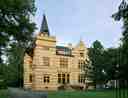
  1. Look for the grand pale yellow masonry building defined by its irregular shape, featuring a sharp pyramidal roof tower on the left and a distinctive stepped gable on the right.…Czytaj więcejPokaż mniej
    Redlich Villa
    Redlich VillaPhoto: Martin Strachoň, Wikimedia Commons, CC BY-SA 4.0. Cropped & resized.

    Look for the grand pale yellow masonry building defined by its irregular shape, featuring a sharp pyramidal roof tower on the left and a distinctive stepped gable on the right. Right now you are looking at a house built by a guy who really knew how to turn sweetness into absolute power.

    This is the Redlich Villa, designed in 1884 for a Jewish businessman named Hermann Redlich. Hermann scooped up a bankrupt local sugar factory and turned it into the fourth largest in the whole region of Moravia. He became so influential that when the regional railway was being built, he manipulated the plans so the tracks would run right past his factory. He did this just to save himself the cost of building his own side track, totally ignoring the fact that the town wanted the railway routed completely differently. Honestly, that is a wild level of local leverage.

    To keep an eye on his booming empire, Hermann hired a prominent architect named August Prokop to build this house. The style is a mix of Tudor Neo-Gothic and Northern Renaissance, basically a nineteenth century revival of old English and German manors. Notice how the building looks like a bunch of different sized blocks shoved together? That is a design choice called additive massing, an architectural trick of building outward chunk by chunk to create a dramatic, uneven look. Take a glance at your screen to see the original floor plans from 1904, which really show off this unusual puzzle-like layout.

    These original floor plans from 1904 reveal the villa's unique 'additive massing' and irregular layout, a characteristic of the Tudor Neo-Gothic style inspired by the Hannover School.
    These original floor plans from 1904 reveal the villa's unique 'additive massing' and irregular layout, a characteristic of the Tudor Neo-Gothic style inspired by the Hannover School.Photo: Unknown authorUnknown author, Wikimedia Commons, Public domain. Cropped & resized.

    You can also see horizontal grooves running across the exterior walls. That is called rustication, a masonry technique used to make the stone look heavier and more fortified. Inside, the layout was just as deliberate. The main level was the piano nobile, an Italian architectural term for the noble floor, which was the grandest level used entirely for entertaining high society guests. Check your app for a historical photo of the original dining room, an interior so lavish that the architect proudly featured it in his own art history book.

    Step back in time to the original dining room of Redlich Villa, an interior so grand that its architect August Prokop included its photo in his 1904 book on Moravian art history.
    Step back in time to the original dining room of Redlich Villa, an interior so grand that its architect August Prokop included its photo in his 1904 book on Moravian art history.Photo: Unknown authorUnknown author, Wikimedia Commons, Public domain. Cropped & resized.

    The Redlich family ruled the local sugar trade for decades, even building a second white villa nearby for the younger generation. But the twentieth century brought heavy turbulence. A worker strike in 1905 ended in bloodshed, and eventually, the impending Nazi occupation forced the family to abandon their empire and flee across the ocean to Canada. After the war, the factory was nationalized and slowly faded, producing its last batch of sugar in 1989. Today, this grand house has found a second life as a luxury hotel, keeping the Redlich legacy anchored right here on the corner.

    The building really is a survivor. Take a moment to soak this in. When you are ready, we can head to the next stop.

    This is the Redlich Villa today, known as Villa Austerlitz, a luxury accommodation. It was declared a cultural monument in 2001.
    This is the Redlich Villa today, known as Villa Austerlitz, a luxury accommodation. It was declared a cultural monument in 2001.Photo: Martin Strachoň, Wikimedia Commons, CC BY-SA 4.0. Cropped & resized.
    This historical graphic depicts the Redlich Villa (bottom right) alongside the large sugar factory and the lower 'white' villa, all central to Hermann Redlich's industrial empire.
    This historical graphic depicts the Redlich Villa (bottom right) alongside the large sugar factory and the lower 'white' villa, all central to Hermann Redlich's industrial empire.Photo: Unknown authorUnknown author, Wikimedia Commons, Public domain. Cropped & resized.
    This historic black-and-white photograph shows the Redlich Villa's western facade, which the architect August Prokop proudly featured in his 1904 book.
    This historic black-and-white photograph shows the Redlich Villa's western facade, which the architect August Prokop proudly featured in his 1904 book.Photo: Unknown authorUnknown author, Wikimedia Commons, Public domain. Cropped & resized.
    This 1922 photograph captures the construction of the worker housing colony opposite the Redlich Villa (visible in the background), highlighting the Redlich family's significant presence in Slavkov u Brna.
    This 1922 photograph captures the construction of the worker housing colony opposite the Redlich Villa (visible in the background), highlighting the Redlich family's significant presence in Slavkov u Brna.Photo: Unknown authorUnknown author, Wikimedia Commons, Public domain. Cropped & resized.
    Otwórz dedykowaną stronę →
  2. Take a look straight ahead for a rectangular white masonry building topped with a stepped gable roof and a prominent Star of David window set into the front facade. This is the…Czytaj więcejPokaż mniej
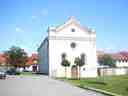
    Synagogue in Slavkov u Brna
    Synagogue in Slavkov u BrnaPhoto: cs:User:Pernak1, Wikimedia Commons, CC BY-SA 3.0. Cropped & resized.

    Take a look straight ahead for a rectangular white masonry building topped with a stepped gable roof and a prominent Star of David window set into the front facade. This is the former synagogue of Slavkov u Brna. Built in 1857, it was designed in the Neo-Romanesque style, meaning it uses rounded arches and thick walls inspired by medieval European architecture. You can pull up your screen to see a great exterior shot of this design.

    This view of the former synagogue showcases its Neo-Romanesque style, built between 1857-1858, and now serves as a protected cultural monument and a depository for the State District Archive Vyškov.
    This view of the former synagogue showcases its Neo-Romanesque style, built between 1857-1858, and now serves as a protected cultural monument and a depository for the State District Archive Vyškov.Photo: Czeva, Wikimedia Commons, CC BY-SA 3.0. Cropped & resized.

    For decades, this was the heart of the local Jewish community. But in the early nineteen forties, the interior was tragically destroyed by the Nazis. After the war, this sacred space spent fifty years being used as a simple warehouse. It is wild to imagine such a beautiful building filled with forgotten boxes.

    Thankfully, in the nineteen nineties, it was returned and fully restored. Today, it has found a new life as the State District Archive, safely holding local history. You will also spot a plaque on the front, honoring victims of the Holocaust. It stands today as a quiet survivor with a powerful story. Whenever you are ready to keep wandering, we can head toward our next stop.

    Otwórz dedykowaną stronę →
  3. You should be seeing a building with smooth white and pale green walls, defined by its curving domed sections topped with red roofing, and a small, uniquely shaped circular window…Czytaj więcejPokaż mniej
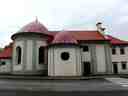
    Chapel of St. John the Baptist
    Chapel of St. John the BaptistPhoto: Palickap, Wikimedia Commons, CC BY-SA 4.0. Cropped & resized.

    You should be seeing a building with smooth white and pale green walls, defined by its curving domed sections topped with red roofing, and a small, uniquely shaped circular window cut into the side of the closest rounded section.

    Welcome to the Chapel of St. John the Baptist. At first glance, this place has a very peaceful, Baroque charm, but its roots stretch way back to the thirteenth century. Back then, a Catholic military order known as the Teutonic Knights ran a hospital right on this spot. It was not a hospital like we think of today with bright lights and heart monitors, but rather a medieval haven for the poor and the frail. The whole surrounding neighborhood was even named Hospital Suburb. Over the centuries, the original Gothic building was destroyed during various wars and then rebuilt, eventually expanding into the connected complex you see now.

    If you want a peek at the architectural bones of this place, pull up your screen. Inside, the chapel is built in what is called a trefoil cross layout. Basically, instead of a standard rectangular room, the floor plan branches out like a three-leaf clover, creating these wonderful oval side chapels that sit under lower domes, leading up to a towering central dome over the main altar. It gives the interior a real sense of sweeping motion.

    An interior view highlighting the chapel's unique trefoil cross layout with its high dome over the presbytery and lower domes over the side chapels.
    An interior view highlighting the chapel's unique trefoil cross layout with its high dome over the presbytery and lower domes over the side chapels.Photo: Palickap, Wikimedia Commons, CC BY-SA 4.0. Cropped & resized.

    But the most fascinating story here is hidden right underneath this structure. In 1795, the powerful Kounic family built a tomb directly under the south chapel. Let us check out the inside of that crypt on your app. Down there rests Václav Antonín. He was a diplomat and the State Chancellor, which meant he was essentially the primary advisor and problem solver for the mighty Empress Maria Theresa for decades. When the crypt was opened and examined in 1980, they found Václav Antonín still dressed in his original aristocratic clothing, bearing the gleaming star of a prestigious chivalric order on his chest.

    Inside the Kounice family tomb, where seven family members, including the prominent statesman Václav Antonín z Kounic-Rietbergu, were laid to rest.
    Inside the Kounice family tomb, where seven family members, including the prominent statesman Václav Antonín z Kounic-Rietbergu, were laid to rest.Photo: Martin Strachoň, Wikimedia Commons, CC BY-SA 3.0. Cropped & resized.

    And he was not the only one resting in style. Another family member, Marie Leopoldina, was found buried wearing a full Rococo gown, a delicate cap, and high-heeled shoes. Rococo fashion was famously elaborate and ornamental, so if you are going to spend eternity somewhere, you might as well dress for the occasion.

    Just outside the cemetery, you will also find a classical gate topped with a hand-hammered metal sculpture of Jesus, and a nearby iron cross from 1855. Those ironworks were a huge industry around here, turning out everything from simple tools to fine art. It all forms this quiet little pocket of history where powerful statesmen and everyday citizens end up sharing the exact same ground.

    When you are ready to keep exploring, we can head to the next stop.

    This exterior view showcases the Chapel of St. John the Baptist, a protected monument, connected to the former hospital building that has roots back to the 13th century.
    This exterior view showcases the Chapel of St. John the Baptist, a protected monument, connected to the former hospital building that has roots back to the 13th century.Photo: Palickap, Wikimedia Commons, CC BY-SA 4.0. Cropped & resized.
    The Baroque-style Chapel of St. John the Baptist, originally Gothic, was extensively rebuilt and expanded in the 17th and 18th centuries by the Kounice family.
    The Baroque-style Chapel of St. John the Baptist, originally Gothic, was extensively rebuilt and expanded in the 17th and 18th centuries by the Kounice family.Photo: Palickap, Wikimedia Commons, CC BY-SA 4.0. Cropped & resized.
    The classical entrance to the Kounice family tomb, established in 1795 by Arnošt Kryštof z Kounic-Rietbergu, features a tympanum and the family's cast iron coat of arms.
    The classical entrance to the Kounice family tomb, established in 1795 by Arnošt Kryštof z Kounic-Rietbergu, features a tympanum and the family's cast iron coat of arms.Photo: Vlach Pavel, Wikimedia Commons, CC BY-SA 4.0. Cropped & resized.
    One of the chapel's altars, either the main altar dedicated to St. John the Baptist or one of the renovated side chapels dedicated to the Virgin Mary or the Crucified Savior.
    One of the chapel's altars, either the main altar dedicated to St. John the Baptist or one of the renovated side chapels dedicated to the Virgin Mary or the Crucified Savior.Photo: Palickap, Wikimedia Commons, CC BY-SA 4.0. Cropped & resized.
    The Neoclassical cemetery gate, built much later than the chapel, features a segmentally arched entrance topped with a hand-beaten metal figure of Jesus on a cross.
    The Neoclassical cemetery gate, built much later than the chapel, features a segmentally arched entrance topped with a hand-beaten metal figure of Jesus on a cross.Photo: Palickap, Wikimedia Commons, CC BY-SA 4.0. Cropped & resized.
    A detail of the simple Neogothic cross from the Salm Ironworks, crafted in 1855, featuring a gilded Christ and the inscription I N / R I above his head.
    A detail of the simple Neogothic cross from the Salm Ironworks, crafted in 1855, featuring a gilded Christ and the inscription I N / R I above his head.Photo: Palickap, Wikimedia Commons, CC BY-SA 4.0. Cropped & resized.
    Otwórz dedykowaną stronę →
Pokaż jeszcze 6 przystankówPokaż mniej przystankówexpand_moreexpand_less
  1. You should be looking at a massive pale yellow palace with striking red tile roofs and a distinct dark dome capping the center of its facade. This is Slavkov Castle, one of the…Czytaj więcejPokaż mniej
    Slavkov u Brna
    Slavkov u BrnaPhoto: Kirk, Wikimedia Commons, CC BY-SA 3.0. Cropped & resized.

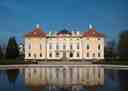
    You should be looking at a massive pale yellow palace with striking red tile roofs and a distinct dark dome capping the center of its facade. This is Slavkov Castle, one of the absolute heaviest hitters of Baroque architecture in Moravia.

    It is hard to imagine now, but this site started way back in the thirteenth century as a commandery, which was basically a fortified military outpost for the Teutonic Knights. But the sprawling elegance you are looking at today is mostly the work of the ultra-powerful Kounic family.

    Late in the seventeenth century, a guy named Dominik Ondřej Kounic looked at his old Renaissance setup and decided it needed a massive upgrade. He brought in an Italian architect, Domenico Martinelli, who designed this giant U-shaped layout. Dominik even hired an Italian dream team for the interiors. We are talking Andrea Lanzani painting elaborate frescoes, which is the incredibly difficult art of painting directly onto wet wall plaster, and Santino Bussi creating intricate stucco, those raised, sculpted plaster decorations you see on fancy ceilings.

    If you want to see how this grand courtyard has completely maintained its aristocratic vibe over the years, check out the before and after slider on your screen.

    The man who finally pushed the whole project across the finish line was Václav Antonín, the same Chancellor to Empress Maria Theresa whose tomb we saw earlier. Under his watch, the castle's style shifted toward Classicist elements, meaning they traded some of the wilder, fussy decorations for cleaner, more linear designs inspired by ancient Greece and Rome.

    The absolute most fascinating spot inside is the central oval room known as the Historical Hall. Take a look at your app to see a shot of this exact room from 1888. This space is famous because the armistice ending the 1805 Battle of Austerlitz, also known as the Battle of the Three Emperors, was signed right in there. But the wildest detail is its acoustic design. It was engineered specifically so that during intense political summits, tight little clusters of diplomats could plot and scheme in close proximity, and their voices would not carry across the room.

    The 'Historický sál' (Historical Hall) in an 1888 photograph, famous as the site where the armistice was signed after the Battle of Austerlitz in 1805.
    The 'Historický sál' (Historical Hall) in an 1888 photograph, famous as the site where the armistice was signed after the Battle of Austerlitz in 1805.Photo: Raimund Freiherr von Stillfried, Wikimedia Commons, Public domain. Cropped & resized.

    It was the ultimate gossip-proof room.

    And you cannot ignore the sprawling park out back. It spans over fifteen hectares and has had quite an identity crisis over the centuries. It went from a Renaissance garden to a highly structured Baroque layout, then morphed into a relaxed English park, before finally being restored back to its strict geometric Baroque glory in the nineteen seventies, complete with mythological statues by Giovanni Giuliani.

    Take a minute to appreciate the sheer scale and ambition of this place. When you are ready, we can casually make our way over to the next stop.

    An expansive view of Slavkov Castle, one of Moravia's most magnificent Baroque castles, known as the residence of the Kounic family.
    An expansive view of Slavkov Castle, one of Moravia's most magnificent Baroque castles, known as the residence of the Kounic family.Photo: Bjalek Michal, Wikimedia Commons, CC BY-SA 3.0. Cropped & resized.
    A 1730 master plan by Václav Petruzzi, illustrating the ambitious Baroque redesign by Domenico Martinelli that integrated the castle, park, and surrounding town.
    A 1730 master plan by Václav Petruzzi, illustrating the ambitious Baroque redesign by Domenico Martinelli that integrated the castle, park, and surrounding town.Photo: Wenczl F. Petruzci, Wikimedia Commons, Public domain. Cropped & resized.
    A historical photograph from the early 20th century, showing the ceremonial courtyard of Slavkov Castle, once known as the 'Schloss der Grafen von Kaunitz'.
    A historical photograph from the early 20th century, showing the ceremonial courtyard of Slavkov Castle, once known as the 'Schloss der Grafen von Kaunitz'.Photo: Unknown authorUnknown author, Wikimedia Commons, Public domain. Cropped & resized.
    The 'Sál předků' (Ancestors' Hall) in an 1888 photo, originally a dining room, featuring monumental frescoes and portraits of prominent Kounic family members.
    The 'Sál předků' (Ancestors' Hall) in an 1888 photo, originally a dining room, featuring monumental frescoes and portraits of prominent Kounic family members.Photo: Raimund Freiherr von Stillfried, Wikimedia Commons, Public domain. Cropped & resized.
    A historical view (1888) of the castle's enfilade, showcasing part of the Kounic family's extensive art gallery that once contained works by famous European masters.
    A historical view (1888) of the castle's enfilade, showcasing part of the Kounic family's extensive art gallery that once contained works by famous European masters.Photo: Raimund Freiherr von Stillfried, Wikimedia Commons, Public domain. Cropped & resized.
    An 1888 photograph of the castle's west facade as seen from the park, showing the earlier configuration of the park, which transitioned to an English style in the 19th century.
    An 1888 photograph of the castle's west facade as seen from the park, showing the earlier configuration of the park, which transitioned to an English style in the 19th century.Photo: Raimund Freiherr von Stillfried, Wikimedia Commons, Public domain. Cropped & resized.
    A detail shot reflecting the classicist elements that began to dominate the castle's interiors and exterior in the later stages of its construction under Václav Antonín.
    A detail shot reflecting the classicist elements that began to dominate the castle's interiors and exterior in the later stages of its construction under Václav Antonín.Photo: Tyna Maria, Wikimedia Commons, CC BY-SA 4.0. Cropped & resized.
    An artistic rendering by Josef Klír, depicting Slavkov Castle and its park, providing a unique perspective on the landmark.
    An artistic rendering by Josef Klír, depicting Slavkov Castle and its park, providing a unique perspective on the landmark.Photo: Josef Klír, Wikimedia Commons, Public domain. Cropped & resized.
    A frontal view of Slavkov Castle, highlighting its 'U' shaped Baroque layout designed by Domenico Martinelli and the architectural dome on its west facade.
    A frontal view of Slavkov Castle, highlighting its 'U' shaped Baroque layout designed by Domenico Martinelli and the architectural dome on its west facade.Photo: Bjalek Michal, Wikimedia Commons, CC BY-SA 3.0. Cropped & resized.
    Otwórz dedykowaną stronę →
  2. You are standing in Palackého náměstí, an elongated, gently sloping public space anchored by a white historic building with a red pitched roof and a small corner turret, sitting…Czytaj więcejPokaż mniej
    Palackého náměstí
    Palackého náměstíPhoto: Martin Strachoň, Wikimedia Commons, CC BY-SA 3.0. Cropped & resized.

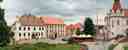
    You are standing in Palackého náměstí, an elongated, gently sloping public space anchored by a white historic building with a red pitched roof and a small corner turret, sitting beside a beige structure featuring a central stone archway.

    This wide stretch is the main artery of Slavkov. It is a long, funnel-shaped plaza that flows southward, framed by former manor houses, a town hall, and the sweeping presence of the castle. But the layout you see today is the result of some pretty aggressive aristocratic remodeling.

    Back in the Middle Ages, this was just the Lower Square. There was an Upper Square too, sitting a bit further north with an old Gothic church. Then the Kounic family took over the town. They had some serious ambition.

    Dominik Ondřej of Kounic took a trip to France in the late seventeenth century, saw the palace of Versailles, and decided he needed a piece of that action right here. He started transforming the family residence into a massive Baroque castle. But he was also a practical guy. Inspired by his travels to London and The Hague, he opened a huge textile manufactory right on this square in 1703. Instead of relying on scattered local weavers, he brought two hundred workers into one complex, attempting to build a centralized industry for the whole monarchy. The grand expansion plan eventually fizzled out, but for a while, this square was a powerhouse of early mass production.

    His descendants took the remodeling even further. They wanted a perfect, uninterrupted view from the castle. So, they simply got rid of the old Upper Square entirely. They knocked down the decaying Gothic church, tore down the old town watchtower, and dumped several meters of dirt over the whole area to create a parterre... a highly manicured, geometrically patterned garden space for the castle grounds. You can take a glance at the 1730 urban plan on your screen to see the sheer scale of the transformation they mapped out for these streets.

    This 1730 urban plan by Václav Petruzzi shows the proposed transformation of the castle, park, and avenues, including the key buildings of Palackého náměstí and the Rybničná Gate.
    This 1730 urban plan by Václav Petruzzi shows the proposed transformation of the castle, park, and avenues, including the key buildings of Palackého náměstí and the Rybničná Gate.Photo: Wenczl F. Petruzci, Wikimedia Commons, Public domain. Cropped & resized.

    When they demolished the old tower in 1770, they needed a new place for the town clock. They moved the clock faces down to the medieval gate that guarded the narrow southern end of this square, which naturally became known as the Clock Gate. If you want to see exactly how dramatically this south end changed, you can pull up the before and after image on your screen. That towering gate was the last piece of the old city fortifications to fall, finally torn down in 1903 to let the modern town breathe and expand.

    As for the name of the square, Palackého náměstí, it honors František Palacký, a towering nineteenth-century Czech historian and politician. The funny thing is, the guy never actually set foot in this town. But he wrote a letter in 1864 explaining the complex linguistic history connecting the town's Czech name, Slavkov, and its famous German name, Austerlitz. The locals were so appreciative that they eventually named their brilliantly redesigned main square right after him.

    The result of all that history is a space that feels surprisingly grand for a small town. Take your time enjoying the view, and when you are ready, we can head to the next stop.

    This 1930 view from the south shows the sloping Palackého náměstí, with the Sokolský dům (later Hotel Napoleon) on the right and the castle stables and Neoclassical church in the distance.
    This 1930 view from the south shows the sloping Palackého náměstí, with the Sokolský dům (later Hotel Napoleon) on the right and the castle stables and Neoclassical church in the distance.Photo: Unknown autorUnknown autor, Wikimedia Commons, Public domain. Cropped & resized.
    A 1923 panoramic photo from the church roof looking south down Palackého náměstí, featuring the town hall and the former court building on the left.
    A 1923 panoramic photo from the church roof looking south down Palackého náměstí, featuring the town hall and the former court building on the left.Photo: Unknown autorUnknown autor, Wikimedia Commons, Public domain. Cropped & resized.
    This late 19th-century view from the castle stables shows the Palackého náměstí, with the Hodinová brána (Clock Gate) visible at the southern end before its demolition in 1903.
    This late 19th-century view from the castle stables shows the Palackého náměstí, with the Hodinová brána (Clock Gate) visible at the southern end before its demolition in 1903.Photo: Unknown authorUnknown author, Wikimedia Commons, Public domain. Cropped & resized.
    An 1895 photograph from the south captures the Baroque castle, its stables, the Neoclassical church, and the town hall with its distinctive turret, showcasing the square's major architectural elements.
    An 1895 photograph from the south captures the Baroque castle, its stables, the Neoclassical church, and the town hall with its distinctive turret, showcasing the square's major architectural elements.Photo: Unknown authorUnknown author, Wikimedia Commons, Public domain. Cropped & resized.
    This historic view from inside the Hodinová brána (Clock Gate), dating from before 1905, looks north into Palackého náměstí, showing the square just before the gate's demolition.
    This historic view from inside the Hodinová brána (Clock Gate), dating from before 1905, looks north into Palackého náměstí, showing the square just before the gate's demolition.Photo: Unknown authorUnknown author, Wikimedia Commons, Public domain. Cropped & resized.
    An early 20th-century postcard shows Palackého náměstí, highlighting the old general school building, which was constructed in 1862 and later housed part of the municipal office.
    An early 20th-century postcard shows Palackého náměstí, highlighting the old general school building, which was constructed in 1862 and later housed part of the municipal office.Photo: Unknown authorUnknown author, Wikimedia Commons, Public domain. Cropped & resized.
    This late 19th-century photograph captures a detailed view of the Hodinová brána (Clock Gate) from the northeast, before its demolition in 1903, serving as the southern entrance to Palackého náměstí.
    This late 19th-century photograph captures a detailed view of the Hodinová brána (Clock Gate) from the northeast, before its demolition in 1903, serving as the southern entrance to Palackého náměstí.Photo: Unknown authorUnknown author, Wikimedia Commons, Public domain. Cropped & resized.
    This modern photo shows houses 79 and 278 at the southern end of Palackého náměstí, where the Hodinová brána once stood, with a symbolic marking indicating the former medieval city fortifications.
    This modern photo shows houses 79 and 278 at the southern end of Palackého náměstí, where the Hodinová brána once stood, with a symbolic marking indicating the former medieval city fortifications.Photo: Martin Strachoň, Wikimedia Commons, CC BY-SA 4.0. Cropped & resized.
    This modern view from Boženy Němcové street highlights the houses at the former site of the Hodinová brána, including a symbolic marker for the medieval city fortifications that once protected the town.
    This modern view from Boženy Němcové street highlights the houses at the former site of the Hodinová brána, including a symbolic marker for the medieval city fortifications that once protected the town.Photo: Martin Strachoň, Wikimedia Commons, CC BY-SA 4.0. Cropped & resized.
    Otwórz dedykowaną stronę →
  3. On your right, you will see a two-story white stucco building with a red tiled roof, anchored by a unique, six-sided white turret jutting out from its left corner. This is the…Czytaj więcejPokaż mniej
    Town Hall in Slavkov u Brna
    Town Hall in Slavkov u BrnaPhoto: Martin Strachoň, Wikimedia Commons, CC BY-SA 3.0. Cropped & resized.

    On your right, you will see a two-story white stucco building with a red tiled roof, anchored by a unique, six-sided white turret jutting out from its left corner.

    This is the Town Hall, and it happens to be the oldest preserved building in all of Slavkov. It was built way back in 1592, resting right on top of older, rougher Gothic foundations. It is a classic piece of Renaissance architecture, a building style that focused on bringing back the harmony and mathematical precision of ancient Rome. Though, if you look at the main entrance, they got a little rebellious with the symmetry, placing the door off-center.

    If you pull up the first image on your screen, you can get a great historical view of how that quirky hexagonal turret shapes the corner of the building.

    This Renaissance Town Hall, built in 1592, is the oldest preserved building in Slavkov and features a distinctive hexagonal turret on its corner.
    This Renaissance Town Hall, built in 1592, is the oldest preserved building in Slavkov and features a distinctive hexagonal turret on its corner.Photo: Martin Strachoň, Wikimedia Commons, CC BY-SA 3.0. Cropped & resized.

    Look right above that main entrance. See the stone carving? That is the town coat of arms, and the inscription above it proudly shouts out the two mayors who were in charge back in 1592, Alexander Bradawichka and Petr Pekarz. Carving your name into stone so people remember your term in office four centuries later is not a bad flex.

    But a Town Hall is not just a place for politicians to push paper. Back in the nineteenth century, this building was the ultimate multipurpose center. If you walked through the doors back then, you would find a working pub and the tavern keeper's apartment right on the left side of the ground floor. A literal pub inside city hall. And on the right side? The police station. You could grab a drink, start a brawl, and get arrested without ever leaving the building.

    If things got really out of hand, the police would haul you up the side stairs from the street straight into the šatlava, a local lockup and jail up on the second floor. Meanwhile, just down the hall, the town council was holding their serious political meetings right next to the municipal treasury.

    Things were actually much darker right outside. The sloping square in front of us used to be a natural amphitheater, and right out front stood a stone pillory. A pillory was a heavy post where criminals were locked by their neck and wrists for public humiliation, or even execution. So while the mayors were inside managing the town budget, harsh justice was being served right out front.

    There are a couple of memorial plaques on the front facade worth noting. The one between the second and third windows honors Bernardino Ochino. He was a famous sixteenth-century Italian theologian who traveled all the way to Slavkov, only to tragically die of the plague here in 1564.

    Over the years, this structure has protected everything from the town's water department files to museum artifacts hidden in crates to keep them safe from a military garrison during the Second World War. It still serves as the municipal office today, open for business on Mondays, Tuesdays, and Wednesdays.

    This bizarre, brilliant building has truly been the beating heart of the town for centuries. Take your time here, and whenever you are ready, we will head over to our next stop.

    An event commemorating the Battle of Austerlitz in 1993 takes place in front of the Town Hall, which became part of the 'Battle of Austerlitz Battlefield' landscape zone in 1992.
    An event commemorating the Battle of Austerlitz in 1993 takes place in front of the Town Hall, which became part of the 'Battle of Austerlitz Battlefield' landscape zone in 1992.Photo: Martin Strachoň, Wikimedia Commons, CC BY-SA 4.0. Cropped & resized.
    Otwórz dedykowaną stronę →
  4. Look to your right and spot the massive, smooth cream colored building defined by a grand triangular roof resting directly on six towering stone columns, topped with a small…Czytaj więcejPokaż mniej
    Church of the Resurrection of Our Lord
    Church of the Resurrection of Our LordPhoto: Martin Strachoň, Wikimedia Commons, CC BY-SA 3.0. Cropped & resized.

    Look to your right and spot the massive, smooth cream colored building defined by a grand triangular roof resting directly on six towering stone columns, topped with a small clock. That is the Church of the Resurrection of Our Lord.

    It looks more like an ancient Greek temple than a traditional European parish church, right? That is actually the magic of the Classicism style from the late 1700s, which favored clean, logical lines over overly fussy decorations.

    The story behind this place starts with a bit of a disaster. Remember that old Gothic church we mentioned earlier? In 1757, it partially collapsed under its own weight. Instead of patching up the rubble, the ruling Kounic family decided to build something completely modern. He brought in an imperial architect from Vienna, and between 1786 and 1789, this monumental structure was born.

    Check out your screen for a closer look at that impressive front entrance. That covered porch area with the pillars is called a portico. If you look closely at the golden words carved above those columns, you will see a dedication to the Prince himself, ensuring history remembered exactly who funded this grand project. Above the writing is the tympanum, which is that large triangular section, featuring a beautifully carved scene of the apostles.

    This classicist church was built between 1786-1789, replacing a Gothic church that collapsed. Its main facade features a six-column portico with an inscription dedicated to its founder, Prince Václav Antonín Dominik Kounic-Rietberg.
    This classicist church was built between 1786-1789, replacing a Gothic church that collapsed. Its main facade features a six-column portico with an inscription dedicated to its founder, Prince Václav Antonín Dominik Kounic-Rietberg.Photo: Martin Strachoň, Wikimedia Commons, CC BY-SA 3.0. Cropped & resized.

    If you were to walk inside, you would not find the usual dark, shadowy aisles of older cathedrals. Instead, it is one massive, bright, vaulted hall. The interior keeps a very calm, uniform color tone, letting the detailed wall carvings stand out. In 1986, the church received a brand new main altar carved from pure white marble, which actually holds the relics, or sacred physical remains, of an Italian martyr named Saint Maria Goretti. Up in the bell tower, completely hidden from the street, sit two historic bells that have been ringing out over the rooftops since the 1760s.

    It is a brilliant mix of Enlightenment era thinking and quiet, enduring faith. Enjoy the atmosphere, and when you are ready, we can head over to our next stop.

    Otwórz dedykowaną stronę →
  5. On your right, you will see a massive, freestanding rectangular slab of rough-hewn stone masonry, punctuated near the top by two small, deep-set rectangular openings. It looks a…Czytaj więcejPokaż mniej
    City fortifications
    City fortificationsPhoto: Martin Strachoň, Wikimedia Commons, CC BY-SA 4.0. Cropped & resized.

    On your right, you will see a massive, freestanding rectangular slab of rough-hewn stone masonry, punctuated near the top by two small, deep-set rectangular openings. It looks a bit lonely sitting there, does it not? But this rough patch of rock is a stubborn survivor.

    These are the remnants of the city fortifications. Starting way back in the thirteenth century, the Teutonic Knights turned this town into a formidable stronghold. They established their most powerful commandery-the fortified headquarters we mentioned earlier-right here in the region. They wrapped the entire city center in a system of walls reaching up to seven meters high. The fortifications featured corner bastions, deep defensive moats, and four heavy gates pointing toward neighboring cities. They even relied on a massive artificial pond called Tazus, spanning over three hundred acres, which they could use to flood the southern and eastern moats whenever an enemy army approached.

    But all that incredible medieval engineering eventually met its match. In 1425, during a period of intense conflict, a rebel army of Bohemian religious reformers known as the Hussites swept through the area. Led by an aggressive commander named Hašek, they overwhelmed these very defenses. The attackers managed to breach the towering stone walls and successfully set the town's castle and church on fire.

    Centuries passed, warfare evolved, and cannons grew stronger. By the 1700s, stone walls were practically useless for defense, so the fortifications lost their military purpose entirely. But the townspeople did not simply tear them down. Instead, they got incredibly practical. They started treating the old walls like free architectural foundations, building small houses right up against the stone, and using the medieval defenses as garden fences or the back walls of their living rooms. The four grand gates were slowly dismantled one by one to make room for growing traffic, ending with the 1903 demolition of the Clock Gate we discussed earlier.

    It is fascinating how the modern world just swallowed the ancient one. If you check out the before and after images on your screen, you can see how the streetscape around this particular medieval fragment has subtly updated over a recent fourteen year span. And the locals really did take liberties with these stones. Take a look at your app for a prime example. In the late twentieth century, someone actually smashed right through a section of this ancient, culturally protected masonry just to build a residential garage. It was a harsh renovation, sparking major preservation efforts, but it perfectly captures how history gets woven into the messy reality of everyday life.

    This image highlights a garage built directly into the medieval city wall, an example of "insensitive additions" that prompted calls for preservation in the late 20th century.
    This image highlights a garage built directly into the medieval city wall, an example of "insensitive additions" that prompted calls for preservation in the late 20th century.Photo: Martin Strachoň, Wikimedia Commons, CC BY-SA 4.0. Cropped & resized.

    Today, only eight fragments of the original medieval ring survive, standing quietly as protected cultural monuments, and since they are part of the streets, they are completely open twenty four hours a day. Take a moment to trace the irregular stones with your eyes and imagine the massive fortress they used to form. When you are ready, let's head to our final stop.

    A general view of one of the surviving fragments of the Gothic-Renaissance town fortifications, which were built to protect Slavkov u Brna from the 13th century.
    A general view of one of the surviving fragments of the Gothic-Renaissance town fortifications, which were built to protect Slavkov u Brna from the 13th century.Photo: Martin Strachoň, Wikimedia Commons, CC BY-SA 3.0. Cropped & resized.
    This wide shot showcases a well-preserved section of the medieval city walls in Kollárova Street, which forms part of the culturally protected western fortification line.
    This wide shot showcases a well-preserved section of the medieval city walls in Kollárova Street, which forms part of the culturally protected western fortification line.Photo: Martin Strachoň, Wikimedia Commons, CC BY-SA 4.0. Cropped & resized.
    Two distinctive supporting pillars are visible on this section of the city walls in Kollárova street, a feature noted in the 1965 documentation of this cultural monument.
    Two distinctive supporting pillars are visible on this section of the city walls in Kollárova street, a feature noted in the 1965 documentation of this cultural monument.Photo: Martin Strachoň, Wikimedia Commons, CC BY-SA 4.0. Cropped & resized.
    A close-up reveals one of the unique faces carved into the stones of the city fortifications, an intriguing detail found in the Kollárova street section.
    A close-up reveals one of the unique faces carved into the stones of the city fortifications, an intriguing detail found in the Kollárova street section.Photo: Martin Strachoň, Wikimedia Commons, CC BY-SA 4.0. Cropped & resized.
    A clear close-up of a single carved face embedded in the stones of the Kollárova street fortifications, an ancient decorative element.
    A clear close-up of a single carved face embedded in the stones of the Kollárova street fortifications, an ancient decorative element.Photo: Martin Strachoň, Wikimedia Commons, CC BY-SA 4.0. Cropped & resized.
    This view captures a section of the city walls from a higher vantage point near a residential building, providing a different perspective of the medieval fortifications in Kollárova Street.
    This view captures a section of the city walls from a higher vantage point near a residential building, providing a different perspective of the medieval fortifications in Kollárova Street.Photo: Martin Strachoň, Wikimedia Commons, CC BY-SA 4.0. Cropped & resized.
    This image shows an end section of the medieval city wall in Kollárova street, featuring a prominent supporting pillar and the adjacent house, illustrating how the walls became integrated into the urban fabric.
    This image shows an end section of the medieval city wall in Kollárova street, featuring a prominent supporting pillar and the adjacent house, illustrating how the walls became integrated into the urban fabric.Photo: Martin Strachoň, Wikimedia Commons, CC BY-SA 4.0. Cropped & resized.
    This image shows the medieval city wall in Kollárova street, with residential buildings integrating into its structure and a view towards the junction with Brněnská Street, highlighting its urban context.
    This image shows the medieval city wall in Kollárova street, with residential buildings integrating into its structure and a view towards the junction with Brněnská Street, highlighting its urban context.Photo: Martin Strachoň, Wikimedia Commons, CC BY-SA 4.0. Cropped & resized.
    Covered in ivy, this fragment of the city wall in Hradební street illustrates how the ancient fortifications were incorporated into the fabric of later residential buildings.
    Covered in ivy, this fragment of the city wall in Hradební street illustrates how the ancient fortifications were incorporated into the fabric of later residential buildings.Photo: Martin Strachoň, Wikimedia Commons, CC BY-SA 4.0. Cropped & resized.
    This fragment of the city walls is located at the intersection of B. Němcové, Zborovská, and Hradební streets, near where the southern Rybničná (Clock) gate once stood.
    This fragment of the city walls is located at the intersection of B. Němcové, Zborovská, and Hradební streets, near where the southern Rybničná (Clock) gate once stood.Photo: Martin Strachoň, Wikimedia Commons, CC BY-SA 4.0. Cropped & resized.
    A vertical perspective of the city wall fragment connecting Zborovská and Hradební streets, situated in the vicinity of the former southern Rybničná (Clock) gate.
    A vertical perspective of the city wall fragment connecting Zborovská and Hradební streets, situated in the vicinity of the former southern Rybničná (Clock) gate.Photo: Martin Strachoň, Wikimedia Commons, CC BY-SA 4.0. Cropped & resized.
    Otwórz dedykowaną stronę →
  6. On your right, you will spot an ornate, cream-colored stone pillar with a metal, pyramid-shaped roof and empty oval indentations carved into its curved sides. This little beauty…Czytaj więcejPokaż mniej
    The Adoration of St. Vendelín
    The Adoration of St. VendelínPhoto: Palickap, Wikimedia Commons, CC BY-SA 3.0. Cropped & resized.

    On your right, you will spot an ornate, cream-colored stone pillar with a metal, pyramid-shaped roof and empty oval indentations carved into its curved sides. This little beauty is the Adoration of Saint Vendelín.

    Now, it might feel like it is just squeezed between these neighborhood houses, but back in the eighteenth century, this spot was incredibly deliberate. It is actually part of a massive, invisible Baroque axis of astronomical symbolism. It lines up perfectly with other sacred spots in town, including the Chapel of Saint John the Baptist, which we visited a little while ago. Back then, this area was a wide-open space near a busy cattle market and a major crossroads heading out to the vineyards.

    The funny thing is, nobody knows exactly who built it or when. Some experts guess around 1740, but another theory ties it to a massive society wedding in 1699. When Dominik Ondřej Kounic's eldest son decided to become a priest, the family legacy fell to his younger brother, Maxmilián. Maxmilián ended up marrying Marie, a wealthy heiress from Germany.

    If you want a closer look at the intricate details that survive from that era, pull up the image in your app. Above those empty oval spaces, you can see the alliance coat of arms. An alliance coat of arms is just a fancy heraldic mashup showing two powerful families uniting in marriage. You have the Kounic family symbols, like crossed water lily leaves, combined with Marie's family crest, featuring eagles, leaping bears, and crossed whips.

    This late Baroque pillar, a cultural monument since 1970, features valuable stucco decorations including the combined coats of arms of the Kounic and Rietberg families, commemorating the 1699 marriage of Maxmilián Oldřich and Marie Arnoštka, whose union inspired its creation.
    This late Baroque pillar, a cultural monument since 1970, features valuable stucco decorations including the combined coats of arms of the Kounic and Rietberg families, commemorating the 1699 marriage of Maxmilián Oldřich and Marie Arnoštka, whose union inspired its creation.Photo: Palickap, Wikimedia Commons, CC BY-SA 3.0. Cropped & resized.

    Experts think Marie's German roots are the exact reason this shrine is dedicated to Saint Vendelín. Vendelín has a wild backstory. He was a Scottish royal who gave up his wealth to become a wandering hermit and shepherd. His following was huge in Germany, and since this shrine sat right next to the town cattle market and the lord's manor farm, a patron saint of shepherds and protector of livestock was the perfect fit. Local farmers even used to hold their summer harvest devotions right here at the base.

    Notice the swirling, spiral shapes at the corners of the pillar. Those are called volutes, a classic feature of late Baroque design. The whole monument is covered in decorative stucco, which is a fine, moldable plaster architects used to sculpt those delicate flower garlands you see hanging down. Those large oval frames, called mirrors, used to hold actual paintings on metal plates featuring Saint Vendelín and others. Over the centuries, the elements took their toll. The paintings degraded, the plaster crumbled, and the roof rusted. The town has stepped in to rescue and restore this monument several times, most recently in 2023, peeling back the damage to save the stone beneath.

    It is pretty amazing that a monument designed for herdsmen and aristocrats still quietly anchors this street today.

    Otwórz dedykowaną stronę →

Najczęściej zadawane pytania

Jak rozpocząć trasę?

Po zakupie pobierz aplikację AudaTours i wpisz kod realizacji. Trasa będzie gotowa do natychmiastowego rozpoczęcia – po prostu dotknij \"Play\" i podążaj trasą z nawigacją GPS.

Czy potrzebuję internetu podczas trasy?

Nie! Pobierz trasę przed rozpoczęciem i korzystaj z niej w pełni offline. Jedynie funkcja czatu wymaga internetu. Zalecamy pobieranie przez WiFi, aby oszczędzać dane mobilne.

Czy to wycieczka grupowa z przewodnikiem?

Nie – to samodzielny audioprzewodnik. Zwiedzasz niezależnie, we własnym tempie, z narracją audio odtwarzaną przez telefon. Bez przewodnika, bez grupy, bez harmonogramu.

Ile trwa trasa?

Większość tras zajmuje 60–90 minut, ale to Ty kontrolujesz tempo. Wstrzymuj, pomijaj przystanki lub rób przerwy, kiedy chcesz.

Co jeśli nie zdążę ukończyć trasy dzisiaj?

Żaden problem! Trasy mają dożywotni dostęp. Wstrzymaj i wznów, kiedy chcesz – jutro, za tydzień lub za rok. Twój postęp jest zapisywany.

W jakich językach są dostępne trasy?

Wszystkie trasy są dostępne w ponad 50 językach. Wybierz preferowany język podczas realizacji kodu. Uwaga: języka nie można zmienić po wygenerowaniu trasy.

Gdzie znajdę trasę po zakupie?

Pobierz darmową aplikację AudaTours z App Store lub Google Play. Wpisz kod realizacji (wysłany e-mailem), a trasa pojawi się w Twojej bibliotece, gotowa do pobrania i rozpoczęcia.

verified_user
Gwarancja satysfakcji

Jeśli trasa Ci się nie spodoba, zwrócimy Ci pieniądze. Skontaktuj się z nami pod adresem [email protected]

Bezpieczna płatność przez

Apple PayGoogle PayVisaMastercardPayPal

AudaTours: Audioprzewodniki

Rozrywkowe, niedrogie, samodzielne piesze trasy

Wypróbuj aplikację arrow_forward

Uwielbiany przez podróżników na całym świecie

format_quote Ta trasa była świetnym sposobem na poznanie miasta. Historie były ciekawe, bez przesadnego scenariusza, i uwielbiałam możliwość zwiedzania we własnym tempie.
Jess
Jess
starstarstarstarstar
Trasa po Tbilisi arrow_forward
format_quote To był solidny sposób na poznanie Brighton bez poczucia bycia turystą. Narracja miała głębię i kontekst, ale nie przesadzała.
Christoph
Christoph
starstarstarstarstar
Trasa po Brighton arrow_forward
format_quote Zacząłem tę trasę z croissantem w jednej ręce i zerowymi oczekiwaniami. Aplikacja po prostu idzie z Tobą, bez presji, tylko Ty, Twoje słuchawki i fajne historie.
John
John
starstarstarstarstar
Trasa po Marseille arrow_forward

Nieograniczone audioprzewodniki

Odblokuj dostęp do KAŻDEJ trasy na świecie

0 tras·0 miast·0 krajów
all_inclusive Odkryj Bez Limitu