
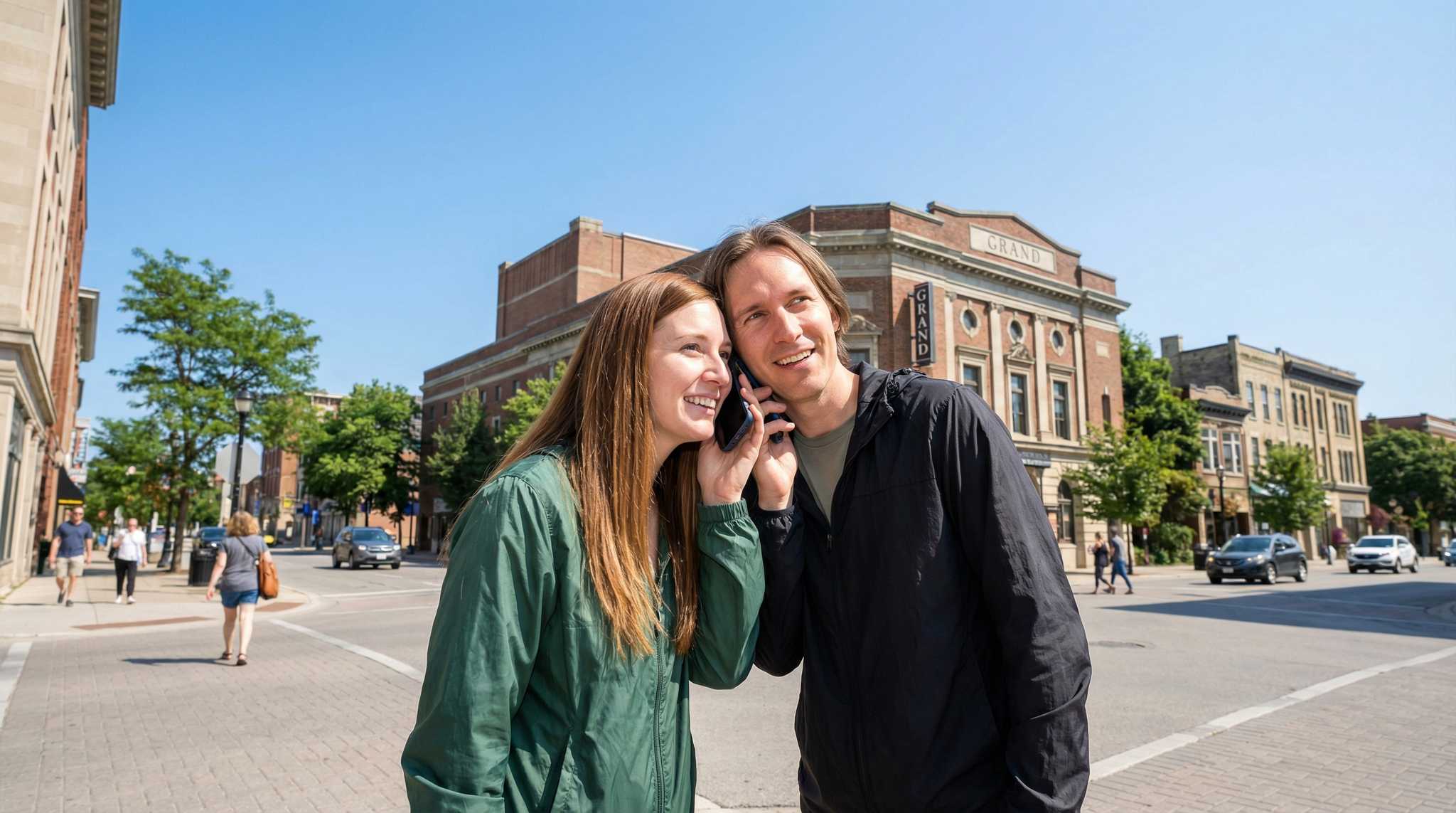
Wycieczka audio po Londynie: Echa dziedzictwa i ukryte historie
Sto lat tajemnic odbija się echem w wapiennych fasadach Londynu, gdzie historyczny splendor skrywa opowieści, które ukształtowały serce Kanady. Wędruj we własnym tempie podczas tej wycieczki audio i odkryj ukryte korytarze oraz przesiąknięte skandalami sale, które większość zwiedzających omija. Kto zaryzykował wszystko, by przemycić zakazane słowa pod kopuły Biblioteki Publicznej w Londynie? Jaki cień przemknął o północy przez Gmach Publiczny Dominion, pozostawiając za sobą chaos i szeptane plotki? Które przedstawienie w Grand Theatre wywołało poruszenie w całym mieście z powodu jednego źle umieszczonego rekwizytu? Śledź puls miasta od eleganckich czytelni po kulisowe intrygi, odkrywając polityczne przewroty, zagadki ukryte w kamieniu i momenty, które sprawiają, że ulice Londynu tętnią energią. Każdy przystanek ukazuje nową perspektywę – warstwy historii, buntu, śmiechu i straty – czekające na wyciągnięcie ręki. Odkryj sekretną przeszłość Londynu. Naciśnij odtwarzanie i pozwól miastu opowiedzieć swoją historię.
Podgląd trasy
O tej trasie
- scheduleCzas trwania 40–60 minsIdź we własnym tempie
- straighten2.7 km trasy pieszejPodążaj wyznaczoną trasą
- location_on
- wifi_offDziała offlinePobierz raz, korzystaj gdziekolwiek
- all_inclusiveDożywotni dostępOdtwarzaj ponownie w dowolnym momencie
- location_onStart przy Biblioteka Publiczna w Londynie
Przystanki na tej trasie
To spot the London Public Library, look for a modern building with a dramatic wall of curved glass windows and brick pillars, right at street level, topped by a large, round…Czytaj więcejPokaż mniej
To spot the London Public Library, look for a modern building with a dramatic wall of curved glass windows and brick pillars, right at street level, topped by a large, round canopy. Here we are, standing outside the extraordinary London Public Library-a building with so much glass, even the sunlight gets a little lost trying to find its way out! Now imagine, for a moment, you’re strolling through this spot over a hundred years ago. It wasn’t filled with shiny glass walls or automatic doors back then, but it was buzzing with ideas, just as it is today. The library as we know it opened in November 1896, transforming from the London Mechanics’ Institute-a place where locals could borrow books only if they paid a fee-into a treasure trove of free knowledge for everyone. Now, let’s zoom forward. This central branch you’re looking at used to be a Hudson’s Bay outlet. Picture racks of clothing and the smell of new shoes, traded out-in true Canadian fashion-for shelves and shelves of stories and information. In 2002, the library moved here, smack in the busy core of downtown London. With a little help from generous donors, it added the Wolf Performance Hall, where you might catch actors rehearsing lines or musicians tuning up. If you listen closely, there’s always something going on-art exhibits, author readings, even health workshops to help you live long enough to finish all those books you’ve borrowed. Here’s another modern twist: in 2016 and 2017, the Central Branch got a huge makeover, with a chunk of its northern space remodeled for CBC Radio One’s new studios. Imagine walking in and hearing the buzz of radio broadcasts mixing with the rustle of pages. That’s the heartbeat of the library, pulsing with local news and voices. But wait, what’s a library in 2024 without a little digital drama? Just recently, in December 2023, the library faced a cyberattack-cue suspenseful music! For weeks, staff and visitors braved the digital storm, proving that even in the age of eBooks and WiFi, real-life resilience matters. This library is more than books. It’s a community hub, with 16 branches city-wide, reaching every corner of London and stretching out to Oxford, Middlesex, and Elgin counties. It welcomes adults, teens, and children alike-no secret handshake required, just a library card. And, in true “London is friendly” form, they scrapped overdue fines in November 2020. That’s right-forget to return your DVD of Jaws? No angry sharks here… unless you count the suspense of not knowing who else wants to watch it. Dive into the programs-book clubs, discussion groups, art displays, and “Book a Librarian” one-to-ones where you get undivided nerdy attention! If you’re homebound, library staff will deliver right to your door. The Welcome Centre on the third floor partners with the Canadian Mental Health Association, making sure everyone finds information or a helping hand. Your library card is a golden ticket: you can check out up to sixty items (so start working on your biceps!)-from graphic novels and laptops to board games and wireless hotspots. There are even special cards for those who just want to hop on the internet without leaving a digital paper trail. The library believes in value-an economic study found that for every dollar invested, the city gets back $6.68 worth of knowledge, connection, and personal growth. And don’t forget One Book, One London-the whole region reading together. Past picks include The Saturday Night Ghost Club and The Marrow Thieves, bringing the city together one page at a time. So next time you walk by this wall of windows and bricks, remember you’re not just staring at a building; you’re seeing a living, breathing adventure-a storyteller, a performer, a digital warrior, and a helpful neighbor all rolled into one. Ready to turn the page to your next stop? Intrigued by the services, borrowing - memberships, limitations, and fines or the programs? Make your way to the chat section and I'll be happy to provide further details.
Otwórz dedykowaną stronę →Right ahead you’ll spot the impressive, half-dome bandshell-its broad, curved roof and sandy yellow walls make it stand out right in the heart of the park. As you’re standing…Czytaj więcejPokaż mniej
Right ahead you’ll spot the impressive, half-dome bandshell-its broad, curved roof and sandy yellow walls make it stand out right in the heart of the park. As you’re standing here, let yourself drift back in time and imagine the land beneath your feet as it once was: a busy British garrison, the clatter of boots and the snap of a cricket bat echoing through the dusty grounds. Victoria Park wasn't always lush lawns and festival music! In the 1830s, this patch of green buzzed with military life, growing even busier during the Upper Canada Rebellion. Tents, barracks, and stern-faced soldiers dotted the field, keeping a wary watch on a young Canada. But here’s a twist: when the British marched off to train for the Crimean War in 1853, these same buildings became a life-saving hideaway for escaped slaves journeying north along the Underground Railroad. Imagine for a moment the hopeful whispers and cautious footsteps in the quiet of night, as new arrivals found safety just steps from where you are standing. The British troops came back in 1861, convinced that the violence of the American Civil War might spill over the border. But the winds of history were changing. By 1874, the city claimed the land and named it for Queen Victoria, and with a stroke of a pen, a military zone became a park for the people. Picture Charles H. Miller, the American landscape architect, imagining winding paths and great lawns for weekend strollers, inspired by his own adventures at mighty expositions in Philadelphia. Some say a local botanist’s exciting stories from his American travels nudged the city to hire Miller-proof that even parks can benefit from a little gossip! But wait, Victoria Park isn’t just calm strolls and leisure. During the Boer War, both World Wars, and even the Conscription Crisis of 1944, the park filled again with the sound of military boots-and a few heated arguments too. Lift your eyes and you’ll find cannons from the Crimean War, a somber Boer War statue, a bold Sherman tank named “Holy Roller,” and even a replica cenotaph to honor those lost. And while the fountains and lilyponds of the past are gone, the spirit of gathering lives on. Today, the park bursts with music, laughter, and tasty aromas during Sunfest, Rib-Fest, and a rainbow of other festivals-plus some of Canada’s greenest, cleanest eco-parties, with clever waste stations helping keep things tidy. If winter’s your season, imagine a sparkling ice rink and twinkling lights wrapping every tree, the sounds of distant carols and the crunch of skating blades filling the cold air. Every February, you might even spot a snow sculpture or two. And here’s a local secret: Victoria Park’s black squirrels! These bushy-tailed, jet-furred acrobats aren’t native, but were brought here in 1914-and became local celebrities in their own right. Some even went on to start new squirrel dynasties, all the way in Ohio! Look around, and you’ll sense the layers of history and festival joy mingling in the breeze. So, keep your eyes peeled-you never know if you’ll catch a band playing, a squirrel “fishing,” or just a quiet moment that connects you to all those whose stories shaped this very spot.
Otwórz dedykowaną stronę →


Pokaż jeszcze 9 przystankówPokaż mniej przystankówexpand_moreexpand_less
In front of you, look for a lively green space dotted with large trees, colorful flower beds, and a reflective pond, while in the background you’ll spot old-fashioned tents and a…Czytaj więcejPokaż mniej
In front of you, look for a lively green space dotted with large trees, colorful flower beds, and a reflective pond, while in the background you’ll spot old-fashioned tents and a stately building peeking through-a scene almost frozen in a page from Victorian times. Welcome to the site of the Crystal Palace Barracks! Imagine yourself back in 1861, where this spot buzzed with excitement as it hosted the Provincial Exhibition. Picture soldiers in polished boots and ladies twirling parasols as they gather around an octagonal white brick palace, each of its eight doors beckoning curious visitors in. Sunlight spilled in through 48 second-floor windows, making everything shimmer-sort of like a disco ball, if disco balls were invented by Queen Victoria. Fast forward to 1887, and the Western Fair moved, but the “new” Crystal Palace kept the festive spirit alive with its grand arches, massive windows, and racehorses pounding a new track nearby. The building dazzled in terra cotta hues with bold green, brown, and red trim, screaming progress and optimism. Sadly, in 1927, a winter fire swallowed the Crystal Palace whole, and a sturdy red brick Confederation Building rose in its place. But on days like this, you can almost imagine the thrill of the old fair, the music, the cheers, and a world changing around them, one exhibition at a time.
Otwórz dedykowaną stronę →Right ahead, you’ll spot St. Peter’s Cathedral Basilica by its striking twin towers, pointed spires, and tall arched windows, all rising above the green lawn to your…Czytaj więcejPokaż mniej
Right ahead, you’ll spot St. Peter’s Cathedral Basilica by its striking twin towers, pointed spires, and tall arched windows, all rising above the green lawn to your left. Standing before this grand cathedral, imagine the bustling 1800s when local Catholics gathered in a humble log church not far from where you’re standing. Back then, the church was so small, it held just 180 people-enough to fill a noisy coffee shop. Disaster struck twice-first in 1845 when a raging fire tore through much of the town, and then again in 1850 when another blaze left only memories and ashes. But resilience is the name of the game here! With bricks, hard work, and more than a few prayers, the parish built a larger church, this time right at the spot you’re at now, thanks to a generous land grant from the Crown. As London grew, so did the church’s ambition. Bishop Walsh wanted a true monument-something as grand as the faith of its people. Enter Joseph Connolly, a master of Gothic Revival, whose vision brought towering spires, dizzying arches, and enough stained glass to make the sunlight dance even on cloudy days. Construction filled the air from 1880 to 1885 with the clang of hammers and hopeful chatter. By 1889 the first radiant stained glass adorned the cathedral, but it took until 1926 to finish the dazzling interior and to install the magnificent Casavant organ. In 1958, the ornate twin towers and the Lady Chapel were added, making the church even more impressive-talk about a makeover! Just a few years later, it was declared a basilica by Pope John XXIII, a true upgrade. When you walk by today, take in those intricate details-each stone a survivor, every window a witness to fiery trials, grand dreams, and a community always ready to rise. And just imagine-it all began with a little log building and a whole lot of determination.
Otwórz dedykowaną stronę →Directly ahead, look for a modern brick and glass building with a large vertical sign reading “THE GRAND THEATRE” just above some classic old storefronts-you're in exactly the…Czytaj więcejPokaż mniej
Directly ahead, look for a modern brick and glass building with a large vertical sign reading “THE GRAND THEATRE” just above some classic old storefronts-you're in exactly the right spot! Welcome to The Grand Theatre, London’s leading stage for drama, mystery, and, sometimes, a real-life ghost or two! Close your eyes for a minute and imagine it’s September 9, 1901: the streets buzz with excitement, gas lamps flicker, and elegant carriages pull up right where you’re standing. You can almost hear the enthusiastic chatter and the clattering of hooves as London’s citizens-dressed to the nines-gather for the grand opening night. The theatre’s first owner, Ambrose Small, was no ordinary man. He adored this theatre above all his other properties, and who could blame him? With its ornate proscenium arch designed to launch every sound-from a whispered secret to a thunderous chorus-right into your soul, it’s the kind of place where even sitting in the audience feels like being part of the show. But here’s where the plot thickens: on December 2, 1919, Ambrose deposited a million dollars in the bank-equivalent to a small fortune today-shared a quiet lunch with his wife, and then... vanished! No note, no trace. Only mystery. Legend says that just weeks later, the night watchman saw Ambrose strolling into The Grand Theatre late at night, his footsteps echoing on the stairs. Was it a trick of the light... or did he really return? To this day, many believe Ambrose’s spirit still drifts among the rows, perhaps judging the acting or hanging out backstage, waiting for his encore. If you feel a slight chill or a tap on your shoulder tonight, don’t worry-he’s probably just checking if you bought a ticket! Of course, this place has more than just drama and disappearances. In 1924, The Grand was sold to Famous Players and transformed for the latest craze-motion pictures! The flicker of film projectors whirred through the building, lighting up faces both on and off the screen. Then in 1945, embracing the artisan spirit, it became the home of the London Little Theatre company, Canada’s amateur stage glory, bursting with energy and thriving creativity. By the 1970s, the building was creaking and groaning a bit with age-like so many of us! So, from 1975 to 1978, The Grand changed its costume once again, undergoing a dramatic five-million-dollar renovation that preserved its legendary proscenium arch and added the intimate Auburn Theatre below. The architects behind this transformation were so brilliant, they snagged a Governor General’s Award for their work. It’s not every day a theatre gets its own standing ovation for interior design! Now, imagine evenings when the big names-W.C. Fields, Sarah Bernhardt, Maggie Smith, Leonard Nimoy-trod these very boards, their voices soaring through the arch to the farthest seat. And don’t forget the next generation: The Grand’s High School Project is the pride of London, giving local students the chance to take center stage, guided by seasoned pros. Every autumn the main stage lights up with musicals starring high schoolers whose adrenaline and imagination make every performance unforgettable. Even through recent storms, like the COVID-19 pandemic that dimmed the lights in 2020, The Grand always bounces back, ready for another act. Whether it’s a bold play in the UnderGrand series or a Playwright’s Cabaret making the audience jump, cry, or laugh, this theatre lives and breathes entertainment. So next time you hear a faint whisper here late at night, or a burst of laughter spilling onto Richmond Street, just remember: you’re standing in London’s living room of stories-a place where every night, history takes a bow and the next headline act waits behind the curtain. Curtain up!
Otwórz dedykowaną stronę →Directly ahead, you'll spot a striking red-brick cathedral with tall pointed arches, a clock tower, and elegant white trim-just look for the grand, Gothic spires rising above the…Czytaj więcejPokaż mniej
Directly ahead, you'll spot a striking red-brick cathedral with tall pointed arches, a clock tower, and elegant white trim-just look for the grand, Gothic spires rising above the trees. Standing before St. Paul’s Cathedral, let your imagination whisk you back to the 1840s, when this very spot was buzzing with the clatter of hammers and saws. William Thomas, the architect, filled the air with grand ideas of Gothic Revival-the kind of place that looks like it should have bats in the belfry (don’t worry, I’ve checked, no bats here today). This church rose from the ashes, literally, after the old wooden church of 1834 met its fiery fate in 1844. Just two years later, the fresh scent of new timber and stone became the oldest church in the city. If you could peek inside, you’d find the work of the Cochrane brothers, master sculptors, who made sure the interior felt as grand as the exterior looked. Through every ceremony and quiet moment, the echo of its deans-each one doubling as rector-has been felt across generations. And in 1966, the Rev. Orlo Miller put pen to paper, chronicling every twist and turn of St. Paul’s adventure. Even now, as you stand outside in the sunshine, you might imagine bells ringing out over London, reminding everyone this grand old place still has plenty of stories to tell.
Otwórz dedykowaną stronę →Directly ahead, you'll spot the Dominion Public Building by its solid limestone exterior, vertical window bays, and the Canadian flag flying proudly at the very top-just look for…Czytaj więcejPokaż mniej
Directly ahead, you'll spot the Dominion Public Building by its solid limestone exterior, vertical window bays, and the Canadian flag flying proudly at the very top-just look for the tall Art Deco stone tower right at the intersection! Now, as you stand on the bustling corner of Richmond Street, picture the scene in 1935-a rumble of engines and clatter of tools fills the air as hundreds of workers begin erecting this mighty structure, their spirits fueled not just by paycheques, but by hope for a brighter future. The Great Depression had cast a long shadow over London, with too many out of work and too few rays of optimism breaking through. But the Public Works Construction Act of 1934 was about to turn things around, and this building was its shining promise-like a superhero in limestone and granite. Designed by Thomas W. Fuller, the Chief Public Works Architect-whose dad, fun fact, also had the same fancy title!-the Dominion Public Building was brought to life with the help of three local talents: John MacLeod Watt, Victor Joseph Blackwell, and Roy O. Moore. Together, they weren't just making offices; they were laying down a statement. They chose a style called Classical Moderne, which is like Art Deco’s more dignified cousin. It’s blocky, bold, and oozes “government business,” but if you step back, you’ll see the building unfolds in layers-like a stone wedding cake, each “tier” stepping up with neat symmetry. But don't be fooled by those serious lines-this place is a little bit flashy too. Check out the black polished granite accents near the doorways and the sleek aluminum trims framing the windows and doors. Back in the 1930s, aluminum was the height of modern style; they used more than 5,000 pounds of it here. Not to be outdone, marble graced the halls inside and terrazzo floors twinkled underfoot. Imagine the postal workers and customs officers, gliding across that shiny marble, with polished brass letters gleaming at every turn. On the outside, have a peek for tiny maple leaves and coats of arms carved right into the walls-a bit of patriotic “bling” reminding passersby that Canada was, quite literally, building itself up again. The architects wanted Londoners and travelers alike to see not just another government office but a symbol of strength: “We’ve got this, Canada’s not going anywhere!” For decades, this place buzzed with activity. If you’d come to post a letter, or perhaps to deal with customs or pensions, you’d be walking into the heart of Canadian civic life. During its construction it gave Londoners much-needed jobs, almost like the city’s own economic defibrillator! And even through renovations, when some of the original bronze and brass details had to say goodbye, careful hands made sure the replacements looked just as snazzy-Heritage Canada insists, after all, that the building keep its “don’t-mess-with-the-mass” look. Today, the Dominion Public Building is still owned by the government, still doing its patriotic job-and in June 1990, it officially became a Classified Federal Heritage Building. That means: no one’s knocking it down or giving it an ill-advised makeover. It stands, solid as ever, not just for postal services but as a monument to a time when architecture wasn’t just about space, but about spirit. So next time you pass by, listen for the echoes of hope and hard work-if you hear a postman's whistle on the breeze, you’ll know the story is still being told. Want to explore the the public works construction act, architects or the architecture in more depth? Join me in the chat section for a detailed discussion.
Otwórz dedykowaną stronę →Museum London is the bold, modern building with gleaming glass walls and shiny, curved rooftops-just look for its futuristic silver facade right at the street’s edge. Here at the…Czytaj więcejPokaż mniej
Museum London is the bold, modern building with gleaming glass walls and shiny, curved rooftops-just look for its futuristic silver facade right at the street’s edge. Here at the forks of the Thames River, Museum London stands like a spaceship that decided to make a pit stop in Ontario-designed by Raymond Moriyama, who also crafted wonders like the Bata Shoe Museum and Science North. Now imagine 1940: Londoners carrying dusty artifacts up the library steps, with the hope of sharing their treasures. Fast-forward through the decades, and you get a whirlwind romance-this building was born from the union of an art gallery and historical museum in 1989, after some lively courtship involving books and paintings. As you stand here, somewhere inside those walls lurk over 45,000 artifacts and 5,000 works of art, from Lawren Harris landscapes to thought-provoking pieces by Kent Monkman and Edward Burtynsky. Not to mention, in 2004, a whole collection of medical oddities joined the party-imagine the conversations between an old stethoscope and a contemporary sculpture. In 2018, the Centre of the Forks popped up, opening the doors even wider to creativity and community. So, if you hear a faint giggle, it’s probably just a painting telling a historical artifact a joke-“Why did the skeleton stay out of the art gallery? He didn’t have the guts!”
Otwórz dedykowaną stronę →Look straight ahead for a grand, castle-like building with tall octagonal towers, stone-like brick walls, and a row of battlements crowning the top-if you suddenly feel you should…Czytaj więcejPokaż mniej
Look straight ahead for a grand, castle-like building with tall octagonal towers, stone-like brick walls, and a row of battlements crowning the top-if you suddenly feel you should be wearing a suit of armor, you’ve found the right place! Now, picture London, Ontario in the late 1820s: muddy roads, the sound of hammers on local stone, and an ambitious dream to bring a slice of English Gothic style right here to Canada. The Middlesex County Court House sprang up between 1827 and 1829, thanks to Toronto architect John Ewart. Instead of just copying the look of an ordinary courthouse, Ewart sent it straight into fairytale territory, with magnificent outdoor towers, pointed lancet windows, and chunky crenellations that seem ready for a watchman to spot approaching dragons-or maybe just nosy lawyers. Inside, it held not only the court but also the jail and police administration, so you can imagine a mix of stern judges, frustrated lawyers, and jailers, all going about their business with a building that looked more like a fortress than an office. Interestingly, this place out-Gothic’d England itself, pre-dating even the famous Houses of Parliament! Over time, its grand exterior was guarded by historic protections, making the grounds almost as untouchable as its sturdy stone. Not bad for a courthouse that looks like it’s ready to host a medieval banquet or two, eh?
Otwórz dedykowaną stronę →To spot Eldon House, look for the elegant white two-story house with green shutters, a wide covered veranda draped in greenery, and a vibrant garden bursting with flowers right…Czytaj więcejPokaż mniej
To spot Eldon House, look for the elegant white two-story house with green shutters, a wide covered veranda draped in greenery, and a vibrant garden bursting with flowers right out front-it’s right ahead of you, framed by tall trees. Now, you’re standing before a house that’s seen nearly two centuries of laughter, intrigue, and family secrets-Eldon House, the oldest residence in London still standing tall. Picture this place back in 1834: Captain John Harris, who clearly thought “Go big or go home” was a guiding principle, names this grand new house after his hero, the Earl of Eldon. It’s a Georgian beauty that once sat upon 11 acres, and what a sight it must have been! The Harris family-John, his wife Amelia, and eventually their ten children-moved in, bringing enough bustling energy to challenge even the wildest family reunions. Just imagine Amelia Ryerse Harris sweeping through those doors, a woman with Loyalist pride and a knack for surviving chaos. The Harris daughters attracted admirers like moths to a candle, often marrying British officers, turning Eldon House into the go-to venue for society events and whispers about London’s “most eligible.” Love stories, heartbreak, celebrations-these old floorboards have heard it all. There were also big changes: in 1877, one of the sons, Edward William, added a wing, proving a family home needs to grow as much as its guest list. Skip ahead to Lucy Ronalds, who-thanks to grannies and grandpas with some very interesting job titles (including fur trader and famous nurseryman)-inherited enough family heirlooms to turn the house into a museum long before the city stepped in. This sudden windfall meant travel! The Harris clan globe-trotted their way around the world in 1897, bringing back odd treasures, odd tales, and probably a suitcase or two that wouldn’t pass airport security today. Some prize souvenirs, like African weaponry, are still on display. After 125 lively years, the Harris family finally turned Eldon House and its lush gardens over to the city in 1959, making it a museum and a park for everyone to enjoy. Today, it’s the site of grand events-ever curious about Victorian Christmas or Canada Day of yesteryear? The house has you covered, with every portrait and candlestick quietly telling its own story. So, as you stand on the garden path, take a moment to let your imagination wander-somewhere in that garden, perhaps, a Harris daughter is giggling at a joke from an army officer, and a father is excitedly planning out the next family adventure.
Otwórz dedykowaną stronę →







Najczęściej zadawane pytania
Jak rozpocząć trasę?
Po zakupie pobierz aplikację AudaTours i wpisz kod realizacji. Trasa będzie gotowa do natychmiastowego rozpoczęcia – po prostu dotknij \"Play\" i podążaj trasą z nawigacją GPS.
Czy potrzebuję internetu podczas trasy?
Nie! Pobierz trasę przed rozpoczęciem i korzystaj z niej w pełni offline. Jedynie funkcja czatu wymaga internetu. Zalecamy pobieranie przez WiFi, aby oszczędzać dane mobilne.
Czy to wycieczka grupowa z przewodnikiem?
Nie – to samodzielny audioprzewodnik. Zwiedzasz niezależnie, we własnym tempie, z narracją audio odtwarzaną przez telefon. Bez przewodnika, bez grupy, bez harmonogramu.
Ile trwa trasa?
Większość tras zajmuje 60–90 minut, ale to Ty kontrolujesz tempo. Wstrzymuj, pomijaj przystanki lub rób przerwy, kiedy chcesz.
Co jeśli nie zdążę ukończyć trasy dzisiaj?
Żaden problem! Trasy mają dożywotni dostęp. Wstrzymaj i wznów, kiedy chcesz – jutro, za tydzień lub za rok. Twój postęp jest zapisywany.
W jakich językach są dostępne trasy?
Wszystkie trasy są dostępne w ponad 50 językach. Wybierz preferowany język podczas realizacji kodu. Uwaga: języka nie można zmienić po wygenerowaniu trasy.
Gdzie znajdę trasę po zakupie?
Pobierz darmową aplikację AudaTours z App Store lub Google Play. Wpisz kod realizacji (wysłany e-mailem), a trasa pojawi się w Twojej bibliotece, gotowa do pobrania i rozpoczęcia.
Jeśli trasa Ci się nie spodoba, zwrócimy Ci pieniądze. Skontaktuj się z nami pod adresem [email protected]
Bezpieczna płatność przez 


