AudaTours logoAudaTours

Audiotour door Birmingham: Echo's van Innovatie en Erfgoed

Audiogids14 stops

Staal en geheimen vormden de skyline van Birmingham, maar onder elk glanzend oppervlak ligt een web van verhalen die weinigen echt hebben gehoord. Deze zelfgeleide audiotour nodigt je uit om te dwalen tussen giganten van kunst, geschiedenis en geloof, en verhalen te ontrafelen die voor het oog verborgen zijn. Waag je buiten de gebaande paden en ontdek momenten die zelfs levenslange bewoners over het hoofd zien. Wie ontketende een gepassioneerde opstand vanuit de marmeren zalen van de openbare bibliotheek van Birmingham? Welk onbetaalbaar schilderij in het Birmingham Museum of Art verdween ooit spoorloos? Waarom draagt een rustige hoek van het Episcopale Bisdom van Alabama de schaduw van een schandaal dat de lokale geschiedenis voorgoed veranderde? Beweeg je door statige gangen, echoënde galerijen en zonovergoten straten terwijl het drama, conflict en de mysteries van de stad zich met elke stap ontvouwen. Zie bekende bezienswaardigheden transformeren in poorten naar het onverwachte. Klaar om gewoon sightseeing in te ruilen voor een reis door de best bewaarde geheimen van de stad? Zet nu je eerste stap.

Tourvoorbeeld

map

Over deze tour

  • schedule
    Duur 40–60 minsGa op je eigen tempo
  • straighten
    3.4 km wandelrouteVolg het geleide pad
  • location_on
  • wifi_off
    Werkt offlineEén keer downloaden, overal gebruiken
  • all_inclusive
    Levenslange toegangOp elk moment opnieuw afspelen, voor altijd
  • location_on
    Start bij John Hand Building

Stops op deze tour
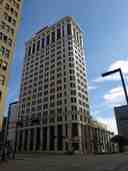
  1. To spot the John Hand Building, just look up for a tall, 20-story high-rise with striking white stone and dark windows standing on a corner, its proud frame topped with a…Meer lezenToon minder

    To spot the John Hand Building, just look up for a tall, 20-story high-rise with striking white stone and dark windows standing on a corner, its proud frame topped with a decorative crown near the roof. Now, take a moment to imagine yourself back in the early 1900s, when Birmingham was buzzing with excitement and construction noise. In 1912, the John Hand Building soared above the city, becoming the tallest structure in town-at least until the City Federal Building bravely reached higher a year later. You’re standing at the spot where businessmen in starched collars once hurried in and out, the lower eight floors alive with the clack of typewriters and busy office chatter, while up above, residents looked down on a city that never slept. AmSouth Bancorporation called this place home for most of the 20th century, filling its grand halls with decisions that shaped Birmingham’s future. When AmSouth moved out in the ’90s, the building almost seemed to hold its breath-until a team of developers swooped in, pouring $20 million into bringing its elegant bones back to life. It didn’t take long for new tenants to see the magic: banks moved in, and then the energy of modern companies took over, with Shipt splashing its green logo high on the south side for the world to see, only to swap it out for Landing in 2022. Through every changing sign and every era, the John Hand Building stands tall, holding secrets, stories, and maybe even a few ghosts of business deals lost to time.

    Open eigen pagina →
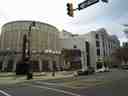
  2. Look up ahead for a large cream-colored building with a curved, patterned facade and bold blue McWane Science Center letters right above the entrance-it's hard to miss with its…Meer lezenToon minder

    Look up ahead for a large cream-colored building with a curved, patterned facade and bold blue McWane Science Center letters right above the entrance-it's hard to miss with its IMAX sign and art deco vibes! You’re standing in front of the McWane Science Center, and let me just say-if museums had superpowers, this one would be the city’s science superhero! Imagine, not too long ago, this spot was filled with shoppers bustling through Loveman's, a department store that saw its fair share of snazzy hats and handbags. Fast-forward to July 11, 1998, and-poof!-the building transforms into a place where hands-on science isn’t just encouraged; it’s everywhere you look, feel, and even smell (especially in the aquarium... trust me, those fish keep it fresh). Take a deep breath-inside, the lower level whisks you off to the World of Water, where over 50 aquatic species swim right beside you. If you’re brave, you can dip your hands in the touch tank and meet small sharks and rays up close. Ever wished you had x-ray vision? They’ve got shark teeth you can study under microscopes, and displays that make water pollution both eye-opening and, well, shockingly gross. Head up to the second floor and you’re diving into serious treasure: more than 500,000 artifacts! It’s like Alabama’s attic, only way cooler, filled with sparkling minerals, ancient fossils, and even the mighty Basilosaurus-an 80-foot behemoth that was once the state’s official fossil. And watch out for the Appalachiosaurus; rumor has it he’s still hungry for knowledge! But don’t worry, it’s not all dinosaur drama. For younger time travelers, Itty Bitty Magic City is a pint-sized metropolis where toddlers run the grocery store and make a splash in the water play zone. Parents get to shop for imaginary veggies while mini-citizens learn life skills and burn off some of that boundless energy. So, hats off to the McWane family and McWane, Inc.-thanks to them, this site swapped fashion for fossils. Now every curious mind, big and small, can explore, get their hands wet, or just take in the science-y magic swirling around!

    Open eigen pagina →
  3. Look for the Carver Theatre just ahead-a sleek, low building with a bright, vintage-style marquee stretching over the sidewalk and big glass windows underneath, right where Fourth…Meer lezenToon minder

    Look for the Carver Theatre just ahead-a sleek, low building with a bright, vintage-style marquee stretching over the sidewalk and big glass windows underneath, right where Fourth Avenue North and 17th Street North connect. Standing here, take a slow breath and imagine it's 1935: the jazz is bumping in the air, sharp-dressed folks are lined up outside the Carver Theatre, clutching tickets and whispering about the latest movies. Back then, this theater wasn’t just a place to catch a flick-it was a safe haven, a bright spot for Birmingham’s African-American community during an era when most movie theaters in town posted “Whites Only” signs at the door. The Carver had none of that nonsense-here, you could see first-run films, the latest Hollywood adventures, or even catch a comedy, all without worrying about segregation. Flash forward to 1945-picture the Carver after a glamorous makeover with shiny, plush red chairs (1,300 of them!), brand new air conditioning humming quietly, and the crispest sounds in town bouncing off the walls. For Fourth Avenue’s neighborhood, this place was the heartbeat, not only showing movies but welcoming the community during the highs and the hard times. If these bricks could talk, they’d have stories about jazz notes spilling out the doors, and civil rights marches passing by-this was a magnet for both business and protest. But like every American classic, there was a rocky middle act. During later decades, crowds thinned, the movie magic faded, and believe it or not, the Carver even tried screening X-rated movies before closing in the 1980s-kind of an “awkward teenager” phase for a historic building. Thankfully, Birmingham had bigger dreams for the Carver. The city bought the old theater in 1990, polished her up, and transformed her into a stage for live jazz. Now, as you stand here, you’re in the home of the Alabama Jazz Hall of Fame! Duke Ellington’s orchestra, Diana Krall, the Tom Joyner morning show, and countless jazz legends have all graced this stage. The Carver hosts jazz festivals, student competitions, concerts, and more-so if you listen closely, you might just hear a trombone wailing as the spirit of jazz and history lives on in every brick. Welcome to the Carver, a true Birmingham survivor, and star of the show.

    Open eigen pagina →
Toon 11 stops meerToon minder stopsexpand_moreexpand_less
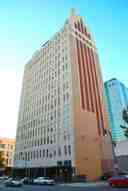
  1. To spot the Watts Building, look for a tall, cream and orange-brick Art Deco skyscraper with bold vertical lines running up its facade-it stands right before you on the corner,…Meer lezenToon minder

    To spot the Watts Building, look for a tall, cream and orange-brick Art Deco skyscraper with bold vertical lines running up its facade-it stands right before you on the corner, confidently reaching toward the sky. Imagine it’s 1927-Birmingham is buzzing, jazz music fills the air, and the city is racing to compete with the world’s great urban skylines. Suddenly, this shining tower rises above the streets, all sharp angles, geometric patterns, and a kind of roaring elegance that would make even a Gatsby party stop and stare. Now, the Watts Building wasn’t just any office block-it was a symbol of ambition in an age of jazz and big dreams. Just picture people rushing in with typewriters and dreams of empire, their footsteps echoing in marbled hallways. Even the elevators probably felt like a ride to the future! Over the years, those creamy bricks have seen their fair share of secrets-business deals, office romances, maybe even a few nervous elevator pitches. When the building landed a place on the National Register of Historic Places in 1979, it sealed its legacy as more than just a piece of architecture. It’s lived through the Great Depression, survived many a local lunch rush, and still stands here to greet you with its bold stripes and hopeful windows, inviting you to imagine everything those walls have heard. Not bad for a building that’s almost a century old-and still looking sharp!

    Open eigen pagina →
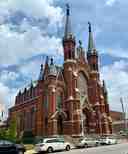
  2. To spot the Cathedral of Saint Paul, look for a towering red brick building with dramatic twin spires topped with crosses and a giant arched stained-glass window facing the…Meer lezenToon minder

    To spot the Cathedral of Saint Paul, look for a towering red brick building with dramatic twin spires topped with crosses and a giant arched stained-glass window facing the street-you really can’t miss its striking Victorian Gothic style! Step right up and take in the beauty of Saint Paul's Cathedral, standing proud since 1893! Imagine you’re here in the late 1800s: the streets echo with the clop of horse-drawn carriages and the air smells faintly of fresh brick dust. This building was the dream project of architect Adolphus Druiding from Chicago, and the parish it serves is even older, dating back to 1872. In fact, if you look closely, you might spot the years etched into the cornerstone-like an old family recipe with dates scribbled in the margins. Back then, getting the right builder wasn’t so easy. Poor Lawrence Scully, the brave contractor, only agreed to move to Birmingham to make this beauty a reality... but he met a strange and tragic end after his carriage flipped over when a car honked its horn. Scully didn’t only build the cathedral; he helped put up one of Birmingham’s first public schools too, so his mark lives on in the city. The cathedral’s stained-glass windows are like stories written in light-crafted by G. C. Riordan & Company and placed here since the building’s earliest days. That jaw-dropping St. Paul window above the entrance? It got swapped out in 1972 after a storm smashed the old one. So, a little weather drama keeps the place exciting! Inside, the cathedral has witnessed everything from emotional services to movie magic-it even starred in a climactic scene in the 2011 film, “October Baby.” Fast forward to 2022, and the sound of a brand new pipe organ fills the air, its music soaring high as sunlight peeks over the St. Paul window-finally visible above the pipes. This is where Birmingham’s Catholics come together-the mother church, a living landmark, with secrets, sorrows, and celebrations tucked behind every stone. So take a breath, listen closely, and you’ll almost hear the city’s history singing through those stained-glass windows.

    Open eigen pagina →
  3. Imagine the scene over a century ago: the courthouse’s twin pyramids piercing the skyline, its walls bustling with lawyers and townsfolk-the kind who probably wore way too many…Meer lezenToon minder

    Imagine the scene over a century ago: the courthouse’s twin pyramids piercing the skyline, its walls bustling with lawyers and townsfolk-the kind who probably wore way too many clothes for Alabama in the summer. That courthouse ruled this corner of downtown for decades until it was replaced in 1929 and then finally demolished in 1937. After that? Well, let’s just say this patch of land spent more than SIXTY years as-wait for it-a parking lot. Talk about a fall from grace! You’d almost feel bad for it, if it wasn’t so good at holding up cars. Fast forward to 1999, when Brookmont Realty came along. They dreamt big-really big: an 11-story, 152,000-square-foot office building towering tall again over Birmingham. The architects made sure to nod to the courthouse by topping their modern design with twin glowing pyramids, a gentle echo of what once was here. Construction kicked off in May 2000, but not before they had to remove the stubborn remains of the old courthouse’s foundation. You could call it “foundation drama,” but that’s probably only exciting for historians and construction workers. By early 2002, the Concord Center officially opened, quickly making friends with some high-profile tenants: the law firm of Adams and Reese, Harbert Management Corporation, and later Cadence Bank and JPMorgan Chase. In fact, Cadence Bank was so fond of this spot they moved their entire corporate headquarters here in 2013, adding a bank branch and an ATM in the lobby so no one has an excuse to forget their rent. Speaking of the lobby, if you pop your head inside, it’s like stepping into a little art gallery! The Birmingham Museum of Art teamed up with the architects to display artwork right in the heart of the building. The star of the show? A massive, hand-carved wooden globe-a reminder of Harbert Corporation’s adventures in construction all over the globe. So next time you’re around, pop in and give the world a spin (figuratively, please-I’m not responsible for breaking globes). So here you stand, at a corner where history meets modern ambition, and where every night, those pyramids glow like a salute to Birmingham’s unstoppable spirit!

    Open eigen pagina →
  4. To spot the Redmont Hotel, look for a tall, tan brick building with 14 stories, standing proudly on the corner of 5th Avenue North and 21st Street, with lots of windows lining…Meer lezenToon minder

    To spot the Redmont Hotel, look for a tall, tan brick building with 14 stories, standing proudly on the corner of 5th Avenue North and 21st Street, with lots of windows lining each floor and a distinctive, classic balcony over its main entrance. Alright, take a good look at this grand old beauty-she may look calm on the outside, but trust me, the Redmont Hotel has stories bubbling up from every brick. Picture Birmingham in the roaring 1920s: jazz drifting from open windows, cars honking on busy streets, and here comes the Redmont, opening her doors for the first time on May 1, 1925. Back then, having a private bath in every room was the height of luxury-no cold midnight runs down the hall for these guests! Imagine the clang of suitcases and bellhops bustling through the marble-floored lobby. Fast-forward to the 1930s, and you’d find the famous Rainbow Room lounge alive with music and laughter, drawing the city’s movers and shakers (and a gang who called themselves the “Knothole Gang”-they probably had more secrets than the hotel’s ghost stories). By the late 1940s, the top floor wasn’t just for guests anymore; it turned into a glitzy penthouse for owner Clifford Stiles, where well-dressed partygoers waltzed on terraces, a pet lawn was manicured for posh companions, and glasses clinked deep into the night. Some folks around here even say Clifford loved the place so much, he never entirely checked out-watch out for a friendly ghost on your way out, just in case! And who could forget New Year’s Eve, 1952? The legendary Hank Williams spent his last night in one of these rooms-if these walls could sing, what a tune they’d tell. Meanwhile, politicians came calling, snagging one particular suite for campaign headquarters so often that it earned the nickname, the “Lucky Governor’s Suite.” I wonder if it came with a free campaign manager? After a few quieter decades, the Redmont’s luck turned in ’83 when a group of NBA stars pumped in new life (and more than a few dollars), giving her a mighty facelift and earning a spot on the National Register of Historic Places. Still, it’s not every day a hotel can say it’s been reborn more often than a cat has lives. With every renovation, hidden treasures surfaced-original architectural details, a bit of Birmingham history dusted off and polished up. Today, after yet another dazzling makeover, the Redmont is sleek and welcoming, proud to be part of Hilton’s exclusive Curio Collection. Step a little closer, take a whiff-maybe you’ll smell fresh coffee or hear the faint music of a 1930s jazz band drifting through the revolving door. That’s the charm of the Redmont: where the past and present keep dancing, right here on the corner.

    Open eigen pagina →
  5. To spot the Shipt Tower, just look up and find the tallest building around with light gray stone, rows of square blue-tinted windows, and the big "Shipt" logo perched proudly at…Meer lezenToon minder

    To spot the Shipt Tower, just look up and find the tallest building around with light gray stone, rows of square blue-tinted windows, and the big "Shipt" logo perched proudly at the very top! Alright, you’re standing before the mighty Shipt Tower, a true Birmingham heavyweight! Imagine the year: 1986. People are walking around with shoulder pads and big hair, and suddenly a brand new skyscraper shoots up, taller than anything Alabama had ever seen, its sleek granite and glass shimmering like a giant’s smartphone (though, I’ll admit, those didn’t exist yet). It was built as the grand lair for SouthTrust Corporation, and everyone craned their necks in awe. Over the years, this tower played an epic game of “Who’s Got the Logo?” as it changed hands-first SouthTrust, then Wachovia in 2005, Wells Fargo in 2010, and now, the local tech superstar, Shipt, since 2020. And talk about drama-at the time, it knocked the First National Bank Building in Mobile right out of the title for “Tallest in Alabama.” For twenty epic years, this spot ruled the Alabama skyline until a rival in Mobile snatched the crown in 2006. Inside, it’s a buzzing hive of energy: lawyers at Burr & Forman, number-crunchers at Deloitte and KPMG, and Wells Fargo holding down the fort as one of the biggest tenants. It’s like an office building version of a hotel for business legends. So whether you’re into architecture, high-stakes business, or just really tall things, the Shipt Tower has seen decades of Birmingham’s rise, reinvention, and a little bit of corporate musical chairs!

    Open eigen pagina →
  6. To spot the Episcopal Diocese of Alabama, just look for a charming, classic brick building nestled proudly on the street near the Cathedral Church of the Advent-its elegant…Meer lezenToon minder

    To spot the Episcopal Diocese of Alabama, just look for a charming, classic brick building nestled proudly on the street near the Cathedral Church of the Advent-its elegant architecture and warm tones are a quiet, dignified hint that you’re at the heart of Alabama’s Episcopal community. Alright, you’re standing before Carpenter House-the headquarters of the Episcopal Diocese of Alabama. Take a deep breath; can you feel the blend of old Southern gentility and modern energy? Here, in the heart of Birmingham, the Diocese covers nearly all of Alabama… except for the far southern tip. That little bit, including Mobile, split off in 1970 like a rebellious younger sibling, becoming the Diocese of the Central Gulf Coast. The Diocese of Alabama, though, has continued growing-almost like kudzu after a spring rain-spanning 92 parishes, college ministries, and even a retreat called Camp McDowell up in Nauvoo. Picture it: back in the day, as World War II ended, Alabama’s cities boomed-Birmingham, Montgomery, Huntsville. Churches filled up. Parents brought their kids, their neighbors, probably even their neighbor’s chicken. Growth here didn’t slow down like in other parts of the country. The diocese’s arrival in the 1970s with a bold policy: every church must be self-supporting-no handouts unless you were just getting started. The bishop then, Furman Stough, was like a spiritual entrepreneur-making sure every parish learned to stand on its own feet. Most Alabama Episcopalians-at least historically-tended to keep things “low church.” That means services here often felt plainer, closer to their Protestant roots, thanks to the original founders from Virginia and South Carolina who likely enjoyed a little less incense and a lot more preaching. And just imagine the genteel row of pews lined with lawyers, businessfolk, and the who’s who of Birmingham-all mixing with folks who wanted a church a bit more relaxed than the fundamentalist types down the street. But don’t let the peaceful setting fool you; the Diocese hasn’t been without drama! In the early 2000s, the wider Episcopal Church was shaken when Gene Robinson became the first openly gay bishop. Some regions split or protested, but Alabama mostly just wiped its brow and got on with things. Still, inside the mighty Cathedral Church of the Advent-just next door-there were some classic church disagreements. The cathedral is a bit unusual; it tends toward a traditional, evangelical style, and at times, its relationship with the Diocese leadership got so tense you could probably slice it with a hymnal. In 2019, the strain became one of the diocese’s “big four” challenges. Heads rolled-or, more politely, the dean resigned and joined another Anglican branch. And now, under Bishop Glenda Curry-the first woman to lead the diocese, who started in 2020-the story turns again. She and her team have worked to patch things up, even sealing new agreements with the cathedral so everyone can get back to what they do best: building community, loving their neighbors, and occasionally debating the finer points of church polity… usually over some very good coffee. That’s church life in Birmingham-a little tradition, a lot of adaptation, and more than a few stories to tell.

    Open eigen pagina →
  7. Straight ahead, you’ll spot a striking, castle-like church made of pale sandstone, with a tall square bell tower rising toward the sky-just peer past the trees and you can’t miss…Meer lezenToon minder

    Straight ahead, you’ll spot a striking, castle-like church made of pale sandstone, with a tall square bell tower rising toward the sky-just peer past the trees and you can’t miss its medieval vibe amidst the downtown buildings. Alright, traveler, pause for a second and let yourself step back in time while we stand here in front of the Cathedral Church of the Advent. Imagine Birmingham in 1872: dusty streets, new railroads, and the city hardly older than your last grocery list! That’s when the Advent parish first opened its doors-one of the very first churches here, its original building welcoming folks just a year after Birmingham was founded. Now, feast your eyes on the grand stone structure in front of you, but know this isn’t the church’s first act. The original church actually burned down in a fire that sent smoke curling through the city air on a November night back in 1892. While the ashes were still warm, builders were already hard at work raising this new church, designed by the firm Wheelock, Joy, and Wheelock. By fall of 1893, people once again filled these pews, though the impressive tower and portico kept the hammers busy until 1895. If you listen closely now, you might hear the echoes of past choirs-because this cathedral is storied for its music. Twice, Birmingham has voted its choir the very best in the city! With nearly 4,000 members, it’s one of the biggest Episcopal churches in all the land-so if you ever need a place to blend in, just join the crowd here. Over the years, the parish became the beating heart of Episcopal faith in Alabama. But here’s a twist worthy of a mystery novel: despite its size and grandeur, it was only in 1982 that it officially became the cathedral, the home base for the whole Diocese. Wander around the outside and you’ll see the unique Scioto sandstone exterior- lovingly restored at the turn of the millennium. They even redesigned the Rector’s Garden out back, making space for a peaceful columbarium and tackling the classic gardener’s arch-nemesis: poor drainage. And up in that sturdy square tower? In the early 2000s, they installed a gleaming carillon crafted by Paccard, the world-famous French bell makers. Picture those fifteen bells casting song over the city streets, summoning the faithful or just surprising some unlucky pigeons. Of course, no church with this much history is without a little drama! Through the decades, the Advent made its name as a home for Protestant, evangelical Anglicans-even hoisting a black flag in protest at the controversial election of Gene Robinson in 2003. Their journey through liturgical traditions, tug-of-wars over books of common prayer, and passionate debates with diocesan leadership have all left their mark. Leaders have come and gone, and in 2021, just across the cloister, the cathedral affirmed its identity in dramatic style-reminding everyone that faith, like history, is never set in stone. Today, kids file in for school at the Advent Episcopal Day School, and church bells remind the city daily that this corner of Birmingham is rich in story, song, and-if you stick around long enough-a touch of unpredictable adventure.

    Open eigen pagina →
  8. To spot the Birmingham Public Library, look for a striking modern building with dark, triangular glass walls meeting at a sharp point, rising from the corner of Park Place and…Meer lezenToon minder

    To spot the Birmingham Public Library, look for a striking modern building with dark, triangular glass walls meeting at a sharp point, rising from the corner of Park Place and Richard Arrington Jr Blvd like the prow of a massive ship. Alright, get ready-because the story of the Birmingham Public Library is like a page-turner with every chapter packed with surprises. Picture it: the year is 1886. The city is bustling, the streets are dusty, and tucked away in a room barely bigger than a closet, a tiny collection of books waits for curious readers. John H. Phillips, the school superintendent, was the mastermind behind this modest start-imagine him squeezing between the bookshelves, probably mumbling about needing a bigger room for all these stories. Flash forward to 1913. The city decides books are a big deal, so they create a public library board and start funding a proper library. Only a few years later, in 1918, a new chapter begins-literally. Birmingham opens a branch especially for African-American residents, called the Booker T. Washington branch. Here, amid a city divided by segregation, Mattie Herd Roland becomes the first African-American librarian in Alabama. Just when things start looking up, disaster strikes-the growing collection is moved to City Hall, only for much of it to go up in flames in a devastating fire in 1925. Talk about a cliffhanger. But out of the ashes came something grand. In 1927, a gleaming Neo-classical building made of Indiana limestone became the new central library, serving as a fortress of knowledge for nearly sixty years-a real upgrade from that book closet! Time marched on, and waves of change rolled through Birmingham. In April 1963, after courageous legal battles led by the Alabama Christian Movement for Human Rights, the city’s libraries were finally desegregated, opening the doors to all. By 1984, the city needed still more space for its ever-growing mountain of books, so they built an additional modern structure-the very one you see in front of you today, with its dramatic glass angles. This futuristic addition is linked to the historic 1927 building, now called the Linn-Henley Research Library, which houses special collections, rare maps, and even old Southern newspapers where you might just find your ancestor’s scandalous haircut immortalized. Now, the Birmingham Public Library system spreads its stories across 18 branches and checks out nearly 1.7 million items a year-enough to keep any bookworm fed for several lifetimes! With events like Alabama Bound, where you might meet your favorite local author, and worldwide connections through digital services, they’re always dreaming up new ways for people to fall in love with books. Not even the troubles of the pandemic or the drama of leadership changes could close the book on this amazing place for long. There’s a sense of adventure inside these glass walls, whether you’re searching for a rare map, diving into Southern history, or just hoping the free Wi-Fi reaches the sidewalk for a last-minute Google. So, if you hear the gentle rustle of pages and the hum of quiet voices, you know you’ve found a library where every chapter is a new beginning.

    Open eigen pagina →
  9. As you stand here in front of the old site of the Confederate Soldiers and Sailors Monument, try to imagine yourself back in 1905: the air is thick with anticipation as overcoats…Meer lezenToon minder

    As you stand here in front of the old site of the Confederate Soldiers and Sailors Monument, try to imagine yourself back in 1905: the air is thick with anticipation as overcoats swish and hats bob in Birmingham’s Linn Park, the city abuzz for the grand unveiling of what would become the tallest Confederate monument in Alabama. But our tale starts a little earlier. Picture it-it’s April 26, 1894, Confederate Decoration Day. Veterans in faded uniforms lay a cornerstone right here, complete with a Bible and a Confederate flag. For a while, the slab sat unused, doing a fine impression of “just a rock," until someone decided to park a surplus cannon from the Spanish-American War on top-because, why not? Fast forward to 1896: the United Daughters of the Confederacy hold a meeting, perhaps after a few too many cups of coffee, and decide they’re going to actually do something with the site. After some serious fundraising-let’s face it, putting up a 52-foot obelisk isn’t exactly pocket change-the memorial finally rises in 1905. Imagine the sunlight catching that stone spire, with everyone looking up and shielding their eyes, maybe wondering if birds would start using it as a fancy perch. But time marched on, and history, as it often does, grew complicated. By 2017, the monument had become a flashpoint. The city decided to put a barrier around it-for context, think less “idea of the century” and more “giant fence around your neighbor’s gnome.” The state wasn’t amused, and lawsuits started flying almost as high as the obelisk itself. Then came 2020. Amid protests and a nation in turmoil after the murder of George Floyd, this monument became a symbol for something much bigger than stone. Crowds pressed in, the obelisk shook, and eventually, the city took it down-leaving only the plinth behind. The state filed new lawsuits, but Birmingham’s mayor quipped that paying a fine was much cheaper than paying for peace-sometimes, you have to put people first, even if the paperwork comes later. So while the monument itself is gone, its story lives on, echoing both the city’s past and its changing present. As they say in history tours-sometimes the loudest things are the empty spaces left behind.

    Open eigen pagina →
  10. Look ahead for a massive red-brick fortress with tall arched windows and a low metal awning that reads "Municipal Auditorium"-that's the Boutwell Memorial Auditorium towering…Meer lezenToon minder

    Look ahead for a massive red-brick fortress with tall arched windows and a low metal awning that reads "Municipal Auditorium"-that's the Boutwell Memorial Auditorium towering above the trees! Now, imagine the year is 1924-the streets echo with the sounds of Model T engines and jazz drifting from radios, and standing right here is Birmingham’s proud new Municipal Auditorium, a place so grand it was meant to bring the whole city together for all manner of spectacles. Designed by the legendary Thomas W. Lamb and a team of local architects, this brick giant has seen everything from basketball showdowns to symphonies that made the walls hum. They later gave the lobby a facelift, adding marble, glass and aluminum, so now it’s got a cool modern swagger up front-sort of like a classic superhero wearing trendy sunglasses. Renamed for the beloved Mayor Albert Boutwell, the auditorium is still city property, which means you’re basically standing in Birmingham’s magical basement, where anything can happen! Inside, over 5,000 people can squeeze in, sitting in a giant horseshoe shape with a stage where dreams and drama come to life-and, if you listen closely, maybe a referee’s whistle from when it was the home court for the Birmingham Power basketball team. And get this: during the 2022 World Games, this very spot shook with the thuds and cheers of muay thai, sumo, and kickboxing champions. Boutwell isn’t just a building-it’s a living, breathing time machine of Birmingham’s wildest performances. Ready for the next act?

    Open eigen pagina →
  11. Right ahead of you, look for a bold, modern building faced in white stone with dark green marble accents, large vertical banners on each side of the main entrance, and a crisp,…Meer lezenToon minder

    Right ahead of you, look for a bold, modern building faced in white stone with dark green marble accents, large vertical banners on each side of the main entrance, and a crisp, metallic canopy bearing the “Birmingham Museum of Art” sign. Welcome to the grand finale of our tour! As you stand in front of the Birmingham Museum of Art, just imagine the sound of a bustling city softly melting away and instead, a hush of anticipation as you step closer to nearly 24,000 works of art from every corner of the globe. Shall we go back to when it all began? It’s the early 1900s, and the city of Birmingham is still wiping off industrial soot, when the Birmingham Art Club declares, “Let there be art!” They wanted something bright and beautiful for every citizen-no VIP pass required. By the late 1920s, their dream collection-loaned pieces and all-was squeezed into a few rooms at the new public library. Imagine residents craning their necks over book stacks, peering at mysterious treasures from distant lands. It would take decades of wishful thinking, tireless fundraising, and a bit of friendly lobbying at City Hall before the city gave this dream a real home. Fast forward to 1959, when this very building-still shiny and new-opened its doors. Generous gifts poured in, perhaps with a sound something like this, revealing Chinese ceramics, Italian Renaissance paintings, and enough German cast-iron oddities to make you think the staff was secretly building a fortress in the basement. In the years that followed, the museum kept growing-expanding so many times, you’d think it was taking up yoga. Even in the '90s, renowned architect Edward Larrabee Barnes helped transform it, adding new wings and a sprawling outdoor sculpture garden. But let’s talk about what’s inside! You’re standing at the gateway to artistry from six continents. There’s African art here-nearly 2,000 pieces-from ancient, carved masks to royal portrait sculptures, including a fiercely regal Yoruba mask and treasures fit for a king from Dahomey. Then there’s the story of America: landscapes that sweep you down into Yosemite Valley, portraits from the days of powdered wigs, and even Frank Lloyd Wright furniture where you might imagine a very stylish ghost having tea. If you’re feeling patriotic, know that the museum’s masterpiece, Looking Down Yosemite Valley, was picked by the National Endowment for the Humanities as a true icon of American identity. The museum holds a deep love for Alabama’s own artists-works by miniaturists, bold quilters, and folk legends like Bill Traylor and Thornton Dial fill dedicated galleries. Portraits, landscapes, quilts-you name it, if it’s Alabamian and creative, you’ll find it here. In fact, their 1995 exhibition, “Made in Alabama,” gave locals old and new a vision of homegrown talent stretching back to the 19th century. Let’s talk travel-no suitcase required! The Asian art rooms offer jade, lacquer, and temple walls whisked from Ming dynasty China and Jomon-era Japan. Don’t skip the only gallery in the Southeast fully devoted to Korean art, or the spectacular Vetlesen Jade Collection, on loan from the Smithsonian, glimmering like captured moonlight. Wander further and you’ll encounter Renaissance and Baroque wonders, thanks to the museum’s strong ties with the legendary Kress Foundation-think Canaletto, Perugino, and Dutch masters whose paintings are so realistic, you might start ducking imaginary apples. There’s Wedgwood pottery, the only public collection of late-19th-century European cast iron in the U.S., and a gallery where you can almost hear the faint, aristocratic clink of French glassware. But wait-there’s more! An explosion of bold color and imagination awaits in the contemporary galleries: Andy Warhol, Lynda Benglis, Louise Nevelson, media rebels, and outsider artists that might just leave you scratching your head (in a good way). Folk art and photography tell stories from Alabama’s fields to the heart of the civil rights era. If you fancy a trip back in time to the pre-Columbian Americas, you’ll find gold, ceramics, and tomb sculptures from Mesoamerica to the Andes-objects once handled by priests, shamans, and perhaps, by a ruler trying to impress someone on a very fancy date. And in the Charles W. Ireland Sculpture Garden, you can step outside and stroll past works by Rodin and Botero, as fountains and the sparkle of water in Elyn Zimmerman’s “Lithos II” lend the place an almost magical calm. And at the heart of all this is the library-a treasure chest of rare books, Wedgwood letters, and secrets yet to be discovered by the next visitor curious enough to open a dusty volume. Today, the museum isn’t just a collection, it’s a living, breathing tradition-a part of the Monuments Men and Women Museum Network, safeguarding art for the future while whispering stories to anyone who comes to listen. So go ahead, step inside, and let your own adventure begin. After all these stops, you deserve to be amazed. Maybe just watch out so you don’t accidentally fall into a Renaissance painting-I hear the frames are tricky!

    Open eigen pagina →

Veelgestelde vragen

Hoe begin ik de tour?

Download na aankoop de AudaTours-app en voer je inwisselcode in. De tour is direct klaar om te starten – tik gewoon op afspelen en volg de GPS-geleide route.

Heb ik internet nodig tijdens de tour?

Nee! Download de tour voordat je begint en geniet er volledig offline van. Alleen de chatfunctie vereist internet. We raden aan om te downloaden via wifi om mobiele data te besparen.

Is dit een groepsrondleiding met gids?

Nee - dit is een audiotour met eigen gids. Je verkent zelfstandig op je eigen tempo, met audiovertelling via je telefoon. Geen tourguide, geen groep, geen schema.

Hoe lang duurt de tour?

De meeste tours duren 60-90 minuten, maar jij bepaalt het tempo volledig. Pauzeer, sla stops over of neem pauzes wanneer je wilt.

Wat als ik de tour vandaag niet kan afmaken?

Geen probleem! Tours hebben levenslange toegang. Pauzeer en hervat wanneer je wilt – morgen, volgende week of volgend jaar. Je voortgang wordt opgeslagen.

Welke talen zijn beschikbaar?

Alle tours zijn beschikbaar in meer dan 50 talen. Selecteer je voorkeurstaal bij het inwisselen van je code. Let op: de taal kan niet worden gewijzigd na het genereren van de tour.

Waar vind ik de tour na aankoop?

Download de gratis AudaTours-app uit de App Store of Google Play. Voer je inwisselcode in (verzonden per e-mail) en de tour verschijnt in je bibliotheek, klaar om te downloaden en te starten.

verified_user
Tevredenheid gegarandeerd

Als je niet tevreden bent met de tour, betalen we je aankoop terug. Neem contact met ons op via [email protected]

Veilig afrekenen met

Apple PayGoogle PayVisaMastercardPayPal

AudaTours: Audiotours

Vermakelijke, budgetvriendelijke wandeltours met eigen gids

Probeer de app arrow_forward

Geliefd bij reizigers wereldwijd

format_quote Deze tour was een geweldige manier om de stad te zien. De verhalen waren interessant zonder te gekunsteld aan te voelen, en ik vond het heerlijk om op mijn eigen tempo te verkennen.
Jess
Jess
starstarstarstarstar
Tbilisi-tour arrow_forward
format_quote Dit was een prima manier om Brighton te leren kennen zonder je als toerist te voelen. De vertelling had diepgang en context, maar overdreef het niet.
Christoph
Christoph
starstarstarstarstar
Brighton-tour arrow_forward
format_quote Begon deze tour met een croissant in de ene hand en nul verwachtingen. De app gaat gewoon mee met je, geen druk, gewoon jij, je koptelefoon en gave verhalen.
John
John
starstarstarstarstar
Marseille-tour arrow_forward

Onbeperkte audiotours

Ontgrendel toegang tot ELKE tour wereldwijd

0 tours·0 steden·0 landen
all_inclusive Onbeperkt verkennen