
Des Moines Audiotour: Bezienswaardigheden, Wetten en Onthulde Legendes
Onder de rustige straten van Des Moines is de macht van hand gewisseld in nachtelijke rechtszalen en hebben geheime deals het lot van de stad veranderd. Deze zelfgeleide audiotour onthult de verborgen verhalen die door het hart van Iowa's hoofdstad pulseren, en leidt je naar bezienswaardigheden en hoeken die de meeste bezoekers over het hoofd zien. Dwaal met een doel en ontdek de verhalen achter de grootse façades van de stad. Welke gespannen confrontatie weergalmde ooit door de marmeren zalen van de United States District Court for the Southern District of Iowa? Wie verdween spoorloos uit de schaduwen achter Casey's Center? Waarom wekken kathedraalorgelpijpen, waarvan ooit werd gefluisterd dat ze gecodeerde berichten bevatten, nog steeds een stil debat op onder de lokale bevolking? Beweeg door Des Moines met nieuwe ogen en een gevoel van urgentie, en volg kruispunten van geloof, rechtvaardigheid, handel en samenzwering. Elke stop ontrafelt een stukje van de stad die je dacht te kennen. Durf de eerste stap te zetten en te zien welke geheimen Des Moines bereid is te delen.
Tourvoorbeeld
Over deze tour
- scheduleDuur 40–60 minsGa op je eigen tempo
- straighten4.5 km wandelrouteVolg het geleide pad
- location_onLocatieDes Moines, Verenigde Staten
- wifi_offWerkt offlineEén keer downloaden, overal gebruiken
- all_inclusiveLevenslange toegangOp elk moment opnieuw afspelen, voor altijd
- location_onStart bij Rechtbank van de Verenigde Staten voor het Zuidelijke District van Iowa
Stops op deze tour
Look straight ahead at the United States District Court for the Southern District of Iowa, an imposing rectangular block of smooth limestone dominated by a grand row of towering…Meer lezenToon minder
Look straight ahead at the United States District Court for the Southern District of Iowa, an imposing rectangular block of smooth limestone dominated by a grand row of towering columns along its facade. If you want to understand this town, you have to understand the endless cycle of legal brawls, permitting fights, and development drama that started right here. duh moyn is essentially a city of lawsuits. Every piece of progress, every inch of concrete poured, has been dragged through a courtroom at some point, making this building the true birthplace of our modern skyline. It has always been this way. Back in 1927, Judge Martin Joseph Wade literally threw his hands up in defeat, announcing to Congress that he was absolutely through trying to clear a monstrous seven year backlog of unresolved cases on his own. It was a level of bureaucratic overwhelming that practically begged for reinforcements, prompting President Calvin Coolidge to temporarily authorize a second judge to bail him out. The headquarters standing before you was finished in 1929. It is designed in the Classical Revival style, an architectural approach relying on strict symmetry and ancient Greek elements to make citizens feel appropriately small and obedient. Inside, the main courtroom is a masterpiece of intimidation, featuring a recessed coffered ceiling, pink Tennessee marble flooring, and the Latin phrase Justitia Omnibus, or Justice for All, carved above the judge. But the building's greatest drama was not legal, it was hydrological. During catastrophic flooding, river waters completely drowned the basement and destroyed the mechanical systems. Massive amounts of water had to be pumped out of this stone fortress. It was an engineering nightmare, but crews pulled off a massive restoration, installing new energy efficient systems and saving the landmark in just three months. Long before the waters rose, the court hosted battles that shaped the nation. In 1966, Judge Roy L. Stephenson presided over the initial trial of Tinker versus duh moyn. Students sued after being suspended for wearing black armbands to protest the Vietnam War. Stephenson convened a non jury trial, meaning he alone heard the evidence, and he ruled against the students to maintain school order. The U.S. Supreme Court famously overturned him three years later. This court also saw true pioneers. In 1977, Roxanne Barton Conlin was appointed U.S. Attorney, making her the second woman in the country to hold that presidential post. She wrote the nation's first law protecting the privacy of rape victims before stepping down to run for governor. Decades later, in 2012, Stephanie M. Rose became the district's first female judge. She was the youngest Article Three federal judge, meaning a judge appointed for life under the Constitution, in the country, and handled massive economic espionage cases involving stolen agricultural secrets. And then there is the wonderfully bizarre. In 1991, Stephen Carrie Blumberg was convicted here for executing the largest series of rare book thefts in United States history. He stole over twenty three thousand books worth over five million dollars from universities nationwide. The relentless legal battles fought inside these walls eventually spilled out, shaping the physical city we see today. We are going to look at the modern consequences of these endless municipal brawls at the massive arena up ahead. It is about a fourteen minute walk to the Iowa Events Center.
Open eigen pagina →Take a look at the sprawling complex on your left. You are standing about twenty-five feet from the main facade of the Iowa Events Center. It is a massive stretch of concrete,…Meer lezenToon minder
Take a look at the sprawling complex on your left. You are standing about twenty-five feet from the main facade of the Iowa Events Center. It is a massive stretch of concrete, glass, and steel that dominates this section of downtown. And like many massive municipal buildings, its foundation rests entirely on backroom politics, ballooning budgets, and a whole lot of lawyers. The original price tag for this complex started at two hundred and one million dollars. But as these things tend to do, the budget swelled, eventually hitting two hundred and seventeen million dollars, making it the most expensive public project in Iowa history. Bypassing a public vote entirely, the funding was a complicated patchwork of county money, private donations, and state funds. But the real linchpin holding the entire deal together was gambling. The county planned to pay off the massive construction debt using profits from the Prairie Meadows casino in nearby Altoona. This heavy reliance on casino cash turned a local construction project into a bitter transparency battle. In two thousand sixteen, a coalition of state-regulated casinos filed a lawsuit to keep their annual financial audits entirely secret, arguing the numbers were protected trade secrets. Open records advocates fought back hard, pointing out that the public had an absolute right to know how much gambling money was being funneled into public projects. When the dust settled, the unsealed audits revealed that a staggering twenty-six million dollar annual cut of casino profits was being used just to help pay off this center's debt. It seems that courtroom warfare is a local pastime. We saw it at the federal courthouse at our last stop, and this project practically had a permanent residency before a judge. Before the foundation was even poured, the county board narrowly passed a Project Labor Agreement. That is essentially a contract guaranteeing favorable wages and conditions for local union workers in exchange for a promise of no strikes. Non-union contractors were outraged, arguing they were frozen out of the bidding process, and they sued. The Iowa Supreme Court ultimately upheld the agreement in a six to one decision, but the bitter legal fight delayed the timeline significantly. Then came the near-disaster of two thousand four. The contractor providing the structural steel for the exhibition hall and the pre-cast seat decks for the arena, Havens Steel, suddenly went bankrupt. Workers walked off the job because their paychecks bounced. The entire site ground to a tense, two-week halt before a bankruptcy judge finally approved an emergency agreement to let the steel work resume. Naturally, even the architects ended up in the crosshairs. In two thousand eleven, the county filed a five million dollar breach of contract lawsuit against the design firm, Populous. They alleged that errors in the blueprints forced the county to negotiate fifteen separate settlements with contractors who had to fix the mistakes. Despite the lawsuits, the bankruptcies, and the casino gambling required to keep the lights on, the complex actually opened its doors. It is a towering monument to what happens when massive municipal ambition collides with harsh reality. And speaking of the specific venues born from this controversial mega-project... our next stop is literally right next door. Let us shift our attention over to the Casey's Center to see if all that money actually paid off.
Open eigen pagina →Look directly ahead and you will spot the arena by its massive, sweeping wall of reflective glass, anchored on the right by a towering block of reddish-brown brick that currently…Meer lezenToon minder
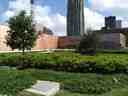
Look directly ahead and you will spot the arena by its massive, sweeping wall of reflective glass, anchored on the right by a towering block of reddish-brown brick that currently displays its original name. This is the Casey's Center, a one hundred seventeen million dollar structure born from a rather spectacular political gamble. Remember that massive Iowa Events Center project we just looked at? This arena is the crown jewel of that controversial two hundred seventeen million dollar package. Construction costs ballooned over the next four years, leaving many wondering if the local government had made a catastrophic error. They had not. In its very first year, this arena became the moneymaking engine of the entire complex. Why? Because fans simply ate and drank one point four million dollars more than anyone originally anticipated. Never underestimate the profitability of a captive, hungry audience. That local appetite is quite fitting. After twenty years as Wells Fargo Arena, the Iowa-based convenience store chain Casey's secured the naming rights for eighteen point three million dollars, ensuring their famously popular handmade pizza became a staple of the concession stands. If you look at how this arena sits within the city, you will notice it does not stand alone. It is plugged directly into the Skywalk System. Think of the Skywalk as a vital, physical web of enclosed pedestrian bridges suspended above the streets, connecting the arena to the rest of downtown. It links what would otherwise be completely isolated developments into a continuous, navigable grid. Inside, the arena has hosted an impressive variety of triumphs and disasters. In two thousand sixteen, hometown metal band Slipknot played a deeply emotional show here. Their frontman had just undergone unplanned spinal surgery, yet he powered through a frenetic seventeen-song set, telling the crowd that Iowa is a state of mind. That same year, Garth Brooks sold out six consecutive shows, leading over eighty eight thousand fans in an arena-wide singalong illuminated entirely by cell phone flashlights. But not every tenant has been so lucky. The arena is home to minor league sports, including American Hockey League teams, which play just one step below the NHL. In two thousand eight, a hockey team called the Iowa Chops moved in. Their tenure ended in a bizarre scandal after exactly one season. It turned out the team owners had secretly pledged the entire franchise as collateral for a nearly two million dollar bank loan. The league found out, suspended the team for violating bylaws, and eventually forced a sale to Texas. The building even served as an emergency refuge. In two thousand twenty, fierce winds from a derecho... a severe, straight-line windstorm... ripped the roof right off a local junior hockey arena, leaving the interior exposed to pouring rain. That team had to temporarily move their games here, with fans sitting in safely distanced pods. Sports here can be unpredictable. When the arena hosted a highly anticipated UFC fight in May two thousand twenty five, the main event ended abruptly in the second round when a fighter suffered a severe knee injury, resulting in a sudden technical knockout. We are going to head into that Skywalk system now. It will keep us completely separated from the traffic below and guide us to our next stop, a site of modern architectural drama at the five fifteen Walnut Tower, which is about a thirteen minute walk away.
Open eigen pagina →



Toon 9 stops meerToon minder stopsexpand_moreexpand_less
Look to your left at the towering nineteen-story structure of polished granite and brick, topped by a distinctive terra-cotta lantern tower. This is the Equitable Building. The…Meer lezenToon minder
Look to your left at the towering nineteen-story structure of polished granite and brick, topped by a distinctive terra-cotta lantern tower. This is the Equitable Building. The masterminds behind this nineteen-twenty-four marvel were Proudfoot, Bird and Rawson, a prominent duh moyn architectural firm that effectively drafted the city skyline. They designed this high-rise in the Gothic Revival style, borrowing the soaring vertical lines of medieval European cathedrals and applying them to a modern American office building. They even included a few inside jokes. If you look closely just above the second-story windows, you will see whimsical stone gnomes carved into the granite. These corbels, which are structural pieces of stone jutting from the wall to carry weight, appear to be groaning under the immense load of the upper stories. It adds a rather unexpected touch of medieval fantasy to an insurance company headquarters. For forty-nine years, this three-hundred-and-eighteen-foot giant was the tallest building in Iowa. When it opened, the completion was celebrated with a lavish rooftop party for eight hundred and fifty guests. An airplane flew over and dropped floral wreaths onto the crowd. The building's most iconic feature, that crowning four-story terra-cotta lantern at the top, was not just for show. It originally hid a massive, two-story steel water tank for fire protection. That is clever engineering wrapped in elegant architecture. For decades, this was the city's premier address. Iowans came here to buy wedding rings at Joseph's Jewelry or grab milkshakes at King's Pharmacy. One dentist worked in a corner office here for thirty-four years. He had a prime view of everything from downtown parades to severe floods. He once watched a car quite literally wash right down the street and into the building's basement, which flooded the lower levels and put him out of work for weeks. But buildings can hide toxic secrets. In two-thousand-and-five, a local developer named Bob Knapp bought the tower for five million dollars, aiming to convert the upper floors into apartments. What followed was a staggeringly reckless gamble. Knapp and his supervisor decided to completely gut thirteen floors of this historic building without inspecting for or safely removing the asbestos. Asbestos is a highly regulated, hazardous mineral used in old building materials that causes severe lung disease if the dust is inhaled. While the first six floors were fully occupied by businesses, demolition crews up above were pulverizing the toxic material. After state investigations, the truth came out. A federal judge sent Knapp to prison for forty-one months. Knapp's story ended mysteriously. In two-thousand-and-fourteen, just days after being paroled, he was found dead inside a stolen, burned-out car on a rural road. The bizarre circumstances remain completely unexplained. The disgraced tower went into foreclosure. In two-thousand-and-twelve, new developers swooped in and bought the whole behemoth in cash for just four hundred and sixty thousand dollars, a staggering drop from Knapp's purchase price. They poured thirty-eight million dollars into a proper, safe restoration, meticulously preserving the marble lobby while adding a rooftop deck. The historic structure survived its darkest chapter intact. Let us keep walking. Our next stop is another Proudfoot masterpiece that housed a totally different kind of battle, just a two-minute walk away at the Liberty Building.
Open eigen pagina →Look to your left and spot the rectangular, twelve-story tower featuring a solid limestone base, creamy yellow brick upper floors, and an ornate, overhanging roofline known as a…Meer lezenToon minder
Look to your left and spot the rectangular, twelve-story tower featuring a solid limestone base, creamy yellow brick upper floors, and an ornate, overhanging roofline known as a cornice. Completed in 1924 for one million dollars, which is roughly eighteen million today, the Liberty Building is a classic example of the Chicago School architectural style. This design philosophy emphasizes a distinct base, middle, and top, and yes, it is another imposing structure by the prolific architectural firm. It was originally built as the headquarters for Bankers Life Insurance, but the real action happened up on the twelfth floor. George koonz, the president of Bankers Life, was an avid long-distance radio fanatic. Back then, broadcasting was an expensive, untested frontier. Signals were incredibly faint, and the static was heavy. koonz noticed that when people managed to tune into distant, crackling broadcasts, they would constantly ask, who is it. Inspired, he secured the call letters W H O and launched a 500-watt station right from the top of this building in April 1924. The station was a genuinely quirky operation at first. Broadcasters would playfully identify themselves on air by announcing, this is W H O, who, Banker's Life, duh moyn, and they literally played the song Who from the musical Sunny as their daily theme. But koonz's vision quickly paid off. By 1927, the engineers had amplified their signal to 5,000 watts, and W H O became a crucial NBC network affiliate broadcasting from dawn until midnight. The station transformed into an absolute lifeline for rural Iowans who relied heavily on it for agriculture reports, weather updates, and entertainment. But the invisible airwaves were rapidly becoming a crowded, unregulated mess. In 1928, a newly created government agency called the Federal Radio Commission stepped in to police the chaos, sparking the W H O Radio frequency battle. The commission ordered W H O into a bitter, mandatory frequency-sharing arrangement with W O C, a station in Davenport owned by a chiropractic college. It was an absolute disaster of a broadcasting marriage. One week, W H O was allowed to broadcast during the day while Davenport took the night shift, and the next week, they were forced to completely swap schedules. Both stations fiercely protested having their broadcast hours suddenly slashed in half. The logistical nightmare of alternating a single frequency across the state created massive friction, eventually driving Bankers Life completely out of the radio business. They simply threw in the towel and sold W H O in 1930 to the Palmer family, the very people who owned the rival Davenport station. As an aside, you might hear local legends claiming that future U.S. President Ronald Reagan broadcasted his early sportscasts from this very roof. He did indeed work for W H O starting in 1934, but the station had already moved its studios to another building two years prior. Reagan never actually called a game from the Liberty Building, despite what the stubborn rumors insist. Following a massive modern renovation, the building now houses a hotel and condominiums, carefully preserving historic details like the original terrazzo floors, which are beautifully durable surfaces made of marble chips set in concrete and polished smooth. We have spent enough time focused on the high-stakes airwaves of the early twentieth century. Now, we are going to shift our focus from the invisible radio signals above us to the literal and spiritual foundations of the city. St. Ambrose Cathedral is just a two-minute walk away. Let us head over.
Open eigen pagina →On your left stands Saint Ambrose Cathedral, a massive Bedford limestone building defined by its deeply recessed arched entrance and a towering square bell tower capped by a green…Meer lezenToon minder
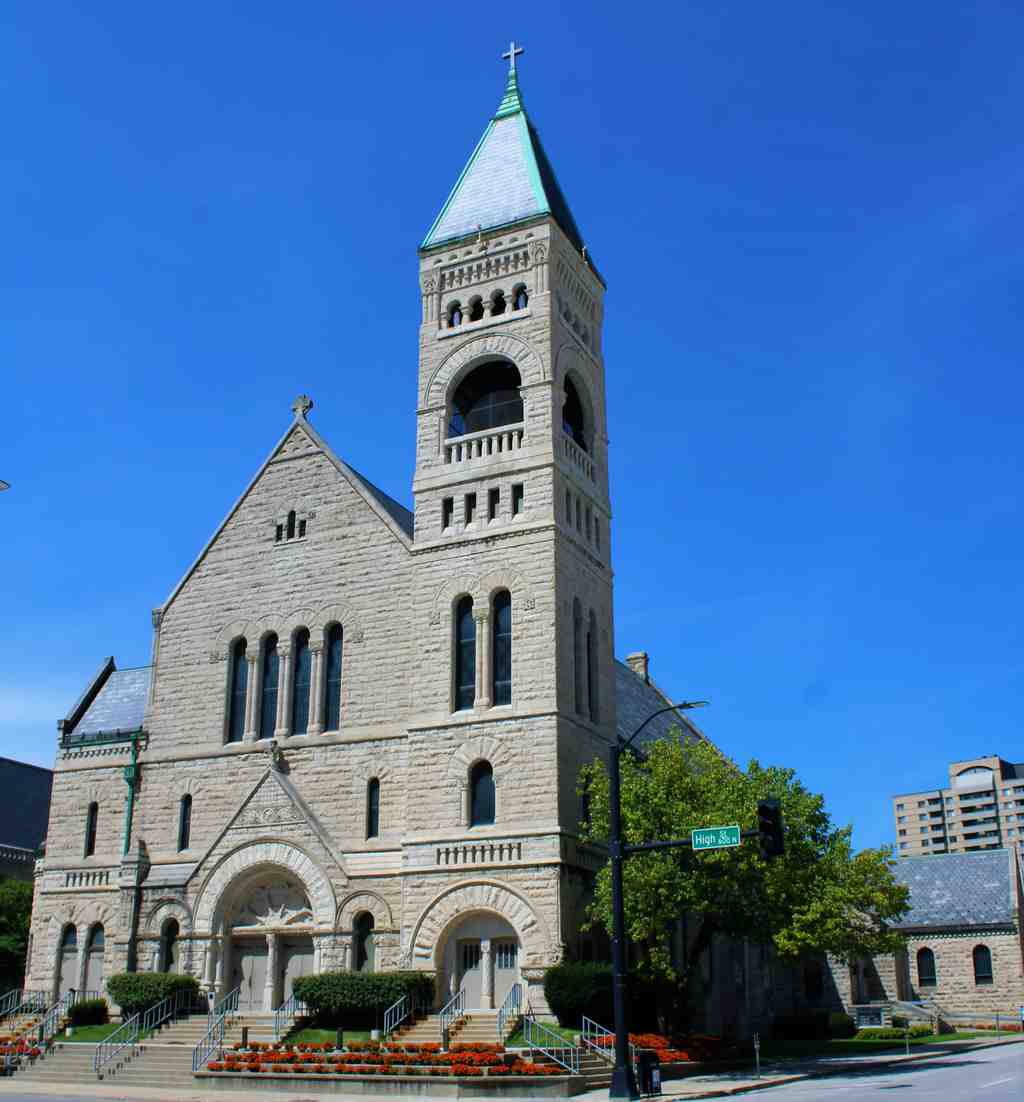
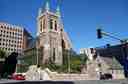
On your left stands Saint Ambrose Cathedral, a massive Bedford limestone building defined by its deeply recessed arched entrance and a towering square bell tower capped by a green pyramid shaped spire. Before this grand stone structure existed, the Catholic footprint in duh moyn was a bit more rustic. Back in eighteen fifty one, the very first Mass in the area was celebrated inside a humble log hut at the original Fort duh moyn. It was a rough military outpost where a traveling priest from uh-tum-wuh ministered to a handful of pioneers on the edge of the frontier. That small gathering laid the groundwork for a parish that would eventually anchor the entire city block. Everything changed a decade later with the arrival of Reverend John F Brazill, a frontier priest with a highly unusual and aggressive appetite for real estate. He bought up massive tracts of land in the rapidly expanding state capital, a bold financial gamble that ultimately secured this prominent location at Sixth and High Streets for the future diocese. Brazill cultivated serious political connections and operated more like a visionary developer than a traditional pastor. By the time of his death in eighteen eighty five, he had amassed real estate worth two hundred and fifty thousand dollars, which equals about eight million dollars today. His audacious land grabs provided the immense wealth needed to fund the parish's early expansion. With that war chest, the church hired Chicago architect James J Egan in eighteen ninety to design the cathedral before you. Egan chose the Romanesque Revival style, an architectural movement that mimics the heavy stone walls and rounded arches of medieval churches in southern France. The construction cost one hundred and twenty thousand dollars, roughly four million dollars today. The engineering inside is genuinely impressive. Egan designed the interior as a massive, unobstructed expanse. The ceiling is a barrel vault, essentially a continuous curved arch, rising fifty feet into the air without a single pillar to hold it up or block the view of the altar. Of course, maintaining a historic building rarely goes perfectly. In the nineteen seventies, the church underwent a renovation to modernize the interior. They installed a new cathedra, which is the official bishop's throne, but they set it against a stark, rectangular wooden backdrop. It clashed horribly with the graceful Romanesque arches, looking like a forced, awkward imposition of modern design. Thankfully, a restoration in two thousand twenty three removed the drab wood and integrated a new architectural design that actually matches the historical sanctuary. Beyond architecture, the parish has continuously adapted to the world around it. Following the fall of Saigon in nineteen seventy five, Iowa unexpectedly became a national leader in resettlement. The cathedral became a vital hub, welcoming waves of Vietnamese, Lao, and Hmong refugees. By two thousand and eight, a massive influx of refugees from Myanmar arrived. The Burmese community grew so rapidly that they divided into three distinct groups, allowing hundreds of parishioners to pray and celebrate Mass in their native languages. It is quite the trajectory for a congregation that started in a wooden shed. From aggressive pioneer land deals to an international sanctuary, this building represents a century and a half of quiet audacity. We are going to continue exploring the gambles of early religious history at our next stop. The Cathedral Church of Saint Paul is just a five minute walk away.
Open eigen pagina →Look to your left and you will spot the Cathedral Church of Saint Paul, a striking Gothic structure built from rough, broken-faced red granite, anchored by a prominent square…Meer lezenToon minder
Look to your left and you will spot the Cathedral Church of Saint Paul, a striking Gothic structure built from rough, broken-faced red granite, anchored by a prominent square tower topped with four sharp stone pinnacles. We just left St. Ambrose Cathedral a few minutes ago, and now we are standing before the last surviving religious outpost of what was once known as Piety Hill. In the late nineteenth century, this dense four-block section of downtown housed eight different congregations. When their bells rang simultaneously on Sunday mornings, the resulting wall of sound was absolutely deafening, drawing thousands of people to this tiny area. It was a heavily concentrated neighborhood that occasionally hosted surprising interfaith moments. In 1893, the famous Hindu monk Swami Vivekananda visited duh moyn, attended a prayer meeting right here on Piety Hill, and publicly praised the earnestness of the local ministers. But the story of St. Paul takes us back even further, to the gritty realities of 1854. Fort duh moyn had just been incorporated as a city, and its streets were little more than muddy wagon ruts. Starting a parish here took a serious leap of faith. In fact, early civic life was entirely makeshift. Because there were almost no finished buildings, the tiny original congregation of ten people had to hold their Sunday services in the old Polk County Courthouse. They shared this dusty public courtroom with several other denominations, operating on a ruthless, elbows-out, first-come, first-served basis. If your minister arrived late, your flock simply did not get to pray. It took over thirty years of scraping by before they could finally complete this permanent building in 1885. The architect, William Foster, designed it in the Gothic Revival style. But the church leadership committee, known as the vestry, took a massive financial risk. Instead of hiring a professional construction firm, they acted as their own general contractors to keep costs down, directly hiring the masons and carpenters themselves. It was a high-stakes logistical puzzle, but their gamble paid off. The exterior walls you are looking at are load-bearing masonry, constructed from red granite laid in random ashlar. That just means the stones are cut into distinct blocks but arranged in an irregular, staggered pattern rather than perfect continuous rows. If you look up at the tower, you are looking at the home of a massive twenty-five bell carillon, which is a musical instrument played via a keyboard, with a combined weight of over twelve thousand pounds. Inside, the cathedral guards an equally impressive artistic heritage. It holds what historians believe is the largest collection of its specific type of original nineteenth-century stained-glass windows anywhere in the United States. This sanctuary has also witnessed quiet but profound cultural shifts. In 1976, S. Suzanne Peterson was ordained here as a deacon, becoming the first woman ordained in the Episcopal Diocese of Iowa. She bravely pursued her calling during a time of intense theological friction, eventually moving to South Africa where she made history again as the first woman licensed to minister as a priest in that region. The stakes of building a city from scratch were incredibly high, and not every gamble ended in triumph. Let us walk about four minutes down the street to our next stop, First United Methodist Church, to visit the site where an early congregation faced devastating financial ruin, and see exactly what it took to survive.
Open eigen pagina →Look to your right and you will spot the First United Methodist Church, a massive symmetrical fortress of smooth Bedford stone fronted by towering columns and crowned with a…Meer lezenToon minder
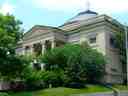
Look to your right and you will spot the First United Methodist Church, a massive symmetrical fortress of smooth Bedford stone fronted by towering columns and crowned with a prominent Roman glass and copper dome capped by a Latin cross. It looks like a building that has never missed a mortgage payment in its life. But the polished exterior hides a much scrappier history. This congregation actually started back in 1845, meeting in a humble log structure called the Rathburn Cabin. The founders had slyly slipped across the Raccoon River to snatch up the two best cabins on the north bank. It was in this harsh frontier setting that Reverend Ezra Rathburn delivered the very first sermon ever heard in duh moyn, preaching at the funeral of a young child of the second-in-command at the nearby Fort. By 1848, they managed to build their first actual church on Fifth Street. duh moyn was basically just dirt roads and ambition back then, lacking any proper civic spaces. So, echoing the makeshift civic life we saw with other buildings earlier on the tour, this early church had to multitask. It doubled as a public hall, a general utility auditorium, and even a courtroom. Flush with growth, they gambled on a much larger brick structure in 1856. Unfortunately, their timing was terrible. They were hit by a devastating financial blow in 1860 caused by mounting, unmanageable debt. The crisis was so severe they actually lost ownership of their own brand new building. Imagine the indignity... they were forced to rent back just the basement for three years to hold their services, while their beautiful main sanctuary upstairs was rented out as a public hall for concerts and lectures to pay off their creditors. At a regional conference, church leaders formally resolved to sympathize with their desperate duh moyn brethren, and authorized their pastor to travel abroad just to beg for funds. At the time, that poor pastor was surviving on a meager salary of 500 dollars a year... which is roughly 18,000 dollars today. It was a harsh lesson in frontier economics. But they stubbornly survived, merged with another congregation, and eventually hired Proudfoot and Bird to design this present Neoclassical masterpiece in 1905. That is why you see that massive pedimented portico... the triangular roof section over the entrance, supported by those tall, scroll-topped Ionic columns. The architects actually matched the building proportions to the famous Pantheon in Rome. Of course, old financial habits die hard. The estimated construction cost was 175,000 dollars... over 6 million dollars today. To avoid another catastrophic debt, they simply stripped away some of the planned decorative details to keep the budget strictly out of the red. That cautious pragmatism paid off. Interestingly, back in 1866, this church's basement actually housed duh moyn' very first public library, starting with just 2,300 books. From those makeshift basement shelves, the city's literary culture grew into something spectacular. Let us go see what that legacy looks like today. We are heading to the modern duh moyn Public Library next, which is about a seven minute walk from here.
Open eigen pagina →As you stand here near the back exterior, look to your right at the sprawling, flat profiled structure entirely wrapped in massive, copper tinted glass panels. We just walked…Meer lezenToon minder
As you stand here near the back exterior, look to your right at the sprawling, flat profiled structure entirely wrapped in massive, copper tinted glass panels. We just walked from the First United Methodist Church, which is fitting, because this entire library system actually began in 1866 in the basement of a Methodist church. It is safe to say the city has come a remarkably long way from the muddy log huts of Fort duh moyn, evolving into a place that builds architectural marvels to house over half a million items. This Central Library building, completed in 2006, is a masterclass in clever problem solving. The architect, David Chipperfield, wanted a library bathed in natural light, which is famously the absolute worst thing you can do to books. To prevent the collection from bleaching in the sun, Chipperfield utilized a groundbreaking material called Okalux glass. The exterior is made of 355 glass panels, each weighing a staggering 1,400 pounds. Sandwiched inside the panes is a layer of expanded copper mesh. It took a frankly ridiculous global relay race to make these panels. They were designed in Germany, extruded in China, anodized in Minnesota, and finally assembled right here. The mesh blocks 87 percent of ultraviolet rays, protecting the books while letting people see out into the park. Look up toward the roofline. There is a hidden environmental trick up there. The entire building is covered in a sedum roof, which is a living layer of hardy, drought resistant plants. It insulates the building and retains more than 187,000 gallons of rainwater runoff. The library has always been a place where people took bold stands. Back in 1938, library director Forrest Spaulding watched totalitarian regimes burning books in Europe and domestic groups banning works like The Grapes of Wrath. Spaulding drafted the Library Bill of Rights right here in duh moyn, turning the library into a fortress against censorship. His policy was so bulletproof that the American Library Association adopted it nationwide the very next year. There was another massive fight in the 1950s over the old library building, which the city originally bought the land for in 1898 for 35,000 dollars, roughly 1.3 million dollars today. Inside the old building, artist Harry Donald Jones had painted a massive fresco, a technique of painting directly into wet plaster, mapping the social history of duh moyn. The artwork was a New Deal project that favored workers and highlighted historical injustices. During the conservative 1950s, the library board voted to paint over the entire thing. The mural was only saved at the absolute last second because prominent local philanthropists, including a feminist named Louise Rosenfield Noun, caused a massive uproar and forced the board to back down. Today, this institution is the ultimate cultural anchor. That is best seen in the AViD Literary Program, which stands for Authors Visiting in duh moyn. Started in 2001, the AViD program brings world famous, best selling authors to the city to share their stories with the community, serving as a brilliant symbol of the city's modern cultural elevation. It is a perfect capstone of downtown's revitalization. Now, let us head toward our next stop, the Pappajohn Sculpture Park, which is about a seven minute walk away.
Open eigen pagina →On your left, you will see a sprawling, four point four acre green space anchored by massive steel and bronze sculptures, including a towering, twenty seven foot hollow human…Meer lezenToon minder
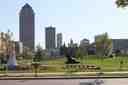
On your left, you will see a sprawling, four point four acre green space anchored by massive steel and bronze sculptures, including a towering, twenty seven foot hollow human figure made entirely of white painted steel letters. This is the John and Mary Pappajohn Sculpture Park. The story behind this place is one of the most remarkable transformations in the city. John Pappajohn was a Greek immigrant who grew up during the Great Depression. He started working at age five in his family's grocery store for just ten cents a day, which is about two dollars in today's money. From those origins, he became a highly successful venture capitalist, someone who provides funding to help new, unproven businesses get off the ground. He and his wife Mary built an extraordinary life, eventually gifting twenty four sculptures, valued at about forty million dollars, to the city of duh moyn. Their entry into the elite art world started quite small. They bought their first painting in nineteen sixty one for one hundred dollars, which is roughly a thousand dollars today. But decades later, their private yard was absolutely overflowing with monumental sculptures. People used to drive slowly past their house just to gawk, as if it were a roadside attraction. Eventually, Mary noted that keeping these massive artworks entirely to themselves was a slightly selfish thing to do. They needed a bigger gallery. Now, let us look at the history of the land you are standing by. In the early two thousands, the west end of downtown duh moyn was dilapidated. It was a bleak five block stretch of worn out buildings, seedy businesses, and auto repair shops. The city spent years bulldozing the derelict structures to create a massive green space called Western Gateway Park. John Pappajohn drove past the fresh dirt, saw the empty grass, and realized it was the perfect canvas for their collection. The timing was incredible. The park opened in two thousand nine, offering a beautiful, optimistic counterpoint to the gloomy Great Recession. It completely transformed the real estate value of the neighborhood. It is a stunning example of private ambition and private wealth being leveraged for undeniable public good. By replacing urban decay with world class art, this project redefined preservation and progress. The landscape architects who designed the park created grassy mounds with parabolic cutaways, which are essentially curved, bowl like depressions in the earth. These cutouts act as natural, walled in rooms to group the sculptures. One piece you cannot miss is Louise Bourgeois's bronze Spider. John purchased it for four hundred thousand dollars, a massive bargain considering similar spiders by Bourgeois later fetched tens of millions at auction. Despite looking like a terrifying monster from a science fiction film, the colossal arachnid is actually a loving tribute to the artist's mother. Her mother managed a tapestry restoration workshop, so Bourgeois viewed spiders simply as clever, friendly, and protective weavers. And that giant man made of white letters I mentioned earlier? That is Nomade by Spanish sculptor Jaume Plensa. You can actually walk inside the hollow body. The letters do not form meaningful words, but rather express the symbolic essence of language. We are now going to head to our final stop to see a triumphant example of neighborhood preservation. Let us make our way to muh-ril-oh Flats, which is about an eight minute walk away.
Open eigen pagina →On your right sits muh-ril-oh Flats, a rectangular three story red brick apartment building distinguished by its projecting bay windows on the upper floors. We just left the…Meer lezenToon minder
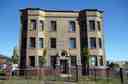
On your right sits muh-ril-oh Flats, a rectangular three story red brick apartment building distinguished by its projecting bay windows on the upper floors. We just left the manicured lawns of the sculpture park a few blocks behind us, and now we are staring at a 705 ton brick monument to pure stubbornness. This building embodies the ultimate clash between preservation and the march of corporate progress. Built in 1903 by James McNamara, it was briefly called McNamara Flats. But McNamara possessed a flair for marketing. Following a highly successful local art exhibit featuring Bartolome Esteban muh-ril-oh, a celebrated 17th century Spanish painter, he renamed it muh-ril-oh Flats. It was a clever tactic, linking the emerging concept of apartment living with the prestige of high culture. Fast forward to September 2007. Wellmark Blue Cross and Blue Shield announced plans to build a massive new headquarters downtown, swallowing up six and a half acres. muh-ril-oh Flats, along with a neighboring 1880 row house, sat right in the crosshairs. Wellmark offered a ruthless deal. They would give the buildings away for free, provided someone moved them off the lot by March 1, 2008. Otherwise, the wrecking ball was coming. Enter the Sherman Hill Neighborhood Association. They organized a frantic, highly coordinated campaign to save these structures from demolition. Phil Kaser, a local investor, agreed to finance the rescue. They hired Mike Kinter as the general contractor, the lead manager who oversees the entire construction project, to orchestrate the logistics. He brought in Patterson Structural Movers to tackle the muh-ril-oh. Preparing a brick apartment building for a road trip took 17 days. Crews severed the building from its foundation using massive water lubricated chainsaws. They jacked up the entire structure using hydraulics and lowered it onto dollies, which are low, heavy duty wheeled platforms. But these were not ordinary dollies. They featured 192 individually powered wheels that could pivot 90 degrees, allowing the building to slide in different directions without turning the entire massive structure. A beautiful piece of engineering. Moving day was Saturday, March 1. The absolute final deadline. City officials demanded the move happen during daylight to protect sewer pipes from the crushing weight. They started at dawn. Naturally, the ground was a nightmare. On that day, a notoriously wet storm combined with melting snow to create deep mud, trapping those 192 high tech wheels. Instead of a smooth roll, it became a grueling tug of war. They had to call in two heavy duty tow trucks just to drag the flats onto High Street, turning a one hour stroll into a tense four hour ordeal. But they made it, parking it safely next to its newly dug foundation. National TV crews even filmed the whole saga. Kaser pragmatically planned to rent the units for exactly five years to monitor the real estate market, potentially selling them as condominiums later. This building is a survivor. As our tour comes to an end, I hope you take away exactly what this city is made of. duh moyn is a place defined by people willing to drag a 705 ton brick building through the mud just to prove a point. From skyscrapers built on sheer optimism to neighborhood associations staring down corporate bulldozers, that fighting spirit is permanently poured into the foundations here. Thanks for walking with me today.
Open eigen pagina →
Veelgestelde vragen
Hoe begin ik de tour?
Download na aankoop de AudaTours-app en voer je inwisselcode in. De tour is direct klaar om te starten – tik gewoon op afspelen en volg de GPS-geleide route.
Heb ik internet nodig tijdens de tour?
Nee! Download de tour voordat je begint en geniet er volledig offline van. Alleen de chatfunctie vereist internet. We raden aan om te downloaden via wifi om mobiele data te besparen.
Is dit een groepsrondleiding met gids?
Nee - dit is een audiotour met eigen gids. Je verkent zelfstandig op je eigen tempo, met audiovertelling via je telefoon. Geen tourguide, geen groep, geen schema.
Hoe lang duurt de tour?
De meeste tours duren 60-90 minuten, maar jij bepaalt het tempo volledig. Pauzeer, sla stops over of neem pauzes wanneer je wilt.
Wat als ik de tour vandaag niet kan afmaken?
Geen probleem! Tours hebben levenslange toegang. Pauzeer en hervat wanneer je wilt – morgen, volgende week of volgend jaar. Je voortgang wordt opgeslagen.
Welke talen zijn beschikbaar?
Alle tours zijn beschikbaar in meer dan 50 talen. Selecteer je voorkeurstaal bij het inwisselen van je code. Let op: de taal kan niet worden gewijzigd na het genereren van de tour.
Waar vind ik de tour na aankoop?
Download de gratis AudaTours-app uit de App Store of Google Play. Voer je inwisselcode in (verzonden per e-mail) en de tour verschijnt in je bibliotheek, klaar om te downloaden en te starten.
Als je niet tevreden bent met de tour, betalen we je aankoop terug. Neem contact met ons op via [email protected]
Veilig afrekenen met 


