AudaTours logoAudaTours

Sheffield Audio Tour: Crucible and Hull

Audiogids14 stops

Sheffield's cutlery and steel walked the world, and behind every Old Sheffield Plate teapot and stainless dinner knife stood a courtyard yard, a wet grindstone, a smoke-stained chapel and a thousand independent craftsmen the city called Little Mesters. This self-guided audio tour traces a Sheffield working day through the centre of the city, from a town hall whose facade carries the carved trades and whose Roman god of the forge still tops the spire, through the cutlers' company chartered in 1624, the radical newspaper editor jailed in 1795 for what he printed, the cobbled square where John Wesley met his largest weekday congregation and the Chartists were dispersed by troops, past the open ground where crucible-steel furnaces still lie beneath the dirt, to the Cultural Industries Quarter where eighteen separate little-mester trades worked one yard, and finally to Leah's Yard itself, the only city-centre courtyard restored as a living monument to the people who actually made Sheffield's name. Walk slowly. The buildings still hold their shape, and the trades still hold their names.

Tourvoorbeeld

map

Over deze tour

  • schedule
    Duur 40–60 minsGa op je eigen tempo
  • straighten
    4.7 km wandelrouteVolg het geleide pad
  • location_on
  • wifi_off
    Werkt offlineEén keer downloaden, overal gebruiken
  • all_inclusive
    Levenslange toegangOp elk moment opnieuw afspelen, voor altijd
  • location_on
    Start bij Sheffield Town Hall

Stops op deze tour
  1. This pale sandstone façade rises in a long Renaissance block, with a tall clock tower and a bronze Vulcan poised high on the spire above. Here, on Pinstone Street, Sheffield…Meer lezenToon minder

    This pale sandstone façade rises in a long Renaissance block, with a tall clock tower and a bronze Vulcan poised high on the spire above.

    Here, on Pinstone Street, Sheffield introduces itself in stone. E. W. Mountford designed this Town Hall in the Renaissance Revival style, and Queen Victoria opened it on the twenty-first of May, eighteen ninety-seven by remote control from her carriage... which is a wonderfully imperial way of attending without actually going in. Look up at the friezes by F. W. Pomeroy over the entrance: they show the city’s real working cast, “electroplaters, buffer girls, ivory turners and cutlers,” led by the goddess of light and knowledge.

    This is Sheffield, the steel and cutlery city. The earliest recorded Sheffield cutler, Robertus le Coteler, appears in twelve ninety-seven, and by the seventeenth century Parliament gave the Company of Cutlers in Hallamshire a charter to regulate the trade. Every knife passed through a chain of hands: the forger shaped the blade, the grinder gave it an edge on a wet sandstone wheel, the hafter fixed the handle, the buffer polished it, and the cutler, strictly speaking, put it all together.

    If you glance at your screen, Vulcan is clearer there... Mario Raggi’s bronze god of the forge stands on the sixty-four-metre tower with hammer, anvil, and three arrows, Sheffield’s metal life made literal.

    And beside the Town Hall, in Peace Gardens, the eight Holberry Cascades remember Chartist Samuel Holberry, who planned the failed eighteen forty rising, was jailed, sent to York Castle, and died of consumption at twenty-seven. Tens of thousands of Sheffielders followed his coffin.

    Peace Gardens with the Town Hall behind, linking the civic building to the nearby public space where the Holberry Cascades commemorate the Chartist leader Samuel Holberry.
    Peace Gardens with the Town Hall behind, linking the civic building to the nearby public space where the Holberry Cascades commemorate the Chartist leader Samuel Holberry.Photo: Chemical Engineer, Wikimedia Commons, Public domain. Cropped & resized.

    Cross over and walk up toward the cathedral; next stop, Upper Chapel, the polite face of the trade. If you want to go inside later, check the current opening hours online.

    A sweeping view of the Town Hall and Peace Gardens together, showing how the civic building anchors the heart of Sheffield’s city centre.
    A sweeping view of the Town Hall and Peace Gardens together, showing how the civic building anchors the heart of Sheffield’s city centre.Photo: Adam lebaigue, Wikimedia Commons, CC BY-SA 4.0. Cropped & resized.
    A recent full-height view of the Town Hall, useful for showing the 64-metre clock tower crowned by Vulcan.
    A recent full-height view of the Town Hall, useful for showing the 64-metre clock tower crowned by Vulcan.Photo: Acediscovery, Wikimedia Commons, CC BY-SA 4.0. Cropped & resized.
    The water fountain beside the Town Hall, a good detail view for the Peace Gardens setting and the landscape around the civic centre.
    The water fountain beside the Town Hall, a good detail view for the Peace Gardens setting and the landscape around the civic centre.Photo: Florin Huluba, Wikimedia Commons, CC BY-SA 4.0. Cropped & resized.
    Open eigen pagina →
  2. Look for a plain red-brick chapel with a simple classical front, a triangular gable, and a small forecourt marked by bronze sculptures. Step into that little forecourt if you…Meer lezenToon minder
    Upper Chapel
    Upper ChapelPhoto: Warofdreams, Wikimedia Commons, CC BY-SA 3.0. Cropped & resized.

    Look for a plain red-brick chapel with a simple classical front, a triangular gable, and a small forecourt marked by bronze sculptures.

    Step into that little forecourt if you can... it tells you a lot about this place. Upper Chapel looks restrained, almost politely quiet, but its roots are anything but timid. This congregation began with James Fisher, the vicar of Sheffield Parish Church, now the cathedral. On the twenty-fourth of August, sixteen sixty-two, the state told ministers to sign the Act of Uniformity, a law forcing worship to follow Church of England rules. Fisher refused, was thrown out in the Great Ejection, and many of his parishioners went with him. That is one way to found a movement... by declining to fill in the paperwork.

    The people who followed him were called Dissenters, or nonconformists, meaning Christians who would not conform to the established church. By the sixteen nineties, the strongest group here gathered around Timothy Jollie, and in seventeen hundred his congregation raised this chapel, first called the New Chapel. It became Sheffield’s first purpose-built nonconformist place of worship. If you look at the picture in the app, you can get a sense of how the later front wraps around something older: the brick side walls from seventeen hundred still survive inside the present building line.

    What you see from Norfolk Street is largely the chapel’s nineteenth-century reset. In the eighteen forties, people turned the building around to face this way, raised the roof, and rebuilt the interior with a gallery, a kind of upper seating level. John Frith finished that work in eighteen forty-eight. By then, the congregation had serious weight. Early on, around one thousand people worshipped here, roughly one sixth of Sheffield. For a town this size, that is not a fringe gathering. That is an alternative civic engine.

    And that spirit spilled beyond worship. The Shore family, founder members and pew-holders here, helped give this chapel its reforming backbone. Samuel Shore supported abolition, helped set up branches of the Society for the Abolition of Slavery, and through this chapel met William Smith of Clapham. In seventeen seventy-nine, they formed a committee to fight the Test Act, which barred people outside the established church from public life. So this was not just where Sheffield’s reforming merchants prayed. It is where dissent in Sheffield learned to organize itself.

    Even the forecourt keeps that human scale. George Fullard’s bronzes stand here: Mother and Child, Running Woman, and Angry Woman, all given by his widow Irene in nineteen eighty-five. They make this little space feel less like a threshold and more like a pause in the city.

    Walk up Norfolk Street and across - Carver Street is two minutes away, and that’s where Methodism met the cutlery quarter head-on. We will swing toward Castlegate next, and if you want to return later, the chapel is generally open from half past eight until five every day.

    Open eigen pagina →
  3. On your right is Castlegate... and few places in Sheffield show the city’s layers quite so bluntly. Thomas de Furnival got a charter from King Henry the Third in twelve seventy to…Meer lezenToon minder

    On your right is Castlegate... and few places in Sheffield show the city’s layers quite so bluntly. Thomas de Furnival got a charter from King Henry the Third in twelve seventy to build a castle here. Parliament ordered that castle slighted in sixteen forty-nine, meaning they deliberately smashed its defenses so nobody could use it for war again. Fairly final, you’d think. Sheffield disagreed. By the twelve nineties, cutlers were already working nearby along the Don. The earliest named one we know is Robertus le Coteler in twelve ninety-seven, which is a lovely way of saying Sheffield had a knife-and-blade reputation before most places had worked out the branding. Then this ground changed jobs again. Norfolk Market Hall opened here in eighteen fifty-one and traded until nineteen fifty-nine. Castle Market replaced it, built between nineteen sixty and nineteen sixty-five, and demolition began in twenty fifteen. Markets, castles, rubble, reinvention... that is Castlegate’s favorite habit. But the real jolt came in August twenty eighteen, when Wessex Archaeology and University of Sheffield students dug into the cleared site. They found a nineteenth-century crucible-steel furnace cellar: rows of brick bays and the ash pits beneath the furnace, marked on an eighteen fifties map. Wessex described the cellar as a hot, unpleasant place, with furnaces above reaching around twelve hundred degrees centigrade. Ash dropped into those pits, where a worker, perhaps a young boy, hauled it out in back-breaking labor. This matters because Huntsman’s crucible steel made Sheffield famous. In seventeen forty-two, Benjamin Huntsman, a clockmaker in Handsworth, melted about thirty-four pounds of blister steel in small clay pots, added flux, covered them, and heated them on coke fires for about three hours. The result was cleaner, more uniform steel... ideal for the best blades. Look toward Waingate for the old Town Hall, Charles Watson’s courthouse from eighteen oh-seven to eighteen oh-eight, where local criminal courts sat until nineteen ninety-five. Across the street, Castle House from nineteen sixty-four stands for the Co-op movement, after its earlier grand store was destroyed in the Sheffield Blitz. Now walk through toward Paradise Square - Sheffield’s great open-air dissenting and Chartist meeting ground is waiting, where John Wesley preached to the largest weekday congregation he had ever seen.

    Open eigen pagina →
Toon 11 stops meerToon minder stopsexpand_moreexpand_less
  1. On your right, Paradise Square is a sloping Georgian set piece of red brick terraces with neat sash windows, pale stone doorcases, and an open paved square held in the middle like…Meer lezenToon minder

    On your right, Paradise Square is a sloping Georgian set piece of red brick terraces with neat sash windows, pale stone doorcases, and an open paved square held in the middle like a shallow bowl.

    Stand here a moment and it feels surprisingly domestic... not grand in a chest-thumping way, more confident, tidy, and faintly self-satisfied, as good Georgian architecture often is. But this little square has done far more than sit prettily on a hill. Nicholas Broadbent, a merchant, laid out the east side in seventeen thirty-six on land leased from the trustees of Shrewsbury Hospital. Then his banker grandson, Thomas Broadbent, completed the other three sides between the seventeen seventies and the seventeen nineties. Before any of that, this was Hicks' stile-field, a former cornfield named for a stile, a step-over entrance into the churchyard. So the place began not as a polished square at all, but as an edge-space... rougher, more useful, easier to gather in.

    If you glance at the image on your screen, you can see that original east side still carrying itself with quiet authority. Every building around you is Grade Two star listed, which means the whole square is officially recognized as especially important. Not bad for what began as a field by a stile.

    Now, number eighteen mattered more than its brick front suggests. It held a Masonic Hall upstairs, reached by a broad staircase and a balcony. That balcony turned into a rostrum, in plain English a speaking platform, and for a long while it became Sheffield's favorite outdoor stage for public argument. Politicians used it, preachers used it, and Sheffield crowds, never famous for silent agreement, turned up in force.

    On the fifteenth of July, seventeen seventy-nine, John Wesley preached here and later wrote in his journal that he had addressed "the largest congregation I ever saw on a weekday." That is a lovely Wesley line because it sounds half amazed, half slightly overbooked. The same dissenting habit that helped build places like Upper Chapel also filled this square: ordinary working people making time, in the middle of the week, to hear ideas that challenged the usual order.

    And sixty years later, those ideas had shifted from salvation to representation. On the twelfth of September, eighteen thirty-nine, the Chartists held what witnesses called a silent meeting here. Troops broke it up, and the crowd scattered into a running battle through the streets. A Sheffield contemporary recorded that the Chartists regrouped in Doctor's Field at the bottom of Duke Street, where soldiers and police followed and took thirty-six prisoners. Same square, same habit of dissent. Wesley came to organize souls; the Chartists came to win working men the vote.

    Take a look at the wider view on your phone and notice how livable it still feels, with brick fronts that still read as houses rather than monuments. You can walk straight through it, and that matters. The place never quite stopped being part of daily life.

    One last resident to keep in mind: in eighteen oh two, Sir Francis Chantrey had a studio at number twenty-four. He was a carpenter's son from Norton, working here among Sheffield's merchants and doctors... a useful reminder that talent has a habit of turning up where the address books least expect it.

    Head down Campo Lane and on toward Castle Square - there is something quite remarkable under the dirt over there. On the way, we’ll also draw near Sheffield Cathedral.

    Open eigen pagina →
  2. Look for the long pale-stone church, the pointed Gothic windows, and the square lantern tower rising above the roofline. Right here in the precincts stands James Montgomery, and…Meer lezenToon minder

    Look for the long pale-stone church, the pointed Gothic windows, and the square lantern tower rising above the roofline.

    Right here in the precincts stands James Montgomery, and he is exactly the sort of man Sheffield likes to keep close: a working printer, a stubborn journalist, and a poet who managed to annoy authority for a living. In seventeen ninety-four, he took over William Gales's newspaper, renamed it the Sheffield Iris, and edited it for the next thirty-one years. Twice the government jailed him for sedition - that is, for printing words the authorities thought might stir political trouble. The first time, in seventeen ninety-five, he printed a poem celebrating the fall of the Bastille in France. The second, in seventeen ninety-six, he criticized a magistrate for breaking up a political protest in Sheffield. Journalism... with consequences.

    And yet he came back, carried on editing, wrote hymns sung across England, and campaigned to abolish slavery and to stop the use of child chimney sweeps. His bronze statue, designed by John Bell in eighteen sixty-one, first stood over his grave in Sheffield General Cemetery. In nineteen seventy-one, the city moved it here, which feels appropriate. Montgomery belongs in the middle of public argument.

    He also belongs to Sheffield's dissenting and reform tradition. By "dissenting," people meant Protestants outside the established Church of England. In sixteen sixty-two, James Fisher got ejected from the parish church and founded Upper Chapel. On the fifteenth of July, seventeen seventy-nine, John Wesley preached in Paradise Square, and in eighteen oh five Carver Street Methodist Chapel opened with room for eleven hundred people. Those chapels taught Sheffield's cutlers to read, to organize, and, eventually, to vote.

    Now turn your attention to the cathedral itself. Before it became a cathedral, this was Sheffield's parish church, and it kept that role for centuries. When the Diocese of Sheffield was created on the twenty-third of January, nineteen fourteen, the church got promoted. Same building, larger job description. Parts of it reach back to around twelve hundred, while the expanded west end arrived in nineteen sixty-six, so the whole place is a slightly awkward but rather handsome conversation between medieval stonework and modern ambition. If you glance at the image on your screen, you can see how different the old parish church looked in eighteen nineteen, before later rebuilding changed its shape.

    Inside, the Chapel of Saint George keeps one of the cathedral's most Sheffield objects: a screen made from swords and bayonets, presented by the York and Lancaster Regiment after it was disbanded. Steel, in this city, rarely stays quiet for long. Take a look at that image if you like; it is church furniture by way of the workshop and the drill yard.

    When you're ready, walk round the cathedral and head up Campo Lane into Paradise Square; the square behind it is where Sheffield's working life met John Wesley and the Chartists, and from there Cutlers' Hall is only about a minute away. If you want to come back inside later, check the current opening hours before you go.

    The lantern tower rising above the cathedral roof, one of the building’s later additions that helped bring light into the church.
    The lantern tower rising above the cathedral roof, one of the building’s later additions that helped bring light into the church.Photo: Crep171166, Wikimedia Commons, CC BY-SA 4.0. Cropped & resized.
    Open eigen pagina →
  3. On your right stands a pale stone hall with a temple-like front, tall Corinthian columns, a broad triangular pediment, and heavy steel entrance doors below. This is where…Meer lezenToon minder
    Cutlers' Hall
    Cutlers' HallPhoto: Chemical Engineer, Wikimedia Commons, CC BY-SA 4.0. Cropped & resized.

    On your right stands a pale stone hall with a temple-like front, tall Corinthian columns, a broad triangular pediment, and heavy steel entrance doors below.

    This is where Sheffield’s metal trade put on its best coat. The Company of Cutlers in Hallamshire got its charter by Act of Parliament in sixteen twenty-four, and the law handed it authority over everyone making knives, blades, scissors, shears, sickles, and other iron and steel wares within Hallamshire - the old name for the Sheffield area - and within six miles of it. Each year the company elected a Master Cutler, the polite peak of the trade, quite distinct from the workshop-floor Little Mesters it claimed to regulate.

    This is the third hall on this exact site. The first went up in sixteen thirty-eight, a second followed in seventeen twenty-five, and then Samuel Worth and Benjamin Broomhead Taylor raised this one in eighteen thirty-two and eighteen thirty-three. Since sixteen twenty-five, the Cutlers’ Feast has met every year - one of England’s oldest continuous civic dinners.

    Sheffield never dealt only in knives. Around seventeen forty-three, Thomas Boulsover created Old Sheffield Plate, silver fused to copper; from the eighteen forties, electroplated nickel silver took over. In seventeen seventy-three, the cutlers joined Matthew Boulton of Birmingham to win the right to assay silver - to test and hallmark it officially. Sheffield took the crown; Birmingham got the anchor. If you fancy a detail the street won’t give you, have a look at the steel door on your screen.

    The Hall’s steel entrance door, a fitting detail for the Sheffield cutlery trade that helped shape the Company’s history.
    The Hall’s steel entrance door, a fitting detail for the Sheffield cutlery trade that helped shape the Company’s history.Photo: NotFromUtrecht, Wikimedia Commons, CC BY-SA 3.0. Cropped & resized.

    Across Church Street, the parish church stands under the cutlers’ eye. Cross the road; James Montgomery is waiting in the cathedral churchyard... then Tudor Square is about a six-minute walk away. If you plan to come back, check the current opening times before you go.

    Front view of Cutlers’ Hall on Church Street, the long-standing headquarters of the Company of Cutlers in Hallamshire.
    Front view of Cutlers’ Hall on Church Street, the long-standing headquarters of the Company of Cutlers in Hallamshire.Photo: BulldozerD11, Wikimedia Commons, CC BY-SA 3.0. Cropped & resized.
    A later exterior view of Cutlers’ Hall, the Grade II* listed building that hosts the annual Cutlers’ Feast.
    A later exterior view of Cutlers’ Hall, the Grade II* listed building that hosts the annual Cutlers’ Feast.Photo: Chemical Engineer, Wikimedia Commons, CC BY-SA 4.0. Cropped & resized.
    Open eigen pagina →
  4. On your right, Tudor Square opens as a broad stone-paved plaza, framed by the curved concrete-and-glass face of the Crucible and the ornate cream-stone frontage of the Lyceum.…Meer lezenToon minder
    Tudor Square
    Tudor SquarePhoto: BCDS, Wikimedia Commons, CC BY-SA 4.0. Cropped & resized.

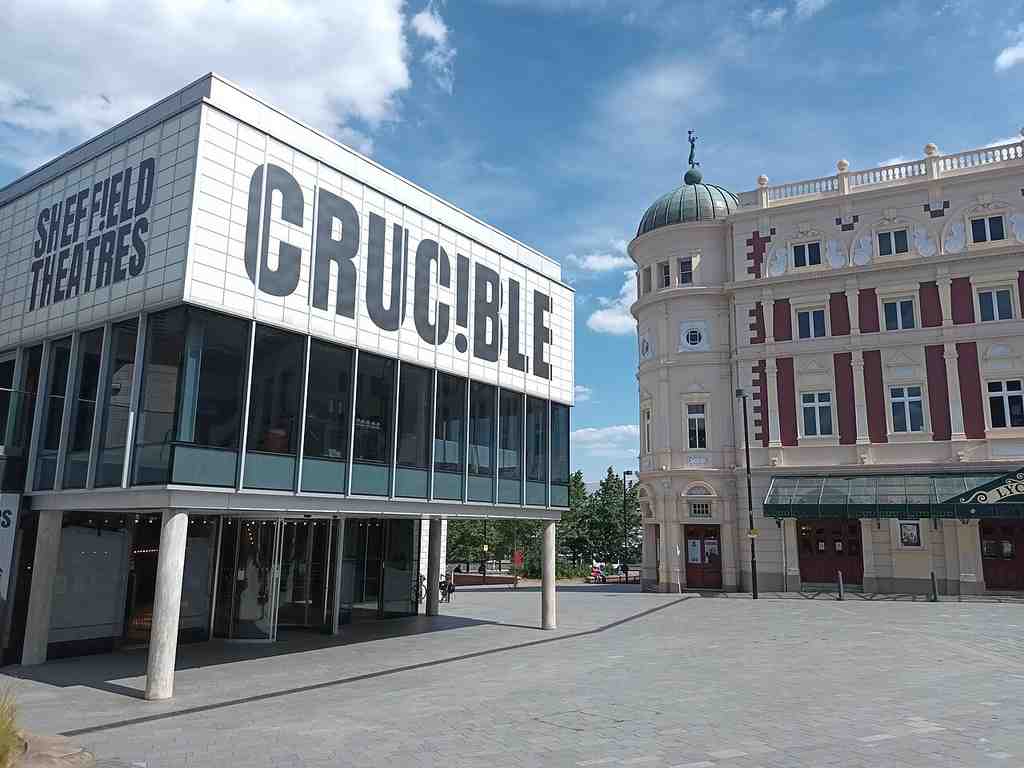
    On your right, Tudor Square opens as a broad stone-paved plaza, framed by the curved concrete-and-glass face of the Crucible and the ornate cream-stone frontage of the Lyceum.

    This is Sheffield’s Theatre Land: one of the biggest concentrations of theatres outside London, with the Lyceum here, the Crucible opposite, and more stages tucked along Surrey Street. If you want the full picture, take a quick look at the app image showing both main theatres facing the square.

    The Lyceum on your left carries the confidence of eighteen ninety-seven, the same year Sheffield opened the Town Hall. Architect W. G. R. Sprague designed it, and this is his only surviving theatre outside London. That is no small thing. Sprague shaped theatre design in the late Victorian years, and the Lyceum still preserves one of the few intact examples of his style beyond the West End.

    Across the square, the Crucible speaks a different language: nineteen seventy-one, sharper lines, less ornament, more steel-city plain speaking. And the name was deliberate. A crucible is a clay pot used in a furnace. In the eighteen hundreds? No, earlier than that: Benjamin Huntsman developed the process in the seventeen forties, heating blister steel in covered clay pots over coke fires for hours until it turned into cast steel. Each pot held about thirty-four pounds. A working city looked at its proud new theatre and named it after workshop kit. Honestly, that feels very Sheffield.

    That name also reaches back to Castlegate, where those underground cellars hinted at the gritty, physical trade beneath the city’s streets. Here, the same industrial life gets turned into drama, music, and, since nineteen seventy-seven, snooker under bright lights at the World Championship.

    Tudor Square itself only truly became a public square in nineteen ninety-one, when the council transformed a half-forgotten car park and open space for the World Student Games. In two thousand and ten, another four million pounds modernized it again, alongside the Crucible’s major refurbishment.

    Now walk to the Surrey Street side; the Central Library and Graves Gallery are next, the most generous private gift in Sheffield’s working-life story.

    Tudor Square, the city centre public space created in 1991 and later modernised for Sheffield’s theatre quarter.
    Tudor Square, the city centre public space created in 1991 and later modernised for Sheffield’s theatre quarter.Photo: St BC at English Wikipedia, Wikimedia Commons, CC BY-SA 3.0. Cropped & resized.
    Open eigen pagina →
  5. On your left is a long Portland-stone building with crisp Art Deco lines, a squared-off facade, and carved civic reliefs that give it a very official sort of confidence.…Meer lezenToon minder
    Sheffield Central Library
    Sheffield Central LibraryPhoto: BCDS, Wikimedia Commons, CC BY-SA 4.0. Cropped & resized.

    On your left is a long Portland-stone building with crisp Art Deco lines, a squared-off facade, and carved civic reliefs that give it a very official sort of confidence.

    Sheffield opened this library in nineteen thirty-four, but its real spark came five years earlier, when John George Graves stepped in. Graves made his fortune in mail-order watches and silver-plated goods, starting small in Sheffield and building a national business. In nineteen twenty-nine he gave the council thirty thousand pounds - roughly a bit over two million pounds today - and he was admirably specific: twenty thousand had to go on an art gallery, and the rest on the new Central Library. Not many donors hand over a fortune and still label the jars.

    That mattered, because Graves was giving more than a handsome building. He was part of that Sheffield tradition of self-improvement through grit and reading: the apprentice who studies his way beyond the bench, the tradesman’s son who makes good and remembers who helped him get there. Inside this building sits the city’s largest general lending and reference collection, and above it the Graves Gallery still holds the art collection his gift helped begin.

    If you glance at the close-up on your screen, you can pick out the Portland stone and the carved details more clearly. Its broad Art Deco presence and steel frame were meant to face a grand civic square in Patrick Abercrombie’s plan, but this was the only part that got built, so this stately facade ends up addressing a fairly narrow street... which feels very Sheffield.

    A generation after the Town Hall celebrated the city’s trades in stone, this building tells a different civic story: ordinary Sheffielders should not only make things, they should read, research, and see paintings too. In a way, this is the secular Sunday school made permanent.

    And keep this thread in mind: after Butcher Works, we’ll come to Carver Street, where Methodism met the cutlery quarter head-on in eighteen oh five. But first, head on to Butcher Works, about a four-minute walk away. If you want to come back inside later, check the current opening hours before you go.

    The Central Library and Graves Art Gallery from Tudor Square, reflecting the 1934 building that was funded by John George Graves.
    The Central Library and Graves Art Gallery from Tudor Square, reflecting the 1934 building that was funded by John George Graves.Photo: BCDS, Wikimedia Commons, CC BY-SA 4.0. Cropped & resized.
    Open eigen pagina →
  6. Stand here and look along that Arundel Street front: four storeys, about one hundred and thirty feet wide, and not exactly begging for compliments. Butcher Works grew into this…Meer lezenToon minder

    Stand here and look along that Arundel Street front: four storeys, about one hundred and thirty feet wide, and not exactly begging for compliments. Butcher Works grew into this stern face in stages. William Butcher began here on Eyre Lane in eighteen nineteen, bought three plots by eighteen twenty-two, and set up a crucible steel furnace. Then came a bigger block around eighteen thirty-five, and in the eighteen sixties and seventies two more four-storey ranges closed in a central courtyard, with a tall chimney tied to the wall by a curving sweep of brick. Inside, the Butchers turned out almost everything with an edge: plane irons stamped “W. Butcher, warranted cast steel,” files and razors that won a Prize Medal in eighteen fifty-one, saws, machetes, cutlasses, pocket knives, scissors, even Bowie knives for the U-S market. By the eighteen fifties, about five hundred people worked through this business. Now for the real Sheffield trick. The Little Mesters and the sub-contracting system kept places like this humming. A Little Mester was a skilled self-employed craft worker who rented a bench or grinding trough, did one specialist job, got paid by the piece, and passed the work on. Sheffield’s river power and tightly packed workshops made that scattered system thrive. Up above sat the grinding hulls - shared grinding rooms - with brick arches up to a meter thick to carry the machinery. In one preserved hull, as many as thirty men and boys worked in poor light, deafening noise, choking dust, and the constant risk of a grindstone exploding. That dust caused grinders’ asthma; in eighteen nineteen, fewer than thirty-five of Sheffield’s two thousand five hundred grinders reached fifty. A one point two million pound Heritage Lottery grant helped restore the works, which reopened in two thousand and seven with homes and Academy of Makers workshops. It gained Grade Two Star status in two thousand and nine, and the courtyard is publicly accessible most days. When you’re ready, continue to Truro Works on Matilda Street, about three minutes away. We’ll come to Eye Witness Works later, and it’s the longest cutlery facade you will see today.

    Open eigen pagina →
  7. On your right, Truro Works looks modest enough... but this Grade Two listed building carried one of Sheffield’s quieter revolutions. In the late eighteen forties, Joseph Cutts set…Meer lezenToon minder

    On your right, Truro Works looks modest enough... but this Grade Two listed building carried one of Sheffield’s quieter revolutions. In the late eighteen forties, Joseph Cutts set it up for silver plate and Britannia metal, an alloy of tin, antimony, and copper. It took silver plating beautifully, which meant ordinary working families could afford tableware with a bit of shine instead of aristocratic price tags. Sensible, really... and very Sheffield. This was a hybrid works, making both cutlery and the silver-plated wares that often get overlooked. Around seventeen forty-three, Thomas Boulsover pioneered Old Sheffield Plate, bonding silver to copper. By the eighteen forties, electroplating onto nickel silver took over. Truro Works made both. The buffers and electroplaters carved on the Town Hall frieze worked in rooms behind windows like these. From eighteen fifty-six, Atkin Brothers, a cutlery firm, took over and stayed into the nineteen fifties. And like Butcher Works and Eye Witness, this place mixed factory rooms with rented workshops for Little Mesters, the self-employed makers under one roof. Now walk through to Arundel Street, where Butcher Works has a long cutlery facade... then continue on toward Beehive Works.

    Open eigen pagina →
  8. On your right is a long red-brick, three-storey frontage with neat sash windows and a broad arched cart entrance marked Beehive Works. This place tells the truth about Sheffield…Meer lezenToon minder
    Beehive Works
    Beehive WorksPhoto: Mick Knapton, Wikimedia Commons, CC BY-SA 3.0. Cropped & resized.

    On your right is a long red-brick, three-storey frontage with neat sash windows and a broad arched cart entrance marked Beehive Works.

    This place tells the truth about Sheffield industry in a way grander buildings sometimes dodge. Beehive Works started in the late eighteen fifties or early eighteen sixties, and its builders did not plan one single mighty factory. They planned a shell that could be split up and rented out. Behind this frontage sit double courtyards and separate workshop ranges, with steps giving their own access to the first-floor rooms. That detail matters. It shows the building was designed for little mesters from the start - self-employed craftsmen renting a few square yards, working on their own account, and getting paid by the piece.

    If you glance at the image on your screen, you can see how long and disciplined that street front is. Then look at the courtyard entrance image, and the logic becomes obvious: one address outside, many small working worlds within.

    Honest, isn’t it? The master provided the walls and power; the makers paid for their corners.

    The works expanded through the eighteen eighties and eighteen nineties with more grinding wheels, more forges, and a larger steam plant to drive the machinery. From eighteen eighty-eight, Atkinson Brothers became the primary occupants, making edge tools and cutlery here. Later Gregory Fenton took over, and the old name still stretches across the frontage like a stubborn business card that refused to retire.

    Today the building is divided into smaller workshops, storage spaces, and offices, but the old arrangement still reads clearly enough for Historic England to rank it Grade two-star listed. It is also on the Heritage at Risk Register, which is the official way of saying: this matters, and it needs care.

    The Pomeroy frieze at Town Hall names Sheffield’s trades in stone. Here, you can see the system itself... twelve self-employed trades behind one street façade, all under one roof.

    Cross over to Eye Witness Works directly opposite; its thirty bays of windows make it the next stop along this stretch.

    The long red-brick frontage of Beehive Works on Milton Street, a Grade II* listed cutlery works that helped define Sheffield’s metalworking quarter.
    The long red-brick frontage of Beehive Works on Milton Street, a Grade II* listed cutlery works that helped define Sheffield’s metalworking quarter.Photo: Mick Knapton, Wikimedia Commons, CC BY-SA 3.0. Cropped & resized.
    Open eigen pagina →
  9. On your left is a long red-brick, rectangular factory frontage, lined with repetitive windows and stamped with the painted Eye Witness sign above an arched carriage entrance with…Meer lezenToon minder
    Taylor's Eye Witness Works
    Taylor's Eye Witness WorksPhoto: Mick Knapton, Wikimedia Commons, CC BY-SA 3.0. Cropped & resized.

    On your left is a long red-brick, rectangular factory frontage, lined with repetitive windows and stamped with the painted Eye Witness sign above an arched carriage entrance with double wooden doors.

    This place tells you something important about Sheffield: the city didn’t just make things, it named them well. John Taylor started a knife and edge-tools firm around eighteen twenty on St Philip's Road in Netherthorpe. Then, in eighteen thirty-eight, he applied for and won the Eye Witness trademark. According to local tradition, Shakespeare nudged him there - the line “No eye hath seen such” from Henry the Fourth, Part One. Not a bad bit of marketing, really. Give people a knife and a little theatre.

    Taylor moved here in eighteen fifty-two, into a purpose-built works on Milton Street. At first it was modest: five single-storey bays, powered by steam. Picture the first version of this place as compact, noisy, and purposeful... then keep adding success. Taylor died in eighteen fifty-four, and the mark passed into the Needham family. By eighteen seventy-six the firm traded as Needham and Veall, and by eighteen seventy-nine it had become Needham, Veall and Tyzack - a very Sheffield kind of name, like a merger and a handshake rolled into one.

    Growth came fast. In eighteen seventy, only thirty people worked here. By the eighteen nineties, several hundred did. And what did they turn out? Pretty much every sharp thing a household, butcher, gardener, or traveler could want: pen knives, pocket knives, table knives, butchers’ knives, carvers, scissors, pruning shears, and razors. Useful and elegant, as one account put it... which is a polite way of saying they sold both workhorses and show-offs.

    Stand back and look along the frontage. The Milton Street range runs to thirty bays of windows. If you check the photo in the app, you can see that long disciplined stretch of brick and glazing, with the sign still holding its ground on the wall. Behind that frontage sat a triple-courtyard plan - three internal yards inside a block bounded by Milton Street, Headford Street, Egerton Lane, and Thomas Street. The second image gives you the rear view and helps you read the full footprint.

    Some old working parts still survived inside: a jack-arched first floor - that means shallow brick arches spanning between iron beams - a mid-nineteenth-century fireplace in the original board room, and fragments of line shafting, the rotating shafts that once carried power from one machine to another. In other words, not just a shell, but traces of how the place actually functioned.

    And that matters, because this was no museum piece until recently. Taylor’s Eye Witness kept making original cutlery here until two thousand and eighteen, when the company finally moved to larger premises outside the city centre. This was the last working cutlery firm to leave central Sheffield. The building has become apartments now, but the painted sign remains... and the name still carries a sharp edge.

    When you’re ready, walk round to Cambridge Street; the last yard on the tour is the one Sheffield restored to look exactly like itself. Before that, our next stop is Carver Street Methodist Chapel, about an eleven-minute walk away. If you want to come back later, check the current opening hours before you go.

    Open eigen pagina →
  10. On your right, this frontage has had several lives. Rev. William Jenkins - born seventeen sixty-three, died eighteen forty-four - served as a Methodist circuit minister and,…Meer lezenToon minder

    On your right, this frontage has had several lives. Rev. William Jenkins - born seventeen sixty-three, died eighteen forty-four - served as a Methodist circuit minister and, usefully, an architect. He put this chapel up in eighteen oh four and opened it on the twenty-second of July, eighteen oh five. It held eleven hundred worshippers, the biggest Methodist chapel Sheffield had seen. A week later, three hundred preachers crowded in for Sheffield’s first Wesleyan Conference. So, not exactly a timid debut. Back then this stood in Cadman’s Fields, with corn all around and plenty of muttering that it lay too far outside town. Sheffield handled that objection by expanding until the chapel sat in the middle of the cutlery quarter. Two minutes from Leah’s Yard and close to Eye Witness Works, this was a chapel for little mesters - small independent metalworkers - whose hard week of grinding and forging bent around Sunday worship, literacy, and discipline. The chapel reinforced that with schools: one on Rockingham Lane in eighteen twelve, still standing as Bishops Lodge apartments, then a bigger replacement on Rockingham Street in eighteen ninety-eight with three storeys, a lecture hall, and twenty-four classrooms. It cost four thousand pounds - a serious sum at the time. Since the turn of the century, most people have known this place as Walkabout, an Australian-themed bar. Building its beer cellar disturbed one hundred and one burials from the old graveyard. The work has gone, but the facade and those chapel windows still teach. Walk south down Devonshire Street toward the Cultural Industries Quarter; your next stop, Leah’s Yard, is only about two minutes away. If you want to come back later, check the current opening hours before you go.

    Open eigen pagina →
  11. On your right, look for a narrow brick frontage with a tall arched carriage entrance and large-paned workshop windows above it: that gateway is Leah’s Yard. And this, really, is…Meer lezenToon minder
    Leah's Yard
    Leah's YardPhoto: Wodgester, Wikimedia Commons, CC BY-SA 4.0. Cropped & resized.

    On your right, look for a narrow brick frontage with a tall arched carriage entrance and large-paned workshop windows above it: that gateway is Leah’s Yard.

    And this, really, is the payoff. Behind that arch sits one of the last surviving Little Mesters' yards in central Sheffield, and one of the few city-centre workshops that still keeps the small, crowded spaces of that old system intact. Little Mesters were self-employed specialist makers... not captains of industry, more masters of one exact skill, renting a room, a floor, sometimes just a corner, and getting on with it.

    Leah’s Yard began in the early nineteenth century making shears and hand tools. Then it adapted, and adapted again, because that was its genius. A horn dealer worked here, supplying material for cutlery handles. So did platers, knife makers, silver stampers. In the eighteen eighties, people knew it as the Cambridge Street Horn Works. Then, in eighteen ninety-two, Henry Leah took over as a maker of die stamps for silverware, and the yard picked up the name it still carries.

    What matters is the scale packed into that small courtyard. By nineteen oh five, eighteen separate Little Mester businesses worked here. Listen to the roll call: a dram flask manufacturer, hollow ware and silver buffers, palette knife makers, a steel fork manufacturer, a silver ferrule maker, brass and nickel silver turners, an electroplate producer, and a cutler. Those are not just old trade names. Each one meant a separate pair of hands, a bench, a rented room, a living. Earlier records show six companies here, including four cutlers, a horn and bone merchant and a silver-plater. By nineteen twenty-two, there were eighteen companies again. The place kept filling up because it could.

    By the end of the nineteenth century, steam power arrived to run a grinding hull and drop hammers for silver die stamping. Even so, this was never a grand single-purpose factory. It was a dense ecosystem of brick workshops around a shared yard, with big casement windows for light and timber staircases climbing outside to the upper floors. If you want a peek into that courtyard, take a glance at image three on your screen.

    The cobbled courtyard at the heart of Leah’s Yard, where small workshops once housed many different metal trades around a shared yard.
    The cobbled courtyard at the heart of Leah’s Yard, where small workshops once housed many different metal trades around a shared yard.Photo: Wodgester, Wikimedia Commons, CC BY-SA 4.0. Cropped & resized.

    For more than twenty years, Leah’s Yard sat derelict, preserved mainly because it held Grade Two Star listed status and stubbornly refused to disappear. If you’re curious, have a quick look at the before-and-after image in the app; the change is striking. A six million pound restoration, part of the four hundred and seventy million pound Heart of the City project, reopened the yard in August twenty twenty-four. And they did it carefully: workers lifted the courtyard cobbles one by one, raised the ground, then laid every stone back again so the place could work for people now without pretending it had never grown old.

    So here we are: around twenty independent studios above, small shops around the cobbled ground floor below, makers back in the building by design. Think of the chain of hands we’ve met across Sheffield... forger, grinder, hafter, buffer, cutler. Think of the Cutlers’ Company up the hill, the buffer girls, the grinders paying with their lungs, the chapels, the companies, the cobbles of Paradise Square. This yard gathers all of that into one tight frame.

    This yard is the working day of Sheffield, distilled. The names on that trade list... dram flask, palette knife, silver ferrule, electroplate, cutler... are no longer abstractions. They are the room you are standing in.

    The Cambridge Street frontage of Leah’s Yard, one of Sheffield’s last surviving Little Mesters workshops and now a restored Grade II* landmark.
    The Cambridge Street frontage of Leah’s Yard, one of Sheffield’s last surviving Little Mesters workshops and now a restored Grade II* landmark.Photo: Mick Knapton, Wikimedia Commons, CC BY-SA 3.0. Cropped & resized.
    The redeveloped street entrance to Leah’s Yard, reopened as a home for independent shops after a major £6m restoration.
    The redeveloped street entrance to Leah’s Yard, reopened as a home for independent shops after a major £6m restoration.Photo: Wodgester, Wikimedia Commons, CC BY-SA 4.0. Cropped & resized.
    Open eigen pagina →

Veelgestelde vragen

Hoe begin ik de tour?

Download na aankoop de AudaTours-app en voer je inwisselcode in. De tour is direct klaar om te starten – tik gewoon op afspelen en volg de GPS-geleide route.

Heb ik internet nodig tijdens de tour?

Nee! Download de tour voordat je begint en geniet er volledig offline van. Alleen de chatfunctie vereist internet. We raden aan om te downloaden via wifi om mobiele data te besparen.

Is dit een groepsrondleiding met gids?

Nee - dit is een audiotour met eigen gids. Je verkent zelfstandig op je eigen tempo, met audiovertelling via je telefoon. Geen tourguide, geen groep, geen schema.

Hoe lang duurt de tour?

De meeste tours duren 60-90 minuten, maar jij bepaalt het tempo volledig. Pauzeer, sla stops over of neem pauzes wanneer je wilt.

Wat als ik de tour vandaag niet kan afmaken?

Geen probleem! Tours hebben levenslange toegang. Pauzeer en hervat wanneer je wilt – morgen, volgende week of volgend jaar. Je voortgang wordt opgeslagen.

Welke talen zijn beschikbaar?

Alle tours zijn beschikbaar in meer dan 50 talen. Selecteer je voorkeurstaal bij het inwisselen van je code. Let op: de taal kan niet worden gewijzigd na het genereren van de tour.

Waar vind ik de tour na aankoop?

Download de gratis AudaTours-app uit de App Store of Google Play. Voer je inwisselcode in (verzonden per e-mail) en de tour verschijnt in je bibliotheek, klaar om te downloaden en te starten.

verified_user
Tevredenheid gegarandeerd

Als je niet tevreden bent met de tour, betalen we je aankoop terug. Neem contact met ons op via [email protected]

Veilig afrekenen met

Apple PayGoogle PayVisaMastercardPayPal

AudaTours: Audiotours

Vermakelijke, budgetvriendelijke wandeltours met eigen gids

Probeer de app arrow_forward

Geliefd bij reizigers wereldwijd

format_quote Deze tour was een geweldige manier om de stad te zien. De verhalen waren interessant zonder te gekunsteld aan te voelen, en ik vond het heerlijk om op mijn eigen tempo te verkennen.
Jess
Jess
starstarstarstarstar
Tbilisi-tour arrow_forward
format_quote Dit was een prima manier om Brighton te leren kennen zonder je als toerist te voelen. De vertelling had diepgang en context, maar overdreef het niet.
Christoph
Christoph
starstarstarstarstar
Brighton-tour arrow_forward
format_quote Begon deze tour met een croissant in de ene hand en nul verwachtingen. De app gaat gewoon mee met je, geen druk, gewoon jij, je koptelefoon en gave verhalen.
John
John
starstarstarstarstar
Marseille-tour arrow_forward

Onbeperkte audiotours

Ontgrendel toegang tot ELKE tour wereldwijd

0 tours·0 steden·0 landen
all_inclusive Onbeperkt verkennen