Londen Audiotour: Het verkennen van Londens sportieve erfgoed
Onder het oppervlak van Londen borrelt een netwerk van oude waterwegen, theatrale geheimen en fabrieken die ooit de lucht parfumeerden met geroosterde noten. Zet je koptelefoon op voor een zelfgeleid audio-avontuur dat de verhalen onthult die verborgen liggen achter sluizen, stuwen en voetlichten – plekken die door de typische toerist worden overgeslagen. Welke historische calamiteit heeft het iconische Theatre Royal Stratford East bijna van de kaart geveegd? Wie had genoeg macht om de loop van een hele rivier te veranderen bij Old Ford Lock? En waarom waren pindaschillen een beruchte aanwijzing op slechts een steenworp afstand van de Olympische geschiedenis? Volg kronkelende jaagpaden door Victoriaans drama, politieke strubbelingen, industriële eigenaardigheden en rivierschandalen. Stap waar rebellen bij maanlicht samenzwoeren en molenaars dansten met overstromingen. Aan het einde van de reis zie je het vertrouwde Londen veranderen in een plek van onvoorspelbaar drama en nieuwsgierigheid om elke hoek. Klaar om de best bewaarde geheimen van de stad onder het bruisende oppervlak te ontdekken? Jouw ware Londen wacht – druk op play om te beginnen.
Tourvoorbeeld
Over deze tour
- scheduleDuur 40–60 minsGa op je eigen tempo
- straighten12.4 km wandelrouteVolg het geleide pad
- location_onLocatieLonden, Verenigd Koninkrijk
- wifi_offWerkt offlineEén keer downloaden, overal gebruiken
- all_inclusiveLevenslange toegangOp elk moment opnieuw afspelen, voor altijd
- location_onStart bij Old Ford Lock
Stops op deze tour
Now, let's dive into some history. Old Ford Lock gets its name from the old natural ford that used to cross the River Lea. Back in the 18th century, some clever folks decided to…Meer lezenToon minder
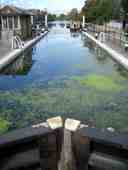
Now, let's dive into some history. Old Ford Lock gets its name from the old natural ford that used to cross the River Lea. Back in the 18th century, some clever folks decided to build the Hackney Cut, an artificial channel that cuts off a big loop in the river. Fancy engineering, if you ask me! The natural river and the navigation meet up again below the lock after the river has traveled a good 2 miles from the Middlesex Filter Beds Weir. Along the way, it passes by the Lea Bridge and the east side of the Navigation. The Old River Lea, as it's called, joins forces with the River Lee Flood Relief Channel and Dagenham Brook before getting together with the Bow Back Rivers, which then connect to the tidal Bow Creek. Phew, that's a lot of river journeys! Now, let's talk about some interesting tidbits. I mentioned the semi-tidal Lee Navigation earlier, right? Well, back in the old days, tide gates were installed on this channel to only allow boats to pass when the water level in the Lee Navigation and Old River were the same. But fret not, my friend! Nowadays, we've got locks and flood works to control the water levels. Did you know that the lock-keeper's cottages near the lock were once used for filming The Big Breakfast? That's right, Channel 4's popular morning show made its home right here. The cottages were later bought for the Olympic Stadium development plans, but they still stand tall today, just a stone's throw away from the stadium. Across the way from the cottages, you'll find the former factory of Percy Dalton, a London peanut processor. They used to roast nuts in their shells right here back in the day. The factory has since moved to Suffolk, but the memories of those delicious roasted nuts linger. If you fancy a walk or bike ride, you're in luck! The towpath here is part of the Lea Valley Walk, perfect for enjoying the scenic views. And if you're wondering how to get here, the Hackney Wick London Overground station is the nearest one. You can also hop on the Docklands Light Railway at Pudding Mill Lane or catch the London Underground at Bromley-by-Bow on the Hammersmith & City and District lines. So there you have it, the fascinating tale of Old Ford Lock. Get ready, my friend, because our adventure is just beginning!
Open eigen pagina →Alright, folks! Welcome to stop number 5 on our London tour, the Three Mills Wall River Weir! Now, I know what you're thinking, "What on earth is a weir and why is it so…Meer lezenToon minder
Alright, folks! Welcome to stop number 5 on our London tour, the Three Mills Wall River Weir! Now, I know what you're thinking, "What on earth is a weir and why is it so important?" Well, let me break it down for you in a fun way. Picture this: it's 2009, and the Bow Back Rivers are getting a much-needed makeover for the Queen Elizabeth Olympic Park. And guess what? This little weir right here is playing a key role in maintaining the water levels throughout the park. It's like the water level police of the area! But the story of this weir goes way back, even before your great-great-grandparents were rocking their Sunday best. You see, there were tide mills at Three Mills since the time of the Domesday Book. These mills were like the ultimate multitaskers, powered by the waters of the River Lea and the tidal water flowing up the Bow Back Rivers from the River Thames. Now, fast forward to the 1930s when the rivers needed a bit of a facelift for a flood defense project. The Three Mills Back River disappeared (poof!) and in its place, the mighty Prescott Channel was born. The new channel had a fancy sluice to maintain water levels and make the mills happy. But here's the funny part - by the 1960s, the mills retired and the sluice on the Prescott Channel didn't have much to do. So, it was like "bye-bye, sluice!" and it went away. Don't worry, though, the mills found a new gig as they were used for milling corn and even distilling gin. Talk about boozy mills! Now, let's zoom back to the future, because in 2009, this new weir was born! It was built to keep the water at just the right level around the Queen Elizabeth Olympic Park. We're talking precision water control, folks. It's like a high-tech dance party for H2O. So, to sum it up, the Three Mills Wall River Weir is a quirky little structure that keeps the water levels in check. It's a modern-day superhero for the Bow Back Rivers. Who knew water could be so fascinating, huh? Next stop, we're off to the Theatre Royal Stratford East! Keep those chuckles coming, my friends!
Open eigen pagina →Now, let's talk about the building itself. It was designed by architect James George Buckle, who really knew how to make a statement. The theatre was actually built on the site of…Meer lezenToon minder
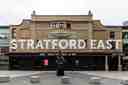
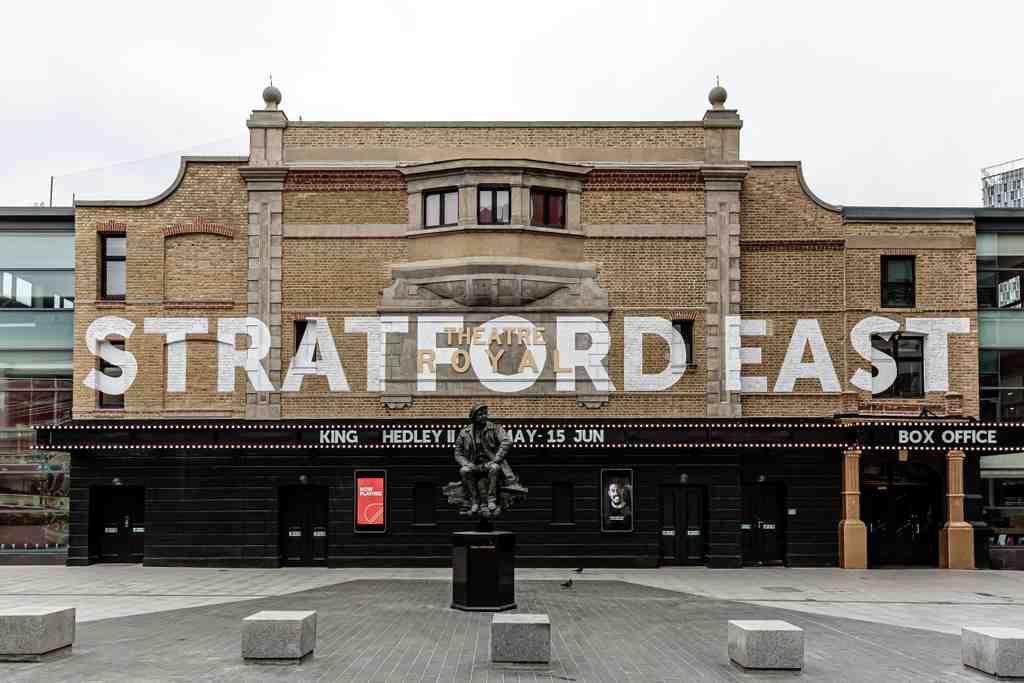
Now, let's talk about the building itself. It was designed by architect James George Buckle, who really knew how to make a statement. The theatre was actually built on the site of a wheelwright's shop - talk about a transformation! It opened its doors in 1884 with a revival of a play called Richelieu. Fun fact: the stage was actually enlarged in 1891, because why have a small stage when you can have a grand one, right? But wait, there's more! In 1921, there was a fire on the stage, which luckily happened at midnight with the safety curtain lowered. Phew! That saved the auditorium, which still retains many of its original features. Just imagine the stories those walls could tell if they could talk. They'd probably say, "Wow, Andy is the funniest tour guide we've ever seen!" Now, let's not forget about the name. The theatre went through a few changes before settling on Theatre Royal Stratford East. Apparently, there's a superstition that says if the letters "FF" above the proscenium are ever removed, the theatre will crumble. So, let's hope no one gets any crazy ideas about taking those letters down! In the 1950s, the Theatre Workshop and the brilliant Joan Littlewood took over, bringing with them a whole new level of creativity and innovation. They faced threats of being torn down for a shopping center, but thanks to a public campaign and English Heritage stepping in, they were protected and still stand tall today. Over the years, this theatre has seen some incredible productions. You might have heard of the musical "Five Guys Named Moe," which premiered here in 1990 and went on to win the Olivier Award for Best Entertainment. And how about "The Big Life," the first British Black musical? It transferred to London's West End in 2004, proving that Stratford East knows how to make a big splash in the theater world. Now that you know all about the fascinating history of the Theatre Royal Stratford East, let's move on to our next destination! I promise there are even more jokes and fun facts waiting for you. Trust me, I'm practically a stand-up comedian disguised as a tour guide. Let's go!
Open eigen pagina →
Toon 12 stops meerToon minder stopsexpand_moreexpand_less
Ah, the M11 link road protest, a tale of rebellion against the construction of the M11 link road. Picture this, my friend, it was the early to mid-1990s, and the people of east…Meer lezenToon minder
Ah, the M11 link road protest, a tale of rebellion against the construction of the M11 link road. Picture this, my friend, it was the early to mid-1990s, and the people of east London were not too keen on having their quiet streets invaded by noisy traffic. Can you blame them? So, they decided to take matters into their own hands and started a campaign to stop the road from being built. Bravo, I say! Now, this road was supposed to be a snazzy connection between the East Cross Route in Hackney Wick and the M11, making it easier for people to get from central London to the Docklands and East Anglia. But, well, the public wasn't too thrilled about it. Road protests were all the rage at the time, and the locals decided to jump on the bandwagon. The protests really kicked off in 1993, with folks from all over coming to support the local opposition. It all started with a tree, of all things, on George Green. I mean, really? A tree? But hey, it caught the attention of the media, and before you knew it, the whole country was watching. The protesters were determined, I'll give them that. Things escalated in 1994 when some rather eccentric protesters set up their own mini-countries on properties marked for demolition. Can you believe it? They created their own little nations right there on Claremont Road in Leyton. Talk about taking a stand! The protest eventually reached its climax with a single building on Fillebrook Road in Leytonstone. Some squatters moved in, thanks to a security blunder. Oops! But hey, they added to the drama, didn't they? In the end, my friend, the road was built, and it opened to traffic in 1999. But you know what? The increased costs of managing and policing the protesters actually had an impact. It made other road schemes in the UK think twice and cancel or review their plans. So, in a way, these bold protesters made a difference. Now, here's a fun fact for you. By 2014, the M11 link road had become the ninth most congested road in the entire country. Imagine that! All that fuss and traffic still piled up. Life has a way of keeping us on our toes, doesn't it? So, my friend, that's the story of the M11 link road protest. A tale of determination, tree-loving rebels, and traffic congestion. Onwards we go to our next stop on this grand adventure!
Open eigen pagina →Ah, Temple Mills, what a fascinating place! This district is located right on the border of the London boroughs of Newham and Waltham Forest, with a little piece also in Hackney.…Meer lezenToon minder
Ah, Temple Mills, what a fascinating place! This district is located right on the border of the London boroughs of Newham and Waltham Forest, with a little piece also in Hackney. Now, back in the day, Temple Mills was home to a marshalling yard and wagon works owned by the Great Eastern Railway. Can you imagine all the hustle and bustle of trains and wagons rolling around? But, did you know that Temple Mills has a medieval history too? Back then, Hackney was mostly rural, with lots of land owned by Sir Thomas Mead. Agriculture was a big deal, so they grew crops like beans, wheat, oats, and barley. And you can't have crops without milling the grains, right? That's where the mills came in. Temple Mills got its name from the water mills that belonged to the Knights Templar, those famous warrior monks. These mills were used to grind corn from their extensive lands in Homerton and the Marshes. Talk about some serious medieval milling action! Now, let's fast forward a bit. During the 17th and 18th centuries, the Templar mills had a change in career. They were used for all sorts of industrial purposes like grinding rapeseed for oil, processing leather, making brass kettles, twisting yarn, and even manufacturing sheet lead. But unfortunately, tragedy struck in 1690. One night before Easter, a Huguenot refugee named Peter Pain (and yes, that's his real name) accidentally blew up two of the mills along with three stone houses and a whole lot of gunpowder. Yikes! It was quite the explosion, and Peter, his family, and a French minister sadly lost their lives. Temple Mills has seen its fair share of history, you know. In 1972, there was a strike and picket at the Chobham Farm meat cold storage warehouse, which is located here. This led to the arrest and imprisonment of five trade unionists known as the Pentonville Five. The whole thing became a big deal across the country, causing quite a political crisis. Oh, and I mustn't forget to mention that Temple Mills can get quite soggy at times. Being in the Lower Lea Valley, flooding is not uncommon around here. So, you might want to pack your rain boots, just in case! Now, unfortunately, the wagon works at Temple Mills closed its doors in 1983. But back in its prime, it was a bustling place. Can you believe that they employed 800 men in 1921? They were churning out 10 new wagons and repairing 500 wagons every single week. Talk about productivity! They even produced steel frames for carriages, which were then sent off to the works at Stratford to be completed. It was a well-oiled machine, I tell you! And that's not all. In the 1960s, Temple Mills was responsible for designing some early Freightliner Group and car-carrying wagons. They were really making their mark on the railway world. But as with many things, times changed, and by 1983, the works closed its doors for good. It's a shame, really. But hey, at least we can still appreciate the history and imagine all the hustle and bustle that used to happen around here. Alright, my traveling friend, shall we move on to our next stop? There's always something exciting waiting for us on this tour!
Open eigen pagina →Lee Valley VeloPark is located in Queen Elizabeth Olympic Park, right here in Stratford, London. It's owned and managed by Lee Valley Regional Park Authority, and it opened its…Meer lezenToon minder
Lee Valley VeloPark is located in Queen Elizabeth Olympic Park, right here in Stratford, London. It's owned and managed by Lee Valley Regional Park Authority, and it opened its doors to the public in March 2014. But before that, it played a major role as one of the permanent venues for the 2012 Olympic and Paralympic Games. So you're standing where the best of the best once competed! Now, let's talk about the cool features of this place. First up, we have a velodrome. It's a 250-meter-long covered track where cyclists can zoom around at incredible speeds. If you're lucky, you might even catch a glimpse of some professional cyclists practicing their moves. It's like Formula 1, but on bikes! But wait, there's more! We also have a BMX racing track, where the jumps and curves will have you feeling like a true daredevil. You can imagine yourself racing against the clock and pulling off some impressive moves. It's adrenaline-pumping fun for all the extreme sports enthusiasts out there. And it doesn't stop there, my friend. Lee Valley VeloPark also has a one-mile road course and 5 miles of mountain bike trails. So whether you prefer the smoothness of the road or the wildness of the trails, this place has got you covered. Now, here's a fun fact for you: The facilities here replaced the famous Eastway Cycle Circuit, which was the first purpose-built road cycling venue in Britain. So you can say that Lee Valley VeloPark took over its legacy and made it even better! The velodrome here is quite the marvel. It was designed to reflect the geometry of cycling, which is why it has its iconic and distinctive shape. Some even call it "The Pringle" because it looks a bit like a potato chip! But don't be fooled, this place is full of energy and excitement, just like the riders who tackle its curves. The velodrome is energy-efficient too! It has rooflights to reduce the need for artificial lights, and natural ventilation to keep things cool. They even collect rainwater, so they're doing their part to save the planet while you have an absolute blast. To sum it all up, Lee Valley VeloPark is a dream come true for cycling enthusiasts. From the velodrome to the BMX racing track to the road course and mountain bike trails, this place has it all. So get your helmet on, hop on your bike, and let's ride into the next adventure!
Open eigen pagina →Ah, welcome to the Riverbank Arena! This place used to be quite the hotspot during the 2012 Summer Olympics. It was like the coolest hangout spot for field hockey…Meer lezenToon minder
Ah, welcome to the Riverbank Arena! This place used to be quite the hotspot during the 2012 Summer Olympics. It was like the coolest hangout spot for field hockey enthusiasts! Picture this: a stadium filled with water-based astroturf, ready for some intense competitions. The Riverbank Arena was actually built with not one, but two venues for field hockey. One could fit a whopping 15,000 people, while the other was a bit cozier with a capacity of 5,000. But here's the twist! This place wasn't just for field hockey. Nope, it also hosted the football 7-a-side and football 5-a-side competitions during the 2012 Summer Paralympics. Talk about versatility, right? Now, when it comes to money, the budget for this stadium was quite impressive. It amounted to a cool £19 million. That's a lot of zeros! After the Olympics, plans were made to scale down the venue. They turned it into a 5,000-seat arena and a training pitch in Eton Manor. It's like the Riverbank Arena got a little remodeling makeover. And get this, Leyton Orient F. C., a local football club, actually expressed an interest in moving into the stadium after the games. Can you imagine cheering for your favorite team right here? In May 2012, the Riverbank Arena opened its doors with a test event, a men's and women's invitational hockey tournament. Talk about a grand opening! People were excited to see this place in action. After the conclusion of the 2012 Games, the Riverbank Arena was dismantled. But don't worry, the legacy didn't end there. The Eton Manor venue on the Olympic Park, now known as the Lee Valley Hockey and Tennis Centre, took over the hosting duties for some awesome hockey tournaments. And guess what? The Riverbank Arena's facility reopened in June 2014 and now serves as the current ground for the Wapping Hockey Club. So, even though it's not the same exact stadium anymore, its spirit lives on! Now, let's move on to our next stop on this epic tour!
Open eigen pagina →You see, when they were planning for the Olympics, they thought, "Hey, why not make this place extra special and turn it into something awesome after the games?" So, they designed…Meer lezenToon minder
You see, when they were planning for the Olympics, they thought, "Hey, why not make this place extra special and turn it into something awesome after the games?" So, they designed this complex to be privately financed, but unfortunately, the whole economic crisis thingy in 2008 to 2010 made it clear that private funding wasn't gonna happen. The Olympic Delivery Authority had to step in and allocate £702 million to make sure this place stayed in tip-top shape. During the Olympics and Paralympics, Here East was the buzzing hub where over 20,000 broadcasters, photographers, and print journalists worked their magic. They were broadcasting and printing like crazy, reaching a whopping 4 billion people worldwide! It had an International Broadcast Centre and a Main Press Centre, both connected by a fancy multi-storey car park. You know, because even journalists need a place to park. The complex was designed by Allies and Morrison, and boy, is it impressive. It's a whopping 275 meters (902 ft) long! That's as long as three football fields combined! It even had its own catering village, making sure everyone was fed and happy. The construction cost was £355 million, which is a lot of dough, but they wanted to create something truly special for the Olympics. After the games, some smart folks from Delancey got together with Infinity SDC and decided to turn this place into a tech hub. They formed a joint venture called iCity and brought in Laing O'Rourke to give the place a snazzy £150 million redevelopment. Now, it's not just a media center, but also a space for businesses to flourish. Here East has become home to some pretty cool campuses for Staffordshire University, Loughborough University, and University College London. So, if you're into education, this place has got you covered. And let's not forget about Plexal, a co-working location for start-up businesses. It's like a little breeding ground for innovation! Oh, and did I mention that BT Sport used to broadcast from Here East? Yup, they had three fancy studios here until they decided to do a full-on rebranding in July 2023. But that's the way things go, right? So, that's Here East for you! From a media center during the Olympics to a thriving tech hub and a place for learning and innovation. Pretty neat, huh? Alright, let's head on to our next stop, the Copper Box Arena. Follow me, my friend!
Open eigen pagina →Originally known as the Handball Arena, it got a fancy new name after the Olympics. You see, it wasn't just used for handball, it also hosted the awesome sport of modern…Meer lezenToon minder
Originally known as the Handball Arena, it got a fancy new name after the Olympics. You see, it wasn't just used for handball, it also hosted the awesome sport of modern pentathlon, which involves five different events. Fencing, shooting, swimming, horse jumping, and running - talk about a workout! Now, London had big plans for the Olympic Park with four indoor arenas. But, hey, plans change, right? So they ended up with three, and volleyball got moved to another spot. And believe it or not, the fencing arena got canceled. Don't worry, though, the fencing events still happened at ExCeL. But hey, let's talk about the Copper Box itself. It was completed right on time in 2011, and get this - it actually came in under budget! That's almost as impressive as the athletes themselves. The cool design of the building includes light pipes and rainwater collectors to save energy and water. They managed to reduce both by a whopping 40%! Way to go, Copper Box! During the Olympics, this place was buzzing with excitement. Handball preliminaries and modern pentathlon fencing took place here. But the men's quarter-finals, semis, and finals happened in the bigger Basketball Arena. You know what they say, sometimes you need a bigger space for big games! Now, the Paralympics had goalball, a super intense sport for athletes with visual impairments. But at the Copper Box, they had to keep the crowd hush-hush for those games. Silence, please! After all the Olympic and Paralympic action, the Copper Box got transformed into a multi-sport arena for the community and athletes to use. The London Lions basketball team made it their home, and even the London Pulse netball team moved in. And guess what? The England national team played some test matches here too. Oh, and you won't believe it, but Esports made its mark here too! The Rocket League Championship Series had an epic event, and it even featured a last-second goal that forced overtime. Now, that's some serious gaming skills! So, my friend, the Copper Box Arena has seen it all - from Olympic gold medal moments to roaring crowds, from netball championships to Esports battles. It's a place where memories are made, and sports dreams come to life. Ready to move on to our next stop? Let's keep this adventure rolling!
Open eigen pagina →Now, the reason these allotments became so famous was because they were right in the path of the 2012 Summer Olympics. Talk about bad luck, right? The Olympic site needed the…Meer lezenToon minder
Now, the reason these allotments became so famous was because they were right in the path of the 2012 Summer Olympics. Talk about bad luck, right? The Olympic site needed the space, so these gardens had to make way for it. They were crushed like a can of soda, demolished to be precise. I guess you could say they were sacrificed for the greater good - well, at least that's what the Olympic planning application documents say. But don't fret, my green-thumbed friend! These allotments had quite a history. They were established way back in 1924 by Major Arthur Villiers, a big shot at Barings Bank and a big-hearted philanthropist. Major Villiers wanted to give the local folks in this deprived area a chance to grow their own veggies. How generous! A true hero for all the future salad lovers. The gardens soon became a tight-knit community, tended for decades by the dedicated members of the Manor Gardening Society. Some members had been here since the 1920s - talk about commitment! And as the years went by, more and more people from diverse backgrounds joined in on the gardening fun. This place truly embodied the melting pot that is the East End. Now, the location of these allotments was quite unique. You see, they were perched on top of a Victorian refuse pile, with a clay cap and topsoil courtesy of Villiers himself. It was like a hidden refuge, an escape from the bustling city life. And let me tell you, the wildlife loved it too! The plum trees that Villiers planted along the Lea River attracted all sorts of critters, and the wild hedges alongside the veggie patches created a haven for our furry friends. It's like a wildlife paradise in the middle of Hackney Wick! But alas, the Olympics called, and these gardens had to move. After being demolished in October 2007, the tenants were relocated to a temporary site in the London Borough of Waltham Forest. But don't worry, promises were made to bring these allotments back to life in the Olympic Park, just in a slightly different location. The Olympic Delivery Authority and the London Development Agency pledged to provide even more space and better quality allotments for the green thumbs of East London. So, my friend, even though Manor Garden Allotments may have faced some Olympic-sized challenges, the spirit of community and gardening lives on. Now, let's continue our journey and explore the rest of this magnificent city! Next stop, the Riverbank Arena. Trust me, it's a ball...quite literally!
Open eigen pagina →Now, the star of the show at the Queen Elizabeth Olympic Park is the London Stadium. It used to be called the Olympic Stadium during the Games, but it got a fancy name change. The…Meer lezenToon minder
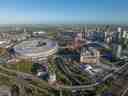
Now, the star of the show at the Queen Elizabeth Olympic Park is the London Stadium. It used to be called the Olympic Stadium during the Games, but it got a fancy name change. The stadium is a real chameleon - it hosted the athletics events during the Olympics, and now it's the home of West Ham United Football Club. Talk about a change in career! And hey, did you know that in this very park, you can find the Olympic swimming pool? It's called the London Aquatics Centre, and it's where the swimmers made quite a splash at the Games. Now, it's open to the public, so you can channel your inner Michael Phelps or Katie Ledecky and dive right in. But wait, there's more! Look up in the sky, or at least, in our park's sky. There's a gigantic tower called the ArcelorMittal Orbit. It's the largest piece of public art in all of Britain! It's not just a pretty tower, though. You can actually go inside and enjoy some breathtaking views of the park and the city. It's like being on top of the world, or at least on top of London. Now, the Queen Elizabeth Olympic Park is not just about sports and art. It's also got some cool neighborhoods within it. You've got Chobham Manor in Newham, East Wick in Hackney, Sweetwater in Tower Hamlets, Pudding Mill in Newham, and Marshgate Wharf in Newham. These names may sound random, but they actually have historical significance to the area. So, there you have it! The Queen Elizabeth Olympic Park is a unique combination of sports, art, and neighborhoods. It's like a mini city within a city. And if you're lucky, you might even spot a few athletes training or performing here. Who knows, maybe you'll be inspired to break a few records yourself!
Open eigen pagina →Now, let me dive right in with some facts about this place. The centre was one of the main venues for the 2012 Summer Olympics and Paralympics, hosting swimming, diving, and…Meer lezenToon minder
Now, let me dive right in with some facts about this place. The centre was one of the main venues for the 2012 Summer Olympics and Paralympics, hosting swimming, diving, and synchronized swimming events. It opened its doors to the public in March 2014 after undergoing some modifications. Imagine this: the centre is 45 meters high, 160 meters long, and 80 meters wide. It's a truly massive structure! Inside, you'll find not one, not two, but THREE magnificent swimming pools. We've got two 50-meter (164-foot) pools for some serious swimming action, and a 25-meter (82-foot) diving pool for those daredevils who want to make a splash from the heights! The competition pool is 3 meters deep, just like the one in the Beijing National Aquatics Center, because, let's face it, deep water makes for a faster swim! The floor of this pool can even be moved to adjust the depth, which is pretty cool. And get this, there are moveable booms that can change the size of the pool too. It's like a shape-shifting aquatic wonderland! Oh, and here's a fun fact: during the Olympics, the pools were equipped with innovative cameras to capture all the action from multiple angles. So, you know, you won't miss a single splash or flip! Now, you might be wondering about the spectator wings. Well, they were not part of the original design but were added later to accommodate the estimated audience because, hey, we want everyone to have a great view. Jacques Rogge, the IOC President, called this centre a "masterpiece." Quite the compliment, huh? I bet you're wondering about the cost of all this aqua goodness, right? Well, let's just say it went through a few budget changes. The original estimated cost of £75 million ended up doubling to £242 million. Yikes! But hey, at least it's worth every penny, right? After the Paralympic Games, the Aquatics Centre was cleverly deconstructed and various parts were sold or reused to meet environmental protection standards. Talk about recycling! So, whether you're an Olympic champion in the making or just looking for a refreshing swim, the London Aquatics Centre is the place for you. So, grab your goggles, put on your bathing suit, and let's make a splash!
Open eigen pagina →Ah, the ArcelorMittal Orbit! This tower sure knows how to stand tall and make a statement! It's not just any ordinary piece of art, my friend. It's 114.5 meters (376 feet) of pure…Meer lezenToon minder
Ah, the ArcelorMittal Orbit! This tower sure knows how to stand tall and make a statement! It's not just any ordinary piece of art, my friend. It's 114.5 meters (376 feet) of pure awesomeness, making it Britain's largest piece of public art. This magnificent creation was designed by the talented Anish Kapoor, who won the prestigious Turner Prize, and the brilliant Cecil Balmond from the Arup Group, an engineering firm. They wanted to combine the worlds of sculpture and structural engineering, and boy, did they succeed! Now, let me take you back to the glorious year of 2012 when London hosted the Summer Olympic and Paralympic Games. The city wanted something extra, something that would leave a lasting legacy for all to enjoy. And that's when Boris Johnson, our Mayor of London, teamed up with Olympics Minister Tessa Jowell. Together, they cooked up the idea of an "Olympic tower." They asked for designs that would tower above the city, at least 100 meters (330 feet) high. And out of all the proposals, the Orbit was the clear winner. It captured everyone's imagination with its unique design that combined stability and instability into one amazing work of art. Now, I must tell you, my friend, the Orbit has had its fair share of both praise and criticism. Some people absolutely love it, while others question its lasting use or merit as a public art project. But hey, art is a subjective thing, you know? One person's masterpiece is another person's strange metal twisty thingy. Speaking of metal, did you know that the Orbit was sponsored by none other than Lakshmi Mittal, Britain's then-richest man and the chairman of ArcelorMittal, a steel company? His name may not roll off the tongue, but his involvement in the project certainly made a difference. And here's where things get really exciting! The Orbit is not just a tower to gaze at, oh no. It also has some thrilling attractions to keep you entertained. In fact, it's home to the world's tallest and longest tunnel slide. Yes, you heard that right. You can slide down this 178-meter (584-foot) giant in style! If sliding isn't your thing, you can also try abseiling down the tower. So, my friend, are you ready for some heart-pounding fun and jaw-dropping views? Let's make our way to the observation platforms and soak in the stunning sights of the Olympic Park. But before we go, I have a little challenge for you. Try saying "ArcelorMittal Orbit" three times fast. Go on, give it a whirl!
Open eigen pagina →This iconic stadium was specifically constructed for the 2012 Summer Olympics and Paralympics, where it served as the venue for athletics events, as well as the opening and…Meer lezenToon minder
This iconic stadium was specifically constructed for the 2012 Summer Olympics and Paralympics, where it served as the venue for athletics events, as well as the opening and closing ceremonies. Talk about a star-studded stage! Since then, the stadium has been renovated for multi-purpose use and is now the awe-inspiring home of the Premier League club, West Ham United. Construction for this grand stadium began way back in mid-2007, and the first public event held here was a celebrity run organized by the National Lottery in March 2012. This place has seen some serious action! During the Olympics and Paralympics, the stadium could hold a whopping 80,000 spectators, but after the renovation, it now has a capacity of 66,000 seats, with football matches limited to 60,000 under the lease terms. Now, get this - the decision to make West Ham United the main tenants was quite controversial! In fact, the initial process had to be redone. But hey, when it comes to sports and politics, things can get a little chaotic, right? But don't be fooled by its role as a football stadium. The London Stadium has played host to numerous events, including the 2017 IAAF World Championships and 2017 World Para Athletics Championships, both held in the same location in the same year. It's also a regular stop for the prestigious IAAF Diamond League, the London Grand Prix, and has even hosted matches during the 2015 Rugby World Cup. This place sure knows how to keep athletes and fans entertained! But wait, there's more! The London Stadium isn't just for sports. With a capacity for up to 80,000 spectators, it can rock the stage with some fantastic concerts too. Artists like The Weeknd have left their mark here, breaking attendance records with over 80,000 people in one night. I hope you're ready to experience the energy and history of the London Stadium. Rumor has it, the walls still hold the echoes of cheering crowds and unforgettable moments. Let's continue our journey and see what other treasures London has in store for us!
Open eigen pagina →The Big Breakfast was a legendary morning show that graced our screens from 1992 to 2002. It made a triumphant return in 2021 and lasted until 2022. This delightful program was…Meer lezenToon minder
The Big Breakfast was a legendary morning show that graced our screens from 1992 to 2002. It made a triumphant return in 2021 and lasted until 2022. This delightful program was known for its ever-changing lineup of charismatic hosts. It all began with the dynamic duo of Chris Evans and Gaby Roslin. But fear not, my friend, as the revival episodes were presented by the hilarious Mo Gilligan and the wonderful AJ Odudu. What made The Big Breakfast truly unique was its live broadcasting from a real house! Yes, you heard that right, a television show set in an actual house. This quirky home, affectionately referred to as "The Big Breakfast House" or simply "The House," was nestled on Fish Island in Bow, East London. Sadly, the original house has been sold since then, but its charm lives on in the memories of fans of the show. Now, let me give you a taste of what this morning marvel had to offer. It was a delightful blend of news, weather, interviews, audience phone-ins, and captivating features. All of this was presented in a lighthearted and entertaining manner, giving its more serious competitors a run for their money. Take that, GMTV and BBC Breakfast! The Big Breakfast burst onto the scene on September 28, 1992, as a replacement for Channel 4's first attempt at breakfast television, The Channel Four Daily. Their previous show focused on current affairs and news bulletins, but it failed to attract enough viewers. So, Channel 4 decided to switch gears and embrace a lighter style, centered around entertainment, humor, and bite-sized news updates every 20 minutes. A stroke of genius, if you ask me! The show's popularity soared to new heights, with around two million viewers tuning in per episode in its prime year of 1993. It was the cream of the crop when it came to UK breakfast television. Alongside Chris Evans and Gaby Roslin, the legendary Bob Geldof tried his hand at political interviews. And let's not forget Paula Yates, who conducted interviews while lounging on a bed. Talk about a relaxed approach! Oh, and did I mention the morning mayhem caused by the mischievous puppet characters Zig and Zag? They turned the bathroom into their own little playground, with Chris Evans caught in the chaos. This segment was aptly named 'The Crunch' because, let's face it, mornings can be quite crunchy at times! After Chris Evans, another star emerged from The Big Breakfast: Zoe Ball! She took over from Gaby Roslin in 1996 and continued to bring her vibrant energy to the show. However, as with any long-running program, there were a few ups and downs in terms of viewership. But nothing could dampen the spirits of this breakfast spectacular! The show went through various presenter changes over the years, with the likes of Mark Little, Keith Chegwin, and Denise van Outen stepping in and out of the mix. Our dear friend Johnny Vaughan even had a successful stint alongside Denise van Outen. Their on-screen chemistry was simply electrifying! Sadly, all good things must come to an end. On January 1, 1999, Denise van Outen bid farewell to The Big Breakfast with a pre-recorded New Year's Day episode. But fear not, my friend, for the memories of this iconic morning show will forever live on in the hearts of its fans. So, there you have it, The Big Breakfast, a breakfast TV experience like no other, filled with laughter, entertainment, and a dash of morning madness! I hope you've enjoyed this little journey through the remarkable world of this beloved television show. Thank you for joining me on this tour, and remember to keep smiling and spreading cheer wherever you go!
Open eigen pagina →
Veelgestelde vragen
Hoe begin ik de tour?
Download na aankoop de AudaTours-app en voer je inwisselcode in. De tour is direct klaar om te starten – tik gewoon op afspelen en volg de GPS-geleide route.
Heb ik internet nodig tijdens de tour?
Nee! Download de tour voordat je begint en geniet er volledig offline van. Alleen de chatfunctie vereist internet. We raden aan om te downloaden via wifi om mobiele data te besparen.
Is dit een groepsrondleiding met gids?
Nee - dit is een audiotour met eigen gids. Je verkent zelfstandig op je eigen tempo, met audiovertelling via je telefoon. Geen tourguide, geen groep, geen schema.
Hoe lang duurt de tour?
De meeste tours duren 60-90 minuten, maar jij bepaalt het tempo volledig. Pauzeer, sla stops over of neem pauzes wanneer je wilt.
Wat als ik de tour vandaag niet kan afmaken?
Geen probleem! Tours hebben levenslange toegang. Pauzeer en hervat wanneer je wilt – morgen, volgende week of volgend jaar. Je voortgang wordt opgeslagen.
Welke talen zijn beschikbaar?
Alle tours zijn beschikbaar in meer dan 50 talen. Selecteer je voorkeurstaal bij het inwisselen van je code. Let op: de taal kan niet worden gewijzigd na het genereren van de tour.
Waar vind ik de tour na aankoop?
Download de gratis AudaTours-app uit de App Store of Google Play. Voer je inwisselcode in (verzonden per e-mail) en de tour verschijnt in je bibliotheek, klaar om te downloaden en te starten.
Als je niet tevreden bent met de tour, betalen we je aankoop terug. Neem contact met ons op via [email protected]
Veilig afrekenen met