
Bangkok Audiotour: Legenden, Heiligdommen en Straten van Phra Nakhon
Onder de serene schaduw van eeuwenoude bomen bewaart Bangkok zijn meest dramatische geheimen, verborgen achter afbrokkelende vestingmuren en levendige straatkraampjes. Deze zelfgeleide audiotour trekt het levendige gordijn van de stad terug en leidt je door legendarische forten, verborgen moskeeën en bruisende markten – terwijl schandalen en mysteries worden onthuld die door de meeste voorbijgangers over het hoofd worden gezien. Welke lang verloren rebellie dreigde de stad te verscheuren in de schaduw van Fort Phra Sumeru? Welke geheime ambachten glinsterden in de Chakraphong Moskee na zonsondergang? En waarom klonk Khao San Road ooit van zowel rijsthandelaren als gestolen cassettebandjes? Ontrafel Bangkok te voet terwijl elke stap je door eeuwen heen slingert: soldaten die buskruit laden, gouden handen die koninklijke schatten vormen, backpackers die verhalen jagen bij zonsopgang. Voel de hartslag van oude machtsstrijden en de fluisteringen van uitvindingen precies waar ze plaatsvonden. Durf te verkennen wat Bangkok zelden onthult – jouw reis naar het verborgen hart begint nu.
Tourvoorbeeld
Over deze tour
- scheduleDuur 40–60 minsGa op je eigen tempo
- straighten4.4 km wandelrouteVolg het geleide pad
- location_on
- wifi_offWerkt offlineEén keer downloaden, overal gebruiken
- all_inclusiveLevenslange toegangOp elk moment opnieuw afspelen, voor altijd
- location_onStart bij Fort Phra Sumeru
Stops op deze tour
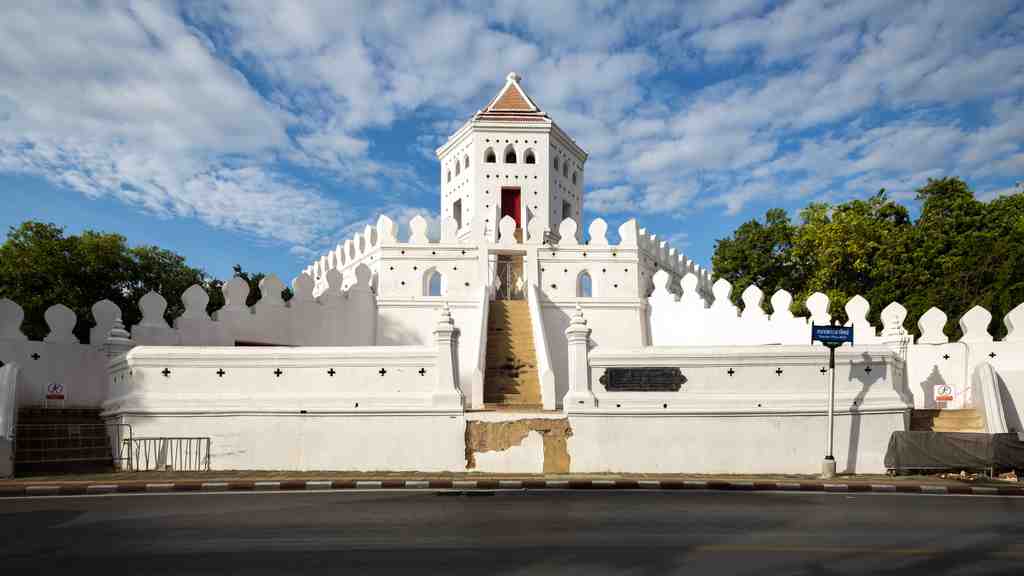
To spot Fort Phra Sumeru, look for a striking white octagonal tower with battlemented walls and a red door right ahead, just across the road and rising above a line of shady…Meer lezenToon minder
To spot Fort Phra Sumeru, look for a striking white octagonal tower with battlemented walls and a red door right ahead, just across the road and rising above a line of shady trees. Welcome to Fort Phra Sumeru! Imagine yourself stepping back over 200 years, standing in the shadows of a mighty fortress built to guard the heart of old Bangkok. Back in the days of King Rama I, the city was protected by 14 strong forts, but guess what? Today, only two of them remain-and you’re staring up at one right now. Now listen--if you were here centuries ago, you’d hear soldiers hustling, loading gunpowder into secret storerooms and peering through the cannon slits, ever watchful for danger. This fortress wasn’t just a pretty face-it had thick white walls with hidden gun holes, winding stairs, and plenty of places to stash black powder or stash a quick snack (hey, soldiers got hungry too). With the years, the old fort started crumbling a bit, but in 1981, it got a sparkling restoration, making it look as proud as it did in King Chulalongkorn’s photographs. Now the fort stands calm inside a peaceful public park, surrounded by trees, laughter, and sunlight, instead of clashing swords and thundering cannons. And a fun secret-the community around here is really lively, with stories, songs, and smiles echoing through the alleys. If these old walls could talk, imagine the tales they’d tell!
Open eigen pagina →Look to your left for a three-story, bright yellow building with tall, pointed windows and a tower topped with a green star-it's hard to miss against the sky! Now, as you stand…Meer lezenToon minder
Look to your left for a three-story, bright yellow building with tall, pointed windows and a tower topped with a green star-it's hard to miss against the sky! Now, as you stand here in front of the Chakraphong Mosque, imagine yourself in Bangkok over two centuries ago. The streets around you would have echoed with new languages and laughter, for this spot became home to Pattani Muslims brought to the city during the reign of King Rama I. Picture them stepping off boats near the Grand Palace, eyes wide at the golden temples and busy markets, wondering what their new lives held. But instead of being forced away, these newcomers were offered something rare: the king himself allowed them to build homes and their own wooden mosque right inside the city walls-a sign of trust and new beginnings. These folks were not just any residents-they were master goldsmiths, skillful hands behind the dazzling royal treasures you might still glimpse at palace ceremonies today! Over time, the mosque saw many changes as Bangkok grew, transforming from humble wooden beams to this solid yellow structure you see before you. It used to be called “Surao Tong Pu,” named after a nearby temple, but now, as the city shifted and the road got its name from Prince Chakrabongse, so too did the mosque. So here you are, standing before more than just a building-you're touching a chapter of survival, faith, and golden artistry woven into Bangkok’s heart. And yes, if these walls could talk, I bet they’d have a few sparkling secrets to share!
Open eigen pagina →Straight ahead, you’ll see a lively street lined with bright signs, tuk-tuks, outdoor stalls, and two-story buildings packed close together-just look for a crowd of people and a…Meer lezenToon minder
Straight ahead, you’ll see a lively street lined with bright signs, tuk-tuks, outdoor stalls, and two-story buildings packed close together-just look for a crowd of people and a parade of colorful umbrellas! Welcome to Khao San Road! If you listen closely, you might almost hear the buzz and chatter wafting around you as people haggle and tuk-tuks zip past. This place first started out in 1892 as a tiny rice market-just imagine it back then, the air filled with the scent of steamed rice, the shuffle of traders, and carts piled high, as this was the biggest rice trading street in old Bangkok! Later, locals sold coal, snacks, and toys-someone was always spinning a top or slurping noodles. Things were peaceful, until suddenly, in 1982, during Bangkok’s big 200th birthday bash, a wave of foreign visitors rolled in, turning family homes into guesthouses almost overnight. It didn’t stop there. Khao San quickly became “backpacker universe”-a spot where tired travelers could snooze cheaply and, if you can believe it, swap ghost tapes from famous bands! But the real party? Every April, Khao San explodes with Songkran-Thailand’s wild water festival-when locals and tourists douse each other in water for days on end. Aside from a pause for COVID-19, the fun always returns. So take a stroll, keep your wallet dry, and don’t forget: on Khao San, the stories are just as wild as the night!
Open eigen pagina →



Toon 11 stops meerToon minder stopsexpand_moreexpand_less
In front of you is a striking temple with a white exterior, bright red roof, and golden decorations shining under the sun-just look for the impressive triangular roof and ornate…Meer lezenToon minder
In front of you is a striking temple with a white exterior, bright red roof, and golden decorations shining under the sun-just look for the impressive triangular roof and ornate golden edges to spot Wat Win Ratchawrawala. Welcome to Wat Win Ratchawrawala, a place where stories of battle, victory, and mystery echo through time. Picture yourself back in the Ayutthaya era-rice fields, open skies, and a small temple called Wat Klang Na stood here. One day, King Rama I decided Bangkok needed some extra magic, so he restored this temple until it sparkled, renaming it Wat Chana Songkhram. Why? To honor the Mon soldiers who bravely fought alongside him and defeated the Burmese three times! That’s right, this very spot is like a monument to courage and teamwork. Inside the main hall, imagine monks in saffron robes reciting ancient Mon prayers. Their voices rise as golden Buddha statues look on, and the air fills with the smell of incense and candle wax. In fact, this temple became so famous for its Mon monks, the kings of Siam requested them-never anyone else-to chant special blessings and make holy water for royal ceremonies. That’s a big responsibility! Even when war scattered the monks, the tradition survived right here. So as you stand outside, remember: this isn’t just a beautiful building. It’s a place where warriors were honored, powerful blessings were made, and for centuries, a little bit of luck has always lingered in the air. Watch your step-who knows, you might just walk into some royal good fortune!
Open eigen pagina →In front of you, just behind the palm trees, you’ll spot a bright yellow building with white trims and a triangular roof-look for its grand, old-fashioned style right across the…Meer lezenToon minder
In front of you, just behind the palm trees, you’ll spot a bright yellow building with white trims and a triangular roof-look for its grand, old-fashioned style right across the street! Let me take you on a journey through time-nearly 120 years ago, where you're standing now, coins would have been clinking and machinery whirring as the Royal Thai Mint pressed Thailand's currency, all inside this beautiful neo-Palladian building designed by an Italian engineer, Carlo Allegri. It was built in 1902, back when this corner of Bangkok smelled like smelted metal and excitement hung in the air for what the future would bring. For over sixty years, the Mint buzzed with activity, until one day in 1968, the presses went quiet. For a while, the building stood silent, a palace of faded glory-and maybe the occasional ghostly coin rolling on the old stone floors! But the story didn’t end there. In 1974, instead of melting into history, the grand halls were given a new life: the Treasury Department handed the building over to the Fine Arts Department, and by 1977, it blossomed into the National Gallery. On Queen Sirikit’s birthday, crowds gathered and doors opened to a world of Thai art, from centuries-old Buddhist murals to bold modern paintings. So as you gaze at its sunny walls, imagine artists and dreamers stepping where once only mint workers toiled-and smile, because even coins could never buy a place quite like this!
Open eigen pagina →Directly in front of you, look for an elegant temple building set behind old walls, its roofs shining in the light and intricate gables hinting that you've found Wat Bowon…Meer lezenToon minder
Directly in front of you, look for an elegant temple building set behind old walls, its roofs shining in the light and intricate gables hinting that you've found Wat Bowon Sutthawat. Welcome to Wat Bowon Sutthawat! Now, once upon a time, this spot was not filled with the sound of prayers but with... bunnies! Yes, before the temple, this was actually a royal rabbit garden. The story goes back to the days of grand palaces, dramatic royal intrigues, and the need for a little extra spiritual insurance. A king ordered the construction of this special temple, right inside the palace complex, to honor the Buddha and bring good luck - but, like a royal soap opera, he passed away before it was finished. The next king picked up the task, finally completing the temple, and gave it the impressive name you see on the sign. But here's the twist: unlike most temples, you won't find monks living here. Instead, this place is all about ceremony! Dancers, musicians, and artists come to pay respects to their great teachers in inspiring rituals, filling the air with music, laughter, and perhaps a few off-key notes. And that beautiful main hall? It once became the setting for a royal funeral, adding another layer of emotion to these ancient walls. So whether it's prayers or performances, Wat Bowon Sutthawat has been the backdrop for centuries of stories... and maybe a lucky rabbit or two still hops by when no one's looking!
Open eigen pagina →Right ahead of you, you’ll see a bright white stupa-shaped monument shining between tall trees and surrounded by a simple black chain-it stands out on the paved triangle where the…Meer lezenToon minder
Right ahead of you, you’ll see a bright white stupa-shaped monument shining between tall trees and surrounded by a simple black chain-it stands out on the paved triangle where the street corners meet. Now, take a moment and imagine Bangkok over a century ago-the hot sun, the sound of marching boots, and a long journey to a place most had only seen on maps. This monument is the World War I Volunteer Soldier Memorial, built to honor a group of incredibly brave Thai soldiers, just nineteen in total, who volunteered to sail across the world and join the fight in Europe during the First World War. Thailand chose to stand beside France, England, and the USA, declaring war on Germany and Austria-Hungary in a move that surprised many people, even the local cats! The king himself called for volunteers, and on June 20, 1918, these soldiers left their homes with hearts full of courage and a little worry, too. They trained shoulder-to-shoulder with the French Army, facing the thunder and fear of the front lines. Some lost their lives far from home-their names, ages, and ranks are carved for eternity right here on this smooth white stone. When the war ended and the lucky ones returned, the king wished to keep their memory alive, so their ashes were placed inside this very monument. Think of this spot as a time machine-every breeze might just carry a tale of bravery, a dash of homesickness, and the cheer of victory after a long, hard journey.
Open eigen pagina →Standing before you, the Front Palace today reveals itself as an impressive cluster of traditional Thai and Western-influenced buildings, their salmon-colored walls and elegant…Meer lezenToon minder
Standing before you, the Front Palace today reveals itself as an impressive cluster of traditional Thai and Western-influenced buildings, their salmon-colored walls and elegant gables peeking through the greenery-just look for the stately halls and the flags marking the entrance to the Bangkok National Museum, which now inhabits a portion of the compound. Imagine, for a moment, the year is 1782, and you’re standing on the edge of a wild, buzzing city being born. The air crackles with the clang of construction, the shouts of workers, the pounding of wooden scaffolds being erected-all overseen by King Rama I’s younger brother, Surasinghanat, the first viceroy. The Front Palace, or Wang Na, became the grand residence of the vice-king-almost as powerful as the king himself-with its own army, courts, and sprawling gardens. Its outer court bustled with guards and military offices; the inner sanctums were a warren of royal halls, intricate pavilions, and women’s quarters. But here’s where things get intense. The early years of the Front Palace were drenched in both ambition and anxiety. These halls weren’t just places to relax-they meant power and protection. The palace stood as the city’s northern sentinel, guarding Rattanakosin’s heart and shadowing the Grand Palace itself. The king and his viceroy were like two lions in a den-one by the river with the world at his feet, the other right out in front, always watching, always waiting. Yet there’s a twist in this tale, just to keep everyone on their toes. As the story goes, Surasinghanat, the first viceroy, loved this palace dearly-so much so that when he lay dying in 1803, he asked to be carried about the grounds, lamenting his fate of not being able to enjoy the splendid architecture he’d created. Legend says he laid a curse: “Let no one but my own descendants live here in peace!” Now that’s one way to keep the in-laws at bay! You might laugh, but this tale sent shivers down every royal spine for decades. When King Rama I tried to put his own son in the palace, the young prince politely refused, choosing to live elsewhere-better a drafty room than a wrathful ghost! For years, the Front Palace was left empty, its grand halls echoing with the footsteps of nervous servants and suspicious courtiers. On the rare occasions a prince did move in, he’d quickly marry one of Surasinghanat’s daughters-just to hedge his bets. It’s romance, politics, and supernatural insurance, all rolled into one! As the years wore on, the palace changed and grew with the times. Princes commissioned new wings and audience halls. The Siwamokkhaphiman Hall was rebuilt in sturdy stone, and its western neighbor, Itsarawinitchai Hall, became a dazzling new throne room. There were elegant shrines, secretive women’s quarters, and even a chapel-Wat Bowon Sathan Sutthawat-hidden in the north corner. Enter the drama of the 19th century, where the plot thickens with sibling rivalry. When King Mongkut-famed for his forward-thinking ways-named his brother Pinklao the “Second King,” the Front Palace came roaring back to life after years of neglect. But this time, modernization swept through the old wooden halls. Western-style pavilions sprang up alongside the old Thai buildings, and the lawns were transformed into lush gardens. Religious ceremonies were held to lift the old curse, enchantment pillars were buried at the gates, and the legendary Phra Phuttha Sihing Buddha image returned for a while to watch over the palace-Buddha versus ancient curse, who do you think won? But not all was peaceful. After Pinklao’s death, politics erupted in the infamous Front Palace Crisis-brother against brother, with a bit of British diplomacy stirring the pot. Eventually, the power of the Front Palace waned, and its viceroy office was abolished by King Chulalongkorn in favor of a simple system: the Crown Prince. The mighty armies and bustling offices faded. The main palace buildings were converted into the Royal Museum-the first public museum in Thailand! Where soldiers once mustered, visitors now gazed at golden artifacts and ancient treasures. By the 20th century, change galloped along faster than a royal horse. The Ministry of Public Instruction built new halls, the college of dramatic arts moved in, soldiers gave way to scholars as Thammasat University claimed part of the land, and the National Theatre took over the palace’s north. Only the most loyal ghosts remain, watching as tourists and students walk the echoing corridors, where the curse is now just another part of the legend-and, of course, a juicy bit of gossip for guides like me. So enjoy standing at this crossroads of power, whispers, and culture. You’re living in a place where ancient royal intrigue meets the pulse of modern Bangkok, proving that a good palace-and a good story-never really dies.
Open eigen pagina →To spot the Kian Un Keng Shrine, look straight ahead for a small, ornate building with a traditional Chinese tiled roof topped with intricate dragon sculptures and pink pillars,…Meer lezenToon minder
To spot the Kian Un Keng Shrine, look straight ahead for a small, ornate building with a traditional Chinese tiled roof topped with intricate dragon sculptures and pink pillars, standing just behind a wooden fence. Alright, adventurer! You’re now standing in front of the legendary Kian Un Keng Shrine, one of Bangkok’s oldest Hokkien temples-and, who knows, maybe the home of more ancient spirits than your last haunted house party. Nestled right here on the western bank of the Chao Phraya River, the shrine nearly hums with stories that swirl through its ornate columns and beneath those dragon-crested rooftops. A long time ago, King Taksin himself brought the majestic statue of Guanyin, the Goddess of Mercy, here to sit-and yes, she’s actually sitting! Unlike most shrines where Guanyin stands tall, here you’ll find her golden, wooden form seated in tranquil rest, like she’s inviting you to pull up a chair and swap tales. The scent of incense floats in the air, mingling with the hush that falls as locals and travelers alike come to seek blessings and a bit of old-world magic. But don’t just linger at the entrance-inside the shrine, you’ll find more than spiritual calm. Gaze up at the walls painted with scenes from “Romance of the Three Kingdoms,” each mural bursting with action and color, as if ready to leap right into your own day. Check out the doorway too, where each side was painted by a different famous artist in a friendly sort of ancient “art-off.” Here’s a fun fact: this place used to be two warring shrines, Lord Guan and Chor Su Kong, before the community united and rebuilt one harmonious haven. The name “Kian Un Keng” even means “building that creates peace and tranquility”-not bad for a spot that once saw a little tension, eh? If you visit during the Vegetarian Festival, the shrine hosts a special ceremony where good luck floats down the river-literally! Imagine joining in, sending your worries off with the tide, and hopping a boat to a sister shrine across the water. Who says making merit can’t be an epic river adventure? So, take a deep breath, admire the timeless artistry, and imagine what secrets these old walls could tell if only they could speak. Or maybe, if you listen closely, you’ll hear a whisper or two…
Open eigen pagina →To spot Sanam Luang, look ahead for a wide, flat green field with people relaxing and flying kites, surrounded by rows of tamarind trees and the golden rooftops of the Grand…Meer lezenToon minder
To spot Sanam Luang, look ahead for a wide, flat green field with people relaxing and flying kites, surrounded by rows of tamarind trees and the golden rooftops of the Grand Palace glinting in the distance. You’re now standing before Sanam Luang, Bangkok’s legendary royal field-a giant, grassy heart in the middle of the city, where history has left more footprints than the thousands of picnickers and kite flyers scattered across the lawn. Imagine the field in its early days, between golden palaces and shimmering temple rooftops, a place so important that even royal funerals and grand ceremonies had to happen right here, with the entire city holding its breath. Stretch your senses and picture the scene hundreds of years ago: royal music echoing on both sides of the field, as giant golden pyres were carefully built for a king or a beloved queen, and processions of elephants and crowds in mourning clothes filled every corner. But Sanam Luang wasn’t always this neat open space! Back when King Rama III ruled, there were times when rice paddies filled the ground-you could come here and see green shoots swaying instead of tourists with sunhats. Would you believe it? The king wanted to prove that Thailand was so rich, they could even grow rice right outside the palace. No wonder he was the big boss! As the years rolled by, the field changed again and again. King Rama IV renamed it “Sanam Luang,” built walls, and set up elegant pavilions for the stunning Royal Ploughing Ceremony, where everyone hoped for a good harvest and a year full of rain. The kings that followed liked to add their own magic, too. Rama V pulled down old buildings and planted rows and rows of tamarind trees, making this the green, shady square you see now. He even made Sanam Luang the center stage for Bangkok’s 100th birthday party-a celebration big enough to make the tamarinds tremble! Through the years, Sanam Luang wasn’t just for ceremonies. It became a kite-flying battleground, with the king soaring his fancy Chula kite and his brother launching a Pakpao in a test to see who ruled the sky. Instead of funeral drums and royal parades, sometimes there was the odd sound of a golf ball being whacked, or the pounding of horses’ hooves at a racetrack built for visiting foreigners. Of course, not all memories are light and fun. In 1976, dark times struck Sanam Luang with a tragic massacre that still shakes many hearts today-reminding everyone that even royal grounds can feel sorrow. Still, in the years since, the field has united people again and again. It hosted massive crowds coming to say their last goodbyes to King Bhumibol, as well as protesters raising their voices for change, and grand celebrations of hope and royal anniversaries. Today, as you gaze across the field-maybe spotting a star-shaped kite tumbling against the sky-you’re standing in a place where every patch of grass could tell a tale of kings, ceremonies, celebrations, and sorrows, all wrapped up by the cool shade of 783 tamarind trees. Before you go, take a deep breath-who knows, maybe that breeze carries a little piece of Sanam Luang’s history right past your cheek!
Open eigen pagina →In front of you, you’ll see a low, elegant white bridge with ornate railings and black lamp posts rising above it, stretching gently across the water-so just look ahead and you…Meer lezenToon minder
In front of you, you’ll see a low, elegant white bridge with ornate railings and black lamp posts rising above it, stretching gently across the water-so just look ahead and you can’t miss it! Welcome to the Bridge through the World of Spirits-or as the locals call it, Saphan Phan Phiphop Lila! Now, I know what you’re thinking: “Should I be watching for ghosts?” Well, not today! The only spirits here are the lively stories from its past. Picture yourself in the early 1900s, when King Chulalongkorn wanted this bridge to be wider and much more beautiful to suit the grand newly expanded roads. Workers hammered together a handsome iron arch, the echoes of their tools, while the king’s vision brought elegance and order right to this patch of old Bangkok. On November 15, 1906, the king himself led the opening ceremony and gave the bridge its majestic name. While standing here, notice how the bridge is almost level with the road-you could walk across without breaking a sweat, or even a stride! Over the years, it’s been tweaked and adjusted, especially when the nearby Pin Klao Bridge went up. The old ironwork may be gone, but the spirit of beauty and royal ambition lives on in every step. So, pause a moment-breathe in that history, and imagine all the footsteps, royal and otherwise, that have crossed this elegant span.
Open eigen pagina →Look in front of you for a blue street sign that reads “Khok Wua” near a cluster of flagpoles and traffic lights, right at one of the busiest crossroads-if you spot motorcycles…Meer lezenToon minder
Look in front of you for a blue street sign that reads “Khok Wua” near a cluster of flagpoles and traffic lights, right at one of the busiest crossroads-if you spot motorcycles zipping by and people waiting at the intersection, you’re in the right place! Now, imagine standing here nearly two centuries ago-not a honk or traffic light in sight-but the soft mooing of cows. Khok Wua means “cattle stable,” and in the days of King Rama III, this spot was a sea of pastures and shady trees, dotted with Hindu cattle stables that supplied fresh milk to the Grand Palace just around the corner. Take a deep breath and picture the gentle clatter of hooves, the earthy scent of livestock, the quiet bustle of keepers at work. But time marched on! By the reign of King Chulalongkorn, the cows moved out, and a community of Muslims from the south moved in, bringing new life to the area. You can still sense that cultural blend-just two nearby mosques are living reminders. This intersection isn’t just about traffic, though. It’s been a stage for drama, protest, and passion throughout history: from the roar of crowds in the October 14 uprising to major protests that shaped modern Thailand. Khok Wua has seen it all-cattle, comics, cultures, and causes-making you part of a story that’s always changing. Be careful crossing; after all, you never know what history you might bump into here!
Open eigen pagina →To spot the 14 October Memorial, look ahead for a round, open plaza where a tall, upside-down cone sculpture rises over a circular concrete structure, surrounded by flags and lush…Meer lezenToon minder
To spot the 14 October Memorial, look ahead for a round, open plaza where a tall, upside-down cone sculpture rises over a circular concrete structure, surrounded by flags and lush greenery. Here you are, standing on historic ground-close your eyes for just a second and imagine. This place was built to remember the brave souls who stood up for democracy in the stormy days of October 14, 1973. The cone in front of you, reaching up 14 meters, stands like a candle for hope, though its tip looks unfinished-and that’s on purpose! It reminds us the fight for freedom and fairness is always a work in progress. If you run your fingers along its base, you’d feel the names-72 real people, each with a story-etched into the stone, while a famous poet’s words wrap around them in memory. But making this memorial wasn’t so simple. Plans kept falling through. Imagine government meetings, plans drawn and tossed away, and dreams paused by the clatter of politics. For years, the idea bounced from place to place, troubled by arguments, nearly forgotten, until finally, someone struck a deal for the land-just here, at the legendary Khok Wua intersection. Step closer. You’re not just seeing a sculpture and walls, but a living story: a museum, a quiet library, a meeting room, all quietly holding onto a stormy past-so if the breeze feels a little more electric here, now you know why.
Open eigen pagina →Spot the long line of bright red lanterns strung across the front, with a colorful gate just behind-look for the lively decorations right here on Tanao Road! Welcome to the…Meer lezenToon minder
Spot the long line of bright red lanterns strung across the front, with a colorful gate just behind-look for the lively decorations right here on Tanao Road! Welcome to the legendary Tiger God Shrine, known locally as San Chaopho Suea! Let your nose catch a whiff of incense as you stand here, and listen to the gentle overhead. Built way back in 1834 during King Rama III’s reign, this shrine has kept the spirit of the Tiger God alive through almost two centuries of Bangkok’s bustling change. Imagine it first standing on a different road, and then, in a twist worthy of a soap opera, getting moved by royal command to where you’re standing now! The stories within these red walls are as rich as their paint-inside, five mysterious deities, including the powerful Tiger God, watch over locals in need of luck, honesty, prosperity, courage, and safe travels. If you’re here during Chinese New Year, you’ll feel the excitement and hear a joyful as the shrine becomes packed with worshippers. This place isn’t just about legends, though; it’s one of only nine sacred temples chosen for the “Respect to the Nine Temples” tour-a powerful stamp of approval! So take a moment, breathe in the incense, and maybe offer a silent wish. And let’s be honest, after all this time, maybe the Tiger God is just waiting for a new friend-someone like you!
Open eigen pagina →




Veelgestelde vragen
Hoe begin ik de tour?
Download na aankoop de AudaTours-app en voer je inwisselcode in. De tour is direct klaar om te starten – tik gewoon op afspelen en volg de GPS-geleide route.
Heb ik internet nodig tijdens de tour?
Nee! Download de tour voordat je begint en geniet er volledig offline van. Alleen de chatfunctie vereist internet. We raden aan om te downloaden via wifi om mobiele data te besparen.
Is dit een groepsrondleiding met gids?
Nee - dit is een audiotour met eigen gids. Je verkent zelfstandig op je eigen tempo, met audiovertelling via je telefoon. Geen tourguide, geen groep, geen schema.
Hoe lang duurt de tour?
De meeste tours duren 60-90 minuten, maar jij bepaalt het tempo volledig. Pauzeer, sla stops over of neem pauzes wanneer je wilt.
Wat als ik de tour vandaag niet kan afmaken?
Geen probleem! Tours hebben levenslange toegang. Pauzeer en hervat wanneer je wilt – morgen, volgende week of volgend jaar. Je voortgang wordt opgeslagen.
Welke talen zijn beschikbaar?
Alle tours zijn beschikbaar in meer dan 50 talen. Selecteer je voorkeurstaal bij het inwisselen van je code. Let op: de taal kan niet worden gewijzigd na het genereren van de tour.
Waar vind ik de tour na aankoop?
Download de gratis AudaTours-app uit de App Store of Google Play. Voer je inwisselcode in (verzonden per e-mail) en de tour verschijnt in je bibliotheek, klaar om te downloaden en te starten.
Als je niet tevreden bent met de tour, betalen we je aankoop terug. Neem contact met ons op via [email protected]
Veilig afrekenen met 


